81) Given a table with the structure: EMPLOYEE (EmpNo, Name, Salary, HireDate), which of
the following would find all employees whose name begins with the letter “S” using Microsoft
Access?
A) SELECT *
FROM EMPLOYEE
WHERE Name IN [‘S’];
B) SELECT EmpNo
FROM EMPLOYEE
WHERE Name LIKE ‘S’;
C) SELECT *
FROM EMPLOYEE
WHERE Name LIKE ‘S*’;
D) SELECT *
FROM EMPLOYEE
WHERE Name LIKE ‘S%’;
82) In an SQL query, which built-in function is used to total numeric columns?
A) AVG
B) COUNT
C) MAX
D) SUM
83) In an SQL query, which built-in function is used to compute the average value of numeric
columns?
A) AVG
B) MEAN
C) AVERAGE
D) SUM
18
84) In an SQL query, which built-in function is used to obtain the largest value of numeric
columns?
A) AVG
B) COUNT
C) MAX
D) MIN
85) In an SQL query, which built-in function is used to obtain the smallest value of numeric
columns?
A) AVG
B) COUNT
C) MAX
D) MIN
86) In an SQL query, the built-in functions SUM and AVG work with columns containing data
of which of the following data types?
A) Integer
B) Numeric
C) Char
D) Both A and B are correct
87) In an SQL query, which built-in function is used to compute the number of rows in a table?
A) AVG
B) COUNT
C) MAX
D) SUM
88) Assuming the “Quantity” column of an ORDER table contains integer data, what does
COUNT(Quantity) compute?
A) The number of rows in the ORDER table
B) The number of non-zero values in the Quantity column
C) The number of distinct values in the Quantity column
D) The number of non-null values in the Quantity column
89) In an SQL query, which SQL keyword is used with built-in functions to group together rows
that have the same value in a specified column or columns?
A) GROUP BY
B) ORDER BY
C) SELECT
D) SORT BY
90) In an SQL query, which SQL keyword is used with GROUP BY to select groups meeting
specified criteria?
A) AND
B) WHERE
C) HAVING
D) IN
91) Given a table with the structure: EMPLOYEE (EmpNo, Name, Salary, HireDate), which of
the following is not a valid ANSI SQL command?
A) SELECT *
FROM EMPLOYEE
WHERE Name LIKE ‘Ja%’;
B) SELECT COUNT(*)
FROM EMPLOYEE
WHERE Salary < 30000;
C) SELECT HireDate, COUNT(*)
FROM EMPLOYEE
GROUP BY HireDate;
D) SELECT HireDate, COUNT(*)
FROM EMPLOYEE
WHERE Salary < 30000;
22
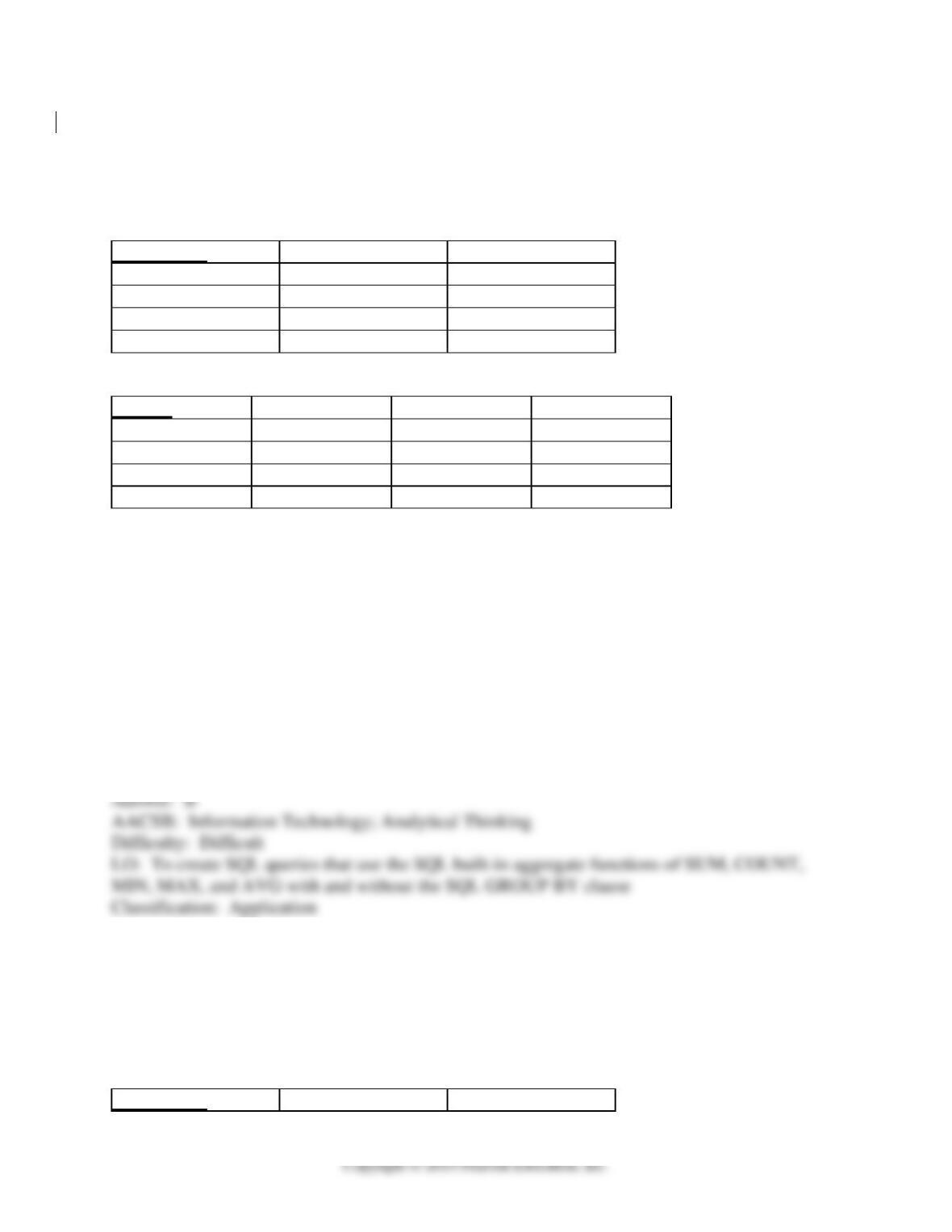
92) Based on the tables below, which of the following SQL commands would return the average
customer balance grouped by SalesRepNo?
GENERAL SALES DATABASE:
SALESREP
SalesRepNo
RepName
HireDate
654
Jones
01/02/2005
734
Smith
02/03/2007
345
Chen
01/25/2018
434
Johnson
11/23/2004
CUSTOMER
CustNo
CustName
Balance
SalesRepNo
9870
Winston
500
345
8590
Gonzales
350
434
7840
Harris
800
654
4870
Miles
100
345
A) SELECT AVG (Balance)
FROM CUSTOMER
WHERE SalesRepNo;
B) SELECT AVG (Balance)
FROM CUSTOMER
GROUP BY SalesRepNo;
C) SELECT AVG (Balance)
FROM CUSTOMER, SALESREP
WHERE SALESREP.SalesRepNo = CUSTOMER.SalesRepNo;
D) SELECT AVG (Balance)
FROM CUSTOMER
ORDER BY SalesRepNo;
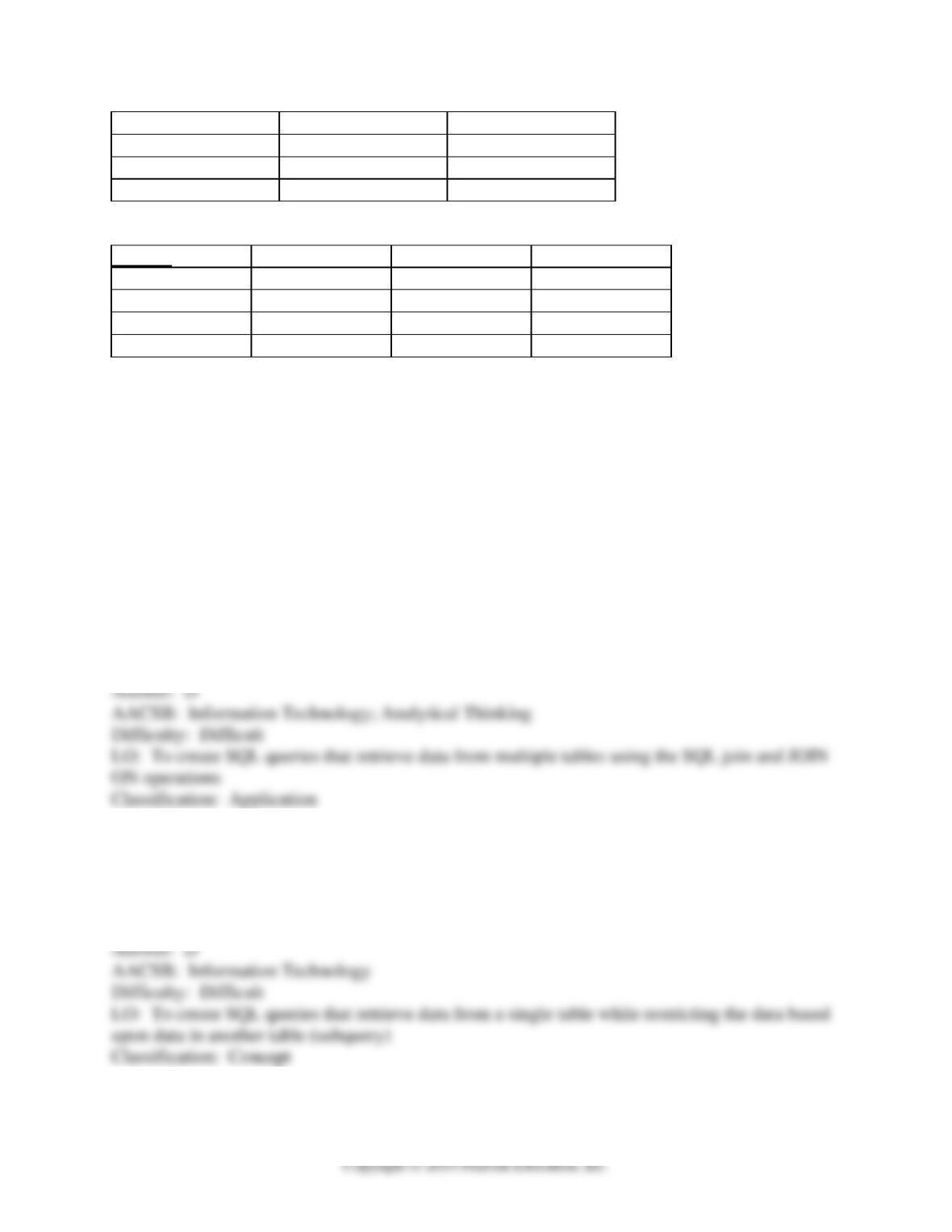
93) Based on the tables below, which of the following commands in ANSI SQL would return
only the name of the sales representative and the name of the customer for each customer that
has a balance greater than 400?
GENERAL SALES DATABASE:
SALESREP
SalesRepNo
RepName
HireDate
23
654
Jones
01/02/2005
734
Smith
02/03/2007
345
Chen
01/25/2018
434
Johnson
11/23/2004
CUSTOMER
CustNo
CustName
Balance
SalesRepNo
9870
Winston
500
345
8590
Gonzales
350
434
7840
Harris
800
654
4870
Miles
100
345
A) SELECT *
FROM SALESREP, CUSTOMER
WHERE Balance > 400;
B) SELECT DISTINCT RepName, CustName
FROM SALESREP, CUSTOMER
WHERE Balance > 400;
C) SELECT *
FROM SALESREP, CUSTOMER
WHERE SALESREP.SalesRepNo = CUSTOMER.SalesRepNo
AND Balance > 400;
D) SELECT RepName, CustName
FROM SALESREP, CUSTOMER
WHERE SALESREP.SalesRepNo = CUSTOMER.SalesRepNo
AND Balance > 400;
94) In an SQL query, which SQL keyword is used to implement a subquery?
A) GROUP BY
B) HAVING
C) ORDER BY
D) SELECT
95) When one SQL query is embedded in another SQL query, this is referred to as a ________.
A) subquery
B) join
C) WHERE Query
D) subset query
96) When one SQL query is embedded in another SQL query to simulate a join, the second SQL
query is embedded in the ________ of the first query.
A) SELECT
B) FROM
C) WHERE
D) HAVING
97) When one SQL query is embedded in another SQL query, the top-level SQL query can still
contain an SQL ________ clause.
A) FROM or SORT BY
B) UNIQUE IN
C) GROUP BY
D) WHERE IN
98) In an SQL query, which SQL keyword is used to specify the names of tables to be joined?
A) FROM
B) HAVING
C) JOIN
D) WHERE
99) In an SQL query, which SQL keyword is used to specify the column names to be used in a
join?
A) FROM
B) JOIN
C) SELECT
D) WHERE
100) Regarding the interchangeability of subqueries and joins, ________.
A) a join can always be used as an alternative to a subquery, and a subquery can always be used
as an alternative to a join
B) a join can sometimes be used as an alternative to a subquery, and a subquery can sometimes
be used as an alternative to a join
C) a join can always be used as an alternative to a subquery, and a subquery can sometimes be
used as an alternative to a join
D) a join can sometimes be used as an alternative to a subquery, and a subquery can always be
used as an alternative to a join
101) In an SQL query of two tables, which SQL keyword indicates that we want data from all
the rows of one table to be included in the result, even if the row does not correspond to any data
in the other table?
A) LEFT JOIN
B) RIGHT JOIN
C) INCLUDE
D) Both A and B are correct
102) Suppose tables EMPLOYEE and CUSTOMER both store address information, and you
want to send a letter to all employees and customers of your company to make a major
announcement. Which SQL keyword would you most likely use here?
A) INTERSECT
B) UNION
C) UNION ALL
D) JOIN
103) Suppose your company stores EMPLOYEE and CUSTOMER data in separate tables. If you
want to find all employees who are also customers, which SQL keyword would you most likely
use?
A) INTERSECT
B) UNION
C) EXCEPT
D) UNION ALL
104) Suppose your company stores EMPLOYEE and CUSTOMER data in separate tables. If you
want to find all customers who are not also employees, which SQL keyword would you most
likely use?
A) INTERSECT
B) UNION
C) EXCEPT
D) UNION ALL
105) What is SQL?
106) Explain why it is important to learn SQL.
107) Briefly describe subqueries and joins. Explain when each is not an acceptable alternative
for the other.
108) The following database will be used in this question:
GENERAL SALES DATABASE:
SALESREP
SalesRepNo
RepName
HireDate
654
Jones
01/02/2005
734
Smith
02/03/2007
345
Chen
01/25/2018
434
Johnson
11/23/2004
CUSTOMER
CustNo
CustName
Balance
SalesRepNo
9870
Winston
500
345
8590
Gonzales
350
434
7840
Harris
800
654
4870
Miles
100
345
Explain the use of the of SQL keyword SELECT. Include an example based on the CUSTOMER
table in the General Sales database.
109) The following database will be used in this question:
GENERAL SALES DATABASE:
SALESREP
SalesRepNo
RepName
HireDate
654
Jones
01/02/2005
734
Smith
02/03/2007
345
Chen
01/25/2018
434
Johnson
11/23/2004
CUSTOMER
CustNo
CustName
Balance
SalesRepNo
9870
Winston
500
345
8590
Gonzales
350
434
7840
Harris
800
654
4870
Miles
100
345
Explain the use of the SQL keyword LIKE. Include an example based on the CUSTOMER table
from the General Sales database; use at least one wildcard.
110) The following database will be used in this question:
GENERAL SALES DATABASE:
SALESREP
SalesRepNo
RepName
HireDate
654
Jones
01/02/2005
734
Smith
02/03/2007
345
Chen
01/25/2018
434
Johnson
11/23/2004
CUSTOMER
CustNo
CustName
Balance
SalesRepNo
9870
Winston
500
345
8590
Gonzales
350
434
7840
Harris
800
654
4870
Miles
100
345
Explain the use of the GROUP BY keyword. Include an example based on the CUSTOMER
table from the General Sales database.
111) Given the table CUSTOMER(CustID, Name, PhoneNumber, AccountBalance), write
the standard SQL query to retrieve the Name and PhoneNumber of customers with a balance
greater than 50.
112) Given the table CUSTOMER(CustID, Name, PhoneNumber, AccountBalance), write
the standard SQL query to retrieve the Name and PhoneNumber of customers whose name
begins with ‘S’.
113) What are SQL Built-in Functions?
114) Distinguish between the HAVING and WHERE clause.