
Copyright © 2019 Pearson Education, Inc.
Database Processing, 15e (Kroenke)
Appendix J: Business Intelligence Systems
1) Business Intelligence (BI) systems are information systems that help users analyze and use
data.
Answer: TRUE
2) Business Intelligence (BI) systems support operational activities.
Answer: FALSE
3) Business Intelligence (BI) reporting systems are used to filter data, sort data, group data, and
make simple calculations based on the data.
Answer: TRUE
4) Business Intelligence (BI) reporting systems can analyze data using standard SQL.
Answer: TRUE
5) BI reporting systems summarize the current status of business activities and compare that
status with past events but not with predicted future activities.
Answer: FALSE

Copyright © 2019 Pearson Education, Inc.
6) Data mining uses sophisticated statistical and mathematical techniques to perform what-if
analyses, to make predictions, and to facilitate decision making.
Answer: TRUE
7) Report delivery is more difficult for data mining than it is for reporting systems.
Answer: FALSE
8) A data warehouse is a database system that has data for, programs for, and personnel
specialized in BI processing.
Answer: TRUE
9) Data warehouses are populated with data prepared by Extract, Transform, and Load (ETL)
systems.
Answer: TRUE
10) Problematic data include so-called dirty data.
Answer: TRUE
11) A data mart is a collection of data that addresses a particular component of functional area of
a business.
Answer: TRUE

Copyright © 2019 Pearson Education, Inc.
12) BI reporting systems are intended to create meaningful information from disparate data
sources and to deliver that information to the proper users on a timely basis.
Answer: TRUE
13) RFM analysis is a way of analyzing and ranking customers based on on-line survey data.
Answer: FALSE
14) In RFM analysis, R stands for “how recently”, F stands for “how frequently” and M stands
for “how many months.”
Answer: FALSE
15) In a common form of RFM analysis, customers with an R score of 5 are in the 20% of
customers who have the most recent orders.
Answer: FALSE
16) In a common form of RFM analysis, a score of 1 is “high” or “good” while a score of 5 is
“low” or “bad.”
Answer: TRUE
17) In a common form of RFM analysis, an RFM score of 5 1 1 means that the customer orders
frequently and orders items of high monetary value but has not ordered anything for some time.
Answer: TRUE

Copyright © 2019 Pearson Education, Inc.
18) A reporting system does not maintain a database of metadata.
Answer: FALSE
19) A digital dashboard is an electronic display customized for an individual user.
Answer: TRUE
20) Report modes include dynamic and static.
Answer: FALSE
21) Reports that do not change once prepared are called static reports.
Answer: TRUE
22) Reports that rely on the most current data when they are prepared are called dynamic reports.
Answer: TRUE
23) A report that is sent to users on a predetermined schedule is called a push report.
Answer: TRUE

Copyright © 2019 Pearson Education, Inc.
24) A report that is sent to users only upon the user’s request is called on-demand report.
Answer: FALSE
25) Report systems include three functions: authoring, management, and delivery.
Answer: TRUE
26) Report authoring includes responsibility for delivery of the report.
Answer: FALSE
27) Report management defines who gets the report, how often, and how it is to be delivered.
Answer: TRUE
28) Report management systems include the ability to create associated user accounts and
groups.
Answer: TRUE
29) Data mining is the application of mathematical and statistical techniques to find patterns and
relationships that can be used to classify and predict.
Answer: TRUE

Copyright © 2019 Pearson Education, Inc.
30) Most data mining techniques are simple and easy to use.
Answer: FALSE
31) In unsupervised data mining, explanations are created after patterns are found.
Answer: TRUE
32) In unsupervised data mining, a model or hypothesis is created ahead of time.
Answer: FALSE
33) In supervised data mining, statistical techniques are used to estimate the parameters of the
model.
Answer: TRUE
34) Cluster analysis is a commonly used technique in supervised data mining.
Answer: FALSE
35) Market basket analysis is a data mining technique for determining which sets of products
customers tend to purchase at the same time.
Answer: TRUE

Copyright © 2019 Pearson Education, Inc.
36) Market basket analysis as described in the text uses the technique of conditional
probabilities.
Answer: TRUE
37) In market basket analysis, support is defined as the probability that two items will be
purchased together.
Answer: TRUE
38) In market basket analysis, confidence is the probability that one particular product will be
purchased.
Answer: FALSE
39) In market basket analysis, lift is confidence divided by support.
Answer: FALSE
40) A decision tree represents a set of rules that can be easily expressed in English or in SQL.
Answer: TRUE
41) In using a decision tree, questions are represented by ovals and decisions by rectangles.
Answer: FALSE

8
Copyright © 2019 Pearson Education, Inc.
42) A decision tree is created in two main phases, namely the ________ and the ______.
A) creation phase, implementation phase
B) training phase, implementation phase
C) training phase, testing phase
D) creation phase, testing phase
Answer: C
43) Business Intelligence (BI) systems do which of the following?
A) Analyze current and past activities
B) Predict future events
C) Record and process transactions
D) Both A and B are correct
Answer: D
44) Business Intelligence (BI) systems fall into which of the following categories?
A) Processing
B) Reporting
C) Data mining
D) Both B and C are correct
Answer: D
45) Business Intelligence (BI) systems obtain their data by all of the following means except
________.
A) read and process data from an operational database
B) triggers defined on the operational database
C) process data purchased from data vendors
D) process extracts from operational databases
Answer: B
46) Business Intelligence (BI) reporting systems can do all of the following operations except
________.

9
Copyright © 2019 Pearson Education, Inc.
A) filter data
B) group data
C) modify data
D) sort data
Answer: C
47) One Business Intelligence (BI) reporting system that uses extensions to SQL is ________.
A) cluster analysis
B) OLAP
C) regression analysis
D) RFM analysis
Answer: B
48) Data mining applications are used accomplish all of the following tasks except ________.
A) update the database
B) make predications
C) facilitate decision making
D) perform what-if analysis
Answer: A
49) Which of the following is (are) true about data mining applications?
A) They use sophisticated mathematical techniques.
B) They use sophisticated statistical techniques.
C) Their report delivery is more difficult than report delivery for reporting systems.
D) Both A and B are correct
Answer: D
50) Which of the following is not a reason that operational data are difficult to read?
A) Dirty data
B) Large values
C) Non-integrated data

10
Copyright © 2019 Pearson Education, Inc.
D) Missing values
Answer: B
51) We have obtained access to the company’s operational data. In one record, we find that a
customer’s age has been recorded as “337”. This is an example of ________.
A) dirty data
B) inconsistent data
C) non-integrated data
D) a “wrong format” problem
Answer: A
52) We have obtained access to the company’s operational data. We examine 50 records for
customers with phone numbers that should use the current area code of 345. Of these 50 records,
we find 10 that still use an older area code of 567. This is an example of ________.
A) dirty data
B) inconsistent data
C) non-integrated data
D) a “wrong format” problem
Answer: B
53) We have obtained access to the company’s operational data. We have been asked to produce
a report with an item by item analysis of sales, but the only sales figure available is the total sale
value for each order. This is an example of ________.
A) dirty data
B) inconsistent data
C) nonintegrated data
D) a “wrong format” problem
Answer: D
54) A data warehouse database differs from an operational database because ________.
A) data warehouse data are not stored in tables

11
Copyright © 2019 Pearson Education, Inc.
B) data warehouse databases do not have metadata
C) data warehouse data are often stored in a dimensional database
D) efficiency does not matter in a data warehouse
Answer: C
55) Which of the following is not a component of a data warehouse?
A) Data extract, transform, and load (ETL) preparation programs
B) Data warehouse data
C) Data warehouse metadata
D) Operational database updates
Answer: D
56) A data mart differs from a data warehouse in all the following ways except ________.
A) data marts use more operational data
B) it deals with a particular component or functional area of the business
C) data mart users do not have the data management expertise of data warehouse employees
D) it has a smaller database
Answer: A
57) A BI reporting system ________.
A) creates meaningful information from disparate data sources.
B) delivers information to users on a timely basis.
C) uses statistical procedures to predict future events.
D) Both A and B are correct
Answer: D
58) RFM analysis analyzes and ranks customers based on ________.
A) their purchasing patterns
B) their income status
C) their residential location.
D) their age

Copyright © 2019 Pearson Education, Inc.
Answer: A
59) The “R” in RFM analysis stands for ________.
A) rank
B) recent
C) relationship
D) readiness
Answer: B
60) RFM scores commonly range from ________, with ________ being the “high” or “most
desirable” score.
A) 0 to 5; 0
B) 0 to 5; 5
C) 1 to 5, 1
D) 1 to 5; 5
Answer: C
61) We have done an RFM analysis on our customer data. John Smith has a score of “5 1 1”.
This means that John ________.
A) has ordered recently, and orders a lot when he orders
B) hasn’t ordered recently, but orders a lot when he orders
C) has ordered recently, but doesn’t order a lot when he orders
D) hasn’t ordered recently, and doesn’t order a lot when he orders
Answer: B

Copyright © 2019 Pearson Education, Inc.
62) RFM analysis can be done using SQL ________.
A) user-defined functions
B) stored procedures
C) triggers
D) union queries
Answer: B
63) To produce the set of customers with a R score of 2, the SQL SELECT TOP ________
PERCENT syntax should be used.
A) 50
B) 33
C) 25
D) 20
Answer: C
64) The metadata maintained by a reporting system database describes all of the following
except ________.
A) triggers
B) users
C) groups
D) reports
Answer: A
65) The reports generated by a reporting system can be classified as any of the following except
________.
A) static
B) dynamic
C) fluid
D) push
Answer: C

Copyright © 2019 Pearson Education, Inc.
66) A report generated by a reporting system is delivered to the appropriate users via an
electronic display customized for each user. This system uses which of the following media?
A) Paper
B) Web portal
C) Digital dashboard
D) E-mail
Answer: C
67) The reports generated by a reporting system can be delivered in all of the following media
except ________.
A) Paper
B) Smoke signals
C) Digital dashboard
D) E-mail
Answer: B
68) A report generated by a reporting system is delivered to the appropriate users via a printed
report on a pre-determined schedule. This system uses which of the following report modes?
A) Push
B) Pull
C) Query
D) OLAP
Answer: A
69) OLAP stands for ________.
A) Online Analytical Processing
B) Offline Analytical Processing
C) Online Analysis Process
D) Offline Analytical Process
E) Lazy, Old and Particular
Answer: A

Copyright © 2019 Pearson Education, Inc.
70) Data mining techniques are used to find patterns and relationships that can be used to
________.
A) report
B) classify
C) predict
D) Both B and C are correct
Answer: D
71) Which of the following is a common unsupervised data mining technique?
A) Cluster analysis
B) Regression analysis
C) RFM analysis
D) QBE queries
Answer: A
72) Which of the following is a common supervised data mining technique?
A) Cluster analysis
B) Regression analysis
C) RFM analysis
D) SQL analysis
Answer: B
73) Which of the following popular data mining techniques does not require special software?
A) Decision tree analysis
B) Logistic regression analysis
C) Market basket analysis
D) Neural networks
Answer: C

74) Market basket analysis is ________.
A) a data mart specific technique
B) a reporting technique
C) an OLAP application
D) a data mining technique
Answer: D
Copyright © 2019 Pearson Education, Inc.
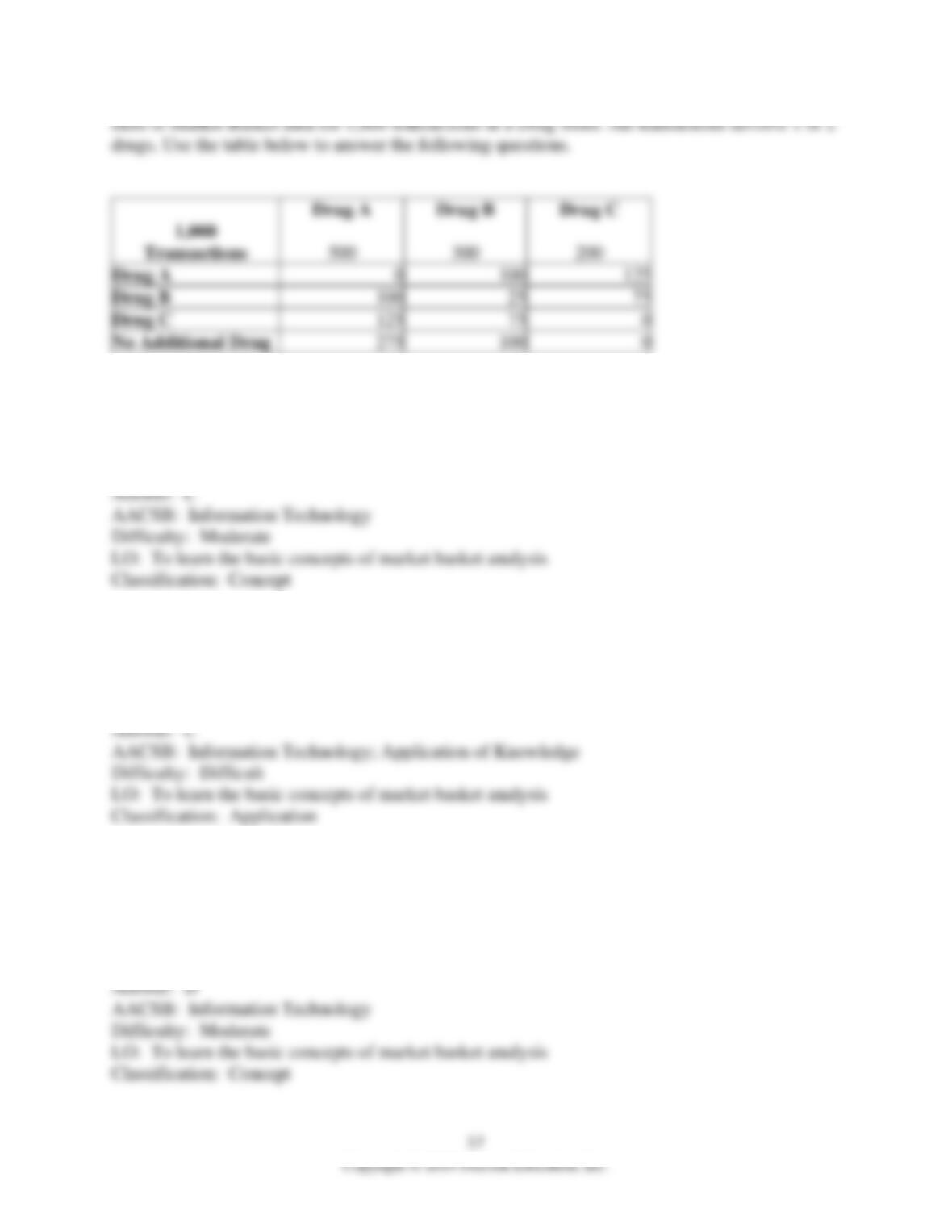
Here is Market Basket data for 1,000 transactions at a Drug Store. All transactions involve 1 or 2
75) Refer to the table above. What is the definition of support for Drug A and Drug B?
A) The probability that Drug A will be purchased.
B) The probability that Drug B will be purchased.
C) The probability that both Drug A and Drug B will be purchased.
D) The probability that Drug A will be purchased given that Drug B has been purchased.
Answer: C
76) Refer to the table above. What is the support for Drug A and Drug B?
A) .025
B) .075
C) .100
D) .125
Answer: C
77) Refer to the table above. What is the definition of confidence for Drug B with reference to
Drug A?
A) The probability that Drug A will be purchased.
B) The probability that Drug B will be purchased.
C) The probability that both Drug A and Drug B will be purchased.
D) The probability that Drug B will be purchased given that Drug A has been purchased.
Answer: D
Copyright © 2019 Pearson Education, Inc.
78) Refer to the table above. What is the confidence of Drug B being purchased given that Drug
A has been purchased?
A) .200
B) .250
C) .333
D) .400
Answer: A
79) Refer to the table above. What is the lift for Drug B being purchased given that Drug A has
been purchased?
A) .200
B) .250
C) .333
D) .667
Answer: D
80) What are Business Intelligence (BI) systems?
Answer: Business Intelligence (BI) systems are information systems used by managers and
81) What is a reporting system?
Answer: A reporting system is one of the main categories of a Business Intelligence (BI)
Copyright © 2019 Pearson Education, Inc.
82) What is data mining application?
Answer: A data mining application uses sophisticated statistical and mathematical techniques to
83) Why is operational data sometimes unusable for Business Intelligence use?
Answer: Data in operational databases can suffer from problems such as: (1) Dirty data—data
84) What is a data warehouse?
Answer: A data warehouse is a non-operational database intended for use by Business

Copyright © 2019 Pearson Education, Inc.
85) What is a star schema?
Answer: The star schema describes the arrangement of the tables in a dimensional database. A