44) Using the information in Table J.9 and the slack per remaining operation (S/RO) rule, what is the
average days past due?
A) fewer than or equal to 6.0 days
B) greater than 6.0 days but fewer than or equal to 8.0 days
C) greater than 8.0 days but fewer than or equal to 9.0 days
D) greater than 9.0 days
45) Using the information in Table J.9 and the critical ratio rule, what is the average flow time?
A) fewer than or equal to 9.0 days
B) greater than 9.0 days but fewer than or equal to 10.0 days
C) greater than 10.0 days but fewer than or equal to 11.0 days
D) greater than 11.0 days
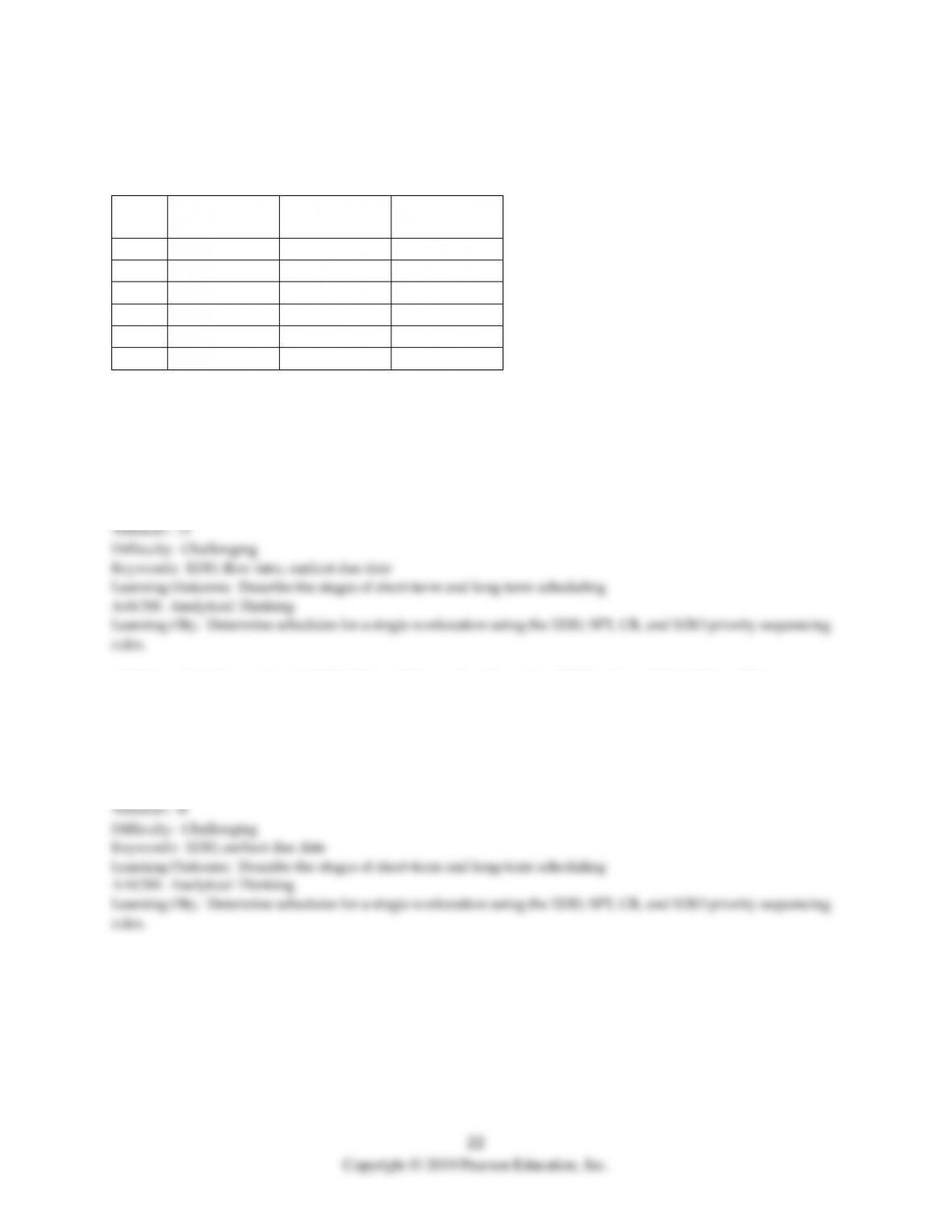
Table J.10
A workstation has six jobs waiting to be processed. They arrived at the end of Day 0 and it is now the
beginning of Day 1. It is now time zero. Times are expressed in terms of days.
Job
Time Since Job
Arrived
Processing
Time
Due Date
A
12
8
24
B
7
2
11
C
18
6
31
D
5
12
25
E
6
7
8
F
19
5
6
46) Using the information in Table J.10 and the earliest due date (EDD) rule, what is the average flow
time?
A) fewer than or equal to 20 days
B) greater than 20 days but fewer than or equal to 22 days
C) greater than 22 days but fewer than or equal to 24 days
D) greater than 24 days
47) Using the information in Table J.10 and the earliest due date (EDD) rule, which job(s) will be
completed on or before their due dates?
A) F only
B) A and F only
C) B, A, and E only
D) E and B only
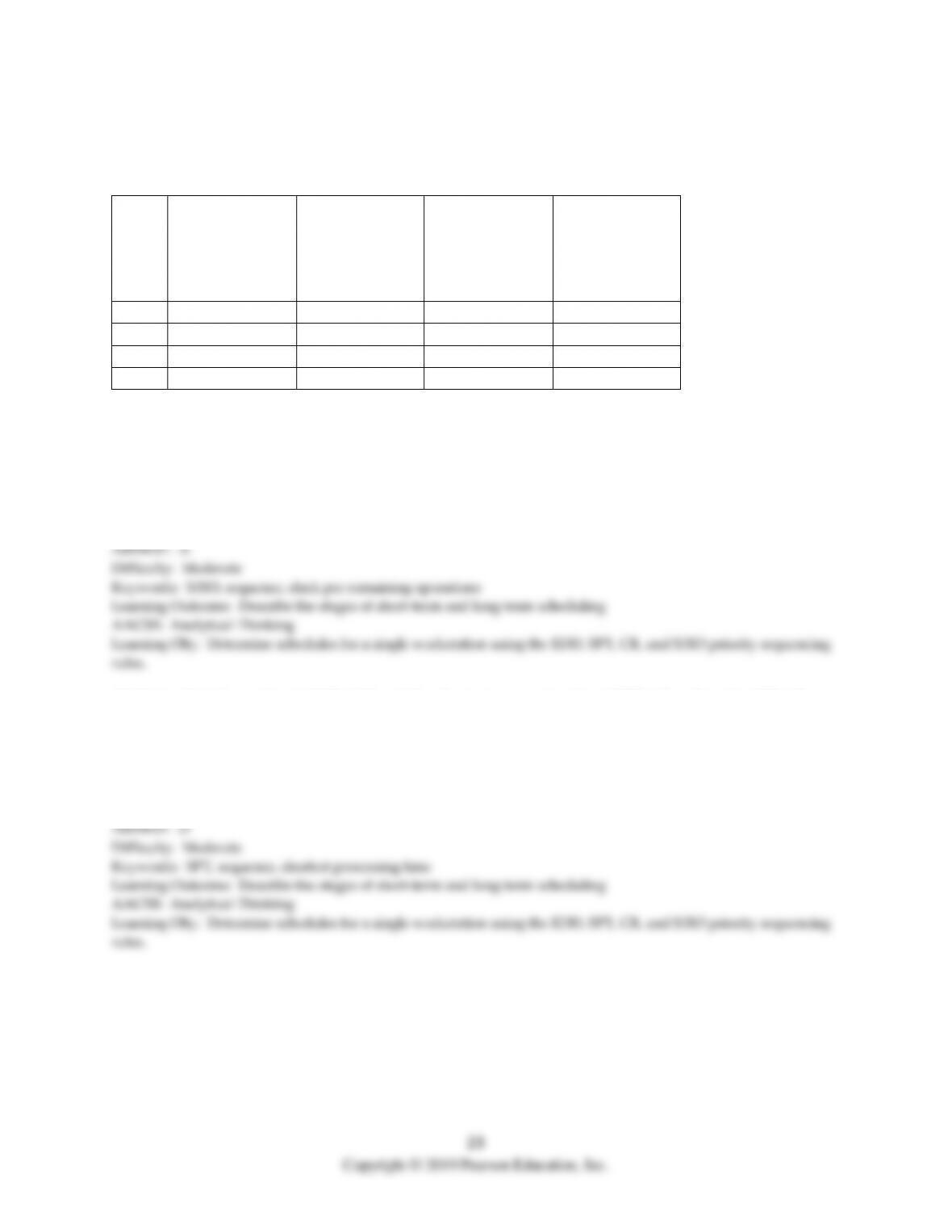
Table J.11
Work center Q45 has four jobs that just arrived (the start of Day 1) to be processed, as shown in the
following table. Assume the shop works eight hours per day.
Job
Processing Time
at Workstation
Q45
(hours)
Time Remaining
to Due Date
(days)
Work Time
Remaining
Including
Workstation Q45
(days)
Remaining
Number of
Operations
A
10
7
3
3
B
6
12
8
2
C
15
11
10
5
D
12
4
6
2
48) Using the information in Table J.11 and the slack per remaining operations (S/RO) rule, what should
be the sequence of jobs processed at Q45?
A) D-C-A-B
B) A-B-C-D
C) D-A-C-B
D) B-C-A-D
49) Using the information in Table J.11 and the shortest processing time (SPT) rule, what should be the
sequence of jobs processed at Q45?
A) C-D-A-B
B) D-A-C-B
C) A-D-B-C
D) B-A-D-C
50) Using the information in Table J.11 and the critical ratio rule, what should be the sequence of jobs
processed at Q45?
A) A-B-C-D
B) D-A-C-B
C) D-C-B-A
D) B-C-A-D
51) Using the information in Table J.11 and the critical ratio rule, what is the flow time of job B?
A) fewer than or equal to 10 hours
B) greater than 10 hours but fewer than or equal to 20 hours
C) greater than 20 hours but fewer than or equal to 30 hours
D) greater than 30 hours
52) Using the information in Table J.11 and the slack per remaining operations ratio (S/RO) rule, what is
the average past due?
A) fewer than or equal to 10 hours
B) greater than 10 hours but fewer than or equal to 20 hours
C) greater than 20 hours but fewer than or equal to 30 hours
D) greater than 30 hours
Table J.18
Job
Production
Time
Due Date
A
10
20
B
15
25
C
17
22
D
20
31
E
16
20
F
20
24
53) Use the information in Table J.18 and sequence the jobs using the SPT rule. What is the average flow
time?
A) fewer than or equal to 52 hours
B) greater than 52 hours but fewer than or equal to 54 hours
C) greater than 54 hours but fewer than or equal to 56 hours
D) greater than 56 hours
54) Use the information Table J.18 and sequence the jobs using the SPT rule. What is the average past
due?
A) fewer than or equal to 29 hours
B) greater than 29 hours but fewer than or equal to 31 hours
C) greater than 31 hours but fewer than or equal to 33 hours
D) greater than 33 hours
55) Use the information in Table J.18 and sequence the jobs using the EDD rule. What is the average flow
time?
A) fewer than or equal to 48 hours
B) greater than 48 hours but fewer than or equal to 50 hours
C) greater than 50 hours but fewer than or equal to 52 hours
D) greater than 52 hours
56) Use the information in the table and sequence the jobs using the EDD rule. What is the average past
due?
A) fewer than or equal to 32 hours
B) greater than 32 hours but fewer than or equal to 34 hours
C) greater than 34 hours but fewer than or equal to 36 hours
D) greater than 36 hours
57) A(n) ________ specializes in low- to medium-volume production using job or batch processes.
58) A(n) ________ specializes in medium- to high-volume production and uses line or continuous flow
processes.
59) ________ specify the job processing sequence when several jobs are waiting in line at a workstation.
60) ________ is a priority sequencing rule that determines priority by dividing the difference between the
due date and today’s date less the processing time remaining by the number of processing steps left to
complete the job.
61) The ________ is a priority sequencing rule that is calculated by dividing the time remaining until a
job’s due date by the total shop time remaining for the job, including the setup, processing, move, and
expected waiting times of all remaining operations, including the operation being scheduled.
62) ________ is a priority sequencing rule that specifies that the job that has the earliest due date is the
next job to be processed.
63) Sometimes referred to as the world champion, the ________ rule is a priority sequencing rule that
minimizes the mean flow time and tends to maximize utilization.
64) ________ is a priority sequencing rule that specifies that the job that arrived at the workstation first is
given the highest priority.
65) The ________ priority sequencing rule is typically applied in a front-office customer service setting.
66) The shortest processing time rule tends to produce a large variance in ________.
67) A rule that establishes a job’s priority based on one piece of information, such as how long it will take
to process or when the job arrived, is a(n) ________.
68) ________ are a set of priority rules that apply to more than one aspect of a job.
29
69) Why is makespan an important performance measure?
70) What are single-dimension scheduling rules? Provide examples and discuss how each rule performs.
Answer: Single-dimension rules (e.g., FCFS, EDD, and SPT) base a job‘s priority assignment on a single
aspect of the job, such as arrival time at the workstation, the due date, or the processing time. Studies
have found that the EDD rule performs well with respect to the percentage of jobs past due and the
variance of hours past due. For any set of jobs to be processed at a single workstation, it minimizes the
71) What are multiple-dimension scheduling rules? Provide examples and discuss how each rule
performs.
Answer: Multiple-dimension rules, such as critical ratio (CR) and slack per remaining operations (S/RO)
are so named because they apply to more than one aspect of the job. These multiple-dimension priority
rules incorporate information about the remaining workstations at which the job must be processed, in
72)
Job
Time Since Order
Arrived (days)
Processing
Time (days)
Due Date
(days from now)
A
8
2
7
B
7
8
16
C
7
4
4
D
4
10
17
E
3
5
15
F
2
12
18
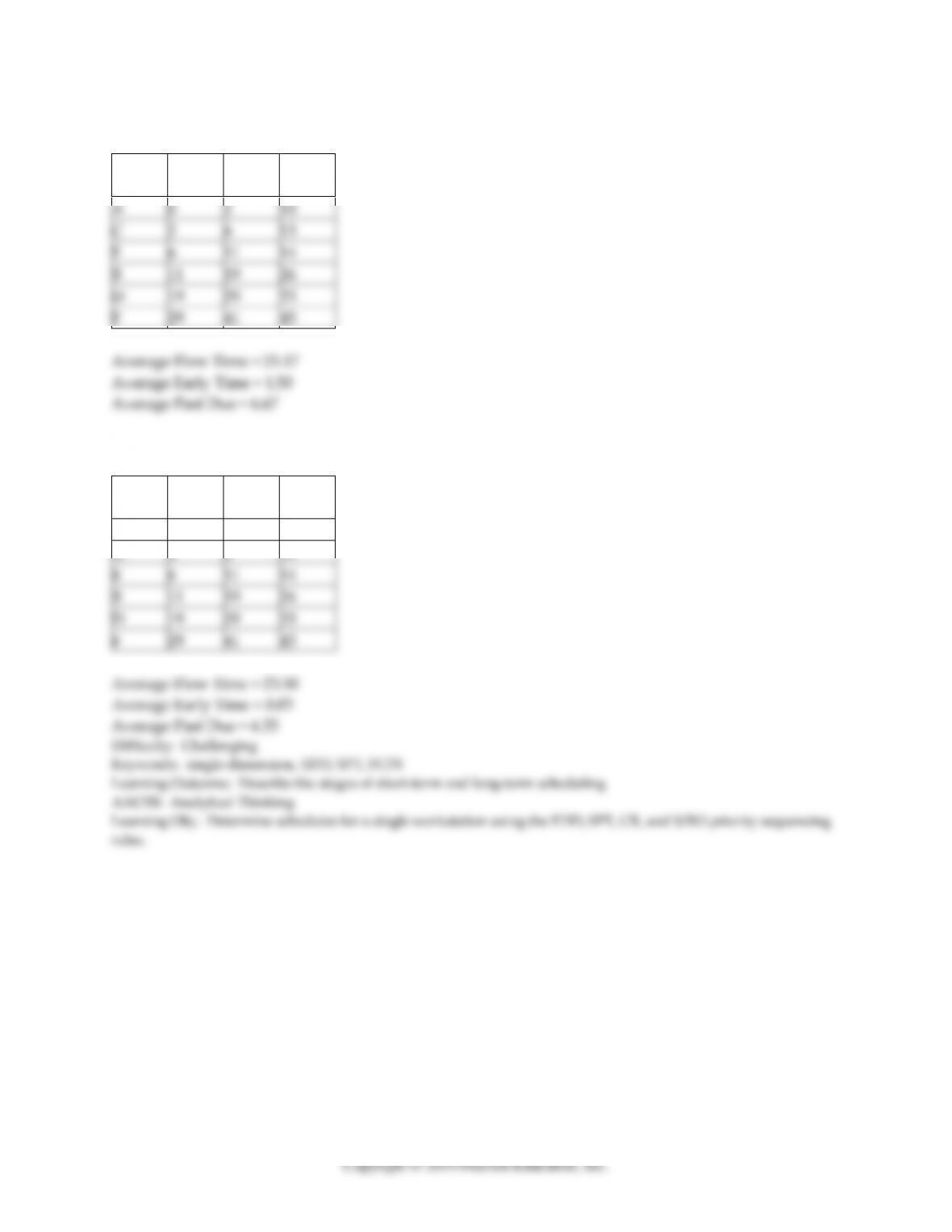
Use the information in the preceding table and sequence the six jobs using FCFS, SPT, and EDD.
Calculate the average flow times, average early times, and average past due.
A
0
2
10
B
2
10
17
C
10
14
21
D
14
24
28
E
24
29
32
F
29
41
43
31
SPT
Job
Start
Time
Finish
Time
Flow
Time
A
0
2
10
C
2
6
13
E
6
11
14
B
11
19
26
D
19
29
33
F
29
41
43
Average Flow Time = 23.17
Average Early Time = 1.50
Average Past Due = 6.67
EDD
Job
Start
Time
Finish
Time
Flow
Time
C
0
4
11
A
4
6
14
E
6
11
14
B
11
19
26
D
19
29
33
F
29
41
43
32
73)
Job
Time Since Order
Arrived (days)
Processing
Time (days)
Due Date
(days from now)
A
10
5
7
B
9
9
5
C
7
7
9
D
6
2
3
E
3
3
4
F
1
8
8
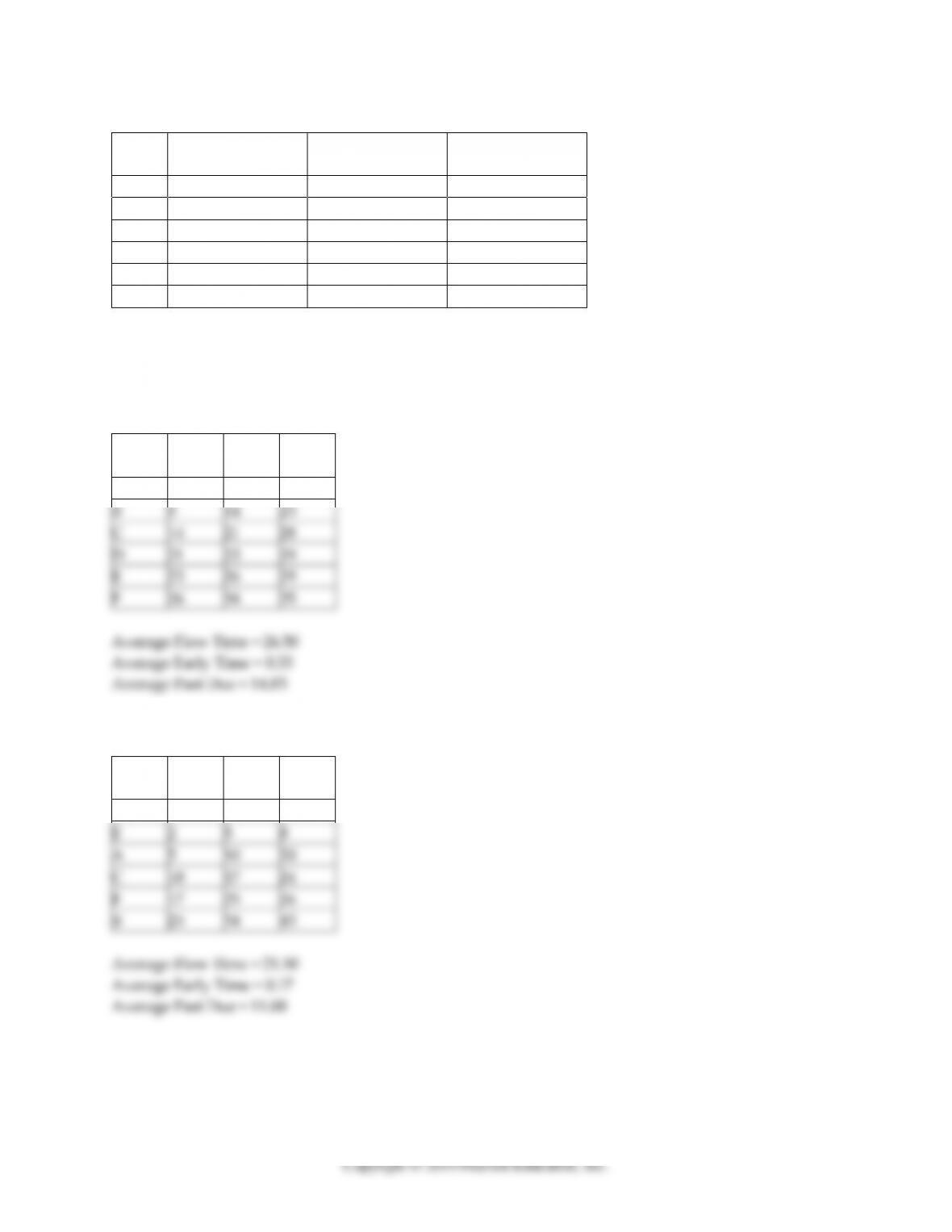
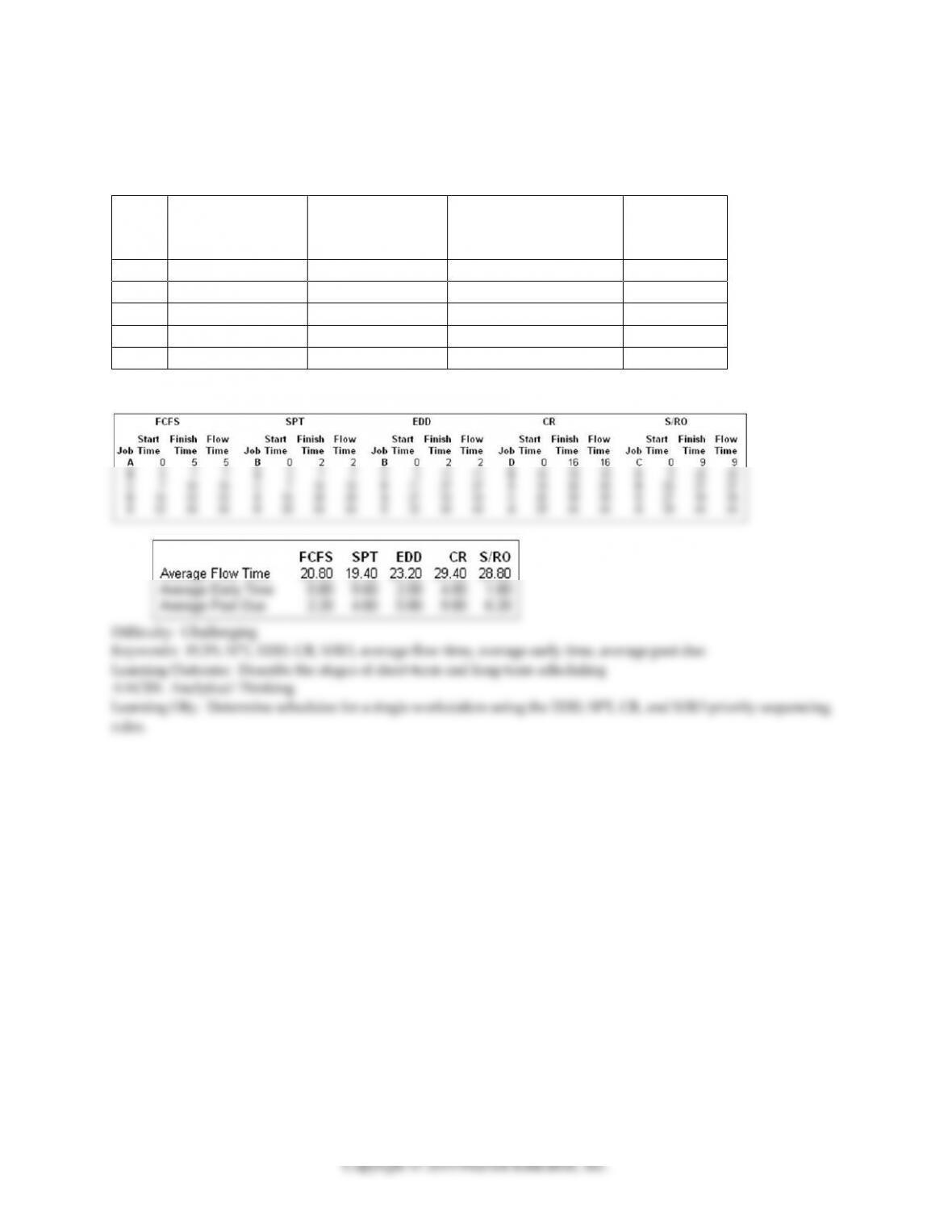
Use the information in the preceding table and sequence the six jobs using FCFS, SPT, and EDD.
Calculate the average flow times, average early times, and average past due.
Answer:
FCFS
Job
Start
Time
Finish
Time
Flow
Time
A
0
5
15
B
5
14
23
C
14
21
28
D
21
23
29
E
23
26
29
F
26
34
35
SPT
Job
Start
Time
Finish
Time
Flow
Time
D
0
2
8
E
2
5
8
A
5
10
20
C
10
17
24
F
17
25
26
B
25
34
43
33
EDD
Job
Start
Time
Finish
Time
Flow
Time
D
0
2
8
E
2
5
8
B
5
14
23
A
14
19
29
F
19
27
28
C
27
34
41
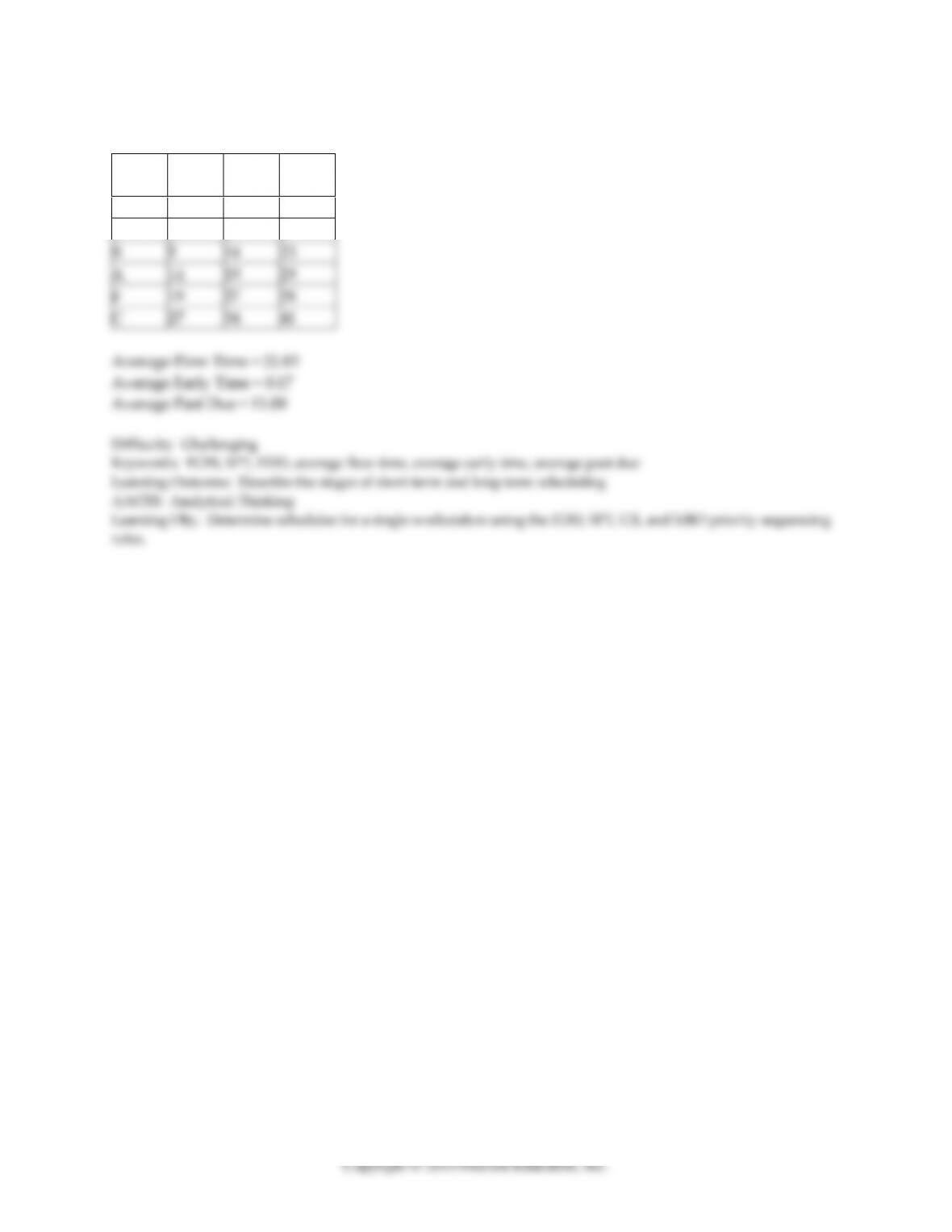
Average Flow Time = 22.83
Average Early Time = 0.17
Average Past Due = 11.00
Difficulty: Challenging
Keywords: FCFS, SPT, EDD, average flow time, average early time, average past due
Learning Outcome: Describe the stages of short-term and long-term scheduling
AACSB: Analytical Thinking
Learning Obj.: Determine schedules for a single workstation using the EDD, SPT, CR, and S/RO priority sequencing
rules.
34
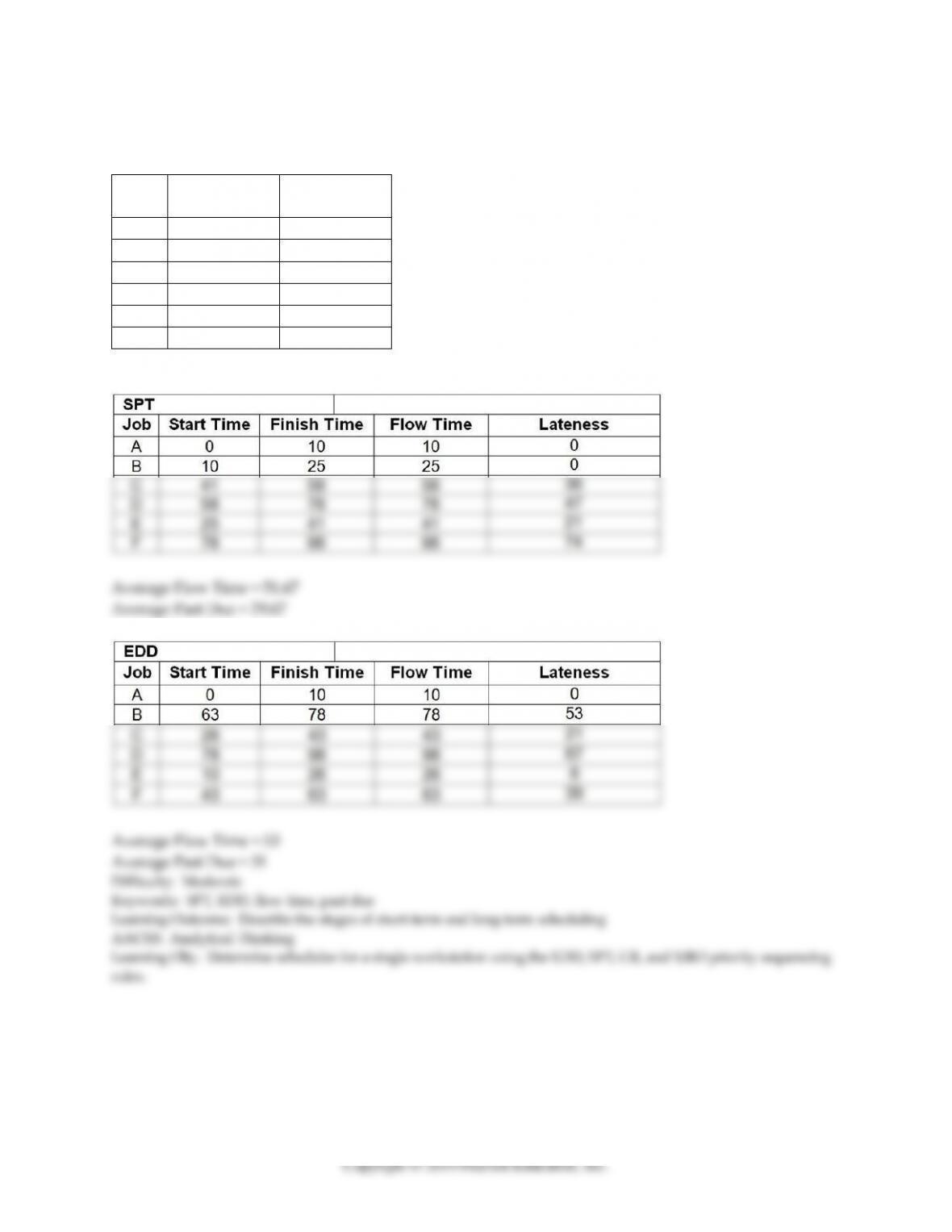
74) A workstation has five jobs that just arrived (the start of Day 1) to be processed, as shown in the
following table. Use this information to sequence the five jobs using FCFS, SPT, EDD, S/RO, and CR.
Calculate the average flow times, average early times, and average past due.
Job
Processing Time at
Workstation
(hours)
Time Remaining to
Due Date (weeks)
Work Time Remaining
Including Workstation
(weeks)
Remaining
Number of
Operations
A
5
30
10
2
B
2
10
5
1
C
9
12
5
3
D
16
25
20
2
E
12
45
22
4
Answer:
35
75) Use the information in the table and sequence the six jobs using SPT and EDD. Calculate the average
flow times and average lateness. All jobs arrived at time zero and are ready at time zero.
Job
Production
Time
Due Date
A
10
20
B
15
25
C
17
22
D
20
31
E
16
20
F
20
24
Answer: