23) Champion Cooling Company uses a kanban system at their location in the Oklahoma City Metroplex.
The daily demand for fans is 2,000 and management insists on using an alpha level of 0.1. They use
containers that hold 20 items and takes 0.04 of a day to process. It takes 0.07 of a day to get a container
filled and for it to wait during its cycle. How many containers should they use? If they use the nearest
integer value number of containers, what is the actual system alpha?
24) Champion Cooling Company uses a kanban system at their location in the Oklahoma City Metroplex.
The daily demand for fans is 2,000 and management insists on using an alpha level of 0.1. They use
containers that hold 24 items and takes 0.02 of a day to process. It takes 0.08 of a day to get a container
filled and for it to wait during its cycle. How many containers should they use? If they use the nearest
integer value number of containers, what is the actual system alpha?
25) Burdell Salad Dressings uses a Kanban system. The daily demand for corrugated boxes used in
packaging its dressings is 300 boxes. The average waiting time for a container of boxes is 0.25 day. The
processing time for a container of boxes is 0.1 day, and a container holds 10 boxes. If Burdell wishes to
use a 5% policy variable, what is the level of work in process inventory in their plant?
26) The Peeps factory can be described as a three step process consisting of Mixing, Forming, and
Packaging. Peeps are made in batches of 1,000 and have a daily demand of 75,000 units during what the
plant manager likes to call “the Peep season.” Mixing has a cycle time of .02 seconds with a setup time of
30 seconds; Forming has a setup time of 24 seconds and a cycle time of .03 seconds, and Packaging has a
setup time of 15 seconds with a cycle time of .04 seconds. Each process step is handled by one operator,
who is available for 8 hours a day. What is the process bottleneck if each process step is assumed to have
100% uptime?
6.5 Value Stream Mapping
1) Use of value stream mapping requires construction of a current state drawing, a future state drawing,
and an implementation plan.
2) The value stream mapping tool often requires completion of the future state drawing before the current
state drawing, to help managers see the future state goals and more easily identify problems with the
current state of the process.
3) To complete the current state drawing of a process, a map of the current situation is developed,
including such items as material and information flows, process times, setup times, batch sizes, scrap
rates, and number of people required.
4) Often in value stream mapping, analysts must rely on process information from shop floor workers
rather than direct observation in an effort to quickly develop a work plan and accelerate implementing
the improved process.
5) The theory of constraints accepts existing system bottlenecks and works to maximize throughput given
these constraints, while value stream mapping endeavors to understand how existing processes can be
altered to eliminate bottlenecks and other wasteful activities.
6) A value stream map shows the flows of materials and information and the lines of responsibility and
authority.
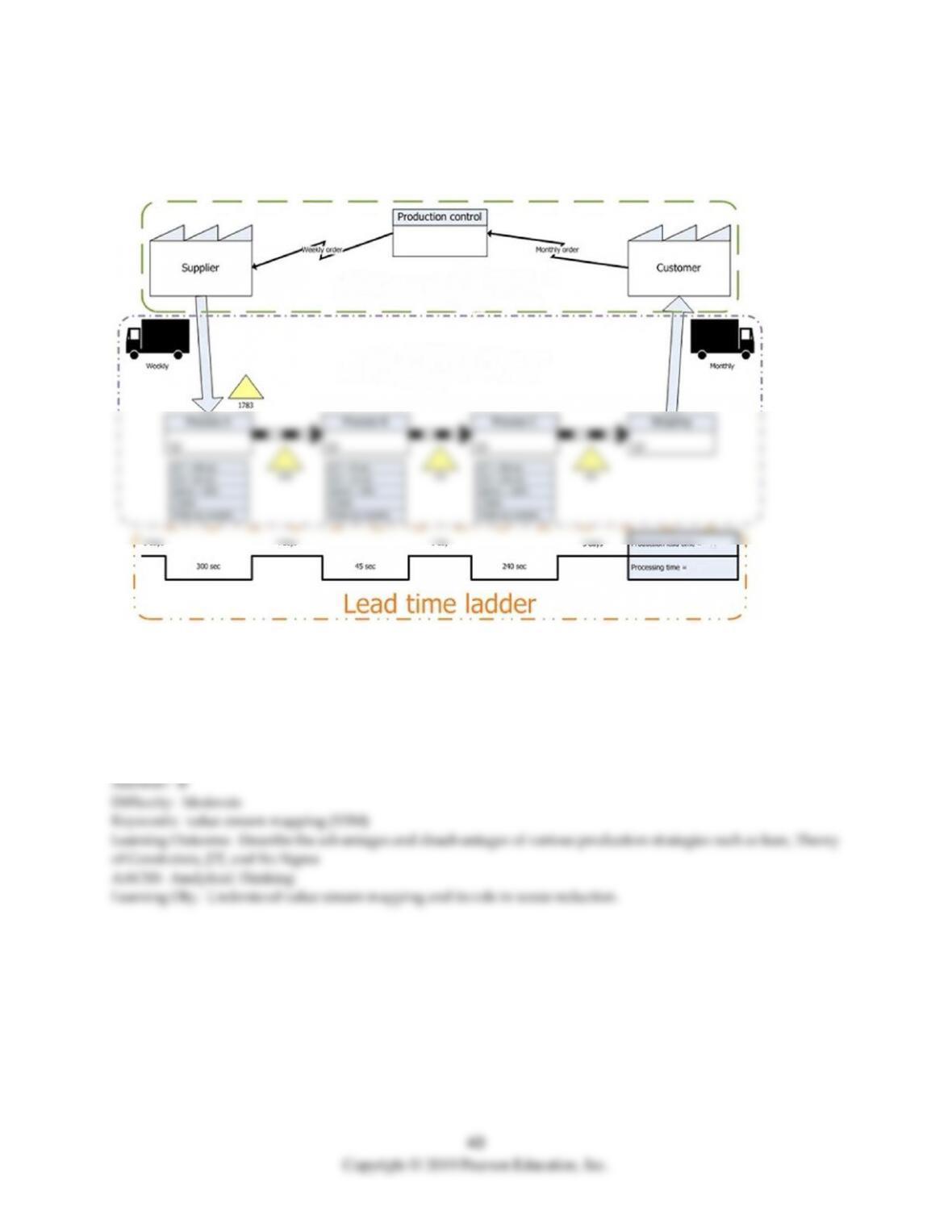
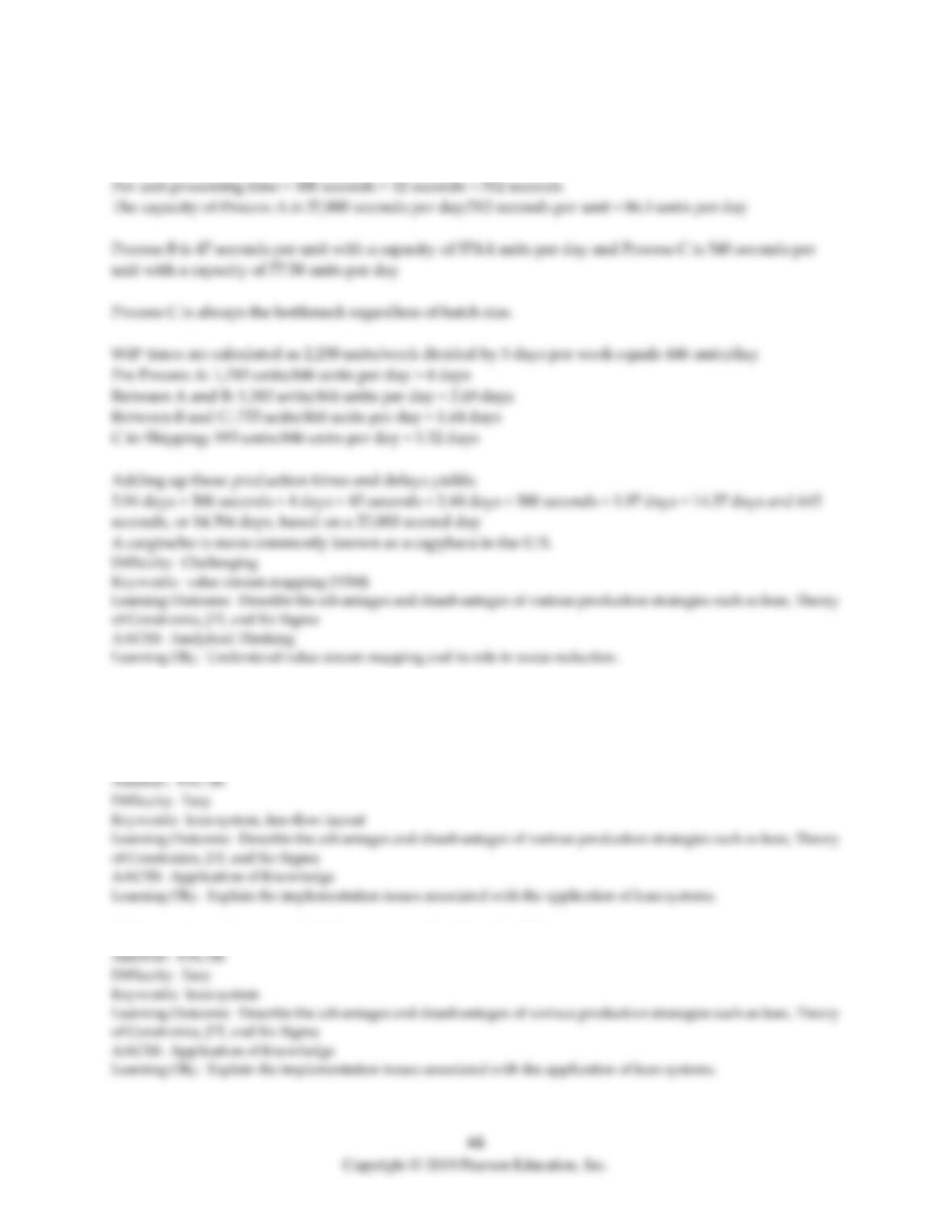
Scenario 6.1
El Gran Raton, the producers of the finest carpincho wallets in all of Argentina, examined their
production process in the form of a value stream map, displayed below.
Daniel Penfield artist
7) Use Scenario 6.1 to determine the total production lead time for carpincho wallets.
A) 14 days 585 seconds
B) 14 days
C) 14 days minus 585 seconds
D) 585 seconds
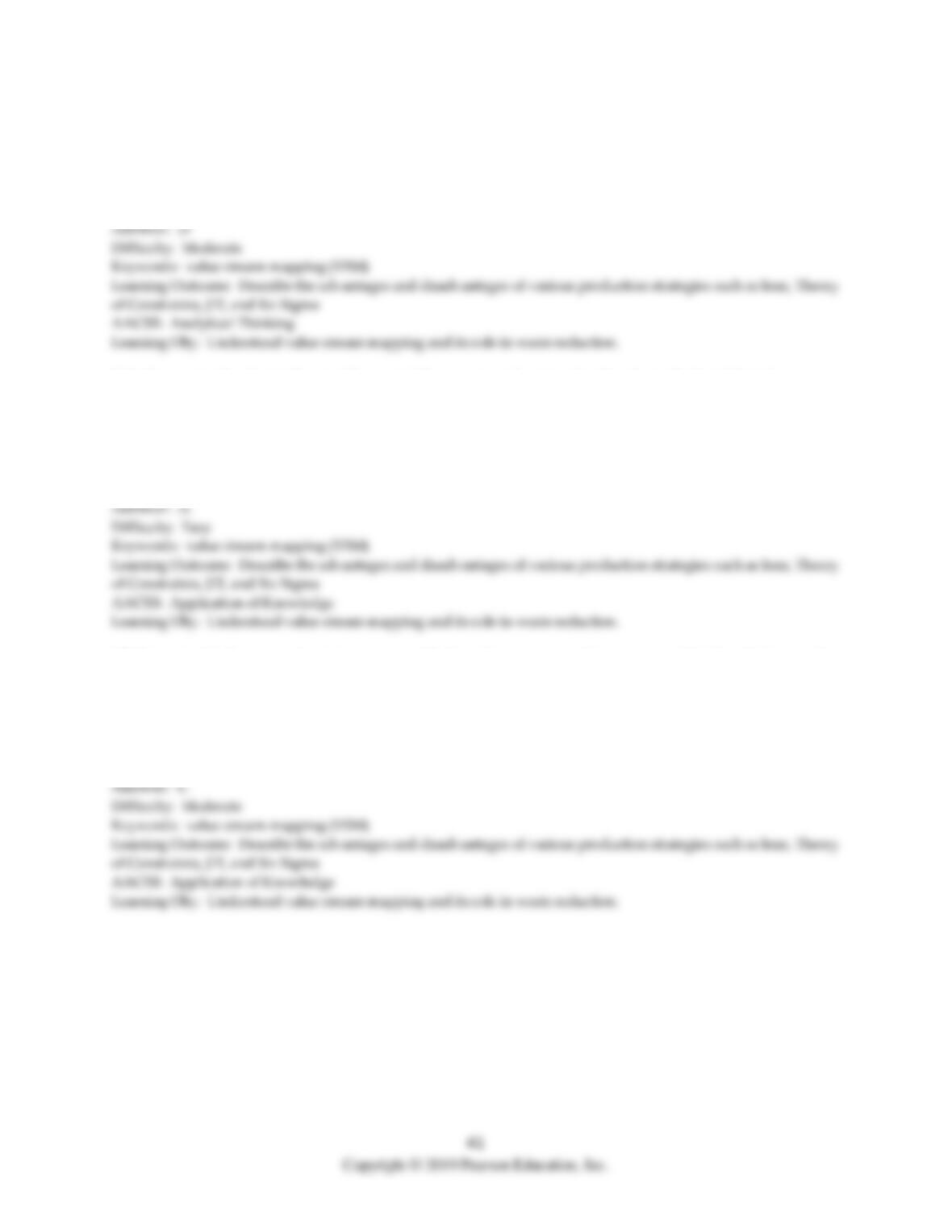
8) Use Scenario 6.1 to determine the total processing time for carpincho wallets.
A) 14 days 585 seconds
B) 14 days
C) 14 days minus 585 seconds
D) 585 seconds
9) In Scenario 6.1, what is the significance of the two jagged arrows leading from the box labeled
Production Control to the boxes labeled Supplier and Customer?
A) the arrows represent flows of information
B) the arrows represent flows of money
C) the arrows represent the flows of materials
D) the arrows represent the passage of time
10) Scenario 6.1 shows a value stream map with the picture separated into a top and bottom halves, each
encircled by a dashed line. The bottom half of the picture could best be described as representing the:
A) flow of information.
B) flow of money.
C) flow of material.
D) flow of power.
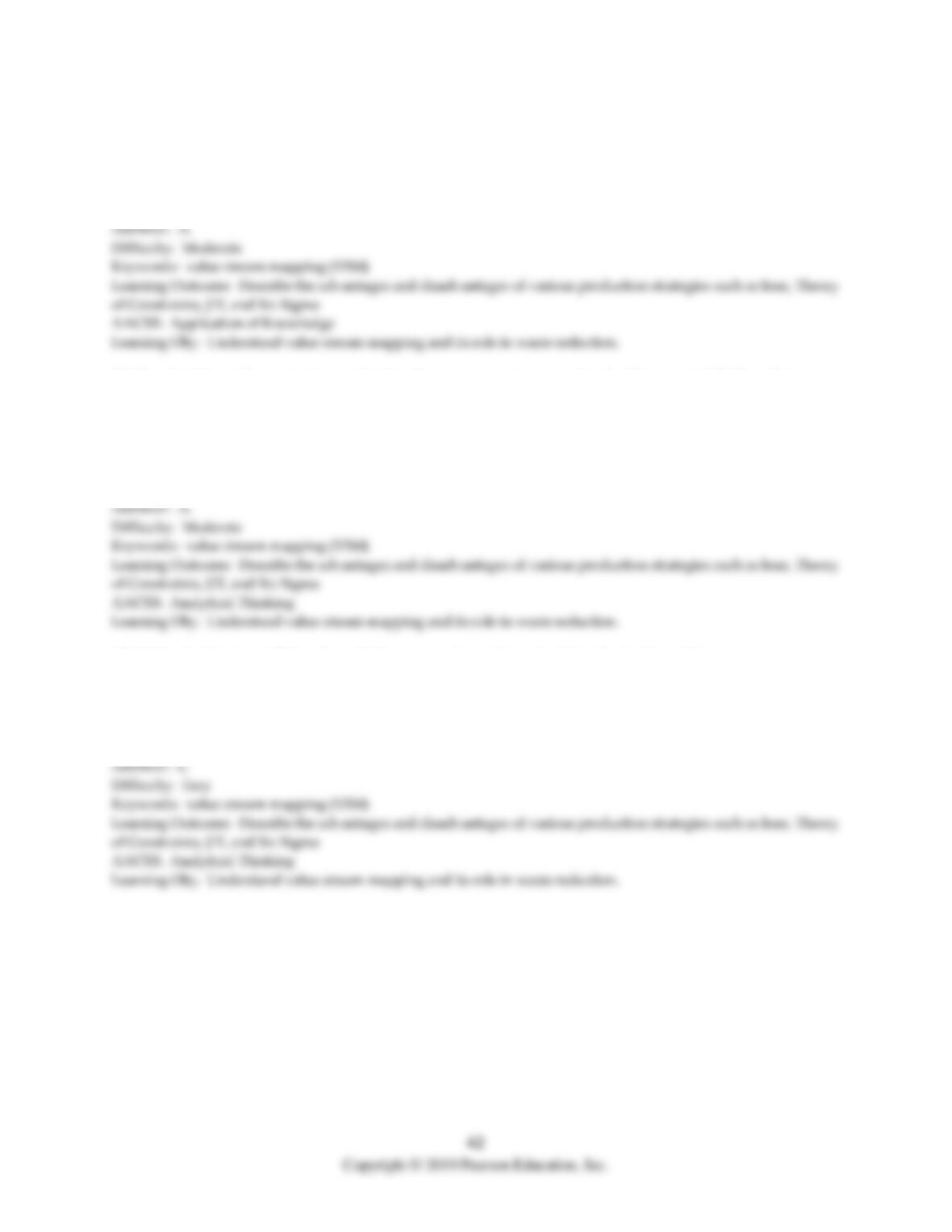
11) In Scenario 6.1, what does the triangle between Process A and Process B represent?
A) WIP
B) takt
C) OWMM
D) kanban
12) Use the data in Scenario 6.1 to calculate the per unit processing time for Process A if El Gran Raton
decides to run a batch size of 360 units. The per unit time is:
A) 310 seconds.
B) 46.67 seconds.
C) 340 seconds.
D) 696.67 seconds.
13) With a batch size of 360 units, which process step in Scenario 6.1 is the bottleneck?
A) Process A
B) Process B
C) Process C
D) the market
14) With a batch size of 300 units, what is the per unit processing time for Process C?
A) 5 minutes 12 seconds
B) 5 minutes 48 seconds
C) 6 minutes
D) 5 minutes 30 seconds
15) With a batch size of 300 units, what is the capacity of process A as shown in Scenario 6.1?
A) 10.3 units per hour
B) 11.5 units per hour
C) 12.7 units per hour
D) 13.9 units per hour
16) Use the data in Scenario 6.1 to determine the batch size necessary to restrict overall process capacity to
10 units per hour.
A) 200 units
B) 220 units
C) 240 units
D) 260 units
17) ________ is a qualitative lean tool for eliminating waste that involves current state and future state
drawings, and an implementation plan.
44
18) Value stream maps consist of a(n)________, a(n)________, and a(n)________.
19) Briefly outline the steps to be followed in evaluating and improving a process using value stream
mapping.
Answer: VSM analysts begin by selecting a product family for which the mapping will be done. This is
followed by drawing a current state map of the existing production situation, and gathering and
including all pertinent information on material and information flows (cycle times, scrap rates, machine
20) Choose a simple, common process and create a value stream map containing the current state, plus a
realistic future state, and implementation plan.
Answer: Answers will vary. See the outline below for steps to be followed and information to be
included.
VSM analysts begin by selecting a product family for which the mapping will be done. This is followed
by drawing a current state map of the existing production situation, and gathering and including all
45
Scenario 6.1
El Gran Raton, the producers of the finest carpincho wallets in all of Argentina, examined their
production process in the form of a value stream map, displayed below.
Daniel Penfield artist
21) Use the value stream map to conduct a complete analysis of the carpincho wallet production process.
Calculate all raw material and WIP lead times and determine overall process capacity assuming El Gran
Raton uses a batch size of 300 units. If a single carpincho wallet were ordered today, how long before it
would reach the back pocket of the delighted customer if his order is but one of an average of 2,230
orders (all for a single wallet) during an average 5 day work week. *Assume that the days indicated on the
lead time ladder are based on a different batch size and not applicable to the 300 unit batch currently in use.*
Answer: Using a batch size of 300 units, the capacity of Process A is calculated as:
60 minute setup * 60 seconds/minute = 3,600 second setup
3,600 seconds/300 units per batch = 12 seconds per unit
6.6 Operational Benefits and Implementation Issues
1) One big advantage of lean systems is that they can usually be put in place without any major changes
to existing layouts.
2) Lean systems do not need stable master production schedules.
3) If frequent, small shipments of purchased items cannot be arranged with suppliers, large inventory
savings for these items cannot be realized.
4) Implementing a lean system:
A) has the advantage that workers have less stress because of the routine, repetitive work they perform.
B) typically relieves the workers and first-line supervisors from activities such as scheduling, expediting,
and productivity improvements.
C) requires an examination of the reward system to make sure it is consistent with the JIT philosophy.
D) involves the reorganization of material flows to that of a flexible flow.
5) Which of the following is a process consideration in the implementation of a lean system?
A) Firms might have to change existing layouts.
B) Workstations typically will have to be moved farther apart.
C) A contract with strict job classifications will have to be adopted.
D) Plant access by rail will become necessary.
6) Which one of the following is an advantage of lean systems?
A) Lean systems reduce equipment needs by using larger lot sizes.
B) Lean systems can be implemented in any production environment.
C) Lean systems result in a decrease in safety stock and work–in-process inventory.
D) Lean systems result in an increase in manufacturing lead times.
7) When implementing a lean system:
A) managers can mitigate some of the effects of worker stress by judiciously using safety stocks and
emphasizing material flows rather than worker pace.
B) management should base the reward system on production volume.
C) the plant layout is the only environmental characteristic that need not be analyzed.
D) it is critical to develop a master production schedule that changes frequently as forecasts change.
8) The final assembly schedule in a lean system:
A) should be developed for each product independent of the process requirements for the other products.
B) strives to create a uniform flow at the work centers in the plant.
C) avoids the use of small lot sizes because they create many production orders and cause confusion.
D) allows daily changes in demand levels, regardless of size, to be incorporated immediately into the
work center schedules.
9) If the inventory advantages of a lean system are to be realized, ________ lot sizes must be used.
10) Transforming a current process design to one embodying a ________ philosophy is a constant
challenge for management, often fraught with implementation issues.
11) Describe the process considerations organizations must evaluate when implementing a lean system.
Answer: Answers will vary, but process considerations will include the following areas:
1) Schedule stability: daily production schedules in high-volume, make-to-stock environments, must be
stable for extended periods so production lines can be balanced.
12) What are the organizational issues companies must address before implementing a lean system?
13) What is schedule stability and why is it important in a lean system?