33) A shortage of capacity (or inventory) occurs when
A) there are excessive cancellations.
B) there are few cancellations.
C) an expensive backup needs to be arranged.
D) B and C only
34) The cost of wasted capacity is
A) the reduction in margin that results from having to go to a backup source.
B) the margin that would have been generated if the capacity had been used for production.
C) the productivity increase generated when the capacity is used for production.
D) the sales potential of excess capacity kept in reserve for emergency production.
35) The cost of a capacity shortage is
A) the reduction in margin that results from having to go to a backup source.
B) the margin that would have been generated if the capacity had been used for production.
C) the productivity increase generated when the capacity is used for production.
D) the sales potential of excess capacity kept in reserve for emergency production.
36) The goal when making the overbooking decision is to maximize supply chain profits by
A) maximizing the value of wasted capacity and the cost of capacity shortage.
B) maximizing supply chain profits.
C) minimizing the cost of wasted capacity and the cost of capacity shortage.
D) minimizing the cost of wasted capacity and minimizing capacity shortages.
37) An effective revenue management tactic when faced with seasonal peaks is to charge a
A) high price during the peak period and a higher price during off-peak periods.
B) higher price during the peak period and a lower price during off-peak periods.
C) lower price during the peak period and a higher price during off-peak periods.
D) low price during the peak period and a lower price during off-peak periods.
38) What should the price be in period 1?
A) $287.50
B) $275.00
C) $262.50
D) $250.00
39) What should the price be in period 3?
A) $185.13
B) $181.27
C) $177.43
D) $173.61
40) What is the expected revenue if the student APICS chapter uses dynamic pricing?
A) $83,975
B) $84,349
C) $84,719
D) $85,209
41) Responding to customer complaints (primarily from period 1 purchasers) the student APICS
chapter decides to use static pricing over the four month season. The club sponsor makes a deal
with the local bootlegger to supply him with all the mason jars he will need for the barbecue
season. What is the optimal price to charge for their barbecue sauce?
A) $122.50
B) $125.00
C) $127.50
D) $130.00
42) Responding to customer complaints (primarily from period 1 purchasers) the student APICS
chapter decides to use static pricing over the four month season. The club sponsor makes a deal
with the local bootlegger to supply him with all the mason jars he will need for the barbecue
season. What is the total revenue for the season’s sales at the optimal price?
A) $89,490
B) $94,747
C) $100,000
D) $90,247
43) The components needed to produce a computer clock cost twenty-five cents. What should
the price of the computer clocks be in the first month of the selling season?
A) $5.68
B) $7.27
C) $10.13
D) $14.52
44) The components needed to produce a computer clock cost twenty-five cents. What should
the price of the computer clocks be in the third month of the selling season?
A) $14.52
B) $10.13
C) $7.27
D) $5.68
45) The components needed to produce a computer clock cost twenty-five cents. How many
clocks should the AITP club produce?
A) 39
B) 47
C) 55
D) 63
46) The components needed to produce a computer clock cost twenty-five cents. What is the
expected profit if the AITP club sponsor produces the optimal number of clocks?
A) $263.72
B) $262.54
C) $260.97
D) $269.41
47) Shifting demand from peak to off-peak periods is beneficial if the discount given
A) during the off-peak period is more than offset by the decrease in cost because of a larger
peak.
B) during the off-peak period is more than offset by the decrease in cost because of a smaller
peak.
C) during the peak period is more than offset by the decrease in cost because of a smaller peak.
D) during the peak period is more than offset by the decrease in cost because of a larger peak.
48) Hotels use differential pricing by day of week and time of year
A) in order to shift demand from peak periods to off-peak periods.
B) in order to increase demand during off-peak periods.
C) in order to shift revenue from peak periods to off-peak periods.
D) in order to shift profit from peak periods to off-peak periods.
49) Most firms must decide what fraction of an asset to
A) sell in bulk and what fraction of the asset to discard.
B) save for the spot market and what fraction of the asset to discard.
C) save for emergencies and what fraction of the asset to rework.
D) sell in bulk and what fraction of the asset to save for the spot market.
50) Uber’s use of surge pricing serves to
A) lower demand and increase supply during busy times.
B) lower demand and lower supply during busy times.
C) increase demand and lower supply during busy times.
D) increase demand and increase supply during busy times.
51) In most instances, owners of supply chain assets prefer
A) to fulfill all demand that arises from bulk sales and serve small customers only if assets are
left over.
B) to fulfill all demand that arises from small customers and serve bulks sales only if assets are
left over.
C) to fulfill the same percentage of demand generated by both bulk sales and small customers.
D) to leave a small percentage of demand generated by bulk sales and small customers unfilled
in case a new customers arises.
52) The fundamental trade-off between selling in bulk or on the spot market is
A) different from the situation where a firm serves two market segments.
B) similar to the case when a firm serves two market segments.
C) similar to the case where a firm must deal with seasonal demand.
D) similar to the case where a firm has a perishable asset.
53) The amount reserved for the spot market should be
A) such that the expected marginal revenue from the spot market equals the current revenue from
a bulk sale.
B) such that the expected marginal revenue from the spot market exceeds the current revenue
from a bulk sale.
C) such that the expected marginal revenue from the spot market is less than the current revenue
from a bulk sale.
D) equal to the maximum revenue available from the spot.
54) How many donkeys should the cruise line have in its herd?
A) 8,111
B) 7,977
C) 7,842
D) 7,707
55) Once a local donkey herder learns of the cruise line’s plan, he raises his donkey rental price
to $25 per tourist. How many donkeys should be in the cruise line’s herd?
A) 9,311
B) 8,971
C) 9,240
D) 8,707
56) Once a local donkey herder learns of the cruise line’s plan, he lowers his donkey rental price
to $17.50 per tourist. How many donkeys should be in the cruise line’s herd?
A) 7,264
B) 6,684
C) 6,711
D) 6,797
57) The cruise line’s insurance policy limits the number of donkeys in their herd to 5,000. What
bulk price should the cruise line negotiate to make the 5,000 donkey herd size optimal?
A) $16,664 per ten thousand
B) $16,362 per ten thousand
C) $16,134 per ten thousand
D) $15,978 per ten thousand
Scenario 16.7 — Commencement
Every year at commencement, the president hands out diploma covers to joyous students that
cross the front of the auditorium to accept the cover and a hearty handshake. Commencement
exercises have averaged 850 students with a standard deviation of 70 the last several years. The
bookstore can provide a box of 144 diploma covers for $2,000 but is unwilling to break bulk.
Any additional diploma covers must be purchased on the black market at $15 each.
58) Use Scenario 16.7 to answer the following. How many gross of diploma covers should be
ordered from the bookstore?
A) 3
B) 4
C) 5
D) 6
59) Use Scenario 16.7 to answer the following. If the university orders the optimal number of
boxes of diploma covers from the bookstore, how many additional covers must they obtain from
the black market?
A) 81
B) 87
C) 90
D) 94
60) Use Scenario 16.7 to answer the following. What would the cost of a gross of diploma covers
have to fall to in order for an optimal order to equal the mean?
A) $1080
B) $1110
C) $1140
D) $1170
61) The forecasting function is
A) the foundation of any revenue management system.
B) unnecessary for a revenue management system.
C) an added plus for any revenue management system.
D) likely to create problems for any revenue management system.
62) The goal of optimization in revenue management is to identify a tactic
A) using forecasts of customer behavior that will be most effective.
B) using linear regression that will maximize revenue.
C) using linear regression that will minimize cost.
D) that will not have to be altered.
63) The decision to use overbooking will
A) lead to upset customers and a high cost of providing them space.
B) lead to unutilized assets and lost revenue.
C) lead to reduced profits.
D) depend upon optimization to be successful.
64) It is important for the firm to structure its revenue management program in a way that
A) it is presented simply as a mechanism for extracting maximum revenue.
B) revenue increases while improving service along some dimension that is important to
customers that pay the highest price.
C) profit is maximized.
D) all of the above
65) In order to achieve the greatest value,
A) supply planning and revenue management should be performed separately.
B) supply planning should be completed first.
C) supply planning and revenue management should be combined.
D) revenue management should be completed first.
30
16.3 Essay Questions
1) Describe the role of revenue management.
2) Explain how revenue management is beneficial.
Answer: Revenue management adjusts the pricing and available supply of assets to maximize
profits. Revenue management has a significant impact on supply chain profitability when one or
more of the following four conditions exist:
31
3) Explain how differential pricing can benefit a firm.
Answer: If a supplier serves multiple customer segments with a fixed asset, he or she can
improve revenues by setting different prices for each segment. In theory, the concept of
differential pricing increases total profits for a firm. There are two fundamental issues, however,
4) How do firms address the problems of spoilage and spill?
Answer: In most instances of differential pricing, demand from the segment paying the lower
price arises earlier in time than demand from the segment paying the higher price. The basic
32
5) How can firms address the problem of perishable assets?
Answer: Any asset that loses value over time is perishable.
6) Explain why forecasting is important to revenue management.
Answer: The foundation of any revenue management system is the forecasting function. To use
overbooking with any degree of success, a firm must be able to forecast cancellation patterns.
33
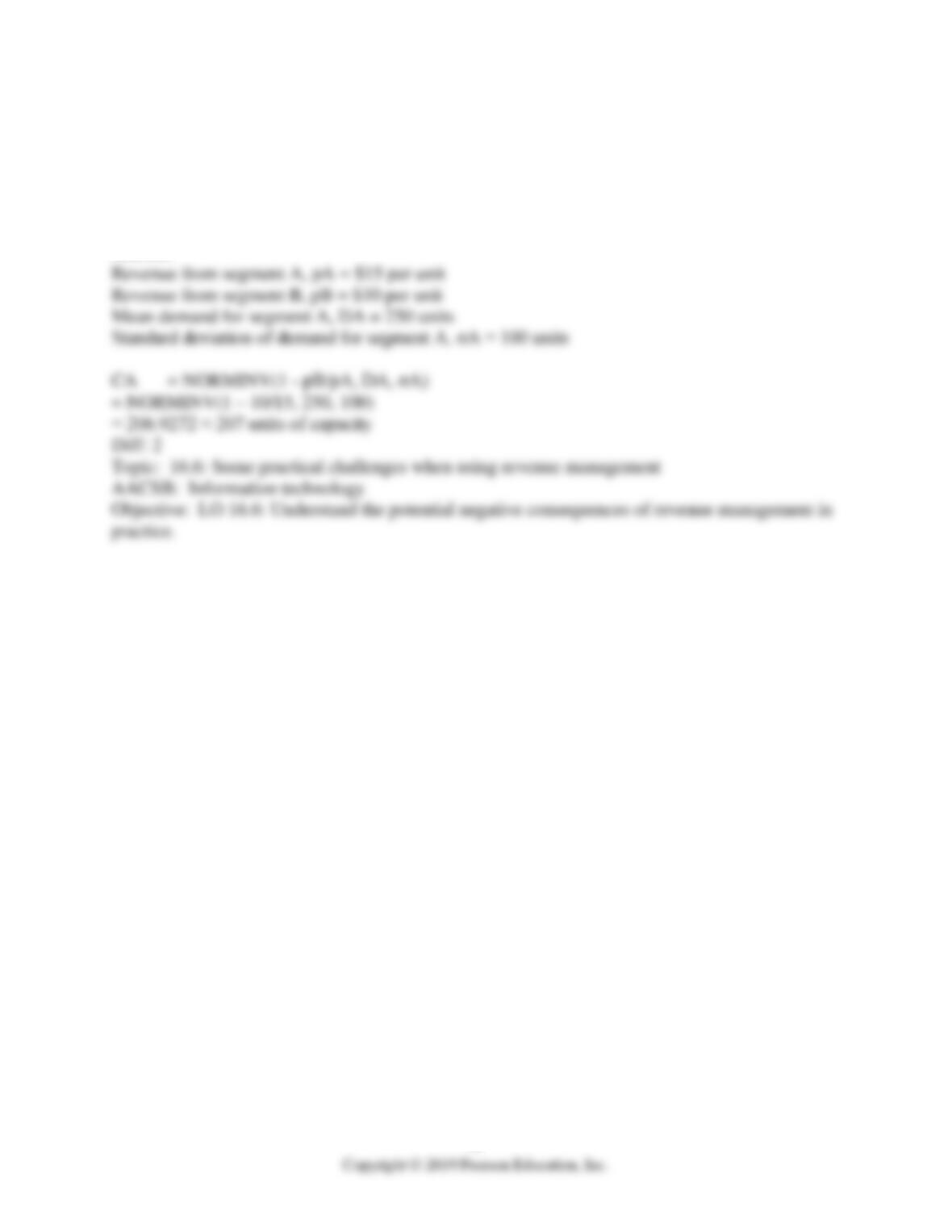
7) A manufacturer of industrial sales has production capacity of 1,000 units per day. Currently,
the firm sells production capacity for $10 per unit. At this price, all production capacity gets
booked about one week in advance. A group of customers have said that they would be willing to
pay $15 per unit if capacity was available on the last day. About ten days in advance, demand for
the high-price segment is normally distributed with a mean of 250 and a standard deviation of
100. How much production capacity should the manufacturer reserve for the last day?
Answer: