30) Supplier performance should be compared based on
A) purchase price alone.
B) its impact on total cost.
C) the supplier’s quality of material.
D) the ability of the supplier to coordinate forecasting and planning.
31) Single sourcing for a product is used to
A) guarantee the supplier sufficient business when the supplier has to make a significant buyer-
specific investment.
B) ensure a degree of competition.
C) ensure the possibility of a backup should a source fail to deliver.
D) control all possible sources of supply in the market.
32) The procurement process for direct materials should primarily focus on
A) improving coordination and visibility with the supplier.
B) decreasing the transaction cost for each order.
C) consolidation of orders to take advantage of economies of scale and quantity discounts.
D) minimizing communication with the supplier.
33) The procurement process for indirect materials should primarily focus on
A) improving coordination and visibility with the supplier.
B) decreasing the transaction cost for each order.
C) consolidation of orders to take advantage of economies of scale and quantity discounts.
D) minimizing communication with the supplier.
34) The procurement process for both direct and indirect materials should work on
A) improving coordination and visibility with the supplier.
B) decreasing the transaction cost for each order.
C) consolidation of orders to take advantage of economies of scale and quantity discounts.
D) minimizing communication with the supplier.
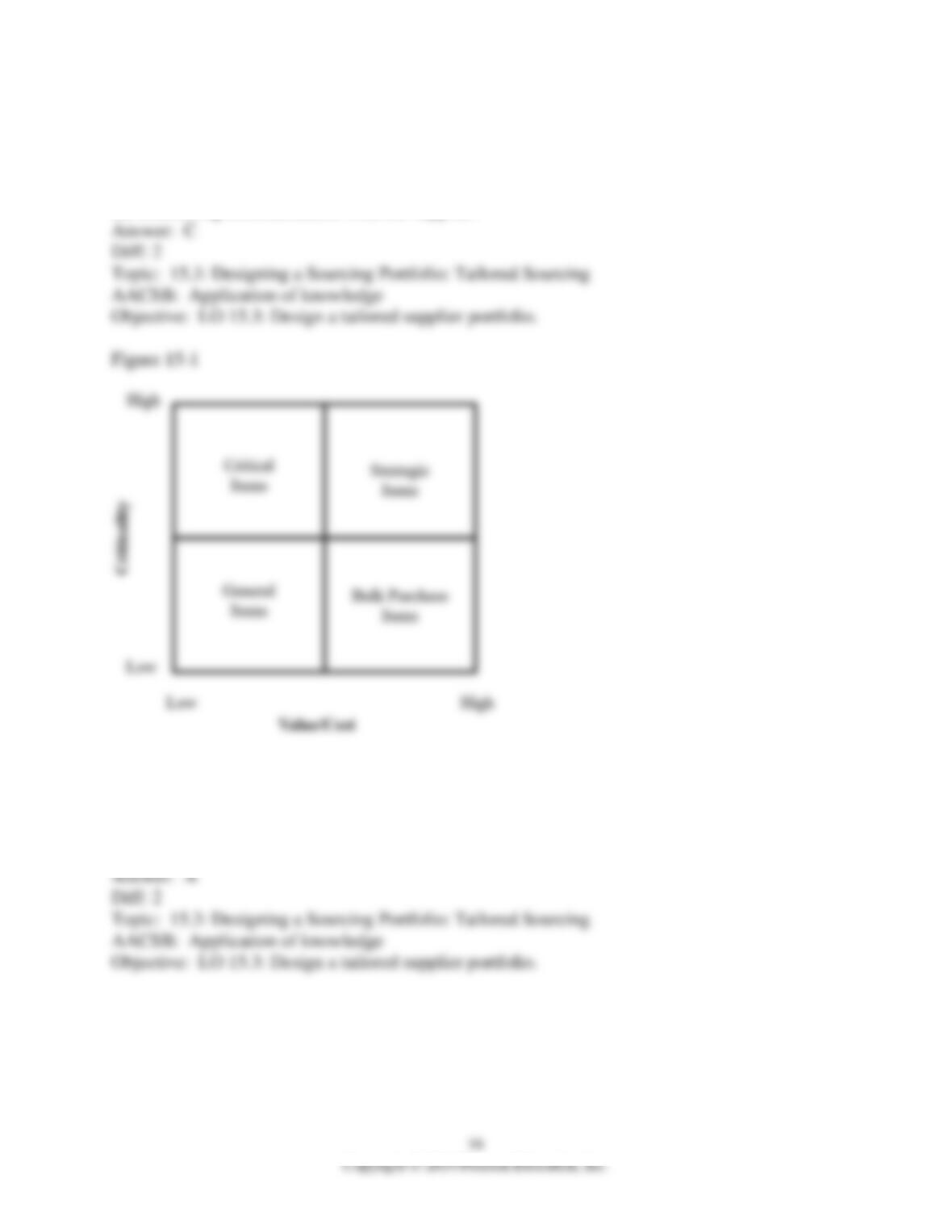
35) Use Figure 15-1 to answer the question. Most indirect materials are included in
A) General items.
B) Critical items.
C) Strategic items.
D) Bulk purchase items.
36) Use Figure 15-1 to answer the question. Most suppliers have a similar price for
A) General items.
B) Critical items.
C) Strategic items.
D) Bulk purchase items.
37) Use Figure 15-1 to answer the question. Ensuring availability is the deciding factor for
A) General items.
B) Critical items.
C) Strategic items.
D) Bulk purchase items.
38) Use Figure 15-1 to answer the question. The buyer-supplier relationship should be long term
for
A) General items.
B) Critical items.
C) Strategic items.
D) Bulk purchase items.
39) Use Figure 15-1 to answer the question. The goal should be to find suppliers that can
collaborate in the design phase for
A) General items.
B) Critical items.
C) Strategic items.
D) Bulk purchase items.
40) Sales efforts and orders peak near the end of any month, quarter, or other evaluation period.
This is commonly referred to as
A) the hockey stick phenomenon.
B) the student syndrome.
C) Murphy’s Law.
D) the Central Limit Theorem.
41) Understanding the impact of incentives on the actions of a supply chain partner is especially
important when
A) there are two or more members in the supply chain.
B) the third party’s actions are not fully observable.
C) more than two firms competing for the same pool of customers.
D) the supply chain uses outsourcing.
42) A contract that allows a retailer to return unsold inventory up to a specified amount, at an
agreed upon price is a
A) buyback or returns contract.
B) revenue-sharing contract.
C) quantity flexibility contract.
D) quantity discount contract.
43) A contract where the buyer pays a minimal amount for each unit purchased from the supplier
but shares a fraction of the revenue for each unit sold is a
A) buyback or returns contract.
B) revenue-sharing contract.
C) quantity flexibility contract.
D) quantity discount contract.
44) A contract that allows the buyer to modify the order (within limits agreed to by the supplier)
as demand visibility increases closer to the point of sale is a
A) buyback or returns contract.
B) revenue-sharing contract.
C) quantity flexibility contract.
D) quantity discount contract.
45) A contract that charges the retailer a lower wholesale price but requires the retailer to deposit
some portion of their sale price with the manufacturer is a
A) buyback or returns contract.
B) revenue-sharing contract.
C) quantity flexibility contract.
D) quantity discount contract.
46) A contract that is used to induce performance improvement from a supplier along
dimensions, such as lead time, where the benefit of improvement accrues primarily to the buyer,
whereas the effort for improvement comes primarily from the supplier is a
A) buyback or returns contract.
B) revenue-sharing contract.
C) quantity flexibility contract.
D) shared savings contract.
47) A downside to which contract is that it leads to surplus inventory that must be salvaged or
disposed?
A) Buyback or returns contract
B) Revenue-sharing contract
C) Quantity flexibility contract
D) Hybrid contract
48) Revenue-sharing contracts usually result in
A) the supply chain producing to consumer demand.
B) higher cost of returns.
C) lower retailer profit.
D) lower retailer effort.
49) Which contract increases the margin for the dealer as sales cross certain levels?
A) Buyback or returns contract
B) Revenue-sharing contract
C) Quantity flexibility contract
D) Threshold contract
Scenario 15.1 — The Jerk Store
George takes an eclectic mix of spices to make his authentic jerk seasoning as a rub for chicken,
pork, and fish. The ingredients and packaging cost $1.50 and he sells the packets by the case to
Jerk Stores in the Caribbean for $2.50 per packet. Tourists to the islands gladly pay $8.75 for
these packets, eager to host their friends for an authentic Caribbean meal and bore them with
vacation photos upon their return. The demand for the packets is normally distributed, with a
mean of 2500 packets and a standard deviation of 600.
50) If each Jerk Store location is acting independently, how many packets of seasoning should
they order?
A) 2840
B) 3069
C) 3233
D) 3678
51) If each Jerk Store location is acting independently, what is their expected profit if they order
the optimal quantity?
A) $13,521
B) $13,840
C) $16,680
D) $16,789
52) If each Jerk Store location is acting independently, what is their expected overstock quantity
if they order the optimal quantity?
A) 412
B) 434
C) 446
D) 468
53) If each Jerk Store location is acting independently, what is their expected understock
quantity if they order the optimal quantity?
A) 89
B) 95
C) 101
D) 107
54) If George and a single Jerk Store act as a vertically integrated supply chain, what is the
optimal quantity for the Jerk Store to order?
A) 2633
B) 2840
C) 3069
D) 3267
55) If George and a single Jerk Store act as a vertically integrated supply chain, what is the total
supply chain expected profit if an optimal order quantity is placed?
A) $16,462
B) $16,571
C) $16,680
D) $16,789
Scenario 15.2 — The Hilltop
Gregory and his followers scavenge the countryside for anything of value and with minimal
investment, make it ready to provide for any customer visiting their compound. Their average
investment in a product is $3, and one popular product, body armor, is in high demand. Residents
of The Kingdom and Alexandria in particular, are eager to procure The Hilltop’s body armor for
$65 and sell it to anyone left in the world at an average price of $650. The demand for the body
armor is normally distributed, with a mean of 250 units and a standard deviation of 50.
56) If The Kingdom and Alexandria are acting independently, how many units should they
order?
A) 284
B) 314
C) 367
D) 380
57) If The Kingdom and Alexandria are acting independently, what is their expected profit if
they order the optimal quantity?
A) $135,218
B) $138,402
C) $140,546
D) $167,894
58) If The Kingdom and Alexandria are acting independently, what is their expected overstock
quantity if they order the optimal quantity?
A) 35
B) 42
C) 54
D) 66
59) If The Kingdom and Alexandria are acting independently, what is their expected understock
quantity if they order the optimal quantity?
A) 2
B) 4
C) 6
D) 8
60) If Gregory and a single retailer — say Alexandria — act as a vertically integrated supply
chain, what is the optimal quantity for Alexandria to order?
A) 284
B) 306
C) 314
D) 380
61) If Gregory and a single retailer — say Alexandria — act as a vertically integrated supply
chain, what is their expected overstock quantity if Alexandria orders optimally?
A) 124
B) 130
C) 136
D) 142
62) If Gregory and a single retailer — say Alexandria — act as a vertically integrated supply
chain, what is their expected understock quantity if Alexandria orders optimally?
A) 0
B) 6
C) 12
D) 18
63) If Gregory and a single retailer — say Alexandria — act as a vertically integrated supply
chain, what is the total supply chain expected profit if an optimal order quantity is placed?
A) $161,312
B) $165,712
C) $166,802
D) $167,892
1) What are some of the benefits of effective sourcing decisions?
2) What factors should be considered when making sourcing decisions?
Answer: When designing a sourcing strategy, it is important for a firm to be clear on the factors
3) Why should replenishment lead time be considered in supplier selection decisions?
4) Why should on-time performance be considered in supplier selection decisions?
5) What is the difference in order quantity and profit achieved if George and The Jerk Store act
independently versus if they behaved as a vertically integrated supply chain?
6) Why should design collaboration capability be considered in supplier selection decisions?