Supply Chain Management: Strategy, Planning, and Operation, 7e (Chopra)
Chapter 14 Transportation in a Supply Chain
14.1 True/False Questions
1) Transportation plays a key role in every supply chain because products are usually produced
and consumed in the same location.
2) A distributor makes investment decisions regarding the transportation infrastructure and then
makes operating decisions to try to maximize the return from these assets.
3) A carrier uses transportation to minimize the total cost (transportation, inventory, information,
and facility) while providing an appropriate level of responsiveness to the customer.
4) Transportation is a significant component of the costs incurred by most supply chains.
5) The vehicle-related cost is incurred whether the vehicle is operating or not and is considered
fixed for short-term operational decisions by the carrier.
6) A carrier’s decisions are affected by the prices that the market will bear, but not the
responsiveness it seeks to provide its target segment.
7) Transportation cost depends on the prices offered by different carriers and the extent to which
the shipper uses inexpensive and slow, or expensive and fast, means of transportation.
8) Rail is the dominant mode of freight transportation in the United States and accounts for over
75 percent of the nation’s freight bill.
9) Quasi-market prices for transportation infrastructure result in higher prices at peak locations
and times and lower prices otherwise.
10) A milk run is a route in which a truck either delivers product from a single supplier to
multiple retailers or goes from multiple suppliers to a single retailer.
11) Milk runs reduce inbound transportation costs by consolidating large shipments directly from
the supplier to the consumer.
12) The most important operational decision related to transportation in a supply chain is the
routing and scheduling of deliveries.
13) The mode of transportation that results in the lowest transportation cost will also lower total
costs for a supply chain.
14) Ignoring inventory costs when making transportation decisions can result in choices that
worsen the performance of a supply chain.
15) A dabba uses the Mumbai railway system to carry about 40 lunches each day.
16) The dabbawalas of Mumbai make a milk run to begin their day.
17) The logistical advantage that the dabbawalas of Mumbai have over many other food delivery
services is an absence of uncertainty and a temporal aggregation of orders.
18) Firms can significantly reduce the safety inventory they require by physically aggregating
inventories in one location, which will generally decrease transportation costs.
19) Temporal aggregation decreases a firm’s responsiveness because of shipping delay but also
decreases transportation costs because of economies of scale that result from larger shipments.
20) A firm can meet customer needs by using tailored transportation to provide the appropriate
transportation choice based on customer and product characteristics, but at a higher cost.
21) Tailored transportation is the use of different transportation networks and modes based on
customer and product characteristics.
22) The combination of a high density of customers and short logistical distance is best served by
a private fleet making milk runs.
23) The combination of a high density of customers and long logistical distance is best served by
contracting with a package carrier.
24) The combination of a medium density of customers and medium logistical distance is best
served by contracting with an LTL carrier.
25) Only safety inventory should be aggregated if low demand exists for low value items.
14.2 Multiple Choice Questions
1) The movement of product from one location to another as it makes its way from the beginning
of a supply chain to the customer’s hands is referred to as
A) transportation.
B) retailing.
C) distribution.
D) manufacturing.
2) Transportation plays a key role in every supply chain because
A) products are normally produced and consumed in the same location.
B) products are rarely produced and consumed in the same location.
C) the cost of transportation is inconsequential.
D) transportation is not a factor in determining profitability.
3) The key players in any transportation that takes place within a supply chain are
A) the shipper and the receiver.
B) the shipper and the supplier.
C) the shipper and the manufacturer.
D) the shipper and the carrier.
4) Investment decisions regarding the transportation infrastructure (rails, locomotives, trucks,
airplanes, etc.) are the primary concern of
A) the shipper.
B) the supplier.
C) the manufacturer.
D) the carrier.
5) Which of the following uses transportation to minimize the total cost (transportation,
inventory, information, and facility) while providing an appropriate level of responsiveness to
the customer?
A) The shipper
B) The supplier
C) The manufacturer
D) The carrier
6) The ________ is the party that requires the movement of the product between two points in
the supply chain.
A) carrier
B) producer
C) shipper
D) consumer
7) The ________ is the party that moves or transports the product.
A) carrier
B) producer
C) shipper
D) consumer
8) Which of the following is the fastest delivery method of transportation?
A) Rail
B) Truck
C) Air
D) Intermodal
9) ________ carriers offer a very fast and fairly expensive mode of transportation for cargo.
A) Air
B) Truck
C) Rail
D) Water
10) ________ carriers typically move commodities over large distances at lower costs per unit
shipped.
A) Air
B) Truck
C) Rail
D) Package
11) ________ carriers are the preferred mode of transport for online businesses such as
Amazon.com and Dell, as well as for companies such as W.W. Grainger and McMaster-Carr that
send small packages to customers.
A) Air
B) Package
C) Rail
D) Water
12) Which mode of transportation is the most expensive?
A) Air
B) Truck
C) Rail
D) Water
13) Which mode of transportation is the least expensive?
A) Air
B) Truck
C) Rail
D) Water
14) Which mode of transportation is the dominant form of domestic freight transportation?
A) Air
B) Truck
C) Rail
D) Water
15) Which mode of transportation is used primarily for petroleum and natural gas?
A) Air
B) Truck
C) Water
D) Pipeline
16) In almost all countries, roads, seaports, airports, rail and canals have this in common.
A) They were built and/or managed by the government.
B) They are located near the water.
C) They are the source of most of the tax revenue for municipalities.
D) They are staffed by foreign nationals.
17) Suppose that a highway is governed by a use fee charged to motorists that is based on
congestion, operation and maintenance. The total traffic t is used to determine the cost of 5t2.
What is the average cost per motorist?
A) 2.5
B) 5
C) 5t
D) 2.5t
18) Suppose that a highway is governed by a use fee charged to motorists that is based on
congestion, operation and maintenance. The total traffic t is used to determine the cost of 5t2.
What is the marginal cost?
A) 5
B) 5t
C) 10
D) 10t
19) Suppose that a highway is governed by a use fee charged to motorists that is based on
congestion, operation and maintenance. The total traffic t is used to determine the cost of 5t2 +
7t. What is the average cost per motorist?
A) 12
B) 5t + 7
C) 10
D) 10t + 7
20) Suppose that a highway is governed by a use fee charged to motorists that is based on
congestion, operation and maintenance. The total traffic t is used to determine the cost of 5t2 +
7t. What is the marginal cost?
A) 12
B) 5t + 7
C) 10
D) 10t + 7
21) Which of these statements about use fees for a highway is best?
A) A flat rate results in lower use by most individuals.
B) A flat rate results in higher use by most individuals.
C) A flat rate has no impact on use by most individuals.
D) A fee based on congestion results in higher use by most individuals.
22) When infrastructure is publicly owned, it is important to price usage to reflect
A) the cost of rebuild the infrastructure once it is fully depreciated.
B) the incremental profit from the use of the infrastructure.
C) the marginal impact on the cost to society.
D) the market clearing price.
23) Which transportation network design option has the elimination of intermediate warehouses
and its simplicity of operation and coordination as its major advantage?
A) Direct shipping network
B) Direct shipping with milk runs
C) All shipments via central DC
D) Shipping via DC using milk runs
12
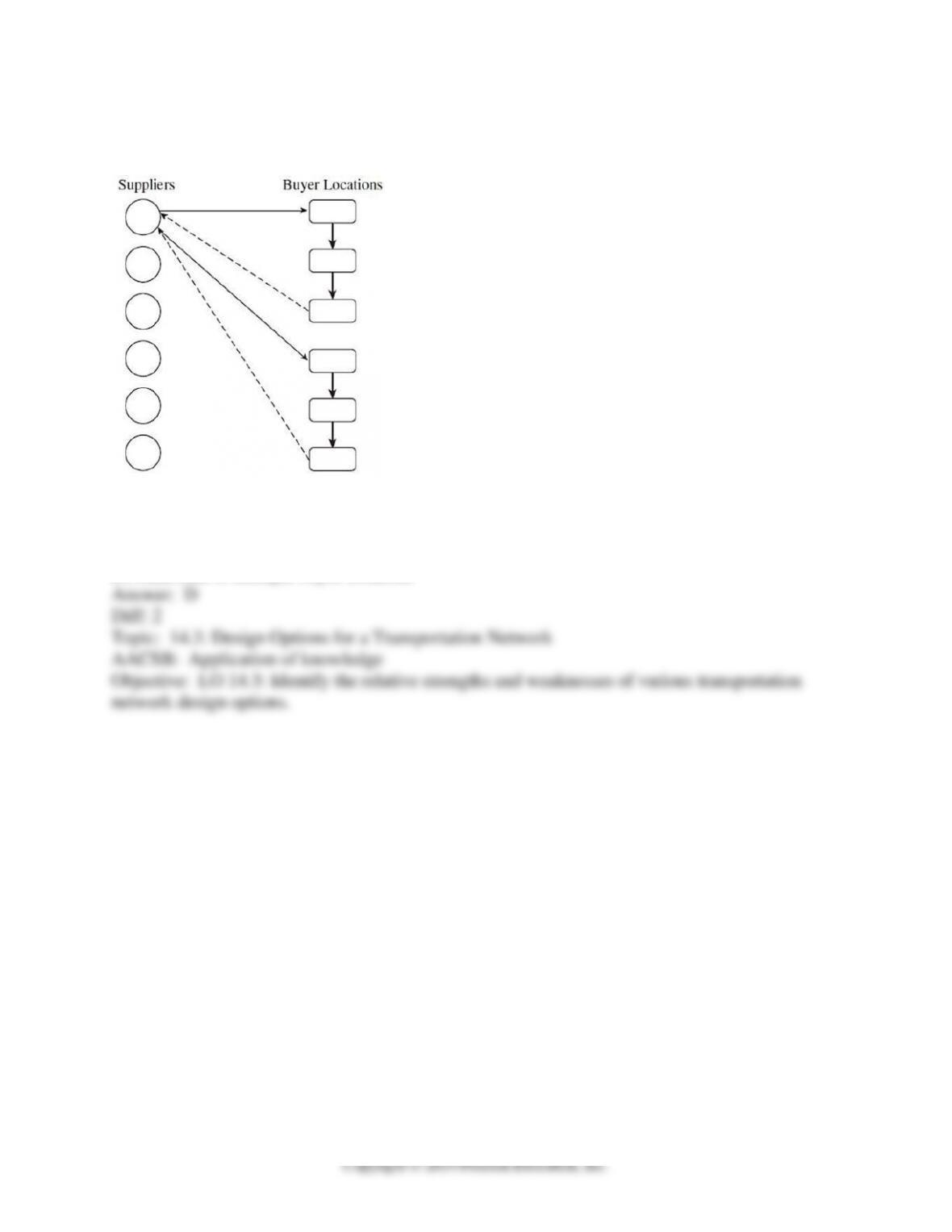
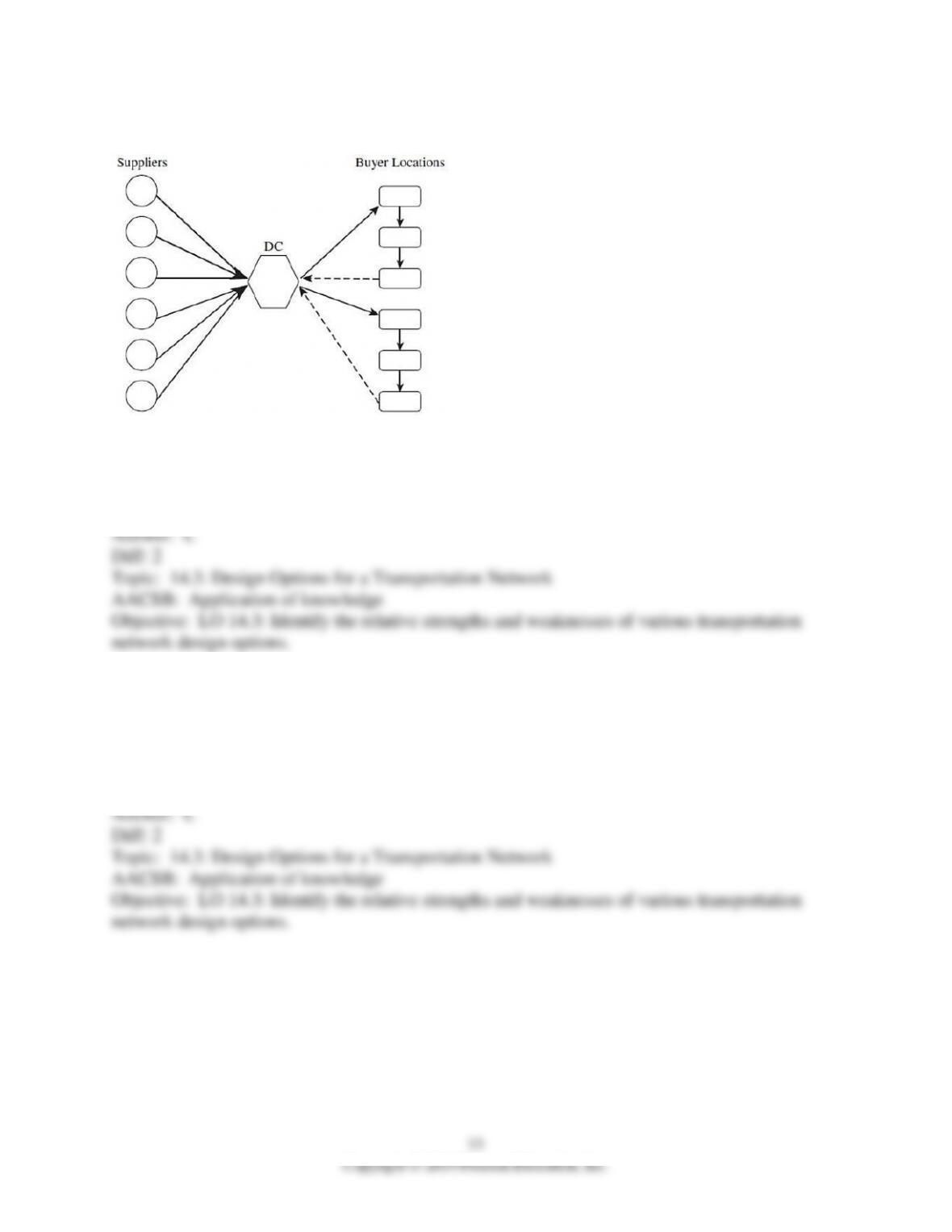
24) Which transportation network design is pictured?
A) Direct shipping network
B) Direct shipping via decentralized DCs
C) All shipments via central DC
D) Milk runs to multiple buyer locations
25) Which transportation network design is pictured?
A) Direct shipping network
B) All shipments via intermediate transit point.
C) Milk runs from a central DC
D) Distributed milk runs by multiple suppliers
26) Which transportation network design option establishes an extra layer between suppliers and
retailers to store inventory and to serve as a transfer location?
A) Direct shipping network
B) Direct shipping with milk runs
C) All shipments via central DC
D) Direct shipping
27) Which transportation network design option uses a combination of milk runs, shipping via
DC, shipping via intermediate DC with storage, and direct shipping with milk runs to reduce the
cost and improve responsiveness of the supply chain?
A) Direct shipping network
B) Direct shipping with milk runs
C) Shipping via DC using milk runs
D) Tailored network
28) Cheaper modes of transport typically have
A) shorter lead times and smaller minimum shipment quantities.
B) shorter lead times and larger minimum shipment quantities.
C) longer lead times and smaller minimum shipment quantities.
D) longer lead times and larger minimum shipment quantities.
29) The most important operational decision related to transportation in a supply chain is
A) minimizing cost of transportation.
B) maximizing profitability of the supply chain.
C) reducing the level of cycle inventory.
D) the routing and scheduling of deliveries.
30) The Mumbai dabbawalas deliver
A) bottled water.
B) home-cooked lunches.
C) prayer beads.
D) letters and legal documents.
31) The Mumbai dabbawalas perform
A) a forward logistics function.
B) a reverse logistics function.
C) both a forward and a reverse logistics function.
D) neither a forward nor a reverse logistics function.
32) At a train station where lines intersect, the Mumbai dabbawalas perform
A) a forward logistics function.
B) a reverse logistics function.
C) a milk run.
D) a cross-dock function.