38) A retailer places an order for the new Bagpipe 2018™ from the supplier and takes note of the
demand pattern. They use this knowledge of the demand to place a second order of Bagpipe
2018 from the supplier. This results in
A) a larger total order placed than when they could order only once per bagpipe season.
B) a slightly larger average overstock to be disposed of at the end of bagpipe season than when
they could order only once.
C) a lower profit than when they could order only once during bagpipe season.
D) no overstocked bagpipes at the end of the first order period.
39) As the number of order cycles per season increases,
A) the leftover inventory increases, but at a decreasing marginal rate.
B) the leftover inventory increases and at an increasing marginal rate.
C) the leftover inventory decreases, and at an increasing marginal rate.
D) the leftover inventory decreases, but at a decreasing marginal rate.
40) As the total quantity for the season is broken up into multiple smaller orders, the buyer is
better able to
A) match supply and demand and increase cost.
B) match supply and demand and increase profitability.
C) match supply and demand and decrease profitability.
D) match supply and demand and decrease product availability.
41) If quick response allows multiple orders in the season,
A) profits decrease and the overstock quantity decreases.
B) profits decrease and the overstock quantity increases.
C) profits increase and the overstock quantity decreases.
D) profits increase and the overstock quantity increases.
42) If quick response allows multiple orders in the season,
A) the manufacturer sells less to the retailer in the short term.
B) the manufacturer sells more to the retailer in the short term.
C) the manufacturer gains more supply chain surplus than the retailer.
D) the retailer must initially expend more effort for the same return.
43) There is a cost associated with postponement because the production cost using
postponement is typically
A) higher than the production cost without it.
B) lower than the production cost without it.
C) very stable.
D) equal to the production cost without it.
44) Postponement is valuable for a firm that
A) sells a large variety of products with demand that is dependent and comparable in size.
B) sells a large variety of products with demand that is independent and comparable in size.
C) sells a small variety of products with demand that is dependent and comparable in size.
D) sells a small variety of products with demand that is independent and comparable in size.
45) Postponement is
A) not very effective if a large fraction of demand comes from multiple products.
B) not very effective if a small fraction of demand comes from a single product.
C) only effective if a large fraction of demand comes from a single product.
D) effective even if a large fraction of demand comes from a single product.
46) A company with multiple products that chooses to delay product differentiation until closer
to the point of sale is using
A) tailored sourcing.
B) quick response.
C) postponement.
D) improved forecasting.
47) When a firm uses production with postponement to satisfy a part of its demand with the rest
being satisfied without postponement, it is using
A) adjustable postponement.
B) flexible postponement.
C) managed postponement.
D) tailored postponement.
48) Under tailored postponement, a firm produces the amount that is very likely to sell using
A) the lower cost production method with postponement and produces the portion of demand
that is uncertain using postponement.
B) the lower cost production method without postponement and produces the portion of demand
that is uncertain using postponement.
C) the higher cost production method with postponement and produces the portion of demand
that is uncertain using postponement.
D) the higher cost production method without postponement and produces the portion of demand
that is uncertain using postponement.
49) The value of postponement decreases as
A) uncertainty increases or demand is positively correlated among end products.
B) uncertainty increases or demand is negatively correlated among end products.
C) uncertainty decreases or demand is negatively correlated among end products.
D) uncertainty decreases or demand is positively correlated among end products.
50) ________ may reduce overall profits for a firm if a single product contributes the majority of
the demand.
A) Shortened forecasting window
B) Quick response
C) Postponement
D) Tailored sourcing
51) ________ allows a firm to increase profits and better match supply and demand if the firm
produces a large variety of products whose demand is unpredictable, not positively correlated,
and is of about the same size.
A) Shortened forecasting window
B) Quick response
C) Postponement
D) Tailored sourcing
52) Postponement may reduce overall profits for a firm if a single product contributes the
majority of the demand because
A) the increased manufacturing expense due to postponement outweighs the small benefit the
aggregation provides in this case for the dominant product.
B) the decreased manufacturing expense due to aggregation outweighs the small benefit the
postponement provides in this case for the dominant product.
C) the decreased manufacturing expense due to postponement outweighs the small benefit the
aggregation provides in this case for the dominant product.
D) the increased manufacturing expense due to aggregation outweighs the small benefit the
postponement provides in this case for the dominant product.
53) When ordering a single product, it is optimal for the buyer to order the minimum of the
available capacity and the optimal order quantity. When ordering multiple products,
A) the buyer should treat each product as a unique purchase and optimize each on an individual
basis.
B) the buyer must consider trade-offs between ordering more of one product than another.
C) the buyer should average the cost, procurement, and holding parameters and create a basket
product that consists of equal ratios of all items.
D) the buyer should construct a weighted average based on all individual item demands and
optimize this quantity.
Scenario 13.2 — Fish or Chicken
The taco stand in the atrium of the new College of Business building carried two items, fish tacos
and chicken tacos. The fish tacos sell for $15 and are made out of $5 of ingredients and the
chicken tacos sell for $10 and are made out of $4 of ingredients. Some days the taco stand owner
has only chicken at his disposal, so he makes nothing but chicken tacos, and some days the
opposite is true and he makes only fish tacos. Thus, he is able to estimate demand for chicken
tacos at 2500 per day with a standard deviation of 600 and the demand for fish tacos at 2000 per
day with a standard deviation of 500. Any fish or chicken tacos that do not sell at the end of the
day can be sold for $1 each as bait. On days when both proteins are available, the taco stand
manager prefers to make a few of each kind. All tacos are made in his home kitchen and then
transported to campus. Due to time constraints and the capacity of his pickup truck bed, he is
limited to beginning each day with only 3000 tacos.
54) Suppose the taco stand manager could wake up a little earlier and borrow his buddy’s full
size pickup to transport tacos to campus. If time and capacity were not an issue, how many total
tacos should he bring to campus each day?
A) 2500
B) 3000
C) 5041
D) 5500
55) Suppose the taco stand manager could wake up a little earlier and borrow his buddy’s full
size pickup to transport tacos to campus. If time and capacity were not an issue, what would the
expected profit be per day?
A) $29,443
B) $31,382
C) $35,000
D) $30,657
56) The taco stand manager decides to make exactly the same quantity of fish tacos as chicken
tacos. If time and capacity are not an issue, and none of the other parameters in the scenario are
changed, what would the retail price of chicken tacos need to be to make the optimal order
quantities identical?
A) $5.68
B) $5.92
C) $6.21
D) $6.47
57) Faced with a 3000 taco capacity constraint, what is the optimal number of fish tacos to
prepare?
A) 2283
B) 1736
C) 1868
D) 2000
58) Faced with a 3000 taco capacity constraint, what is the optimal number of chicken tacos to
prepare?
A) 2758
B) 1736
C) 1264
D) 2500
59) Faced with a 3000 taco capacity constraint, what is the profit resulting from an optimal mix
of fish and chicken tacos?
A) $22,577
B) $25,619
C) $24,667
D) $23,580
60) When setting optimal levels of product availability in practice, it is important to
A) obtain a reasonable estimate of the cost of stocking out.
B) obtain a very precise estimate of the cost of stocking out.
C) focus on the most responsive production method, even if it is not low cost.
D) develop a preset target of product availability.
24
13.3 Essay Questions
1) Explain the relationship between product availability and supply chain profitability.
2) Describe the two key factors that influence the optimal level of product availability within a
supply chain.
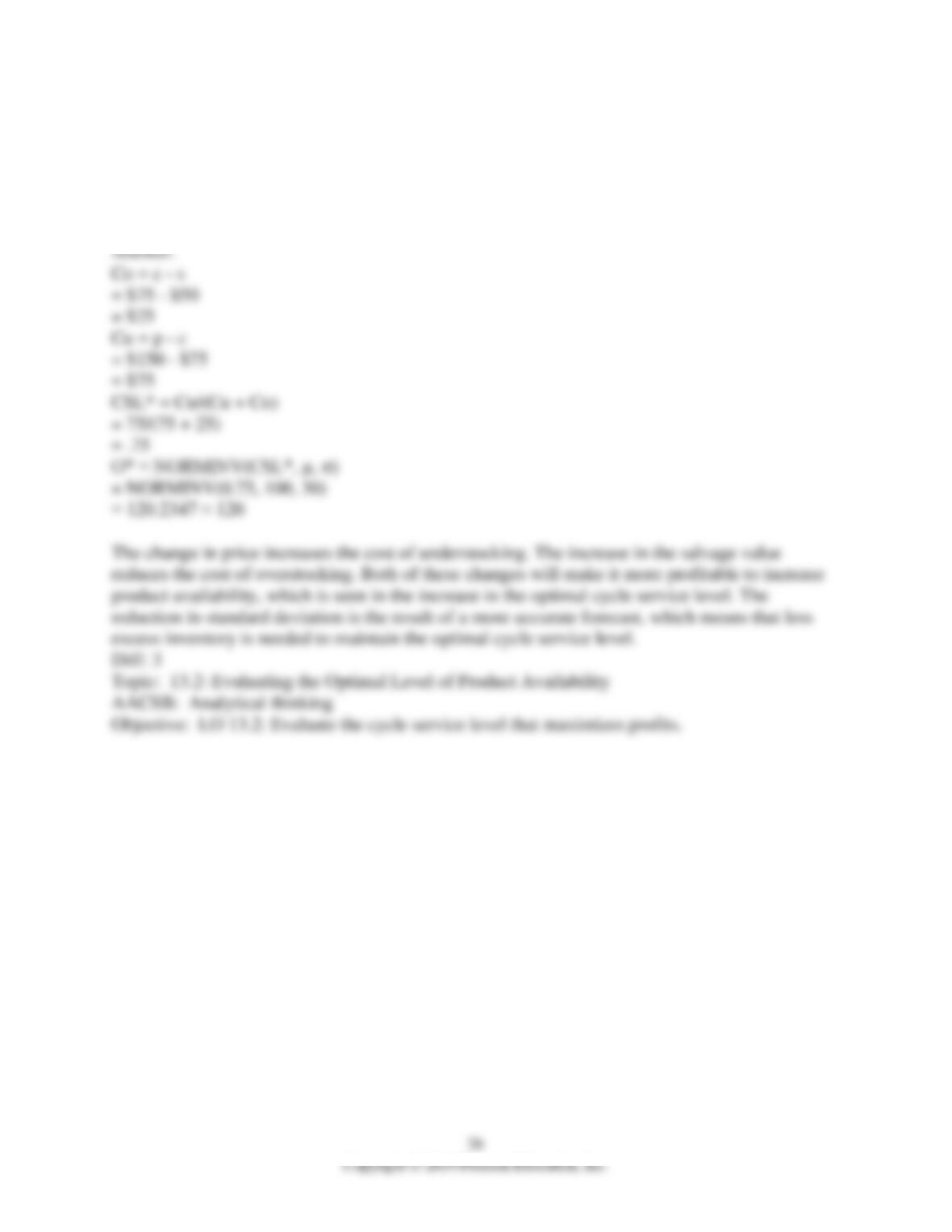
3) A manufacturer of lawn care equipment has introduced a new product. The anticipated
demand is normally distributed with a mean of μ = 100 and a standard deviation of σ = 50. Each
unit costs $75 to manufacture and the introductory price is to be $125 to achieve this level of
sales. Any unsold units at the end of the season are unlikely to be very valuable and will be
disposed of in a fire sale for $25 each. It costs $10 to hold a unit in inventory for the entire
season. What is the cost of overstocking? What is the cost of understocking? What is the optimal
cycle service level? How many units should be manufactured for sale?
Answer:
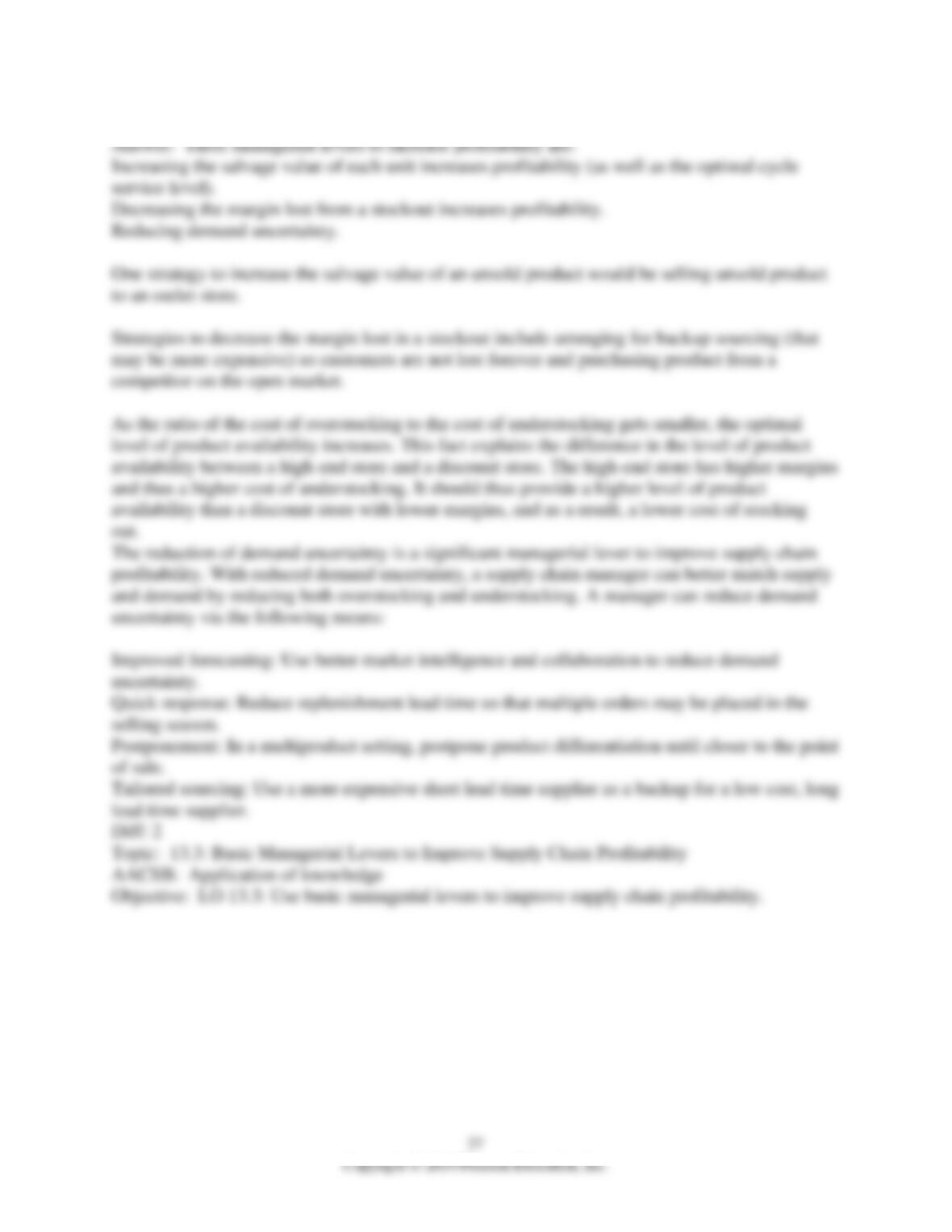
4) In the previous problem, the manufacturer performs additional market research. Based on this
research, they determine that they can increase the price to $150 and are able to reduce the
standard deviation of the forecast to σ = 30. At the same time, they have made an arrangement
with an outlet store that will purchase unsold equipment for $60 each. How will these changes
affect the cost of overstocking, cost of understocking, optimal cycle service level and optimal
order size?
5) Describe managerial levers to increase profitability within a supply chain.
6) Describe the approaches a manager can use to reduce demand uncertainty.
7) Discuss the advantages and disadvantages of quick response.
8) Explain how tailored postponement can improve profitability.
9) Explain how tailored sourcing can be used to improve profitability.