34) The expected shortage per replenishment cycle (ESC) is
A) the units of demand that are satisfied from inventory out of stock in a given replenishment
cycle.
B) the units of demand that are satisfied from inventory in stock in a given replenishment cycle.
C) the average units of demand that are not satisfied from inventory in stock per replenishment
cycle.
D) the average units of demand that are satisfied from inventory in stock per replenishment
cycle.
35) Given a lot size of Q (which is also the average demand in a replenishment cycle),
A) the fraction of demand lost is thus ESC + Q.
B) the fraction of demand lost is thus ESC – Q.
C) the fraction of demand lost is thus ESC/Q.
D) the fraction of demand lost is thus ESC × Q.
36) A shortage occurs in a replenishment cycle
A) only if the demand during the lead time exceeds the ROP.
B) only if the demand during the lead time is less than the ROP.
C) only if the demand during the lead time exceeds the average demand.
D) only if the demand during the lead time is less than the average demand.
37) Often, safety inventory calculations in practice
A) do not include any measure of supply uncertainty, resulting in levels that may be higher than
required.
B) do not include any measure of supply uncertainty, resulting in levels that may be lower than
required.
C) include measures of supply uncertainty, resulting in levels that may be higher than required.
D) include any measures of supply uncertainty, resulting in levels that may be lower than
required.
38) A(n) ________ in supply uncertainty can help ________ safety inventory required without
hurting product availability.
A) reduction; increase
B) increase; reduce
C) reduction; reduce
D) reduction; cancel
39) ________ is the ability of a supply chain to delay product differentiation or customization
until closer to the time the product is sold.
A) Specialization
B) Centralization
C) Postponement
D) Aggregation
40) Aggregation reduces the standard deviation of demand
A) only if demand across the regions being aggregated is perfectly positively correlated.
B) only if demand across the regions being aggregated is not perfectly positively correlated.
C) even if demand across the regions being aggregated is not perfectly positively correlated.
D) whenever demand across the regions being aggregated is not perfectly uncorrelated.
41) Which approach to aggregation requires an information system that allows access to current
inventory records from each location?
A) Information centralization
B) Specialization
C) Product substitution
D) Component commonality
42) Which approach to aggregation would stock the fast-moving items at decentralized locations
close to the customer and slow-moving items at a centralized location?
A) Information centralization
B) Specialization
C) Product substitution
D) Component commonality
43) The use of one product to satisfy demand for a different product is
A) information centralization.
B) specialization.
C) product substitution.
D) component commonality.
44) Which use of common components in a variety of products has been a very effective supply
chain strategy to exploit aggregation and reduce component inventories?
A) Information centralization
B) Specialization
C) Product substitution
D) Component commonality
45) The ability of a supply chain to delay product differentiation or customization until closer to
the time the product is sold is
A) information centralization.
B) specialization.
C) product substitution.
D) postponement.
46) Which approach to aggregation has the goal of moving product differentiation as close to the
pull phase of the supply chain as possible?
A) Information centralization
B) Specialization
C) Product substitution
D) Postponement
47) Periodic review policies for inventory replenishment require safety inventory to cover
demand during
A) lead time only.
B) the review interval only.
C) both lead time and the review interval.
D) neither lead time or the review interval.
48) Continuous review policies for inventory replenishment require safety inventory to cover
demand during
A) lead time only.
B) the review interval only.
C) both lead time and the review interval.
D) neither lead time or the review interval.
49) A continuous review policy dictates that
A) Q + σD units are ordered when the inventory drops to ROP.
B) Q units are ordered when the inventory drops to ROP.
C) Q + σD units are ordered at time T.
D) Q + σD units are ordered at time T + L.
50) A manager using continuous review has to account only for
A) demand variability.
B) lead time variability.
C) demand during lead time.
D) cycle service level.
51) Typically, in continuous review policies, the lot size to order
A) is not known until after the order is placed.
B) is the same as in a periodic review policy.
C) varies with the square root of demand.
D) is kept fixed between replenishment cycles.
52) In a periodic review system, the order up to level
A) equals the current inventory level plus the lot size ordered.
B) equals the current inventory level minus the lot size ordered.
C) equals the current inventory level plus the anticipated demand during lead time.
D) equals the current inventory level plus the anticipated demand during lead time plus the lot
size ordered.
53) Periodic review policies require
A) more safety inventory than continuous review policies for the same level of product
availability.
B) less safety inventory than continuous review policies for the same level of product
availability.
C) the same safety inventory as continuous review policies for the same level of product
availability.
D) no more safety inventory than continuous review policies for the same level of product
availability.
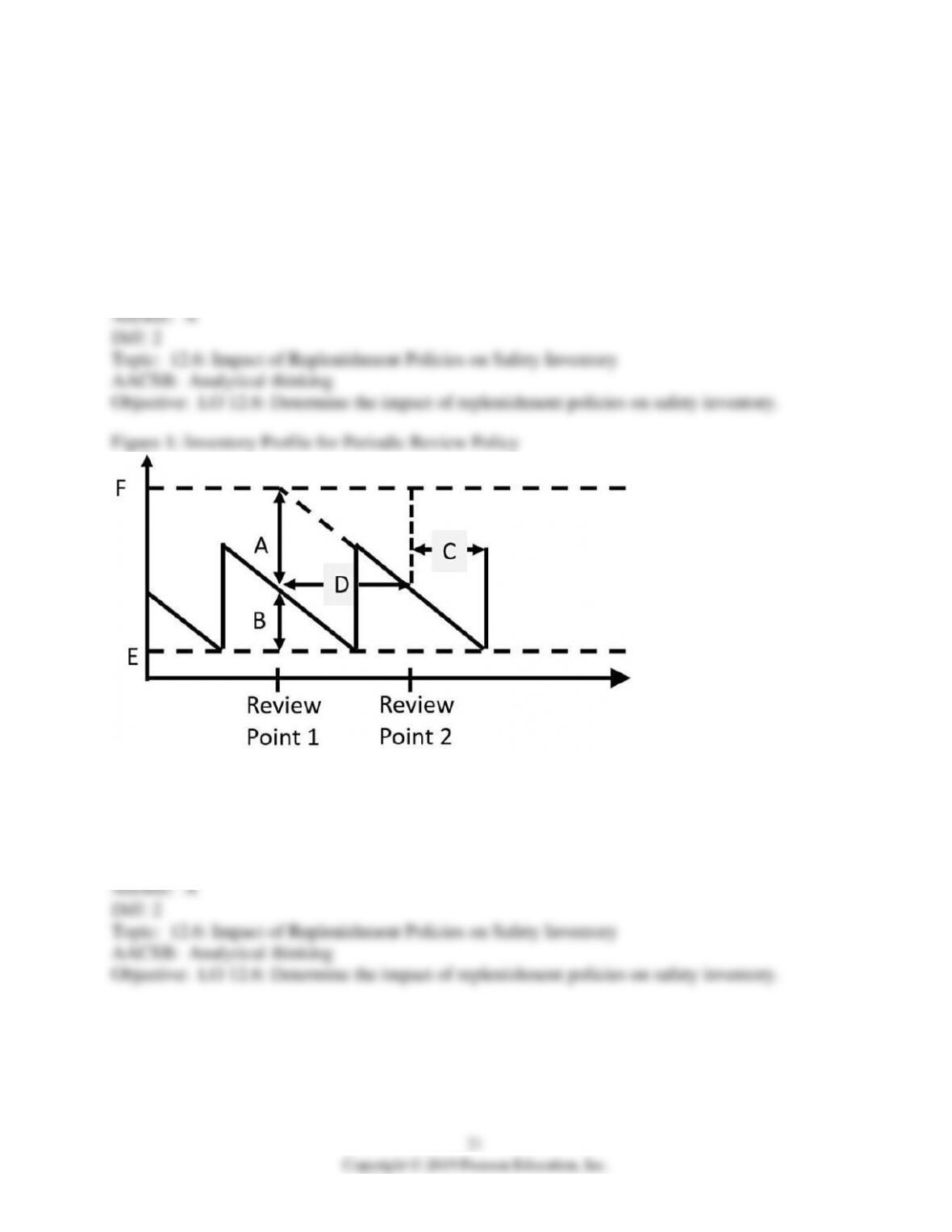
54) What does the letter F represent in Figure 1?
A) Order up to level
B) Safety inventory
C) Warehouse inventory
D) Pipeline inventory
55) What does the letter E represent in Figure 1?
A) Order up to level
B) Safety inventory
C) Warehouse inventory
D) Pipeline inventory
56) What does the distance F-E represent in Figure 1?
A) Order up to level
B) Safety inventory
C) Warehouse inventory
D) Pipeline inventory
57) What does the letter D represent in Figure 1?
A) Throughput
B) Inventory rate
C) Lead time
D) Review interval
58) What does the letter C represent in Figure 1?
A) Throughput
B) Inventory rate
C) Lead time
D) Review interval
59) What does the letter B represent in Figure 1?
A) Demand during lead time
B) Demand during review period
C) Order up to level
D) Cycle stock
60) What does the letter A represent in Figure 1?
A) Demand during lead time
B) Demand during review period
C) Order up to level
D) Cycle stock
61) All inventory between a given stage in the supply chain and the final customer is called the
A) cycle inventory.
B) demand inventory.
C) echelon inventory.
D) safety inventory.
62) A distributor should decide his safety inventory levels based on
A) the level of safety inventory carried by all retailers supplied by him.
B) the level of safety inventory carried by other distributors.
C) the level of cycle inventory carried by manufacturers supplying him.
D) the level of cycle inventory carried by all retailers supplied by him.
24
63) As retailers decrease the level of safety inventory they carry, the distributor will have to
A) decrease his or her safety inventory.
B) increase his or her safety inventory.
C) keep his or her safety inventory at the same level.
D) increase his or her cycle inventory.
64) Carrying more inventory upstream in a multiechelon supply chain
A) decreases the extent of aggregation.
B) increases the amount of inventory required.
C) reduces the amount of inventory required.
D) decreases the lead time.
65) It is better to carry more safety inventory downstream if
A) inventory is inexpensive to hold and customers are not time sensitive.
B) inventory is expensive to hold and customers are not time sensitive.
C) inventory is inexpensive to hold and customers are time sensitive.
D) inventory is expensive to hold and customers are time sensitive.
Answer: C
Diff: 2
Topic: 12.7: Managing Safety Inventory in a Multiechelon Supply Chain
AACSB: Application of knowledge
Objective: LO 12.7: Improve the management of safety inventory in a multiechelon supply
chain.
25
12.3 Essay Questions
1) Discuss the role of safety inventory in the supply chain and the trade-offs involved.
Answer: The primary role of safety inventory is providing product availability for customers
when demand and supply are uncertain. The trade-offs that a supply chain manager must
2) Discuss the various measures of product availability.
Answer: Product availability reflects a firm’s ability to fill a customer order out of available
inventory. A stockout results if a customer order arrives when product is not available. There are
several ways to measure product availability. All availability measures are defined on average
over a given time frame, which can range from hours to a year.
3) Explain the impact of supplier lead time on safety inventory.
27
4) Explain the impact of aggregation on safety inventory.
Answer: Aggregation reduces the standard deviation of demand only if demand across the
regions being aggregated is not perfectly positively correlated. Demand for most products does
5) Describe the two types of ordering policies and the impact each has on safety inventory.
Answer: A replenishment policy consists of decisions regarding when to reorder and how much
to reorder. These decisions determine the cycle and safety inventories along with the fill rate and
the CSL. There are several forms that replenishment policies may take. We restrict attention to
28
6) Weekly demand for corn tortillas at Big Truck Tacos is normally distributed with a mean of
1500 and a standard deviation of 300. Marco’s takes one and one half weeks to supply a Big
Truck order. Big Truck is targeting a CSL of 95 percent and monitors its inventory continuously.
How much safety inventory of corn tortillas should Big Truck carry? What should their ROP be?
Answer:
7) Weekly demand for 12″ hot dogs at Mutt’s Amazing Dogs is normally distributed with a mean
of 2850 and a standard deviation of 425. The store manager continuously monitors inventory and
currently orders 500 hot dogs each time the inventory drops to 6000 dogs. The manufacturer
currently takes two weeks to fill an order. How much safety inventory does the store carry?
8) Weekly demand for avocados at the Guac Shop is normally distributed with a mean of 2500
and a standard deviation of 650. The store manager has decided to follow a periodic review
policy to manage inventory of avocados. They plan to order every two weeks. The farmers
currently take two weeks to fill an order. Given a desired CSL of 97.5 percent, how much safety
inventory should the Guac Shop carry? What should their OUL be?
Answer: ss = Fs-1(CSL) × σT + L