44) In general, as the fraction of increased demand coming from forward buying grows, offering
the promotion during the peak demand period becomes
A) less attractive.
B) more attractive.
C) more profitable.
D) less significant.
45) Offering a promotion during a peak period that has significant forward buying
A) creates a desirable demand pattern.
B) creates a demand pattern less costly to serve.
C) creates a demand pattern even more costly to serve.
D) shifts demand from the peak period to the slow period.
46) Average inventory
A) increases if a promotion is run during the peak period.
B) increases if a promotion is run during the off-peak period.
C) decreases if a promotion is run during the peak period.
D) decreases if a promotion is run during the off-peak period.
47) Promoting during a peak demand month may decrease overall profitability if
A) a small fraction of the demand increase results from a forward buy.
B) any of the demand increase results from a forward buy.
C) a significant fraction of the demand increase results from a forward buy.
D) none of the above
48) As the product margin declines, promoting during the peak demand period becomes
A) less profitable.
B) more profitable.
C) less of a risk.
D) more desirable.
49) Which factor favors promotion during low-demand periods?
A) High forward buying
B) High ability to steal market share
C) High ability to increase overall market
D) High margin
50) Which factor favors promotion during low-demand periods?
A) High margin
B) High ability to steal market share
C) High ability to increase overall market
D) Low margin
21
51) Which factor favors promotion during peak-demand periods?
A) Low margin
B) Low ability to steal market share
C) High ability to increase overall market
D) High margin
The Okra Colada
An okra farm anticipates highly seasonal demand for their product, tender pods of okra that can
be made into the new drink sensation, the okra colada. Their estimate of the demand profile
appears below. This forecast is based on the demand profile of last year’s drink, the tuna colada.
Once everyone in the test market had actually sampled the drink, demand fell to zero.
Month
Demand Forecast
January
1,200
February
2,400
March
3,600
April
4,800
May
2,200
June
200
The costs for the managerial levers appear in this table.
Item
Cost
Materials cost/unit
$10
Inventory holding cost/unit/month
$2
Marginal cost of stockout/unit/month
$5
Hiring and training cost/worker
$300
Layoff cost/worker
$500
Labor hours required/unit
4
Regular time cost/hour
$4
Over time cost/hour
$6
Beginning inventory equals
1000
Ending inventory greater than
500
Marginal subcontracting cost/unit
$30
The base price per okra colada is $40 per unit and there is no promotion, but management is
seriously considering different promotional plans. The beginning workforce level is 80 workers.
52) Use the Okra Colada scenario to answer this question. What should the objective function be
when using linear programming to solve this sales and operations planning problem?
A) Minimize total cost
B) Maximize total revenue
C) Minimize total price
D) Maximize total demand
53) Use the Okra Colada scenario to answer this question. What constraints are associated with
the level of inventory at the end of each period when using linear programming to solve this
sales and operations planning problem?
A) EIJAN-MAY = 0
B) EIJUNE ≥ 500, EIJAN-MAY = 0
C) EIJAN-MAY ≥ 0
D) EIJUNE ≥ 500, EIJAN-MAY ≤0
54) Use the Okra Colada scenario to answer this question. What is the ideal workforce level
throughout January-June?
A) 84 workers
B) 80 workers
C) 57 workers
D) 53 workers
55) Use the Okra Colada scenario to answer this question. Which of the following statements is
true when using linear programming to solve this sales and operations planning problem?
A) No layoffs occur.
B) No stockouts occur.
C) No subcontracting is used.
D) No overtime is used.
56) Use the Okra Colada scenario to answer this question. What is the minimum value for the
cost of a single stockout to ensure that there are no stockouts during the six-month planning
period?
A) $15
B) $20
C) $10
D) $25
57) Use the Okra Colada scenario to answer this question. Which of the following statements is
true when using linear programming to solve this sales and operations planning problem?
A) More workers are hired than laid off.
B) More units are built using subcontracting than using overtime.
C) The number of stockouts exceeds the number of units in ending inventory from January-May.
D) The number of units subcontracted exceeds the number of stockouts that occur.
58) Use the Okra Colada scenario to answer this question. What is the optimal total cost when
using linear programming to solve this sales and operations planning problem?
A) $424,140
B) $414,240
C) $400,340
D) $434,040
25
59) Use the Okra Colada scenario to answer this question. What is the optimal profit when using
linear programming to solve this sales and operations planning problem?
A) $159,330
B) $183,440
C) $167,550
D) $175,660
The Tuna Colada
A fishing consortium anticipates highly seasonal demand for their product, yellowtail tuna steaks
that can be made into the new drink sensation, the tuna colada. Their estimate of the demand
profile appears below. This forecast is based on the demand profile of last year’s drink, the okra
colada with one key difference. The tuna colada is being positioned as a healthier alternative to
eggnog, so demand is expected to climb throughout the planning period with a peak in
December.
Month
Demand Forecast
July
1,560
August
2,200
September
2,850
October
3,440
November
4,020
December
5,280
The costs for the managerial levers appear in this table.
Item
Cost
Materials cost/unit
$10
Inventory holding cost/unit/month
$4
Marginal cost of stockout/unit/month
$12
Hiring and training cost/worker
$200
Layoff cost/worker
$800
Labor hours required/unit
3
Regular time cost/hour
$16
Over time cost/hour
$24
Period beginning inventory equals
0
Period ending inventory equals
0
Marginal subcontracting cost/unit
$80
The base price per tuna colada is $75 and there is currently no promotion, hence, no forward
buying, but management is seriously considering different promotional plans. The beginning
workforce level is 80 employees.
60) Use the Tuna Colada scenario to answer this question. If this problem is to be solved using
linear programming, how should the objective function read?
A) Minimize total cost
B) Maximize total revenue
C) Minimize total price
D) Maximize total demand
61) Use the Tuna Colada scenario to answer this question. If this problem is solved using linear
programming, which of these parameters equals 0 in an optimal solution?
A) Layoff cost per worker
B) Number of units made using overtime
C) Number of workers laid off
D) Number of units made using subcontracting
62) Use the Tuna Colada scenario to answer this question. If this problem is solved using linear
programming, what is the maximum possible profit?
A) $61,370
B) $34,260
C) -$21,070
D) -$34,260
63) Use the Tuna Colada scenario to answer this question. If this problem is solved using linear
programming, which of these statements is best?
A) The workforce rises and then falls as the period moves from July to December.
B) There are more units made using overtime than there are instances of stocking out.
C) Inventory is at its peak during the month of September.
D) There are more units made by subcontracting than there are workers laid off throughout the
planning period.
64) Use the Tuna Colada scenario to answer this question. If this problem is solved using linear
programming, what is the minimum possible cost that still permits the planners to meet demand?
A) $1,472,320
B) $1,451,250
C) $1,443,680
D) $1,430,120
65) Use the Tuna Colada scenario to answer this question. What is the minimum value the cost
of subcontracting must have to ensure that it is not used during the planning period?
A) $110 per unit
B) $107 per unit
C) $104 per unit
D) $101 per unit
66) Use the Tuna Colada scenario to answer this question. Suppose a promotion in month 1
results in 10% consumption and a 20% forward buy. What is the maximum profit possible
throughout the planning period?
A) -$11,588
B) $15,974
C) -$17,548
D) $23,462
67) Use the Tuna Colada scenario to answer this question. Suppose a promotion in month 1
results in 10% consumption and a 20% forward buy. What is the peak level of inventory during
the six-month planning period?
A) 1,220 units in August
B) 1,020 units in September
C) 940 units in August
D) 1,380 units in September
9.3 Essay Questions
1) Discuss how a firm can respond to predictable variability of demand in the supply chain.
31
2) Discuss the approaches that can be used to manage capacity to meet predictable variability of
demand.
Answer: When managing capacity to meet predictable variability, firms use a combination of
the following approaches:
the face of predictable variability.
3) Discuss the approaches a firm can use to manage inventory to meet predictable variability of
demand.
4) Discuss the importance of collaboration within a supply chain when performing aggregate
planning.
5) Discuss the impact of promotion on demand within a supply chain.
34
6) Discuss key issues when managing predictable variability of demand within a supply chain.
Answer: Coordinate planning across enterprises in the supply chain. For a supply chain to
successfully manage predictable variability, the entire chain must work toward the one goal of
maximizing profitability. Everyone in a supply chain may agree with this in principle, but in
35
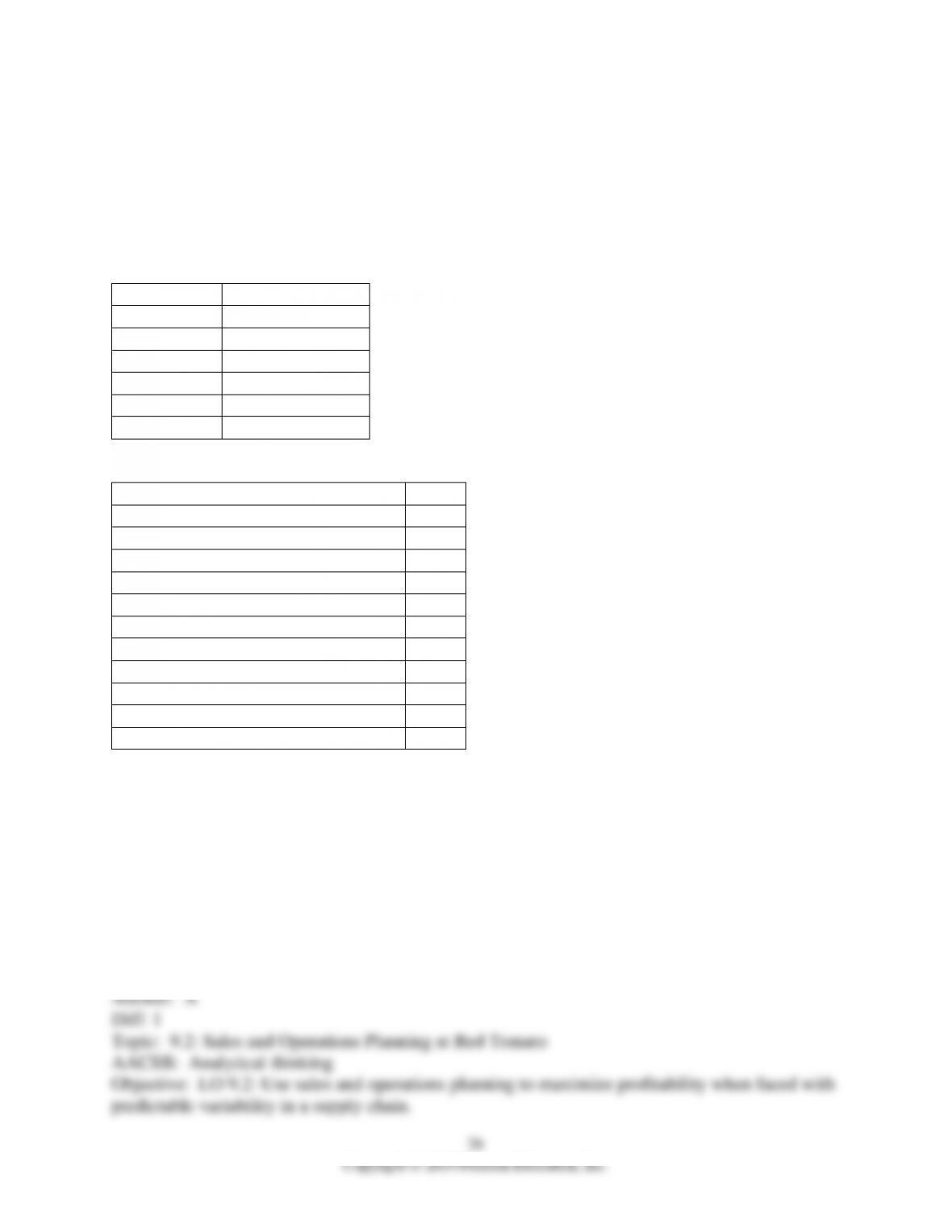
7) An okra farm anticipates highly seasonal demand for their product, tender pods of okra that
can be made into the new drink sensation, the okra colada. Their estimate of the demand profile
appears below. This forecast is based on the demand profile of last year’s drink, the tuna colada.
Once everyone in the test market had actually sampled the drink, demand fell to zero.
Month
Demand Forecast
January
1,200
February
2,400
March
3,600
April
4,800
May
2,200
June
200
The costs for the managerial levers appear in this table.
Item
Cost
Materials cost/unit
$10
Inventory holding cost/unit/month
$2
Marginal cost of stockout/unit/month
$5
Hiring and training cost/worker
$300
Layoff cost/worker
$500
Labor hours required/unit
4
Regular time cost/hour
$4
Over time cost/hour
$6
Beginning inventory equals
1000
Ending inventory greater than
500
Marginal subcontracting cost/unit
$30
With a base price of $40 per bushel of okra and no promotion, what is the optimal sales and
operations plan? Assume that the beginning workforce level is set at 80 workers.
36
Copyright © 2019 Pearson Education, Inc.
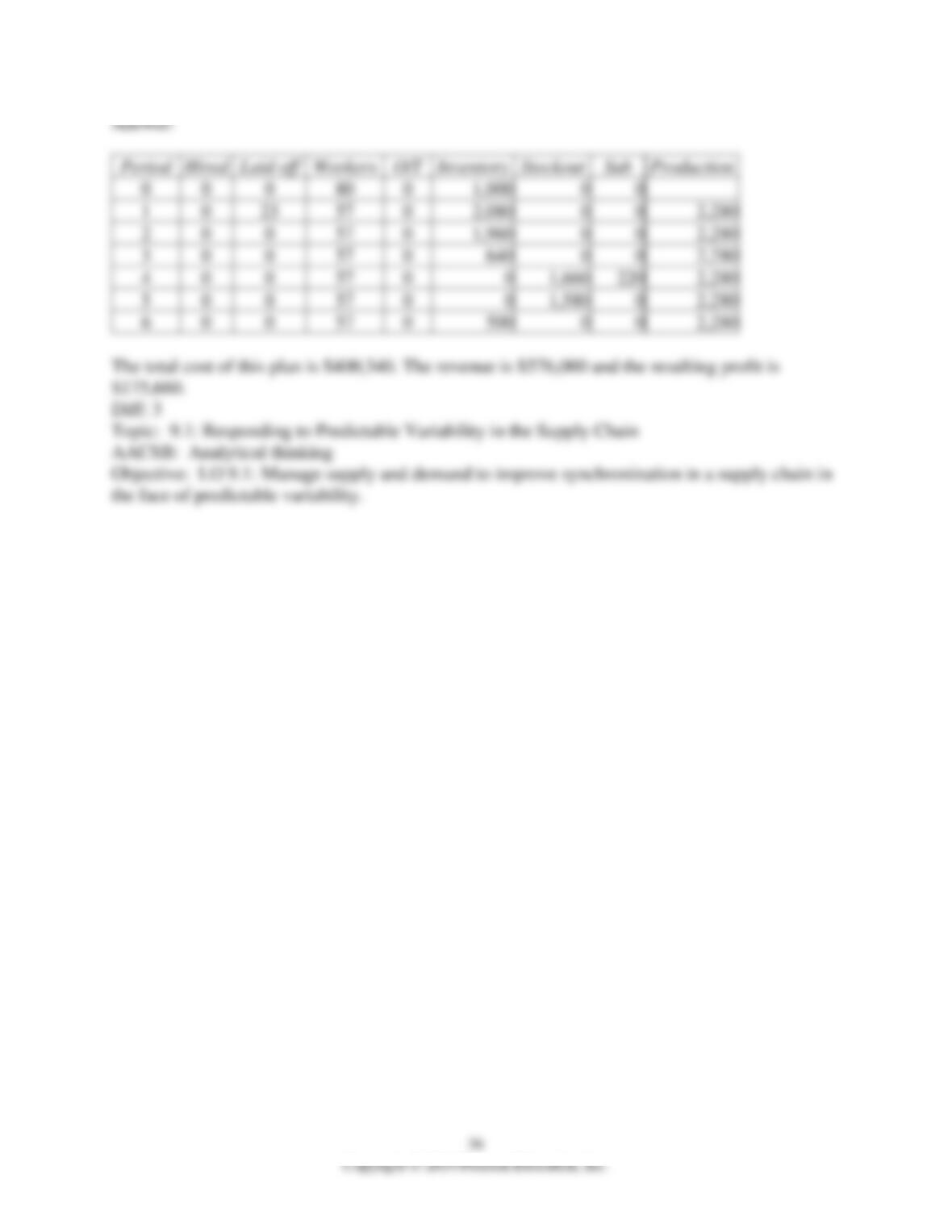
Answer:
Period
Hired
Laid off
Workers
O/T
Inventory
Stockout
Sub
Production
0
0
0
80
0
1,000
0
0
1
0
23
57
0
2,080
0
0
2,280
2
0
0
57
0
1,960
0
0
2,280
3
0
0
57
0
640
0
0
2,280
4
0
0
57
0
0
1,660
220
2,280
5
0
0
57
0
0
1,580
0
2,280
6
0
0
57
0
500
0
0
2,280
The total cost of this plan is $400,340. The revenue is $576,000 and the resulting profit is
$175,660.
Diff: 3
Topic: 9.1: Responding to Predictable Variability in the Supply Chain
AACSB: Analytical thinking
Objective: LO 9.1: Manage supply and demand to improve synchronization in a supply chain in
the face of predictable variability.