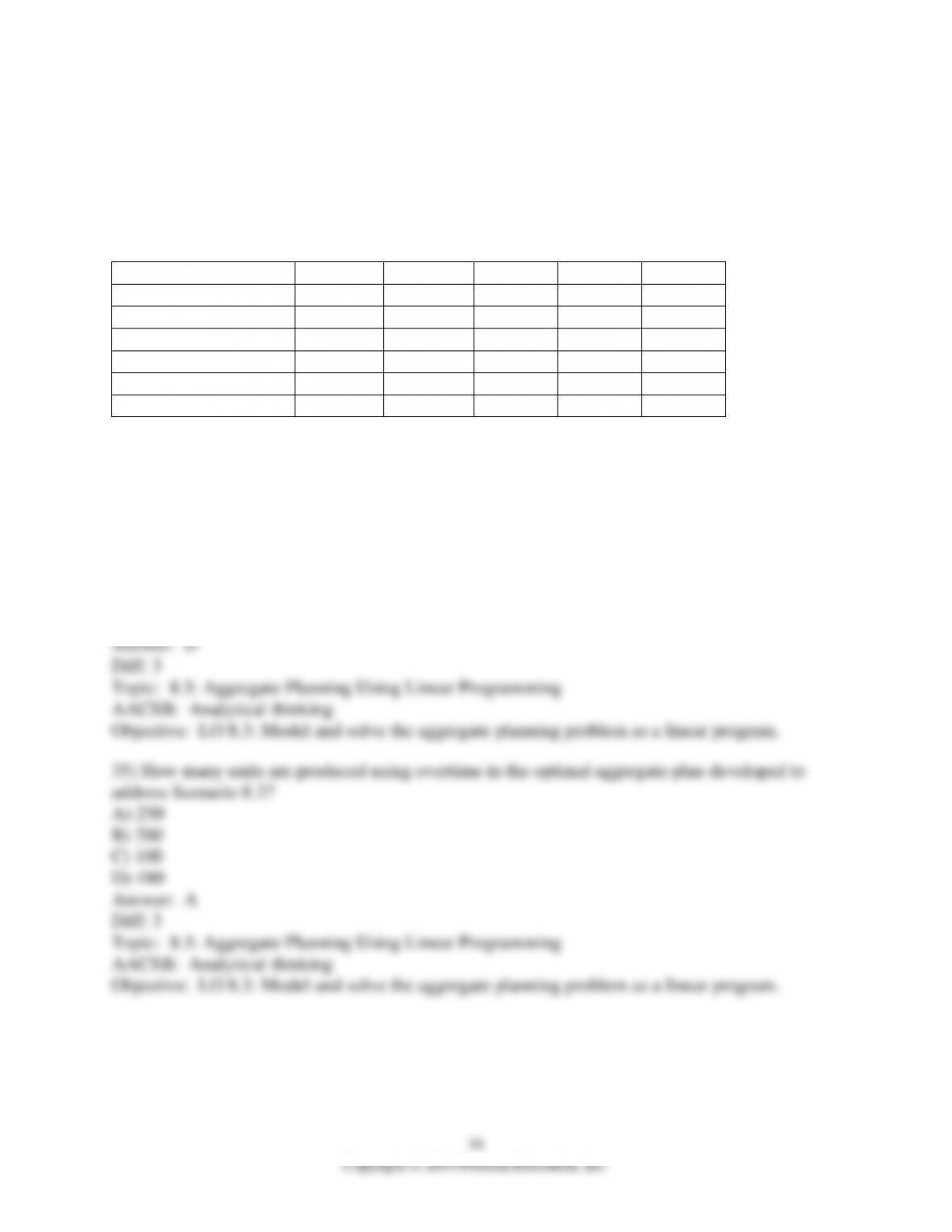
Scenario 8.3 — Mousetraps
A company faces the aggregate planning problem shown in the table below. Cost of regular
production is $15 per unit, the cost of producing the same unit on overtime is $22.50, the cost of
subcontracting is $27 per unit, and the cost of carrying a unit in inventory from one month to the
next is $10.
July
August
September
October
November
Forecast
800
650
450
550
900
Beginning Inventory
140
Regular Time
Overtime
Subcontracting
Ending Inventory
The labor contract at the plant prohibits both overtime and subcontracting output to exceed 250
units in any five-month window. The plant capacity is 20 units per day produced using two shifts
and the plant runs seven days a week. By policy, management wants to avoid stockouts.
34) What is the optimal total cost of the aggregate plan developed to address Scenario 8.3?
A) $47,200
B) $49,960
C) $50,400
D) $51,325
36) How many units are produced using subcontracting in the optimal aggregate plan developed
to address Scenario 8.3?
A) 200
B) 50
C) 100
D) 150
37) Which month has a positive ending inventory for the optimal aggregate plan for Scenario
8.3?
A) August
B) September
C) October
D) November
38) Which is the first month that overtime is used for the optimal aggregate plan for Scenario
8.3?
A) July
B) August
C) September
D) October
39) Which month is less than 100% of regular capacity used for the optimal aggregate plan for
Scenario 8.3?
A) 100% of regular capacity is always used.
B) August
C) September
D) October
40) Suppose management decides to relax the policy about stockouts on a month-to-month basis.
Instead, they just want to make sure that they end the entire five-month planning period with a
zero balance on inventory. They have never worked this way before and don’t have an idea what
it costs to stockout, so they assign a value of $0 for each unit stocked out. What is the optimal
planning period cost?
A) $42,520
B) $45,220
C) $40,225
D) $42,250
41) What is the name of the plan that breaks apart the aggregate plan into distinct product
families?
A) Rough master production schedule
B) Rough cut capacity plan
C) SKU aggregate plan
D) Process plan
42) What information does a master production schedule provide that an aggregate plan does
not?
A) Expense information for the planning period
B) Revenue information for the planning period
C) Specific product family production information
D) A specific machine schedule for each order
43) When formulating aggregate plans,
A) forecast errors have no impact.
B) forecast errors must be taken into account.
C) forecast accuracy is assumed.
D) forecast accuracy is not a factor.
44) Forecasting errors are dealt with using
A) safety backlog.
B) safety capacity.
C) safety inventory.
D) B and C only
45) Inventory held to satisfy demand that is higher than forecasted is
A) safety backlog.
B) safety capacity.
C) safety inventory.
D) safety sales.
46) Capacity used to satisfy demand that is higher than forecasted is
A) safety backlog.
B) safety capacity.
C) safety inventory.
D) safety sales.
47) Which of the following is an approach a company can use to create a buffer for forecast error
using safety inventory?
A) Overtime
B) Carry extra workforce permanently
C) Build and carry extra inventories
D) Subcontracting
48) The earliest supply chain software products were
A) aggregate planning modules.
B) cloud-based.
C) SaaS (software as a service).
D) enterprise resource planning modules.
49) Advanced planning systems for aggregate planning rely heavily on ________ to deliver their
full potential.
A) forecasting
B) the supply chain
C) constraints
D) data accuracy
50) Which of these software vendors offer advanced planning systems?
A) SAP
B) Solver
C) Excel
D) Google
51) The quality of the aggregate plan can be improved by using information from
A) only the local firm.
B) only downstream partners.
C) only upstream partners.
D) all parts of the supply chain.
52) The quality of the forecast can be improved by using information from
A) the focal firm.
B) downstream partners.
C) upstream partners.
D) competing supply chains.
53) The aggregate plan should be communicated to
A) only the local firm.
B) only downstream partners.
C) only upstream partners.
D) all supply chain partners who will be affected by it.
54) The aggregate plan needs to
A) be a final product because changes are disruptive to the supply chain.
B) be considered fixed because forecasts are usually accurate.
C) have some flexibility built into it because forecasts are always wrong.
D) have some flexibility built into it because forecasts are usually right.
55) How frequently should the aggregate plan be rerun?
A) Weekly
B) Monthly
C) Every 3 to 8 months
D) As inputs to the aggregate plan change
56) As capacity utilization increases,
A) it becomes less important to perform aggregate planning.
B) it becomes more important to perform aggregate planning.
C) it does not affect the importance of performing aggregate planning.
D) it lessens the importance of aggregate planning.
57) One drawback of advanced planning systems is that
A) a small change in input data can result in radically different production plans.
B) the amount of computing power necessary requires a substantial source of electricity.
C) the amount of computing power requires significant cloud storage.
D) the technical expertise to operate most systems requires an advanced degree.
58) As a general rule, advanced planning systems rely on
A) game theory.
B) simulation.
C) nonlinear programming.
D) linear approximations of nonlinear functions.
59) The success of advanced planning systems is highly dependent on
A) access to the cloud.
B) operating system.
C) data quality.
D) power structure.
8.3 Essay Questions
1) Discuss the primary objective and operational parameters of aggregate planning.
2) Discuss the information required for aggregate planning.
26
3) Explain the basic strategies that an aggregate planner has available to balance the various
costs and meet demand.
Answer: There are essentially three distinct aggregate planning strategies for achieving balance
between these costs. These strategies involve trade-offs between capital investments, workforce
size, work hours, inventory, and backlogs/lost sales. Most strategies that a planner actually uses
are a combination of these three and are referred to as mixed strategies. The three strategies are
27
Scenario 8.1 — Gang Aft Agley
Gang Aft Agley, a manufacturing company, faces the aggregate planning problem shown in the
table below. Cost of regular production is $5 per unit, the cost of producing the same unit on
overtime is $7.50, the cost of subcontracting is $9 per unit, and the cost of carrying a unit in
inventory from one month to the next is $2.
January
February
March
April
May
Forecast
500
750
1200
650
300
Beginning Inventory
100
Regular Time
Overtime
Subcontracting
Ending Inventory
The labor contract at the plant prohibits both overtime and subcontracting output to exceed 300
units in any five month window. The plant capacity is 600 units per month produced using two
shifts, regardless of the number of days in a month. By policy, management wants to avoid
stockouts.
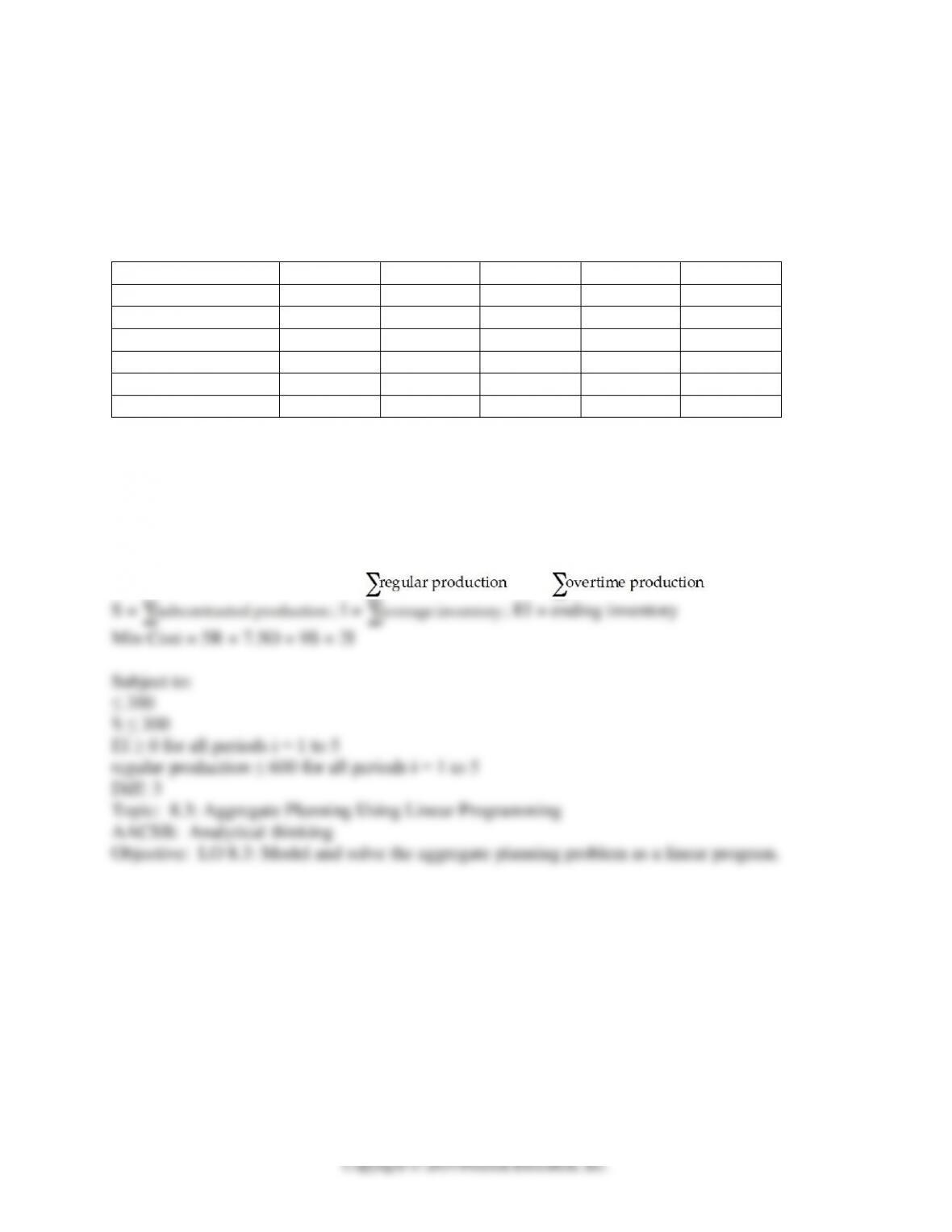
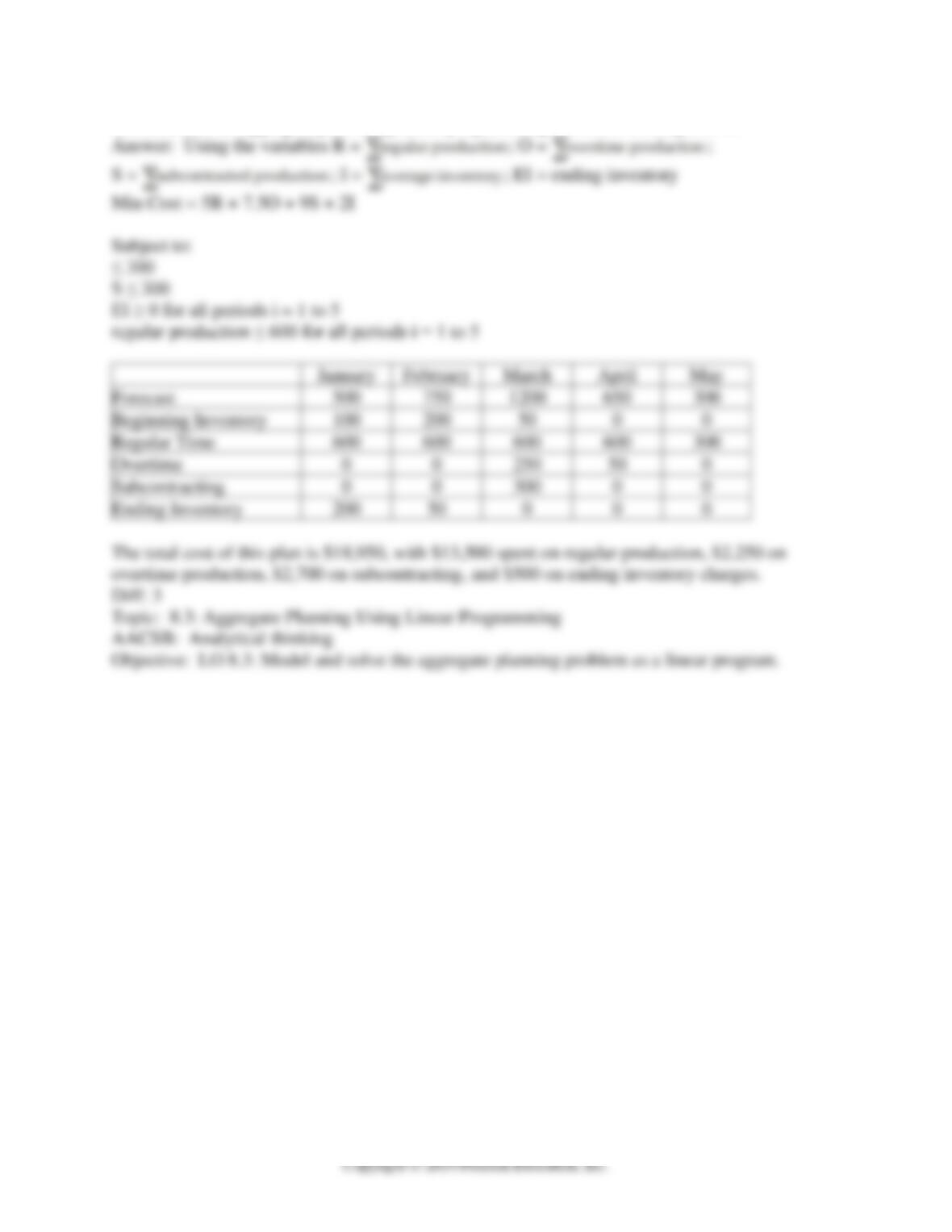
4) Formulate the aggregate plan using linear programming.
Answer: Using the variables R = ; O = ;
28
5) Formulate the aggregate plan using linear programming and solve it using Solver.
Scenario 8.3 — Mousetraps
A company faces the aggregate planning problem shown in the table below. Cost of regular
production is $15 per unit, the cost of producing the same unit on overtime is $22.50, the cost of
subcontracting is $27 per unit, and the cost of carrying a unit in inventory from one month to the
next is $10.
July
August
September
October
November
Forecast
800
650
450
550
900
Beginning Inventory
140
Regular Time
Overtime
Subcontracting
Ending Inventory
The labor contract at the plant prohibits both overtime and subcontracting output to exceed 250
units in any five-month window. The plant capacity is 20 units per day produced using two shifts
and the plant runs seven days a week. By policy, management wants to avoid stockouts.
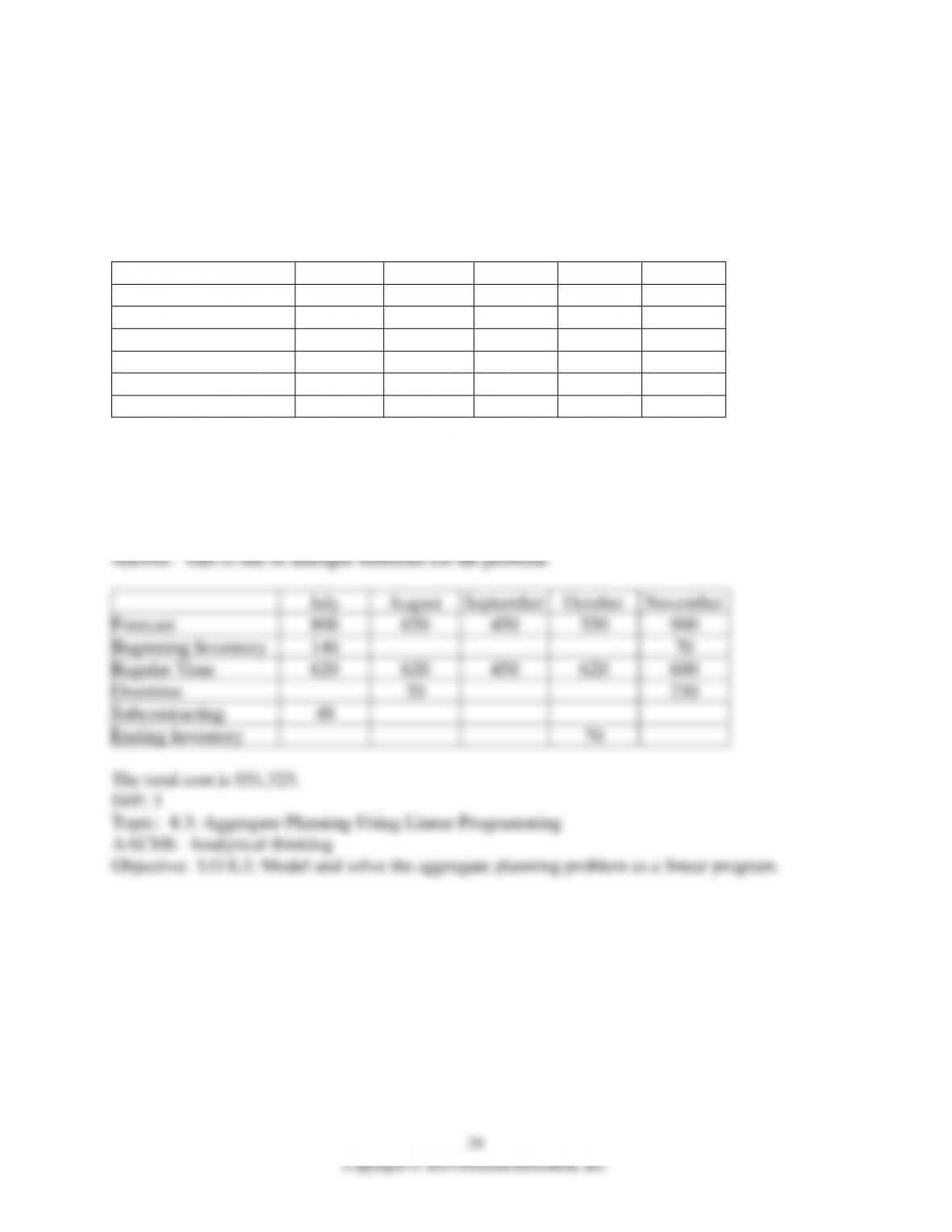
6) Develop an aggregate plan for this scenario and solve it using Solver.
July
August
Forecast
800
650
450
550
900
Beginning Inventory
140
Regular Time
620
620
450
620
600
Overtime
230
Subcontracting
Ending Inventory