Supply Chain Management: Strategy, Planning, and Operation, 7e (Chopra)
Chapter 8 Aggregate Planning in a Supply Chain
8.1 True/False Questions
1) The goal of aggregate planning is to satisfy demand in a way that minimizes profit.
2) Aggregate planning is a process by which a company determines levels of capacity,
production, subcontracting, inventory, stockouts, and even pricing over a specified time horizon.
3) Traditionally, much of aggregate planning is focused within an enterprise and may not always
be seen as a part of supply chain management.
4) Short-term production serves as a broad blueprint for operations and establishes the
parameters within which aggregate planning decisions are made.
5) The aggregate planning problem is concerned with determining the production level,
inventory level, and capacity level (internal and outsourced) for each period that maximizes the
firm’s profit over the planning horizon.
6) To create an aggregate plan, a company must specify the planning horizon for the plan and the
duration of each period within the planning horizon.
7) The goal of aggregate planning is to build a plan that satisfies demand while minimizing
downtime.
8) An aggregate plan can be used to determine whether a company needs to hire or lay off
workers.
9) As inputs into the aggregate plan change, managers do not need to make changes to the
aggregate plan.
10) As capacity utilization increases, it becomes less important to perform aggregate planning.
11) An aggregate planning horizon is usually between three and five years.
12) A poor aggregate plan may result in a large amount of excess inventory and capacity, thereby
raising costs.
13) The aggregate planner must make a trade-off between capacity, inventory, and backlog costs.
14) A chase strategy for aggregate planning synchronizes production rate with the demand rate.
15) Most strategies that an aggregate planner actually uses are in combination, and are referred to
as hybrid strategies.
16) Linear programming finds the solution for an aggregate plan that creates the highest profit
while satisfying the constraints that a company faces.
17) A linear programming formulation of an aggregate plan would typically have a different
decision variable for per unit material cost and labor’s hourly wage.
18) A linear programming formulation of an aggregate plan would typically use a constraint to
limit the number of units produced using overtime or subcontracting labor.
19) Breaking an aggregate plan into separate plans for each product creates a master production
schedule.
20) To improve the quality of aggregate plans, forecast errors must be taken into account when
formulating aggregate plans.
21) Forecasting errors are dealt with in aggregate plans using either safety backlog or safety
capacity.
22) Safety inventory is defined as inventory held to satisfy demand that is higher than forecasted.
23) Safety capacity is defined as capacity used to satisfy demand that is lower than forecasted.
24) Companies should work with downstream partners to produce forecasts and with upstream
partners to determine constraints when doing aggregate planning.
25) Given that forecasts are always wrong to some degree, the aggregate plan needs to have
some flexibility built into it if it is to be useful.
1) The process by which a company determines levels of capacity, production, subcontracting,
inventory, stockouts, and even pricing over a specified time horizon is
A) aggregate planning.
B) detail planning.
C) inventory planning.
D) sales planning.
2) The goal of aggregate planning is to
A) maximize the amount of inventory.
B) satisfy customers in a way that minimizes production.
C) satisfy demand in a way that maximizes profit.
D) maximize the amount of product shipped.
3) Aggregate planning solves problems involving
A) aggregate decisions and stock keeping unit (SKU) level decisions.
B) aggregate decisions or stock keeping unit (SKU) level decisions.
C) aggregate decisions rather than stock keeping unit (SKU) level decisions.
D) stock keeping unit (SKU) level decisions rather than aggregate decisions.
4) Aggregate planning, to be effective, requires inputs from
A) all customers.
B) all departments.
C) all suppliers.
D) throughout the supply chain.
5) Much of aggregate planning has traditionally been focused
A) on short-term production scheduling.
B) on customer relationship management.
C) within an enterprise.
D) beyond enterprise boundaries.
6) The operational parameter concerned with the number of units completed per unit time (such
as per week or per month) is
A) production rate.
B) workforce.
C) overtime.
D) backlog.
7) The operational parameter concerned with the number of workers/units of capacity needed for
production is
A) production rate.
B) workforce.
C) overtime.
D) backlog.
8) The operational parameter concerned with the planned inventory carried over the various
periods in the planning horizon is
A) production rate.
B) overtime.
C) backlog.
D) inventory on hand.
9) Aggregate planning is concerned with determining
A) the production level, sales level, and capacity for each period.
B) the demand level, inventory level, and capacity for each period.
C) the production level, inventory level, and capacity for each period.
D) the production level, forecast errors, and capacity for each period.
10) The planning horizon is
A) the time period over which the aggregate plan is to produce a solution.
B) the duration of each time period in the aggregate plan.
C) the length of time required to produce the aggregate plan.
D) the solution to the aggregate plan.
11) The length of the planning horizon in aggregate planning is usually between
A) one and three months.
B) three and eighteen months.
C) one and three years.
D) three and five years.
12) An aggregate planner requires information on constraints. Which of the following is one of
the typical constraints for an aggregate planner?
A) Inventory holding cost
B) Labor/machine hours required per unit
C) Stockout or backlog cost
D) Limits on overtime
13) ________ is used to determine customer service levels.
A) Inventory held
B) Backlog/stockout quantity
C) Workforce hired/laid off
D) Machine capacity increase/decrease
14) A poor aggregate plan can result in
A) appropriate inventory levels.
B) efficient use of capacity.
C) better sales and lost profits.
D) lost sales and lost profits.
15) Aggregate planning should consider information from
A) only the enterprise as its breadth of scope.
B) downstream partners to produce forecasts.
C) upstream partners to determine constraints.
D) all of the above
16) The fundamental trade-offs available to an aggregate planner are between
A) capability, inventory, and backlog costs.
B) capability, inventory, and sales costs.
C) capacity, inventory, and backlog costs.
D) capacity, inventory, and sales costs.
17) The strategy where the production rate is synchronized with the demand rate by varying
machine capacity or hiring and laying off employees as the demand rate varies is the
A) adjustable strategy.
B) chase strategy.
C) level strategy.
D) mixed strategy.
18) The strategy where workforce (capacity) is kept stable but the number of hours worked is
varied over time in an effort to synchronize production with demand is the
A) flexibility strategy.
B) chase strategy.
C) level strategy.
D) mixed strategy.
19) The strategy where a stable machine capacity and workforce are maintained with a constant
output rate, with inventory levels fluctuating over time, is the
A) adjustable strategy.
B) chase strategy.
C) level strategy.
D) mixed strategy.
20) Demand is forecast for the next five months as 200, 300, 500, 300, 200. The production
planner decides to adopt a level strategy, so over the next five months they should produce
A) 200, 300, 500, 300, 200.
B) 500, 400, 300, 200, 100.
C) 100, 200, 300, 400, 500.
D) 300, 300, 300, 300, 300.
21) Demand is forecast for the next five months as 200, 300, 500, 300, 200. The production
planner decides to adopt a chase strategy, so over the next five months they should produce
A) 200, 300, 500, 300, 200.
B) 500, 400, 300, 200, 100.
C) 100, 200, 300, 400, 500.
D) 300, 300, 300, 300, 300.
11
22) Most strategies that an aggregate planner actually uses are in combination and are referred to
as the
A) adjustable strategy.
B) chase strategy.
C) level strategy.
D) mixed strategy.
23) A highly effective tool for a company to use when it tries to maximize profits while being
subjected to a series of constraints is
A) aggregate programming.
B) distribution programming.
C) production programming.
D) linear programming.
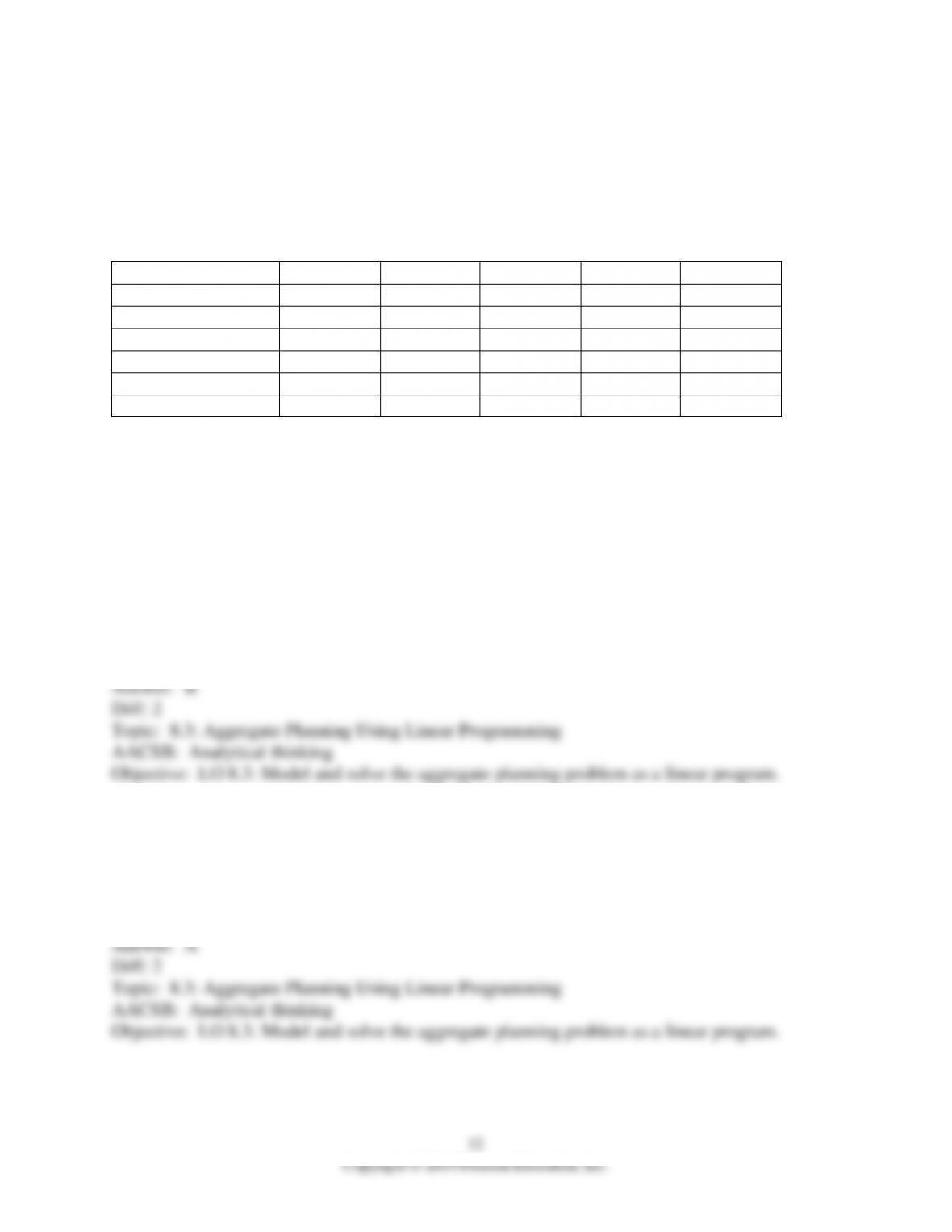
Scenario 8.1 — Gang Aft Agley
Gang Aft Agley, a manufacturing company, faces the aggregate planning problem shown in the
table below. Cost of regular production is $5 per unit, the cost of producing the same unit on
overtime is $7.50, the cost of subcontracting is $9 per unit, and the cost of carrying a unit in
inventory from one month to the next is $2.
January
February
March
April
May
Forecast
500
750
1200
650
300
Beginning Inventory
100
Regular Time
Overtime
Subcontracting
Ending Inventory
The labor contract at the plant prohibits both overtime and subcontracting output to exceed 300
units in any five month window. The plant capacity is 600 units per month produced using two
shifts, regardless of the number of days in a month. By policy, management wants to avoid
stockouts.
24) Use the information from Scenario 8.1 to determine the number of decision variables in this
scenario.
A) 10
B) 15
C) 20
D) 24
25) Use the information from Scenario 8.1 to determine the number of constraints in this
scenario.
A) 12
B) 15
C) 20
D) 24
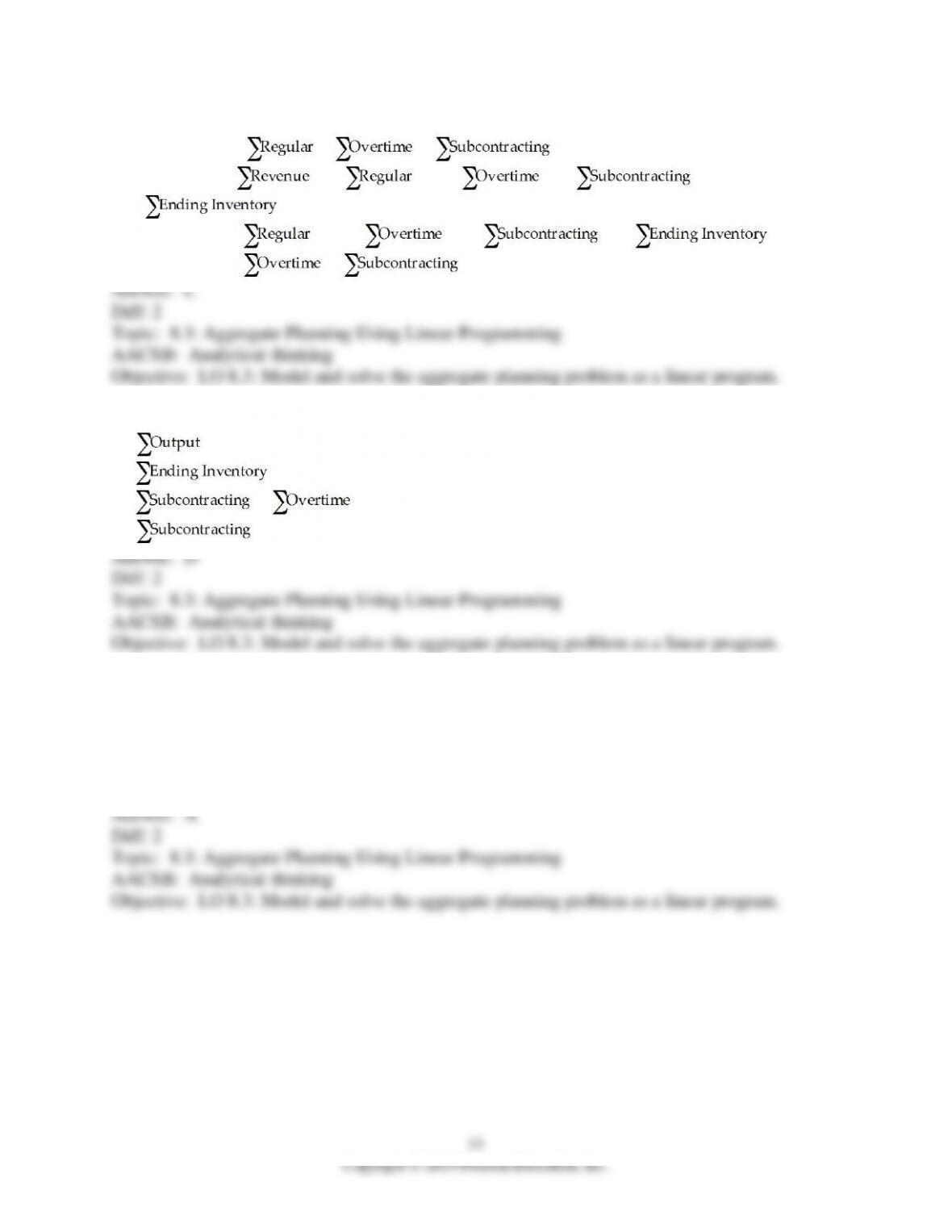
26) Use the information from Scenario 8.1 to determine the objective function for this scenario.
A) Max Output = + +
B) Max Profit = – $5 – $7.5 – $9 –
$2
C) Min Cost = $5 + $7.5 + $9 + $2
D) Min Output = +
27) Which of these is a constraint that is appropriate for Scenario 8.1?
A) ≥ 680
B) ≤ 0
C) + ≤ 300
D) ≤ 300
28) Which of these statements about Scenario 8.1 is evident without even developing an
aggregate plan?
A) Some overtime will be needed.
B) Ending inventory must be negative.
C) Overtime must exceed subcontracting.
D) Subcontracting must exceed regular time output.
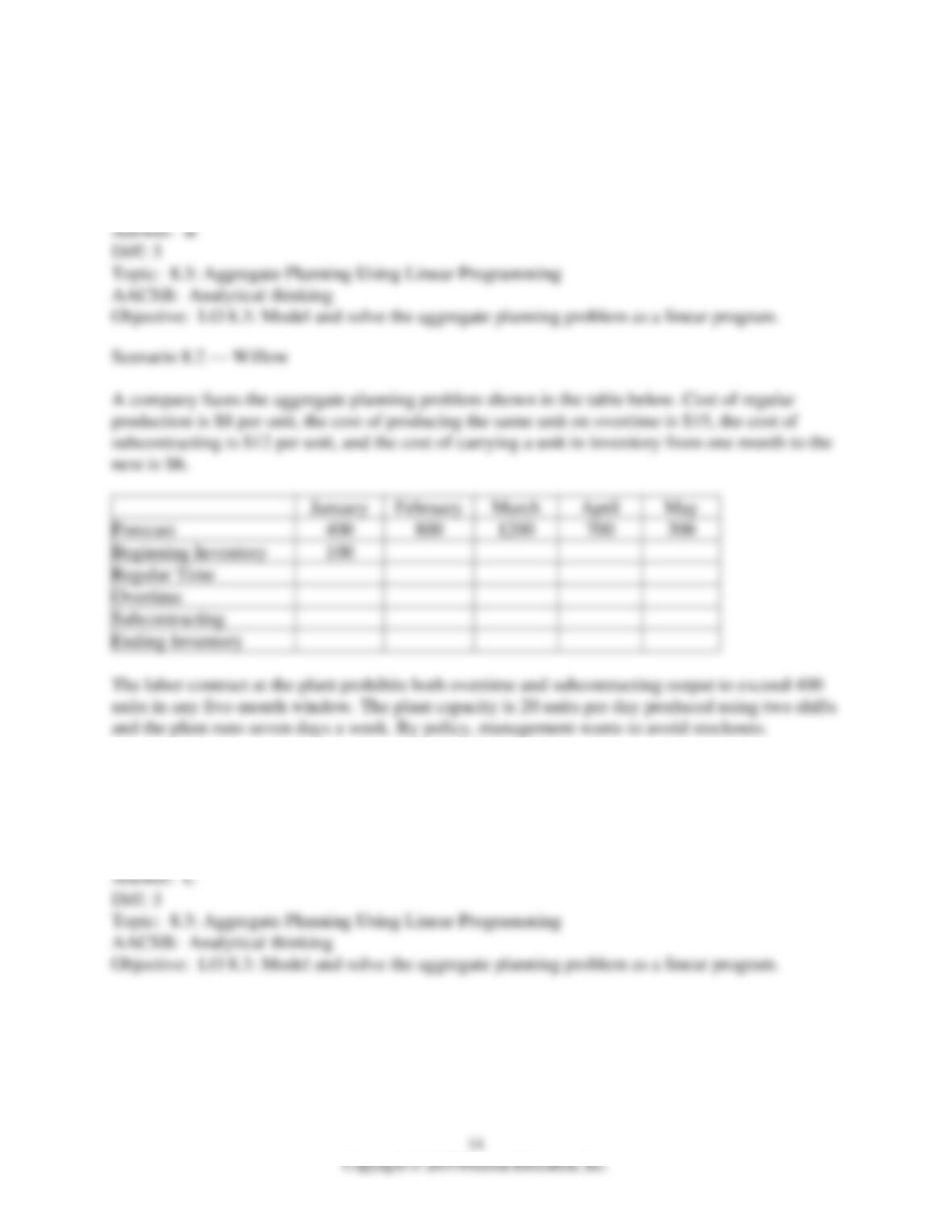
29) What is the optimal total cost of the aggregate plan developed to address Scenario 8.1?
A) $16,700
B) $18,950
C) $18,450
D) $16,250
30) What is the optimal total cost of the aggregate plan developed to address Scenario 8.2?
A) $27,200
B) $20,960
C) $31,400
D) $26,600
31) How many units are produced using overtime in the optimal aggregate plan developed to
address Scenario 8.2?
A) 360
B) 200
C) 400
D) 280
32) How many months does the regular time output exceed plant capacity in the optimal solution
to Scenario 8.2?
A) 0
B) 1
C) 2
D) 3
33) Without actually solving the aggregate planning problem, it is safe to conclude that in the
optimal solution to Scenario 8.2,
A) the total ending inventory will exceed the number of units made using overtime.
B) the number of units made using subcontracting will exceed the number of units made using
overtime.
C) the number of units made using regular time will exceed the forecast.
D) the number of units made using subcontracting will exceed the number of units made using
regular time.