Supply Chain Management: Strategy, Planning, and Operation, 7e (Chopra)
Chapter 6 Designing Global Supply Chain Networks
6.1 True/False Questions
1) Decisions made during the supply chain design phase regarding significant investments in the
supply chain, such as the number and size of plants to build, the number of trucks to purchase or
lease, and whether to build or lease warehouse space, cannot be altered in the short term.
2) The degree of demand and price uncertainty has a significant influence on the appropriate
portfolio of long- and short-term warehousing space that a firm should carry.
3) If price and demand vary over time in a global network, flexible production capacity can be
reconfigured to maximize profits in the new environment.
4) A firm may choose to build a flexible global supply chain even in the presence of little
demand or supply uncertainty if certainty exists in exchange rates or prices.
5) Offshoring typically lowers labor, working capital and fixed costs but increases risk and
freight costs.
6) Appropriate flexibility is an effective approach for a global supply chain to deal with a variety
of risks and uncertainties. Extra flexibility is always worth the cost.
7) The present value of a stream of cash flows is what that stream is worth in today’s dollars.
8) The rate of return k is also referred to as the present value of capital.
9) A negative NPV for an option indicates that the option will lose money for the supply chain.

10) Discounted cash flow (DCF) analysis evaluates the present value of any stream of future cash
flows and allows management to compare two streams of cash flows in terms of their financial
value.
11) When faced with uncertain conditions, it is always best to sign long-term contracts (because
they are typically cheaper) and avoid all flexible capacity (because it is more expensive).
12) The value of flexibility increases with an increase in uncertainty.
13) In reality, demand and prices are highly uncertain and are likely to fluctuate during the life of
any supply chain decision.
14) Long-term contracts for both warehousing and transportation requirements will be more
effective if the demand and price of warehousing do not change in the future or if the price of
warehousing goes up.
15) During network design, managers need a methodology that allows them to estimate the
certainty in their forecast of demand and price and then incorporate this certainty into the
decision-making process.
16) In a complex decision tree, there are thousands of possible paths that may result from the
first period to the last.
17) Simulation methods are very good at evaluating a decision where the path itself is decision
dependent.
18) The main advantage of simulation models is that they can provide low-cost evaluations of
complex situations.
19) Strategic planning and financial planning should be combined during supply chain network
design.
20) Financial analysis should be used as an input to decision making, not as the decision-making
process.
1) Decisions made during the supply chain design phase regarding significant investments in the
supply chain, such as the number and size of plants to build, the number of trucks to purchase or
lease, and whether to build or lease warehouse space,
A) can be altered in the short term.
B) cannot be altered in the short term.
C) cannot be altered in the long term.
D) can only be altered in the short term.
2) Decisions made during the supply chain design phase regarding significant investments in the
supply chain, such as the number and size of plants to build, the number of trucks to purchase or
lease, and whether to build or lease warehouse space,
A) are realigned every few weeks.
B) should be revisited quarterly.
C) only remain in place for a few weeks.
D) often remain in place for several years.
3) Decisions made during the supply chain design phase regarding significant investments in the
supply chain, such as the number and size of plants to build, the number of trucks to purchase or
lease, and whether to build or lease warehouse space,
A) define the boundaries within which the supply chain must compete.
B) have little impact on how the supply chain must compete.
C) are irrelevant regarding how the supply chain will compete.
D) are the only consideration regarding how the supply chain will compete.
4) The opportunities from globalization are often accompanied by
A) a lack of domestic opportunities.
B) the need to eliminate the accounting function.
C) significant additional risk.
D) the need to eliminate the logistics function.
5) Based on the Accenture survey on sources of risk that affect global supply chain performance,
which of the following was found to have affected the lowest percentage of supply chains?
A) shortage of skilled resources
B) currency fluctuation
C) inflexible supply chain technology
D) terrorist infiltration of cargo
6) Based on the Accenture survey on sources of risk that affect global supply chain performance,
which of the following was found to have affected the highest percentage of supply chains?
A) shortage of skilled resources
B) volatility of fuel prices
C) inflexible supply chain technology
D) customs delays
7) As Adam Smith put it so eloquently in the Wealth of Nations, “If a foreign country can supply
us with a commodity cheaper than we ourselves can make it,…
A) …it is only right that we should learn their method of production, so that we too can master
the commodity…”
B) …then we would be well-served to include them in our supply chain…”
C) …better buy it from them with some part of our own industry…”
D) …we should barter with them or take it by force if they prove to be unreasonable…”

8) A global supply chain with offshoring
A) reduces the duration of the cash flow and reduces the length of the product flow.
B) increases the length of the product flow and increases the duration of the information flow.
C) increases the duration of the cash flow but reduces the duration of the information flow.
D) reduces the length of the product flow and reduces the length of the information flow.
9) A global supply chain with offshoring would tend to see which of these performance
dimensions decrease?
A) Working capital
B) Hidden costs
C) Supply chain visibility
D) Product returns
10) A global supply chain with offshoring would tend to see metrics decline associated with
which of these performance dimensions?
A) Working capital
B) On-time delivery
C) Stockouts
D) Product returns
11) Crossing international borders with offshored goods is most closely linked to a change in
A) unit cost.
B) quality.
C) product returns.
D) taxes and tariffs.
12) When evaluating the total cost of offshoring, the raw material costs
A) will usually increase.
B) will usually decrease.
C) could increase or decrease depending on sourcing.
D) will be eliminated.
13) A global supply chain with offshoring would tend to see which of these performance
dimensions increase?
A) Labor costs
B) On time delivery
C) Supply chain visibility
D) Minimum order quantity

14) A global supply chain with offshoring would tend to see metrics associated with which of
these performance dimensions decline in performance?
A) Inventories
B) On time delivery
C) Supply chain visibility
D) Clarity of order communication
15) Offshoring to low-cost countries is most attractive for products with
A) large production volume.
B) high variety.
C) low labor content.
D) a high ratio of transportation cost to product value.
16) One way to lower transportation costs of globally sourced production is to
A) use online ordering when possible.
B) redesign components for greater transport density.
C) increase the labor content of the components.
D) decrease the labor content of the components.
17) Which of these was NOT cited as a factor contributing to decreased attractiveness of
offshoring to China over the period 2003 to 2008?
A) Increase in labor costs
B) Increase in transportation costs
C) Increase in labor content
D) Strengthening of Chinese yuan against the U.S. dollar
18) Which technique can be used to lower shipping costs if several components are being
sourced globally from different locations?
A) Offshoring all components rather than a subset of them
B) Use of faster modes of transportation
C) Assembly and retail in offshored locations
D) Use of supplier hubs
19) The tailored strategy “Focus on low-cost, decentralized capacity for predictable demand”
follows which risk mitigation strategy?
A) Get redundant suppliers.
B) Increase capacity.
C) Increase responsiveness.
D) Increase inventory.
20) A labor dispute is a risk driver to be considered during network design. What category does a
“labor dispute” belong to?
A) Disruptions
B) Inventory risk
C) Systems risk
D) Capacity risk
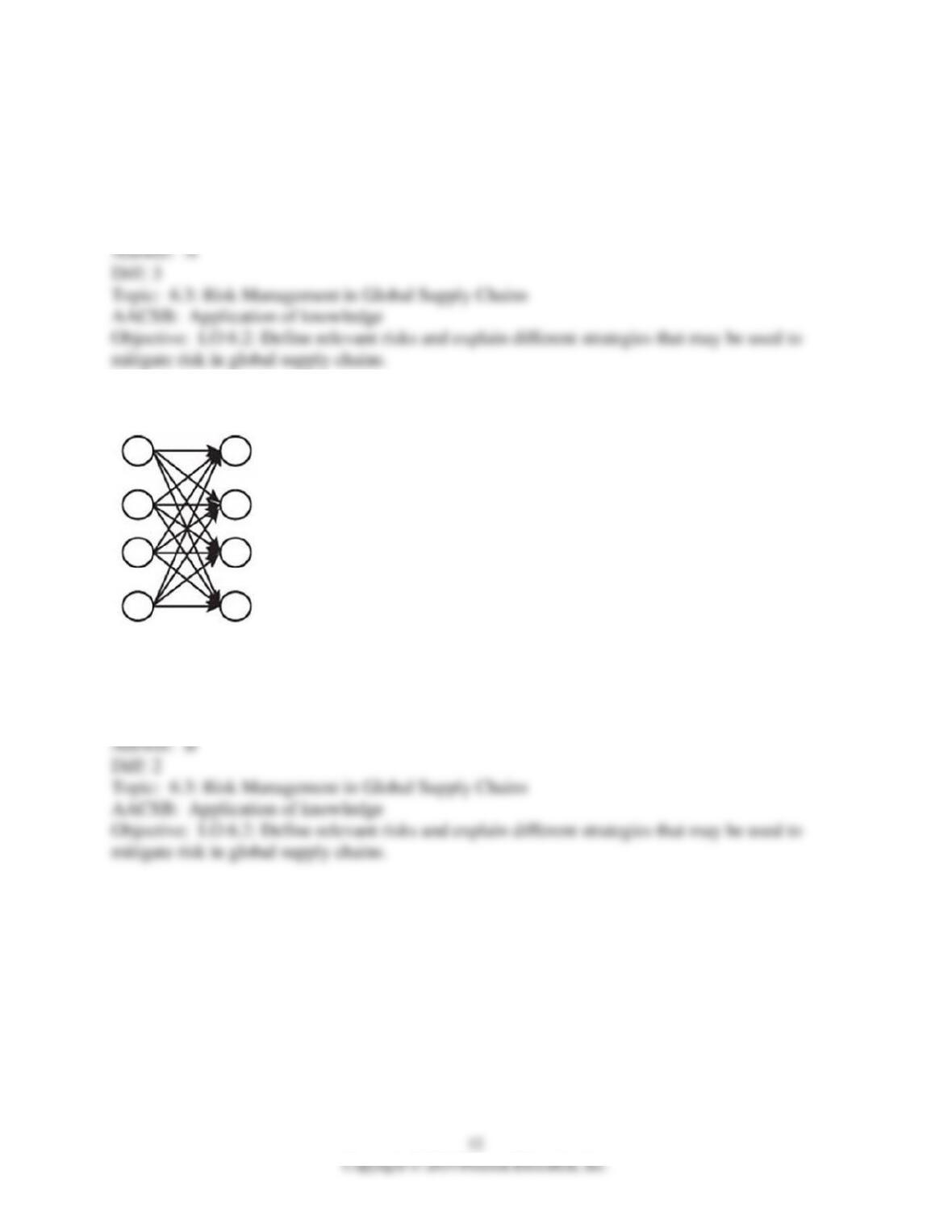
21) What type of network design is represented in the diagram?
A) Dedicated network
B) Fully flexible network
C) Chained network with one long chain
D) Chained network with two long chains
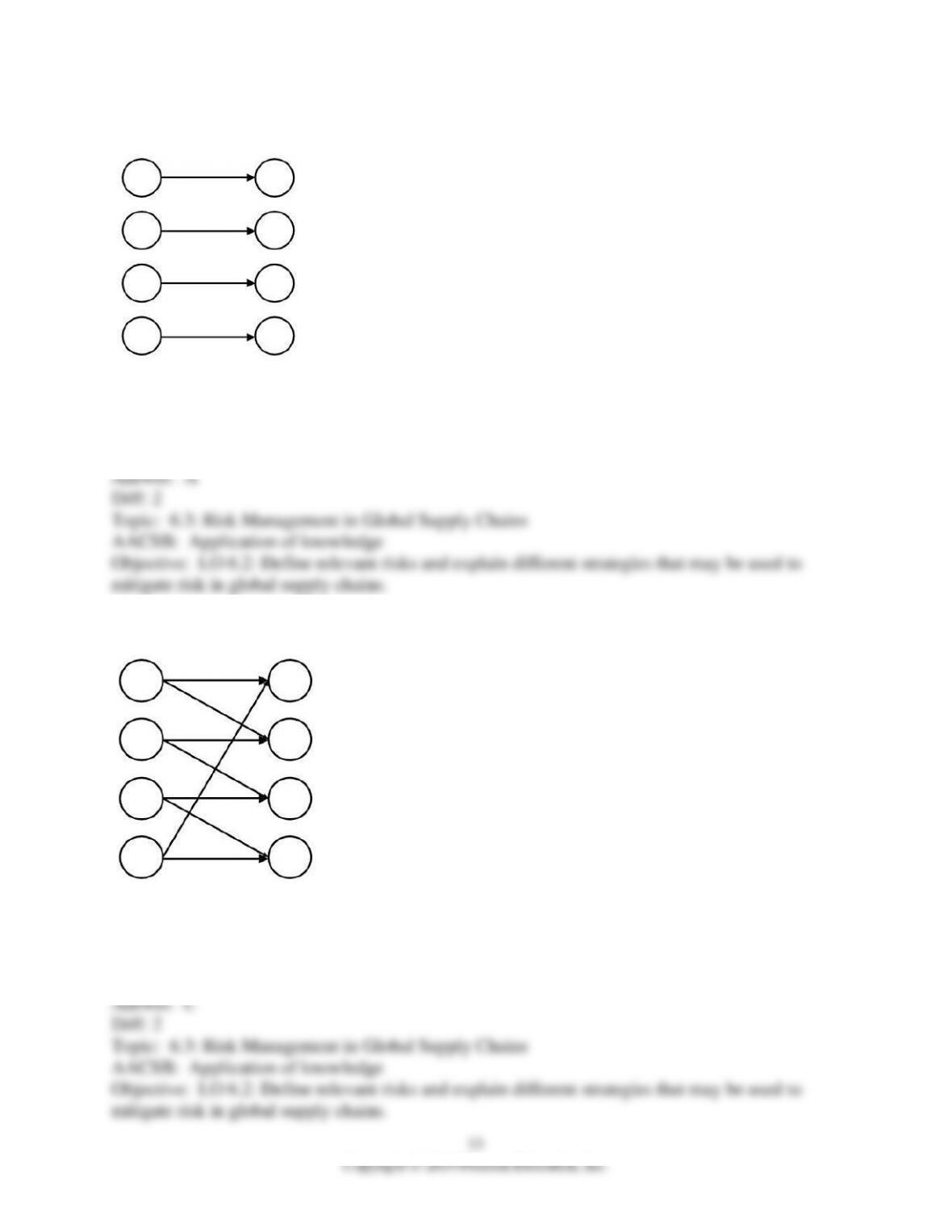
22) What type of network design is represented in the diagram?
A) Dedicated network
B) Fully flexible network
C) Chained network with one long chain
D) Chained network with two long chains
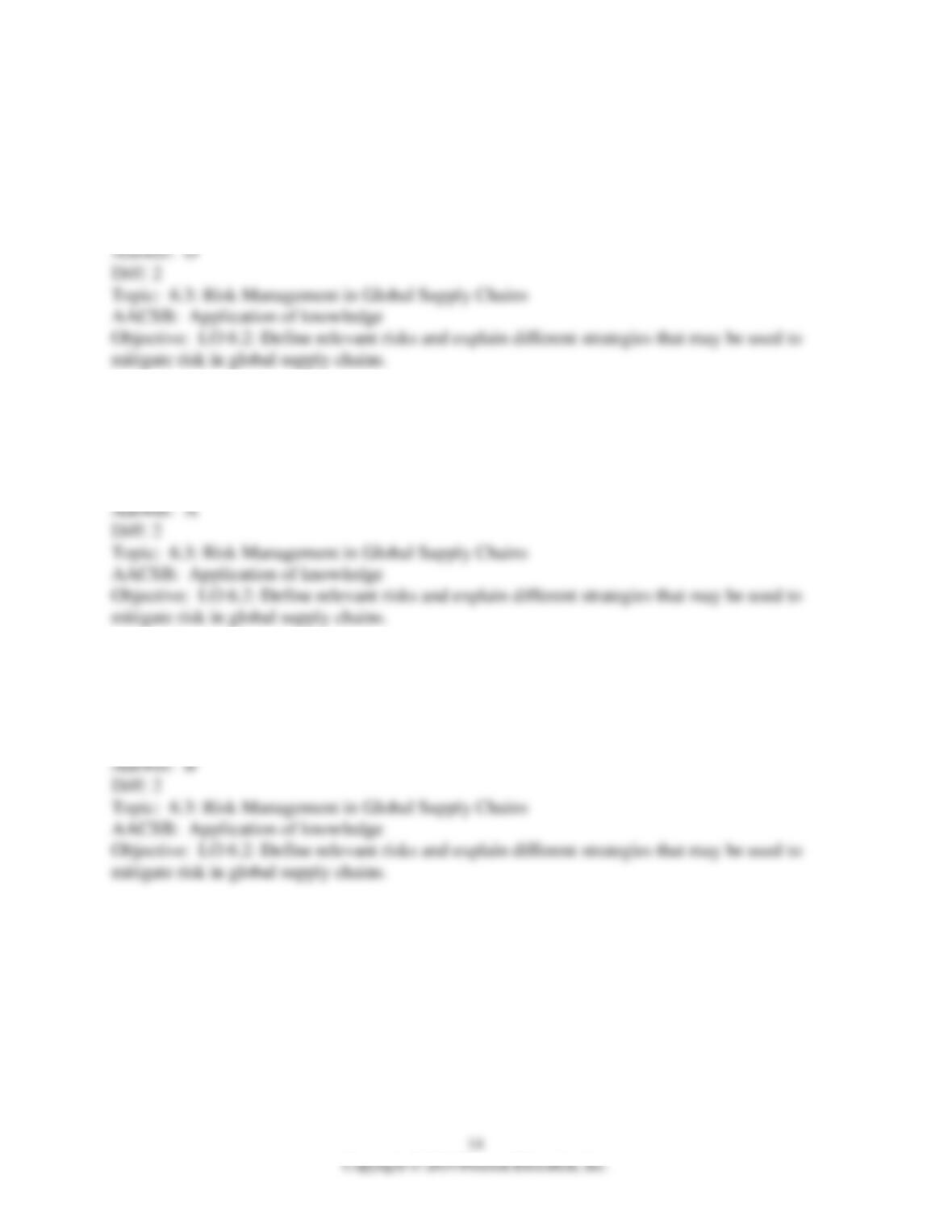
23) What type of network design is represented in the diagram?
A) Dedicated network
B) Fully flexible network
C) Chained network with one long chain
D) Chained network with two long chains
24) The ability to produce a variety of products within a short period of time is called
A) modular flexibility.
B) chained flexibility.
C) volume flexibility.
D) mix flexibility.
25) As flexibility is increased,
A) the marginal benefit of additional flexibility is decreased.
B) the marginal benefit of additional flexibility is increased.
C) the total cost of flexibility is decreased.
D) the total flexibility is decreased.
26) A chained network with one long chain
A) is more flexible than a dedicated network and more costly than a fully flexible network.
B) is more flexible than a dedicated network and less costly than a fully flexible network.
C) is less flexible than a dedicated network and less costly than a fully flexible network.
D) is less flexible than a dedicated network but more costly than a fully flexible network.
27) A chained network configuration means that
A) all plants in the network are capable of producing one product.
B) all plants in the network are capable of producing all products.
C) each plant in the network is capable of producing at least two products.
D) each plant in the network is capable of producing one product.
28) Which of these is a disadvantage of a chained network configuration?
A) The fixed cost of building several small chains far exceeds the cost of building a single long
chain.
B) They are effective when dealing with supply disruptions but ineffective when confronted with
demand fluctuations.
C) They are incapable of producing the products they are designed for.
D) The effect of any fluctuation ripples to all facilities in the chain.
29) When supply disruptions occur,
A) smaller chains outperform a network with one long chain.
B) one long chain outperforms a network with several smaller chains.
C) a dedicated network outperforms a network with one long chain.
D) a dedicated network outperforms a network with several smaller chains.
30) The present value of a future stream of cash flows is what that stream
A) was worth in yesterday’s dollars.
B) is worth in today’s dollars.
C) will be worth in future dollars.
D) might be worth in future dollars.
31) The process of evaluating the present value of any stream of future cash flows so that
management can compare two streams of cash flows in terms of their financial value is
A) annual cash flow (ACF) analysis.
B) discretionary cash flow (DCF) analysis.
C) discounted cash flow (DCF) analysis.
D) future cash flow (FCF) analysis.
32) The present value of future cash flow is found by
A) locating the correct factor on a z-table.
B) using a discount factor.
C) plotting the function on a graph.
D) adding the total of all future cash flows.
33) The discount factor used to obtain the present value of money in the next period where k
represents the rate of return is
A) k.
B) 1 + k.
C) 1/(1 + k).
D) k /(1 + k).
34) The rate of return k is also referred to as the
A) discount rate.
B) hurdle rate.
C) opportunity cost of capital.
D) all of the above
35) The net present value (NPV) of a stream of cash flows is equal to
A) the sum of all cash flows for all periods being considered.
B) the sum of all cash flows for all periods being considered divided by the number of periods.
C) the average of all cash flows for all periods being considered multiplied by the number of
periods.
D) the sum of all cash flows for all periods being considered discounted by the rate of return for
each period.