46) Which of these is considered a hard infrastructure requirement?
A) Utilities
B) Community receptivity to business
C) Availability of skilled labor
D) Workforce turnover
47) Which of these is considered a soft infrastructure requirement?
A) Utilities
B) Community receptivity to business
C) Warehousing facilities
D) Transportation services
48) Models that minimize total costs are used
A) from the start to make the final location decision among the entire array of possibilities.
B) as a final step to make the final location decision among a subset of desirable location
possibilities.
C) from the start to identify broad geographic areas that may be considered further.
D) as a final step to expand the possible locations from those that meet other criteria.
49) A manufacturer of cat towers wishes to locate a super assembly facility to meet their cat
tower assembly needs for the next millennium. Currently, carpet, cylinders, yarn and fasteners
are purchased in bulk from suppliers in North Haverbrook, Ogden, and Springfield in the
quantities shown in the table. The super assembly facility would ship to distribution centers
located in Seattle, Lubbock, Nashville, and Philadelphia. The locations of all of these cities on an
x-y grid, transportation costs on a ton per mile basis, and total tonnage are all contained in the
table.
Sources/Markets
Transportation Cost
$/ton mile (Fn)
Quantity in
Tons (Dn)
Xn
Yn
Supply
North Haverbrook
1.1
650
700
1200
Ogden
1.2
450
250
600
Springfield
1.4
400
225
825
Market
Seattle
2.25
300
50
1200
Lubbock
2.25
200
450
300
Nashville
2.25
500
800
250
Philadelphia
2.25
500
950
1100
What is the distance between the Ogden and Seattle locations?
A) 450 miles
B) 350 miles
C) 630 miles
D) 1050 miles
50) A manufacturer of cat towers wishes to locate a super assembly facility to meet their cat
tower assembly needs for the next millennium. Currently, carpet, cylinders, yarn and fasteners
are purchased in bulk from suppliers in North Haverbrook, Ogden, and Springfield in the
quantities shown in the table. The super assembly facility would ship to distribution centers
located in Seattle, Lubbock, Nashville, and Philadelphia. The locations of all of these cities on an
x-y grid, outbound transportation costs on a ton per mile basis, and total tonnage are all
contained in the table.
Sources/Markets
Transportation Cost
$/ton mile (Fn)
Quantity in
Tons (Dn)
Xn
Yn
Supply
North Haverbrook
1.1
650
700
1200
Ogden
1.2
450
250
600
Springfield
1.4
400
225
825
Market
Seattle
2.25
300
50
1200
Lubbock
2.25
200
450
300
Nashville
2.25
500
800
250
Philadelphia
2.25
500
950
1100
What is the cost to transport 500 tons of material between the Springfield and Seattle locations?
A) $325,777
B) $192,677
C) $682,777
D) $289,677
51) A manufacturer of cat towers wishes to locate a super assembly facility to meet their cat
tower assembly needs for the next millennium. Currently, carpet, cylinders, yarn and fasteners
are purchased in bulk from suppliers in North Haverbrook, Ogden, and Springfield in the
quantities shown in the table. The super assembly facility would ship to distribution centers
located in Seattle, Lubbock, Nashville, and Philadelphia. The locations of all of these cities on an
x-y grid, outbound transportation costs on a ton per mile basis, and total tonnage are all
contained in the table.
Sources/Markets
Transportation Cost
$/ton mile (Fn)
Quantity in
Tons (Dn)
Xn
Yn
Supply
North Haverbrook
1.1
650
700
1200
Ogden
1.2
450
250
600
Springfield
1.4
400
225
825
Market
Seattle
2.25
300
50
1200
Lubbock
2.25
200
450
300
Nashville
2.25
500
800
250
Philadelphia
2.25
500
950
1100
What is the optimal location for the Super Assembly Center?
A) (550, 808)
B) (513, 772)
C) (526, 795)
D) (538, 784)
52) A manufacturer of cat towers wishes to locate a super assembly facility to meet their cat
tower assembly needs for the next millennium. Currently, carpet, cylinders, yarn and fasteners
are purchased in bulk from suppliers in North Haverbrook, Ogden, and Springfield in the
quantities shown in the table. The super assembly facility would ship to distribution centers
located in Seattle, Lubbock, Nashville, and Philadelphia. The locations of all of these cities on an
x-y grid, outbound transportation costs on a ton per mile basis, and total tonnage are all
contained in the table.
Sources/Markets
Transportation Cost
$/ton mile (Fn)
Quantity in
Tons (Dn)
Xn
Yn
Supply
North Haverbrook
1.1
650
700
1200
Ogden
1.2
450
250
600
Springfield
1.4
400
225
825
Market
Seattle
2.25
300
50
1200
Lubbock
2.25
200
450
300
Nashville
2.25
500
800
250
Philadelphia
2.25
500
950
1100
What is the minimal shipping cost that satisfies all market demand?
A) $2,546,632
B) $2,586,342
C) $2,451,668
D) $2,522,982
53) Managers making facility location decisions should carefully consider tariffs and tax
incentives, because
A) network designers can use this fact to influence the role of the new facility and the focus of
people working there.
B) facilities last a long time and have an enduring impact on a firm’s performance.
C) it is astounding how often tax incentives drive the choice of location.
D) the location of a facility has a significant impact on the extent and form of communication
that develops in the supply chain network.
FlexSteal, marketed as a miracle brush-on sealant and baldness cure, is manufactured at three
plants that are struggling to keep up with the demand at the four regional centers. The cost to
ship a truckload from each of the existing plants to the regional centers is shown in the table.
Note that the capacity and the total demand are both measured in truckloads.
Philadelphia
Atlanta
Dallas
Los Angeles
Capacity
Plant 1
89
75
93
115
400
Plant 2
120
88
103
93
400
Plant 3
95
82
112
98
400
Total Demand
350
350
350
350
The supply chain manager has explored plant construction costs in two other cities as well as the
cost to ship a truckload from each of the plants to the regional centers. The current plan is to
build another plant with a capacity of 400 to allow room for sales growth. The construction cost
for the new plants and cost to ship to each of the regional centers is shown here.
Philadelphia
Atlanta
Dallas
Los Angeles
Cost to Build
Plant A
94
78
95
95
$23,500
Plant B
95
88
88
94
$26,000
54) What is the lowest cost solution for the existing set of plants and regional centers?
A) $106,850
B) $107,450
C) $108,650
D) $109,750
55) How many constraints does the linear programming formulation of a lowest cost solution for
the existing set of plants and regional centers contain?
A) 10
B) 7
C) 4
D) 3
56) What is the constraint associated with Plant 2 for the existing set of plants and regional
centers?
A) 120x2P + 88x2A + 103x2D + 93x2L = 400
B) x2P + x2A + x2D + x2L ≤ 400
C) x2P+ x2A + x2D + x2L = 400
D) 120x2P + 88x2A + 103x2D + 93x2L ≤ 400
57) What is the constraint associated with Atlanta for the existing set of plants and regional
centers?
A) 75x1A + 88x2A + 82x3A = 350
B) x1A + x2A + x3A = 350
C) 75x1A + 88x2A + 82x3A ≤ 350
D) x1A + x2A + x3A ≤ 350
58) Which of these assignments is associated with the minimum cost solution for the original set
of plants and regional centers?
A) 50 units from Plant 2 to Dallas
B) 350 units from Plant 1 to Atlanta
C) 300 units from Plant 3 to Philadelphia
D) 150 units from Plant 1 to Los Angeles
59) What is the total (construction plus operating) cost if the supply chain manager chooses
Location A for the new plant?
A) $148,350
B) $148,550
C) $148,450
D) $148,650
60) How does the model change from the original network configuration when Plant A is under
consideration?
A) The plant constraints switch from “less than” to “equal to.”
B) The plant constraints switch from “less than or equal to” to “equal to.”
C) The plant constraints switch from “equal to” to “less than or equal to.”
D) The plant constraints switch from “equal to” to “less than.”
61) Should the company add Location A or Location B based on total construction plus
operating cost and why?
A) Location B because it is cheaper by $350.
B) Location A because it is cheaper by $2500.
C) Location B because it is cheaper by $200.
D) Location A because it is cheaper by $200.
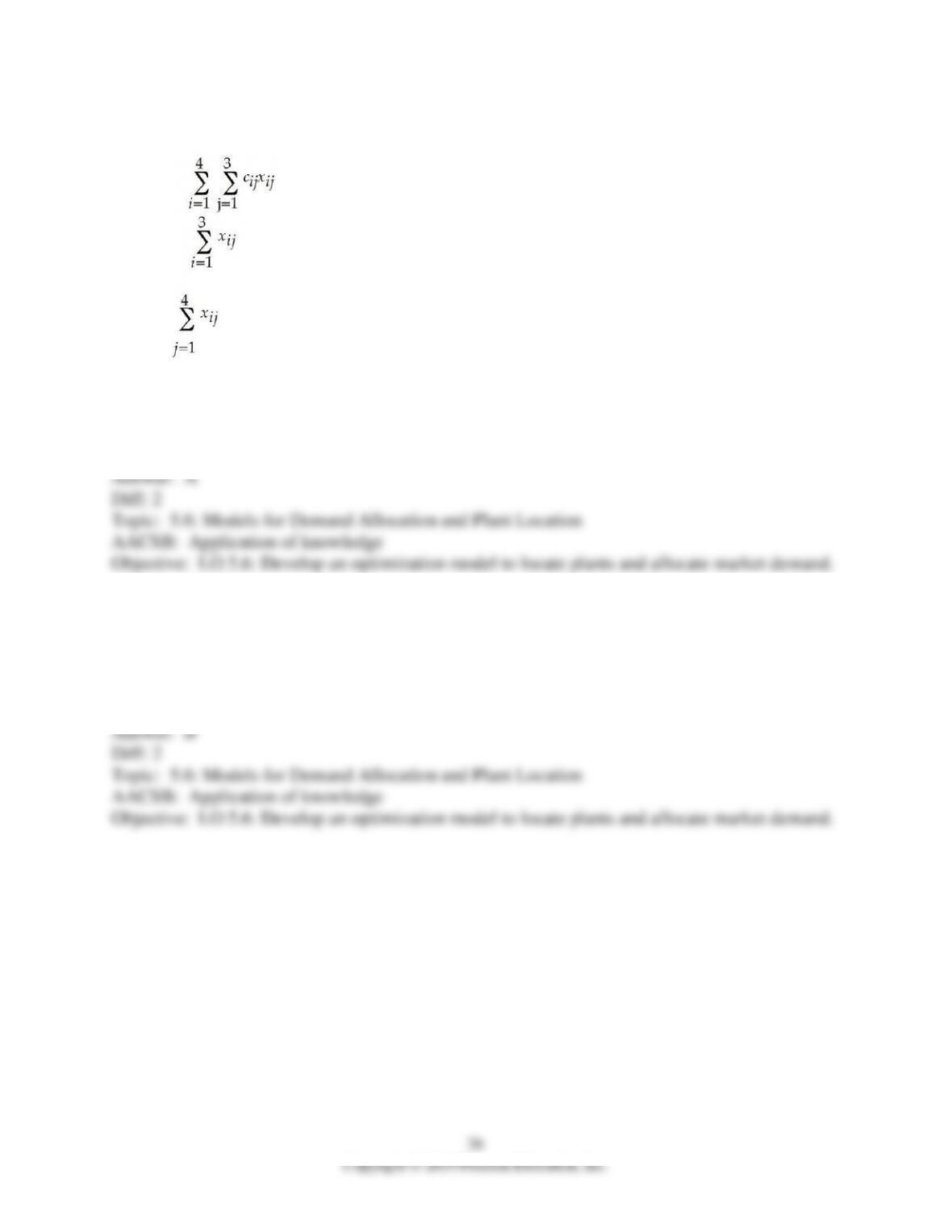
62) What is the result of formulating the linear programming model of the original network
configuration (before considering plants A and B) as follows?
Minimize
subject to ≤ Dj
≤ Ki
A) The shipping quantity from Plant 3 to Atlanta will be 0.
B) The shipping quantity from Plant 3 to Atlanta will be 300.
C) The shipping quantity from Plant 3 to Atlanta will be 50.
D) The shipping quantity from Plant 3 to Atlanta will be 350.
63) What is one assumption made when using linear programming to optimize the assignment of
shipping amounts from plants to regional centers?
A) Supply must equal demand.
B) All costs and volumes are known with certainty.
C) There must be a solution.
D) Supply cannot exceed demand.
5.3 Essay Questions
1) Explain how supply chain network design decisions are classified.
28
Copyright © 2019 Pearson Education, Inc.
2) Describe the factors that influence supply chain network design decisions.
Answer: Strategic Factors. Firms focusing on cost leadership tend to find the lowest cost
location for their manufacturing facilities, even if that means locating very far from the markets
they serve. Firms focusing on responsiveness tend to locate facilities closer to the market and
may select a high-cost location if this choice allows the firm to quickly react to changing market
needs.
Technological Factors. If production technology displays significant economies of scale, a few
high-capacity locations are the most effective. In contrast, if facilities have lower fixed costs,
many local facilities are preferred because this helps lower transportation costs. If the production
technology is very inflexible and product requirements vary from one country to another, a firm
has to set up local facilities to serve the market in each country. Conversely, if the technology is
flexible, it becomes easier to consolidate manufacturing in a few large facilities.
Macroeconomic Factors. Macroeconomic factors include taxes, tariffs, exchange rates, and other
economic factors that are not internal to an individual firm. If a country has very high tariffs,
companies either do not serve the local market or set up manufacturing plants within the country
to save on duties. High tariffs lead to more production locations within a supply chain network,
with each location having a lower allocated capacity. Tax incentives are a reduction in tariffs or
taxes that countries, states, and cities often provide to encourage firms to locate their facilities in
specific areas. Many countries vary incentives from city to city to encourage investments in areas
with lower economic development. Developing countries often create free trade zones where
duties and tariffs are relaxed as long as production is used primarily for export. This creates a
strong incentive for global firms to set up a plant in these countries to be able to exploit their low
labor costs. Many countries also place minimum requirements on local content and limits on
imports. Such policies lead companies to set up many facilities and source from local suppliers.
Exchange rate risks may be handled using financial instruments that limit, or hedge against, the
loss due to fluctuations. Suitably designed supply chain networks, however, offer the opportunity
to take advantage of exchange rate fluctuations and increase profits. An effective way to do this
is to build some over-capacity in the network and make the capacity flexible so that it can be
used to supply different markets. This flexibility allows the firm to alter production flows within
the supply chain to produce more in facilities that have a lower cost based on current exchange
rates. When designing supply chain networks, companies must build appropriate flexibility to
help counter fluctuations in exchange rates and demand across different countries.
Political Factors. Companies prefer to locate facilities in politically stable countries where the
rules of commerce are well defined. Countries with independent and clear legal systems allow
firms to feel that they have recourse in the courts should they need it. This makes it easier for
companies to invest in facilities in these countries. Political stability is hard to quantify, so a firm
makes an essentially subjective evaluation when designing its supply chain network.
Infrastructure Factors. The availability of good infrastructure is an important prerequisite to
locating a facility in a given area. Poor infrastructure adds to the cost of doing business from a
given location. Key infrastructure elements to be considered during network design include
availability of sites, labor availability, proximity to transportation terminals, rail service,
proximity to airports and seaports, highway access, congestion, and local utilities.
29
Copyright © 2019 Pearson Education, Inc.
Competitive Factors. Companies must consider competitors’ strategy, size, and location when
designing their supply chain networks. A fundamental decision firms make is whether to locate
their facilities close to competitors or far from them. How the firms compete and whether
external factors such as raw material or labor availability force them to locate close to each other
influence this decision. Positive externalities lead to competitors locating close to each other.
When there are no positive externalities, firms locate to be able to capture the largest possible
share of the market.
Customer Response Time and Local Presence. Firms that target customers who value a short
response time must locate close to them. If a firm is delivering its product to customers, use of a
rapid means of transportation allows it to build fewer facilities and still provide a short response
time. This option, however, increases transportation costs. Moreover, there are many situations
where the presence of a facility close to a customer is important.
Logistics and Facility Costs. Logistics and facility costs incurred within a supply chain change
as the number of facilities, their location, and capacity allocation is changed. Companies must
consider inventory, transportation, and facility costs when designing their supply chain networks.
Inventory and facility costs increase as the number of facilities in a supply chain increase.
Transportation costs decrease as the number of facilities is increased. Increasing the number of
facilities to a point where inbound economies of scale are lost increases transportation cost. The
supply chain network design is also influenced by the transformation occurring at each facility.
When there is a significant reduction in material weight or volume as a result of processing, it
may be better to locate facilities closer to the supply source rather than the customer. Total
logistics costs are a sum of the inventory, transportation, and facility costs. The facilities in a
supply chain network must at least equal the number that minimizes total logistics costs. A firm
may increase the number of facilities beyond this point to improve the response time to its
customers. This decision is justified if the revenue increase from improved response outweighs
the increased cost from additional facilities.
Diff: 3
Topic: 5.2: Factors Influencing Network Design Decisions
AACSB: Application of knowledge
Objective: LO 5.2: Identify factors influencing supply chain network design decisions.
30
3) Describe the four phases in the framework for network design decisions.
31
Copyright © 2019 Pearson Education, Inc.
Phase IV: Location Choices
The objective of this phase is to select a precise location and capacity allocation for each facility.
Attention is restricted to the desirable sites selected in Phase III. The network is designed to
maximize total profits, taking into account the expected margin and demand in each market,
various logistics and facility costs, and the taxes and tariffs at each location.
Diff: 3
Topic: 5.3: Framework for Network Design Decisions
AACSB: Application of knowledge
Objective: LO 5.3: Discuss a framework for making network design decisions.
4) Explain the two situations in which managers use network design models.
5) A manufacturer of cat towers wishes to locate a super assembly facility to meet their cat tower
assembly needs for the next millennium. Currently, carpet, cylinders, yarn and fasteners are
purchased in bulk from suppliers in North Haverbrook, Ogden, and Springfield in the quantities
shown in the table. The super assembly facility would ship to distribution centers located in
Seattle, Lubbock, Nashville, and Philadelphia. The locations of all of these cities on an x-y grid,
transportation costs on a ton per mile basis, and total tonnage are all contained in the table.
Formulate and solve a model that will minimize the shipping costs to the super assembly center.
Sources/Markets
Transportation Cost
$/ton mile (Fn)
Quantity in
Tons (Dn)
Xn
Yn
Supply
North Haverbrook
1.1
650
700
1200
Ogden
1.2
450
250
600
Springfield
1.4
400
225
825
Market
Seattle
2.25
300
50
1200
Lubbock
2.25
200
450
300
Nashville
2.25
500
800
250
Philadelphia
2.25
500
950
1100
Where should the new plant be located and what is the total system shipping cost?
FlexSteal, marketed as a miracle brush-on sealant and baldness cure, is manufactured at three
plants that are struggling to keep up with the demand at the four regional centers. The cost to
ship a truckload from each of the existing plants to the regional centers is shown in the table.
Philadelphia
Atlanta
Dallas
Los Angeles
Capacity
Plant 1
89
75
93
115
400
Plant 2
120
88
103
93
400
Plant 3
95
82
112
98
400
Total Demand
350
350
350
350
The supply chain manager has explored plant construction costs in two other cities as well as the
cost to ship a truckload from each of the plants to the regional centers. The current plan is to
build another plant with a capacity of 400 to allow room for sales growth. The construction cost
for the new plants and cost to ship to each of the regional centers is shown here.
Philadelphia
Atlanta
Dallas
Los Angeles
Cost to Build
Plant A
94
78
95
95
$23,500
Plant B
95
88
88
94
$26,000
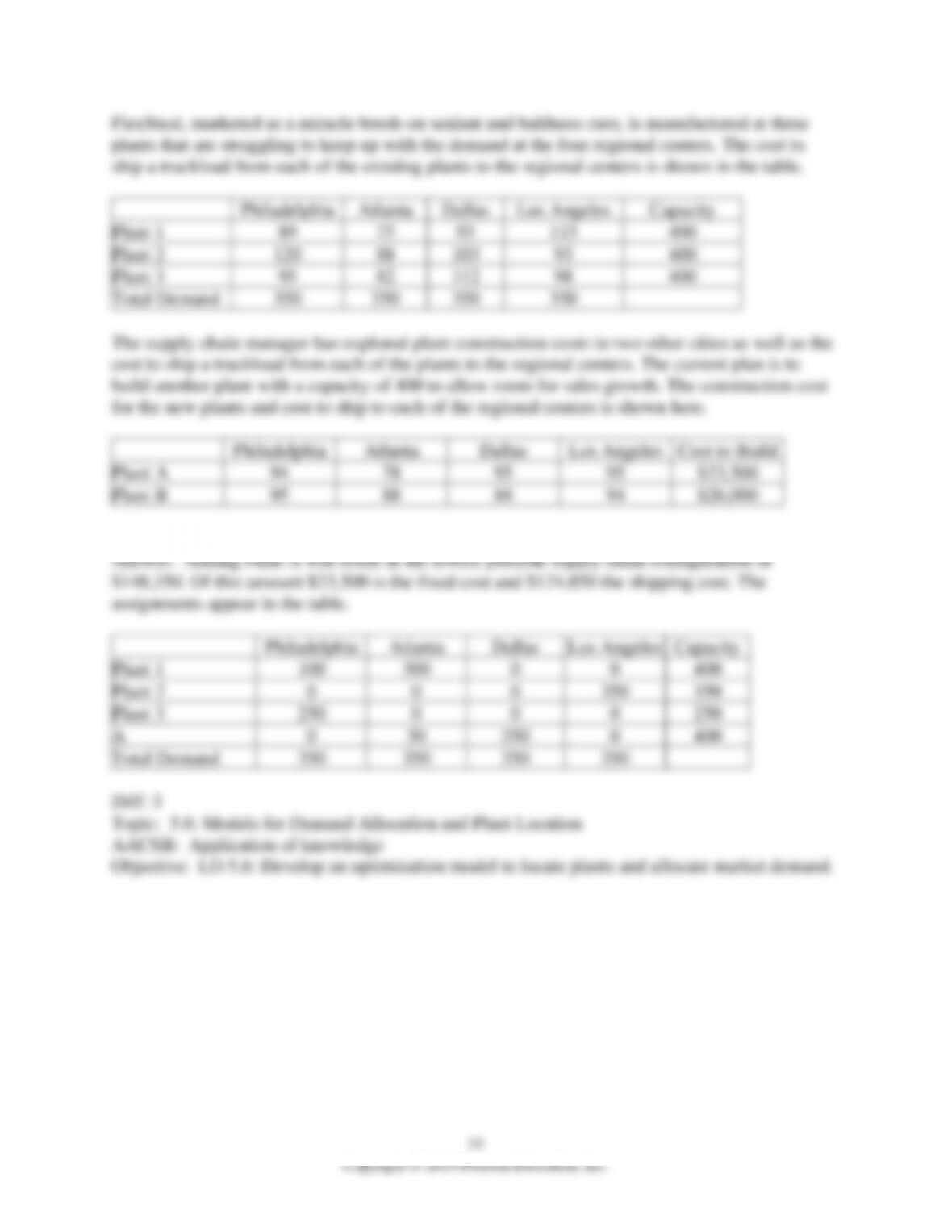
6) What is the lowest cost solution for the adding a new plant?
Dallas
Plant 1
0
400
Plant 2
0
350
Plant 3
0
250
A
0
0
400
Total Demand