Supply Chain Management: Strategy, Planning, and Operation, 7e (Chopra)
Chapter 5 Network Design in the Supply Chain
5.1 True/False Questions
1) Supply chain network design decisions include the location of manufacturing, storage, or
transportation-related facilities and the allocation of capacity and roles to each facility.
2) Decisions concerning the role of each facility are significant because they determine the
amount of rigidity the supply chain has in changing the way it meets demand.
3) Facility location decisions have a long-term impact on a supply chain’s performance because it
is easy to shut down a facility or move it to a different location.
4) Capacity allocation decisions have a significant impact on supply chain performance because
they tend to stay in place for several years.
5) The allocation of supply sources and markets to facilities has a significant impact on
performance because it affects total production, inventory, and transportation costs incurred by
the supply chain to satisfy customer demand.
6) Network design decisions have a significant impact on performance because they determine
the supply chain configuration and set constraints within which inventory, transportation, and
information can be used to either decrease supply chain cost or increase responsiveness.
7) Decisions concerning the role of each facility are significant because they determine the
amount of flexibility the supply chain has in changing the way it meets demand.
8) Network design decisions have a significant impact on performance because they determine
the supply chain configuration and set constraints within which the other supply chain drivers
can be used either to decrease supply chain cost or to increase responsiveness.
9) If facilities have higher fixed costs, many local facilities are preferred because this helps lower
transportation costs.
10) Firms focusing on cost leadership tend to find the lowest cost location for their
manufacturing facilities, but only if that means locating very far from the markets they serve.
11) If production technology displays significant economies of scale, many local locations are
the most effective.
12) If facilities have lower fixed costs, many local facilities are preferred because this helps
lower transportation costs.
13) If the technology is flexible, it becomes more difficult to consolidate manufacturing in a few
large facilities.
14) High tariffs lead to more production locations within a supply chain network, with each
location having a lower allocated capacity.
15) When designing supply chain networks, companies must build appropriate flexibility to help
counter fluctuations in exchange rates and demand across different countries.
16) Inventory and facility costs increase as the number of facilities in a supply chain increase.

17) Transportation costs increase as the number of facilities is increased.
18) A firm may increase the number of facilities beyond the point that minimizes total logistics
cost to improve the response time to its customers.
19) When faced with a network design decision, the goal of a manager is to design a network
that minimizes the firm’s costs while satisfying customer needs in terms of demand and
responsiveness.
20) The supply chain network is designed to maximize total profits, taking into account the
expected margin and demand in each market, various logistics and facility costs, and the taxes
and tariffs at each location.
1) Supply chain network design decisions include
A) only the location of manufacturing, storage, or transportation-related facilities.
B) only the allocation of capacity and roles to each facility.
C) both the location of manufacturing, storage, or transportation-related facilities and the
allocation of capacity and roles to each facility.
D) neither the location of manufacturing, storage, or transportation-related facilities nor the
allocation of capacity and roles to each facility.
2) Supply chain network design decisions classified as facility role are concerned with
A) what processes are performed at each facility.
B) where facilities should be located.
C) how much capacity should be allocated to each facility.
D) what markets each facility should serve and which supply sources should feed each facility.
3) Supply chain network design decisions classified as facility location are concerned with
A) what processes are performed at each facility.
B) where facilities should be located.
C) how much capacity should be allocated to each facility.
D) what markets each facility should serve and which supply sources should feed each facility.
4) Supply chain network design decisions classified as capacity allocation are concerned with
A) what processes are performed at each facility.
B) where facilities should be located.
C) how much capacity should be allocated to each facility.
D) what markets each facility should serve and which supply sources should feed each facility.
5) Supply chain network design decisions classified as market and supply allocation are
concerned with
A) what processes are performed at each facility.
B) where facilities should be located.
C) how much capacity should be allocated to each facility.
D) what markets each facility should serve and which supply sources should feed each facility.
6) Decisions concerning the role of each facility are significant because
A) they determine the amount of flexibility the supply chain has in demanding change.
B) they determine the amount of flexibility the supply chain has in changing the way it meets
demand.
C) they determine the amount of capacity the supply chain has in changing the way it meets
demand.
D) they determine the amount of inventory the supply chain has in demanding change.
7) Facility location decisions have a long-term impact on a supply chain’s performance because
A) it is very expensive to shut down a facility or move it to a different location.
B) it is not expensive to shut down a facility or move it to a different location.
C) it is advisable to shut down a facility or move it to a different location.
D) it is cost effective to shut down a facility or move it to a different location.
8) Capacity allocation decisions have a significant impact on supply chain performance because
A) capacity decisions tend to be permanent.
B) capacity decisions tend to be changed frequently.
C) capacity decisions do not tend to stay in place for several years.
D) capacity decisions tend to stay in place for several years.
9) Allocating too much capacity to a location results in
A) poor utilization, and as a result, higher costs.
B) high utilization, and as a result, higher costs.
C) poor utilization, and as a result, lower costs.
D) high utilization, and as a result, lower costs.
10) Allocating too little capacity results in
A) good responsiveness if demand is not satisfied or low cost if demand is filled from a distant
facility.
B) good responsiveness if demand is not satisfied or high cost if demand is filled from a distant
facility.
C) poor responsiveness if demand is not satisfied or low cost if demand is filled from a distant
facility.
D) poor responsiveness if demand is not satisfied or high cost if demand is filled from a distant
facility.
11) The allocation of supply sources and markets to facilities has a significant impact on
performance because
A) it cannot affect total production, inventory, and transportation costs incurred by the supply
chain to satisfy customer demand.
B) it cannot affect customer demand.
C) it affects total production, inventory, and transportation costs incurred by the supply chain to
satisfy customer demand.
D) it cannot satisfy customer demand.
12) The allocation of supply sources and markets to facilities should be reconsidered on a regular
basis so that
A) the allocation can be held constant as market conditions or plant capacities expand.
B) the allocation can be changed as market conditions or plant capacities stagnate.
C) the allocation can be held constant as market conditions or plant capacities change.
D) the allocation can be changed as market conditions or plant capacities change.
13) Network design decisions have a significant impact on performance because they
A) determine the customer demand.
B) determine the supply chain conflagration.
C) set constraints within which inventory, transportation, and information can be used to either
decrease supply chain cost or increase responsiveness.
D) set constraints within which inventory, transportation, and information can be used to either
increase supply chain cost or decrease responsiveness.
14) Customer order entry is
A) the point in time when the customer has access to choices and makes a decision regarding a
purchase.
B) the customer informing the retailer of what they want to purchase and the retailer allocating
product to the customer.
C) the process where product is prepared and sent to the customer.
D) the process where the customer receives the product and takes ownership.
15) Firms focusing on cost leadership tend to
A) locate facilities close to the market they serve.
B) locate facilities very far from the market they serve.
C) find the lowest cost location for their manufacturing facilities.
D) select a high-cost location to be able to react quickly.
16) Firms focusing on responsiveness tend to
A) locate facilities close to the market they serve.
B) locate facilities very far from the market they serve.
C) find the lowest cost location for their manufacturing facilities.
D) select a high-cost location to be able to react slowly.
17) Positive externalities cause
A) a supplier to locate close to needed raw materials.
B) a customer to locate close to a highway.
C) a company to locate near its competitors.
D) a company to make a political contribution.
18) If no positive externalities exist, then
A) a company will avoid making a location decision.
B) a competitor’s presence will help spur the development of critical infrastructure.
C) a company will locate near its competitors.
D) a company will locate to capture the largest possible share of the market.
19) Firms that must split the market do so
A) by locating closest to the customer.
B) when one has a clear price advantage.
C) by holding both a price and a distance advantage over their competitor.
D) by holding neither a price nor a distance advantage over their competitor.
10
Copyright © 2019 Pearson Education, Inc.
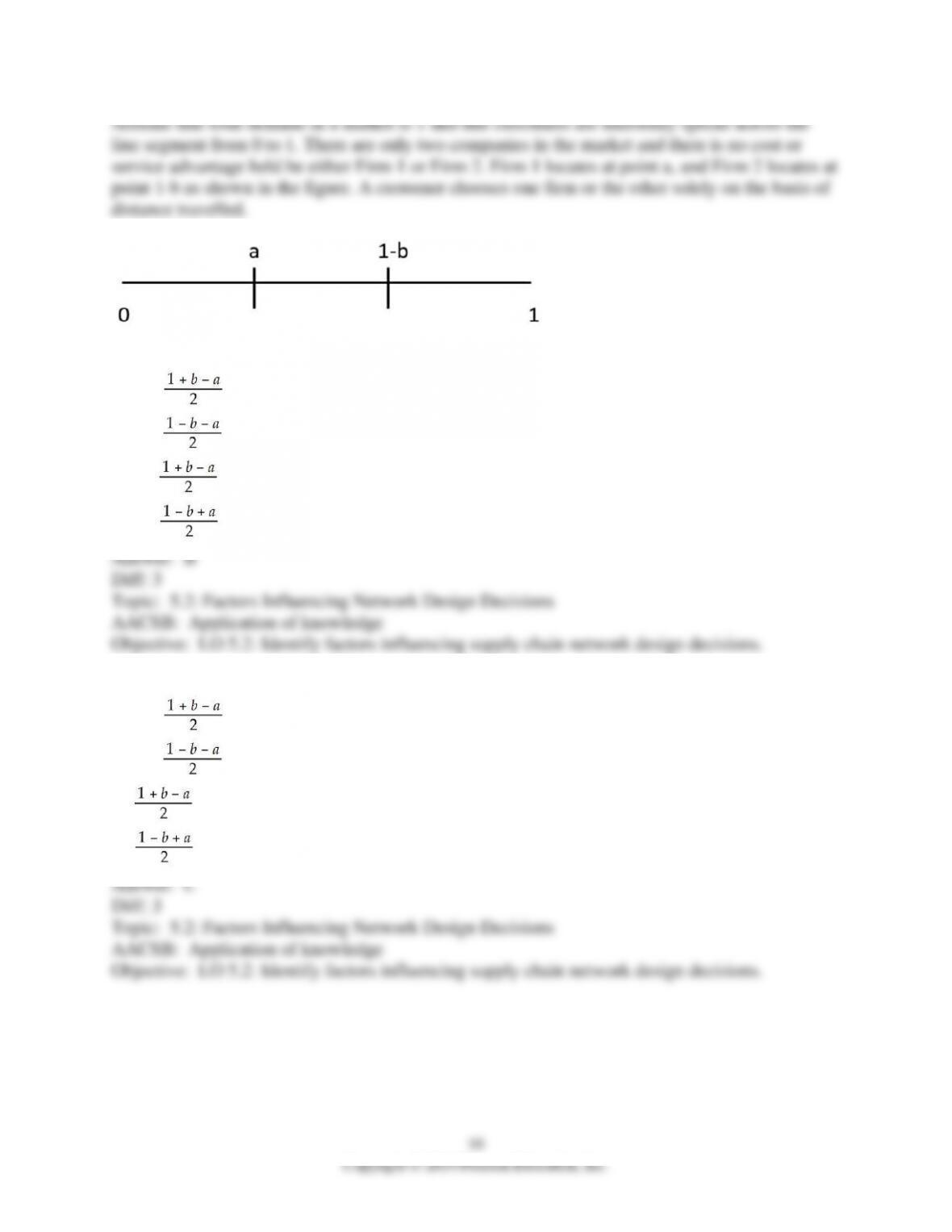
Assume that total demand in a market is 1 and that customers are uniformly spread across the
line segment from 0 to 1. There are only two companies in the market and there is no cost or
service advantage held be either Firm 1 or Firm 2. Firm 1 locates at point a, and Firm 2 locates at
point 1-b as shown in the figure. A customer chooses one firm or the other solely on the basis of
distance travelled.
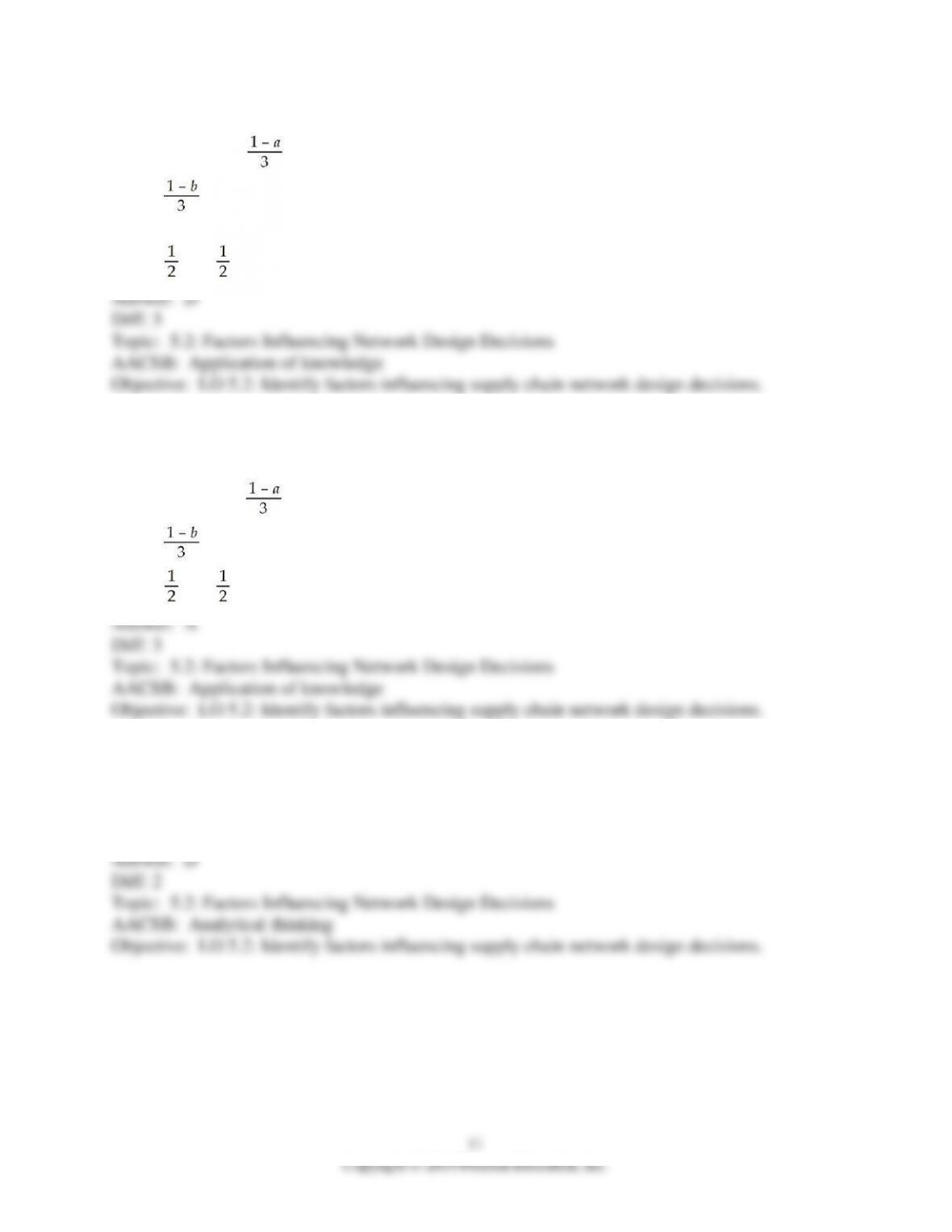
20) The demand at Firm 1 is given by
A) a +
B) a +
C) a –
D) a –
21) The demand at Firm 2 is given by
A) a +
B) a +
C)
D)
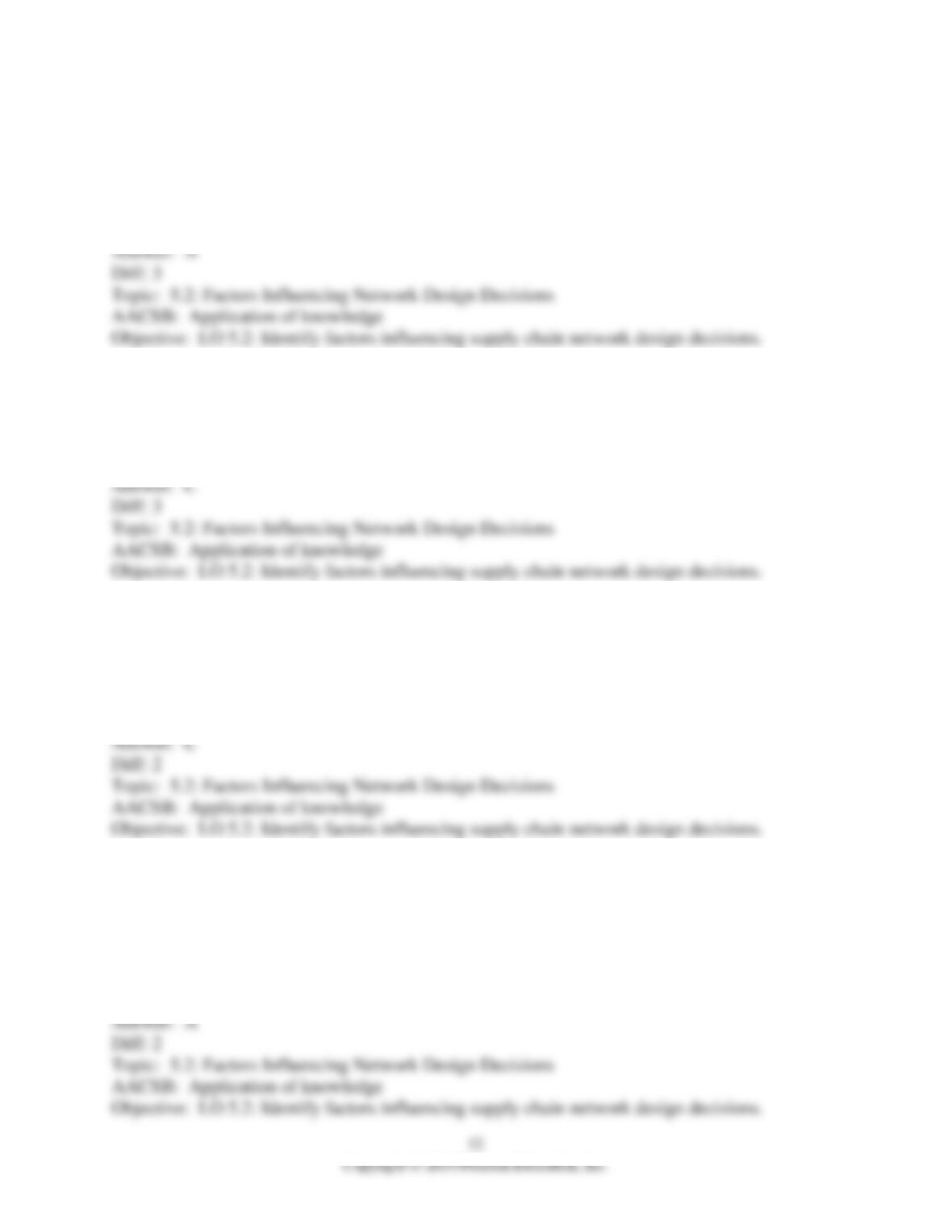
22) The market share is maximized for both firms if they locate at the point(s)
A) a = 1 – 3b; b =
B) a = ; b = 1 – 3a
C) a = 0; b = 1
D) a = ; b =
23) If the two firms compete on price and the customer incurs transportation cost, it may be
optimal for the two firms to locate at the point(s)
A) a = 0; b = 1
B) a = 1 – 3b; b =
C) a = ; b = 1 – 3a
D) a = ; b =
24) If facilities have lower fixed costs
A) a few high-capacity facilities are preferred because this helps lower transportation costs.
B) a few local facilities are preferred because this helps lower transportation costs.
C) many high-capacity facilities are preferred because this helps lower transportation costs.
D) many local facilities are preferred because this helps lower transportation costs.
25) If the production technology is very inflexible and product requirements vary from one
country to another, a firm has to set up
A) local facilities to serve the market in each country.
B) a few high-capacity facilities to serve the market in each country.
C) many local facilities because this helps lower transportation costs.
D) a few high-capacity facilities because this helps lower transportation costs.
26) If the technology is flexible,
A) it becomes more difficult to consolidate manufacturing in a few large facilities.
B) it becomes more difficult to distribute manufacturing in many local facilities.
C) it becomes easier to consolidate manufacturing in a few large facilities.
D) it becomes easier to consolidate manufacturing in many local facilities.
27) Duties that must be paid when products and/or equipment are moved across international,
state, or city boundaries are referred to as
A) taxes.
B) tax incentives.
C) tariffs.
D) incentives.
28) If a country has very high tariffs,
A) companies either do not serve the local market or set up manufacturing plants within the
country to save on duties.
B) companies do not serve the local market.
C) companies set up manufacturing plants within the country to save on duties.
D) companies will not serve the local market or set up manufacturing plants within the country to
save on duties.
29) Developing countries often create free trade zones where
A) duties and tariffs are imposed as long as production is used primarily for export.
B) duties and tariffs are imposed as long as production is used primarily for import.
C) duties and tariffs are relaxed as long as production is used primarily for export.
D) duties and tariffs are relaxed as long as production is used primarily for import.
30) Building some over-capacity in the supply chain network and making the capacity flexible
allows a firm to alter production flows within the supply chain to
A) produce less in facilities that have a lower cost based on current exchange rates.
B) produce more in facilities that have a lower cost based on current exchange rates.
C) produce more in facilities that have a higher cost based on current exchange rates.
D) produce less in facilities that have the same cost based on current exchange rates.
31) Total logistics costs are a sum of the
A) inventory and facility costs.
B) transportation and facility costs.
C) inventory and transportation costs.
D) inventory, transportation, and facility costs.
32) The facilities in a supply chain network must
A) at least maximize total logistics cost.
B) at least equal the number that maximizes total logistics cost.
C) at least equal the number that minimizes total logistics cost.
D) at least minimize total logistics cost.
33) Firms that focus on cost leadership tend to find the lowest-cost location might
A) locate far from their customers.
B) locate in a higher cost area to provide faster response.
C) have many facilities to take advantage of economies of scale.
D) increase inventory levels to reduce stockouts.
34) The quality of life at selected facility locations has a significant impact on performance
because
A) network designers can use this fact to influence the role of the new facility and the focus of
people working there.
B) facilities last a long time and have an enduring impact on a firm’s performance.
C) the location of a facility has a significant impact on the extent and form of communication
that develops in the supply chain network.
D) it influences the work force available and their morale.
35) ________ costs increase as the number of facilities in a supply chain increases.
A) Inventory
B) Transportation
C) Retail operation
D) Information
36) Capital, growth strategy, existing networks and global competition mostly affect which of
the four Global Network Design Decisions?
A) Phase I – Supply Chain Strategy
B) Phase II – Regional Facility Configuration
C) Phase III – Desirable Sites
D) Phase IV – Location Choices
37) The availability of suppliers, transportation services, communication, utilities, and
warehousing infrastructure mostly affect which of the four Global Network Design Decisions?
A) Phase I – Supply Chain Strategy
B) Phase II – Regional Facility Configuration
C) Phase III – Desirable Sites
D) Phase IV – Location Choices
38) Tariffs, economies of scale and aggregate factor costs mostly affect which of the four Global
Network Design Decisions?
A) Phase I – Supply Chain Strategy
B) Phase II – Regional Facility Configuration
C) Phase III – Desirable Sites
D) Phase IV – Location Choices
39) Available infrastructure, skill needs and response time mostly affect which of the four Global
Network Design Decisions?
A) Phase I – Supply Chain Strategy
B) Phase II – Regional Facility Configuration
C) Phase III – Desirable Sites
D) Phase IV – Location Choices

40) When faced with a network design decision, the goal of a manager is to design a network
that
A) maximizes the firm’s profits.
B) minimizes the firm’s costs.
C) satisfies customer needs in terms of demand and responsiveness.
D) maximizes the firm’s profits while satisfying customer needs in terms of demand and
responsiveness.
41) Which of the following is the first phase in the design of a global supply chain network?
A) Define a supply chain strategy
B) Define the regional facility configuration
C) Select desirable sites
D) Location choices
42) The objective of the first phase of network design is to
A) maximize total profits, taking into account the expected margin and demand in each market.
B) select a set of desirable sites within each region where facilities are to be located.
C) identify regions where facilities will be located, their potential roles, and their approximate
capacity.
D) specify what capabilities the supply chain network must have to support a firm’s competitive
strategy.
43) The objective of the second phase of network design is to
A) select a precise location and capacity allocation for each facility.
B) select a set of desirable sites within each region where facilities are to be located.
C) identify regions where facilities will be located, their potential roles, and their approximate
capacity.
D) specify what capabilities the supply chain network must have to support a firm’s competitive
strategy.
44) The objective of the third phase of network design is to
A) maximize total profits, taking into account the expected margin and demand in each market.
B) select a precise location and capacity allocation for each facility.
C) select a set of desirable sites within each region where facilities are to be located.
D) identify regions where facilities will be located, their potential roles, and their approximate
capacity.
45) It is very important that long-term consequences be thought through when making facility
decisions, because
A) network designers can use this fact to influence the role of the new facility and the focus of
people working there.
B) facilities last a long time and have an enduring impact on a firm’s performance.
C) it is astounding how often tax incentives drive the choice of location.
D) the location of a facility has a significant impact on the extent and form of communication
that develops in the supply chain network.