Supply Chain Management: Strategy, Planning, and Operation, 7e (Chopra)
Chapter 4 Designing Distribution Networks and Applications to e-Business
4.1 True/False Questions
1) Distribution occurs between every pair of stages in the supply chain.
2) Companies in the same industry often select very different distribution networks, because the
choice of the distribution network can be used to achieve a variety of supply chain objectives
ranging from low cost to high responsiveness.
3) A customer does not necessarily want the highest level of performance along all dimensions
of customer service, including response time, product variety, product availability, customer
experience, order visibility, and returnability.
4) Outbound transportation costs per unit tend to be lower than inbound costs, because inbound
lot sizes are typically larger.
5) Transportation costs are high with drop-shipping because the average outbound distance to the
end consumer is large and package carriers are used to shipping the product.
6) As long as inbound transportation economies of scale are maintained, increasing the number
of facilities decreases total transportation cost.
7) Customers always want the highest level of performance along all the dimensions response
time, product variety and returnability.
8) A decrease in the response time customers desire increases the number of facilities required in
the network.
9) The main advantage of in-transit merge over drop-shipping is the somewhat lower
transportation cost and improved customer experience.
10) The main advantage of a distribution network with local storage is that it can lower the
delivery cost and provide a faster response than other networks.
11) The major disadvantage of a distribution network with local storage is the increased
inventory and facility costs.
12) A distribution network designer needs to consider product characteristics as well as network
requirements when deciding on the appropriate delivery network.
13) Only niche companies will end up using a single distribution network.
14) Distributors add value to a supply chain between a supply stage and a customer stage if there
are many small players at the customer stage, each requiring a small amount of the product at a
time.
15) Omni-channel retailing refers to an interaction between a customer and a retailer in terms of
three flows —information, product and funds.
16) A well-structured omni-channel supply chain can be both cost effective and responsive to
customer needs.
17) For physical products, i.e., products that cannot be downloaded, customer requests take
longer to fulfill through online sales than in a retail store setting.
18) It is much easier to return a product to an online retailer than to a traditional bricks and
mortar seller.
19) Compared to a business with many retail outlets, an online seller with aggregated inventories
tends to have lower per unit transportation costs across the entire supply chain.
20) It is more common for a manufacturer to not own the distribution network.
21) Consumers prefer purchasing commoditized products at a one-stop shop.
22) To extract the maximum benefit from the online channel for physical goods, firms should
keep it separate from their existing supply chain networks.
1) The steps taken to move and store a product from the supplier stage to a customer stage in the
supply chain are referred to as
A) transportation.
B) retailing.
C) wholesaling.
D) distribution.
2) Where does distribution occur in the supply chain?
A) Between every pair of stages
B) Everywhere downstream from production
C) Between production and the retailer
D) Between suppliers and retailers
3) Distribution is a key driver of the overall profitability of a firm because
A) the addition of distributors only adds cost to the supply chain.
B) it directly impacts both the supply chain cost and the customer experience.
C) it slows down the responsiveness of the supply chain.
D) it cannot be developed as a part of supply chain strategy.
4) Companies in the same industry often select very different distribution networks because
A) some companies are poorly run.
B) different companies try to avoid using the same approach.
C) different companies have different objectives for their supply chain.
D) all of the above
5) Which of the following would not be the result of a poor/inappropriate distribution network?
A) High profitability
B) Low level of customer service
C) High cost
D) Poor profitability
6) The number of different products/configurations that a customer desires from the distribution
network is
A) response time.
B) product variety.
C) product availability.
D) customer experience.
7) The probability of having a product in stock when a customer order arrives is
A) response time.
B) product variety.
C) product availability.
D) customer experience.
8) The ease with which the customer can place and receive their order as well as other aspects of
value that the sales staff provides is
A) customer experience.
B) order visibility.
C) product availability.
D) response time.
9) The ability of the customer to track their order from placement to delivery is
A) customer experience.
B) order visibility.
C) product availability.
D) response time.
10) The amount of time it takes for a customer to receive their order is
A) order visibility.
B) time to market
C) product returnability.
D) response time.
11) The amount of time it takes to develop a product and have it available for sale is
A) order visibility.
B) time to market.
C) product returnability.
D) response time.
12) The ease with which a supplier can take delivery of product a customer is dissatisfied with is
A) order visibility.
B) time to market.
C) product returnability.
D) response time.
13) The costs incurred in bringing material into a facility are
A) sourcing transportation costs.
B) outbound transportation costs.
C) crossbound transportation costs.
D) inbound transportation costs.
14) The costs incurred in sending material out of a facility are
A) sourcing transportation costs.
B) outbound transportation costs.
C) crossbound transportation costs.
D) inbound transportation costs.
15) Outbound transportation costs per unit tend to be
A) about the same as inbound costs.
B) higher than inbound costs.
C) lower than inbound costs.
D) neither higher or lower than inbound costs.
16) As the number of facilities in a supply chain increases
A) the inventory and resulting inventory costs also increase.
B) the inventory and resulting inventory costs decrease.
C) the inventory increases and resulting inventory costs decrease.
D) the inventory decreases and resulting inventory costs increase.
17) As the response time desired by the customer decreases, the required number of facilities in
the distribution network
A) decreases.
B) remains the same.
C) increases.
D) increases and then decreases.
18) As the number of facilities in a supply chain increases, total facility costs
A) decrease.
B) increase.
C) increase to a point and then decrease.
D) decrease to a point and then increase.
19) Total logistics costs for a supply chain network are a sum of
A) inventory and facility costs.
B) inventory, facility, and distributor costs.
C) facility, transportation, and distributor costs.
D) inventory, transportation, and facility costs.
20) In which distribution network design is product shipped directly from the manufacturer to the
end customer, bypassing the retailer (who takes the order and initiates the delivery request)?
A) Manufacturer storage with direct shipping
B) Manufacturer storage with direct shipping and in-transit merge
C) Distributor storage with package carrier delivery
D) Distributor storage with last mile delivery
21) Which distribution network is also referred to as drop-shipping with product delivered
directly from the manufacturer to the customer location?
A) Manufacturer storage with direct shipping
B) Manufacturer storage with direct shipping and in-transit merge
C) Distributor storage with package carrier delivery
D) Distributor storage with last mile delivery
22) Which of the following is an advantage of manufacturer storage with direct shipping?
A) Transportation costs are low because the average outbound distance to the end consumer is
small and package carriers are used to shipping the product.
B) Supply chains save on the fixed cost of facilities, because the need for other warehousing
space in the supply chain has been eliminated.
C) Response times tend to be small because the order has to be transmitted from the retailer to
the manufacturer.
D) Order tracking is easy to implement because of the complete integration of information
systems at both the retailer and the manufacturer.
23) Which of the following would be a disadvantage of manufacturer storage with direct
shipping?
A) The ability to reduce cost of inventory by centralizing inventories at the manufacturer.
B) The manufacturer has to postpone customization until after the customer order has been
placed.
C) Supply chains have to eliminate other warehousing space to save on the fixed cost of
facilities.
D) Response times tend to be large because the order has to be transmitted from the retailer to
the manufacturer and shipping distances are on average longer from the manufacturer’s
centralized site.
24) Which distribution network design is similar to pure drop-shipping, except that pieces of the
order coming from different locations are combined so that the customer gets a single delivery?
A) Manufacturer storage with direct shipping
B) Manufacturer storage with direct shipping and in-transit merge
C) Distributor storage with package carrier delivery
D) Distributor storage with manufacturer pickup
25) The main advantage of in-transit merge over drop-shipping is
A) the ability to reduce cost of inventory by centralizing inventories at the manufacturer.
B) supply chains save on the fixed cost of facilities, because the need for other warehousing
space in the supply chain has been eliminated.
C) somewhat lower transportation cost and improved customer experience.
D) order tracking is easy to implement because of the complete integration of information
systems at both the retailer and the manufacturer.
26) The major disadvantage of in-transit merge compared to drop-shipping is
A) transportation costs are high because the average outbound distance to the end consumer is
large and package carriers are used to shipping the product.
B) response times tend to be large because the order has to be transmitted from the retailer to the
manufacturer and shipping distances are on average longer from the manufacturer’s centralized
site.
C) order tracking becomes harder to implement because it requires complete integration of
information systems at both the retailer and the manufacturer.
D) the additional effort during the merge itself.
27) Which distribution network design is being used when inventory is not held by
manufacturers at the factories, but is held by distributors/retailers in intermediate warehouses and
package carriers are used to transport products from the intermediate location to the final
customer?
A) Manufacturer storage with direct shipping
B) Manufacturer storage with direct shipping and in-transit merge
C) Distributor storage with package carrier delivery
D) Distributor storage with manufacturer pickup
28) Which of the following is an advantage of distributor storage with carrier delivery?
A) Inventory cost is higher than with manufacturer storage.
B) Product variety is lower than with manufacturer storage.
C) Order visibility for the customer is easier than with manufacturer storage.
D) Higher cost to provide the same level of product availability as manufacturer storage.
29) Which of the following is a disadvantage of distributor storage with carrier delivery?
A) Information infrastructure is simpler than manufacturer storage.
B) Response time is faster than with manufacturer storage.
C) Returnability is easier than with manufacturer storage.
D) Product variety is lower than with manufacturer storage.
30) Which distribution network design is being used when the distributor/retailer delivers the
product to the customer’s home instead of using a package carrier?
A) Manufacturer storage with direct shipping
B) Manufacturer/distributor storage with customer pickup
C) Distributor storage with package carrier delivery
D) Distributor storage with last mile delivery
31) Which of the following is an advantage of distributor storage with last mile delivery?
A) It is more expensive to provide product availability than any other option except retail stores.
B) Inventory cost is higher than distributor storage with package carrier delivery.
C) Response time is very quick ranging from same day to next day delivery.
D) Transportation cost is higher than any other distribution option.
32) Which of the following is a disadvantage of distributor storage with last mile delivery?
A) Transportation cost is higher than any other distribution option.
B) Information cost is similar to distributor storage with package carrier delivery.
C) Customer experience is very good, particularly for bulky items.
D) Returnability is easier to implement than other options.
33) Which distribution network design is being used when inventory is stored at the
manufacturer or distributor warehouse but customers place their orders online or on the phone
and then come to designated pickup points to collect their orders?
A) Manufacturer storage with direct shipping
B) Manufacturer/distributor storage with customer pickup
C) Distributor storage with package carrier delivery
D) Distributor storage with last mile delivery
34) Which of the following is an advantage of manufacturer/distributor storage with customer
pickup?
A) Facility costs can be very high if new facilities have to be built.
B) Transportation cost is lower than the use of package carriers, especially if using an existing
delivery network.
C) Order visibility is difficult but essential.
D) Product variety is similar to other manufacturer or distributor storage options.
16
35) Which of the following is a disadvantage of manufacturer/distributor storage with customer
pickup?
A) Customer experience is lower than other options because of the lack of home delivery.
B) Response time is similar to package carrier delivery with manufacturer or distributor storage.
C) Returnability is somewhat easier given that pickup location can handle returns.
D) Product availability is similar to other manufacturer or distributor storage options.
36) A retailer delivers products all the way to the customer’s home without using a package
carrier. This type of service is named
A) full service delivery.
B) turnkey shopping.
C) last mile delivery.
D) disintermediation.
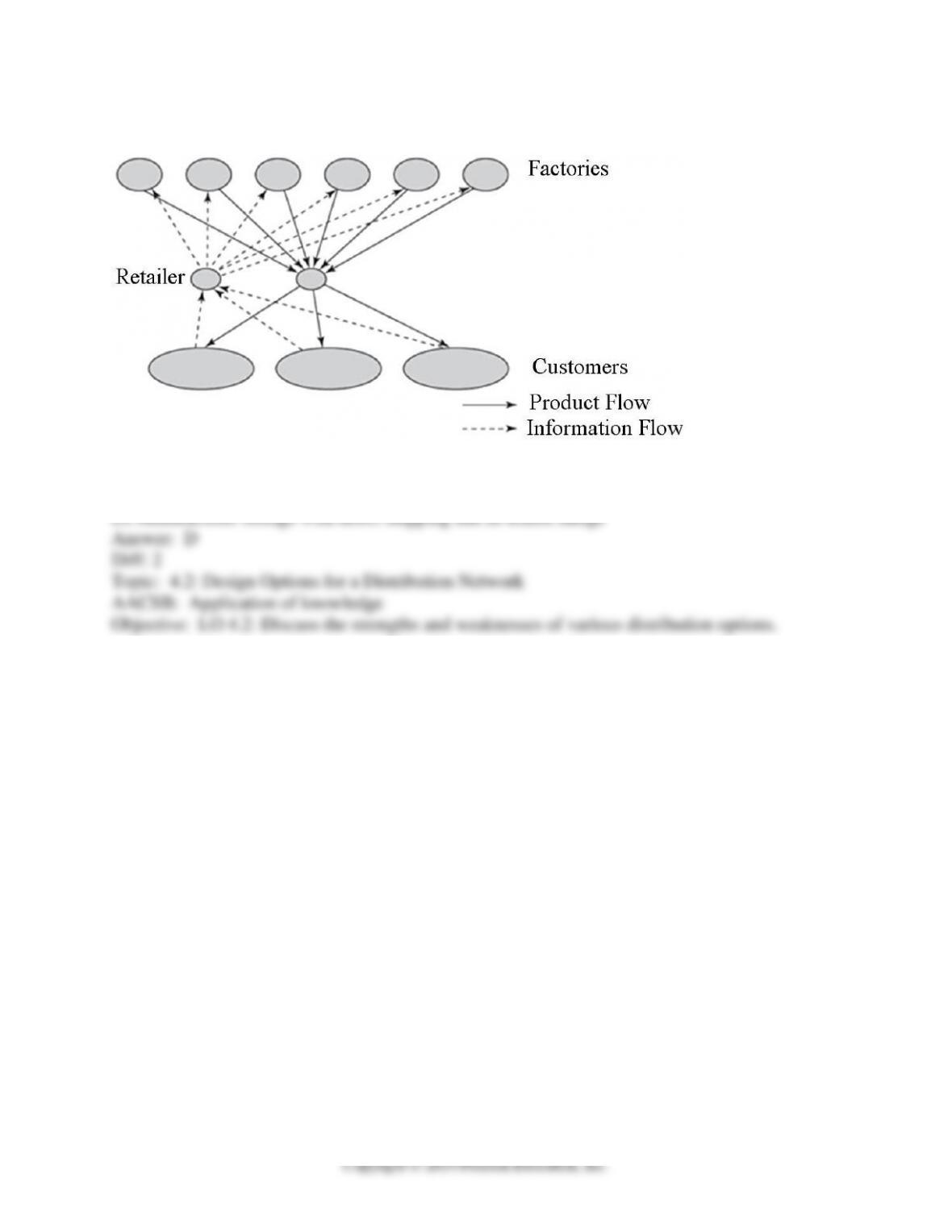
17
37) What type of distribution network is shown in this diagram?
A) Distributor storage with carrier delivery
B) Manufacturer/distributor storage with customer pickup
C) Distributor storage with last-mile delivery