27) The curve that shows the lowest possible cost for a given level of responsiveness is referred
to as the
A) supply chain responsiveness curve.
B) supply chain efficiency curve.
C) cost-responsiveness efficient frontier.
D) responsiveness spectrum.
28) A firm that is not on the cost-responsiveness efficient frontier can improve
A) both responsiveness and cost performance.
B) only responsiveness.
C) only cost performance.
D) responsiveness, but not cost performance.
29) A graph with two axes with implied uncertainty along the horizontal axis and responsiveness
along the vertical axis is referred to as the
A) implied uncertainty spectrum.
B) responsiveness spectrum.
C) uncertainty/responsiveness map.
D) zone of strategic fit.
30) The relationship where increasing implied uncertainty from customers and supply sources is
best served by increasing responsiveness from the supply chain is known as the
A) implied uncertainty spectrum.
B) responsiveness spectrum.
C) uncertainty/responsiveness map.
D) zone of strategic fit.
31) The drive for strategic fit should come from
A) the supply chain manager.
B) the strategic planning department.
C) the highest levels of the organization.
D) middle management.
32) The preferable supply chain strategy for a firm that sells multiple products and serves
customer segments with very different needs is to
A) set up independent supply chains for each different product or customer segment.
B) set up a supply chain that meets the needs of the highest volume product or customer
segment.
C) tailor the supply chain to best meet the needs of each product’s demand.
D) set up a supply chain that meets the needs of the customer segment with the highest implied
uncertainty.
33) Which of the following would be a demand and supply characteristic toward the beginning
stages of a product’s life cycle?
A) Demand has become more certain and supply is predictable.
B) Margins are lower due to an increase in competitive pressure.
C) Product availability is crucial to capturing the market.
D) Price becomes a significant factor in customer choice.
34) Between 1993 and 2006, Dell’s competitive strategy was to provide a large variety of
customizable products at a reasonable price. Given the focus on customization, Dell’s supply
chain was designed to
A) be responsive.
B) provide a different product.
C) operate on a low-cost basis.
D) provide sustainable products.
35) For a company to achieve strategic fit, it must accomplish which of the following keys?
A) The company should have a functional area for each customer.
B) The different functions in a company must each have a strategy that is optimal for their own
processes.
C) The overall supply chain must operate at the lowest cost possible to achieve success.
D) The design of the overall supply chain and the role of each stage must detailed in the annual
report.
36) Efficient supply chains
A) respond quickly to demand.
B) have higher margins because price is not a prime customer driver.
C) maintain buffer inventory to deal with demand/supply uncertainty.
D) maximize performance at a minimum cost.
37) A mechanic invests in a basic set of sockets and open ended wrenches and waits patiently
under a shade tree for the next car to pull up. Under the watchful eye of his dog Spike, the
mechanic can service any make or model car. They never know what type of car and what
problem they will face each day, but are prepared for this uncertainty thanks to
A) excess capacity.
B) flexible capacity.
C) information.
D) Spike.
38) Ron Popiel is so convinced that his next product, the Thong-O-Matic, will be a big hit, that
he has contracted with the three largest outsource call centers in Bangalore India before his first
infomercial airs. “Operators truly will be standing by,” Ron confides in his twin Don, “as I extoll
the virtues of this device that can help a person get dressed in the morning.” Forecasts for
demand are all over the place, which is why Ron has elected to pull the
A) excess capacity lever.
B) flexible capacity lever.
C) information lever.
D) patient customer lever.
39) Wilma has spent a decade perfecting her Hoagie Cannon, which is capable of firing a
submarine sandwich as a projectile across a five-mile radius of Upper Darby Township.
Customers simply type in their coordinates on Wilma’s app, and literally within seconds, they
will receive an incoming hoagie with their choice of cold cuts and dressing. Wilma’s uncertainty
demons are kept at bay with her skillful use of her
A) excess capacity lever.
B) flexible capacity lever.
C) time lever.
D) patient customer lever.
40) Wilma has invested in a 30,000-square foot warehouse to stock a wide variety of cold cuts
and dressings for her hoagie shop in Upper Darby Township. There is no order she has been
unable to accept and fill promptly over her forty years in the same location. Wilma’s approach to
mitigating uncertainty is by the use of
A) excess capacity.
B) flexible capacity.
C) time.
D) inventory.
41) An aggressive investment in customer analytics represents the use of which lever to reduce
supply chain uncertainty?
A) Information
B) Flexible capacity
C) Time
D) Inventory
42) The Boeing 747 was scheduled to take off from Will Rogers Airport bound for Galeão
International in just two days and with only four seats booked, the holiday getaway appeared to
be a money-losing proposition. Bob lowered the airfare 90% and hoped to make up the loss of
logistical revenue by doubling the price of caipirinhas and samba drums throughout the trip. Bob
has handled uncertainty using which tool?
A) Information
B) Price
C) Time
D) Inventory
43) The functions and stages that devise an integrated strategy with an aligned objective are
referred to as
A) competitive strategy.
B) supply chain strategy.
C) scope of strategic fit.
D) scope of marketing strategy.
44) With the ________ view, firms attempt to align all operations within a function. In this view,
all supply chain functions including sourcing, manufacturing, warehousing, and transportation
must align their strategy to minimize total functional cost.
A) intrafunctional scope
B) intraoperation scope
C) interfunctional scope
D) intercompany scope
45) The key weakness of the ________ view is that different functions within a firm may have
conflicting objectives.
A) intrafunctional scope
B) intraoperation scope
C) interfunctional scope
D) intercompany scope
46) Which of these has the broader range?
A) intrafunctional scope
B) intercompany scope
C) interfunctional scope
D) intraoperational scope
47) Scope of strategic fit refers to both the
A) function within the firm and the satisfaction of the customer.
B) satisfaction of the customer and the profits returned to the shareholders.
C) function within the firm and stages across the supply chain.
D) profits returned to the shareholders and the stages across the supply chain.
48) The authors cite IKEA as achieving an intercompany scope of strategic fit which serves to
A) minimize IKEA’s costs.
B) align the strategic fit with the consumer surplus.
C) minimize the costs of all supply chain elements.
D) increase the supply chain surplus.
49) A company’s partners in the supply chain determine
A) the company’s success.
B) the scope of strategic fit.
C) the relevance of sustainability initiatives.
D) the need for customers.
50) Company A and Company B of the same supply chain rely on market responsiveness to
attract customers. Each company has access to the other company’s designs, production
schedules, and goals, and if Company A needs product overnight, Company B gladly ships it,
knowing that in the long run it works to the benefit of both. Such an arrangement is an example
of
A) intrafunctional scope.
B) intraoperation scope.
C) interfunctional scope.
D) intercompany scope.
2.3 Essay Questions
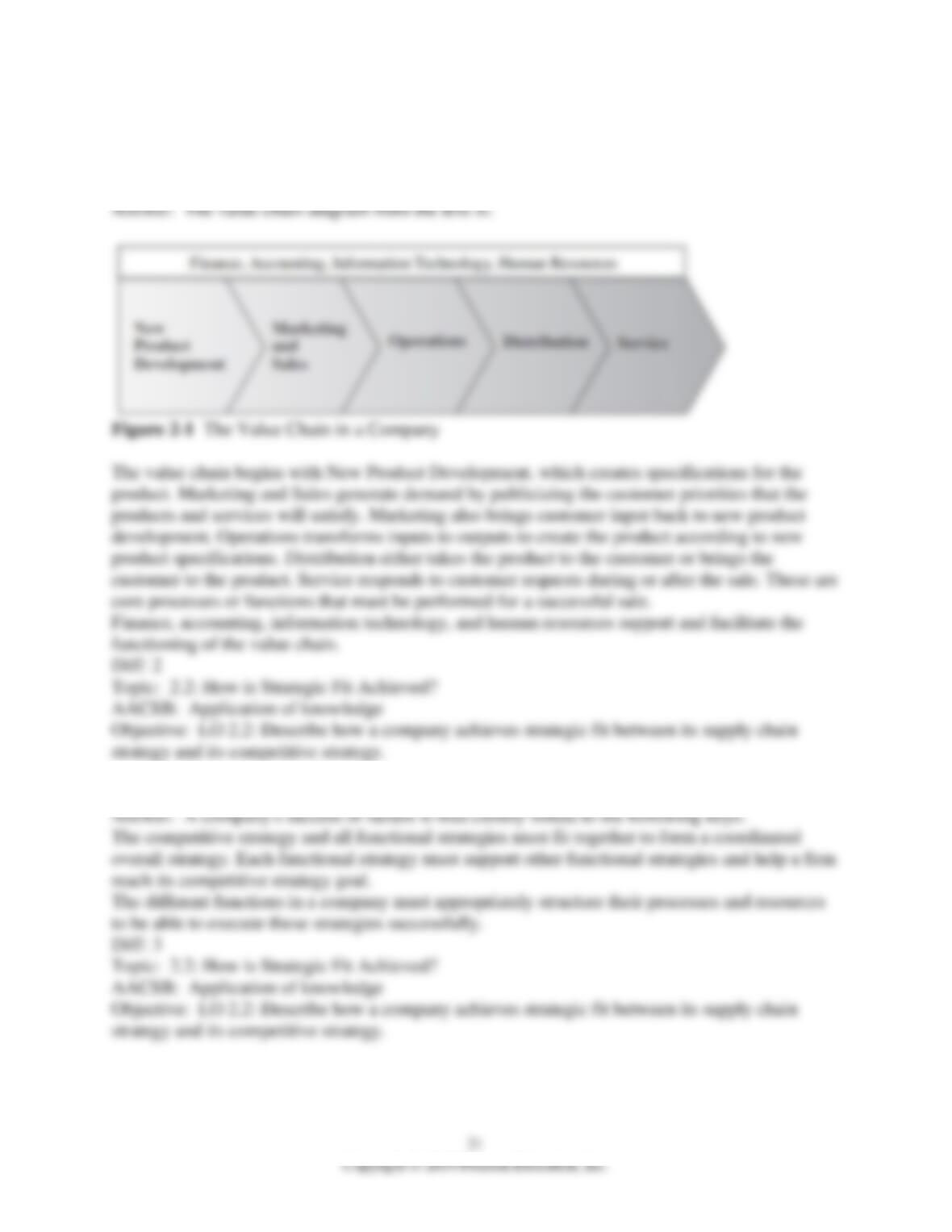
1) Sketch the generic value chain for a company and briefly describe the contributions of each of
its elements.
2) Discuss the two keys to the success or failure of a company.
3) List and explain the three basic steps to achieving strategic fit.
4) Discuss the impact of the product life cycle on strategic fit between implied demand
uncertainty and supply chain responsiveness.
23
5) What are any four ways that a supply chain can help reduce the impact of uncertain demand
and which is most appropriate to use?
6) Explain scope of strategic fit.