Exam
Name___________________________________
MULTIPLE CHOICE. Choose the one alternative that best completes the statement or answers the question.
Provide an appropriate response.
1)
Given that f(x) =x
7 – x , find f –4
5. Express the answer as a simplified fraction.
A)
–4
39
B)
–39
4
C)
4
39
D)
39
4
Answer:
A
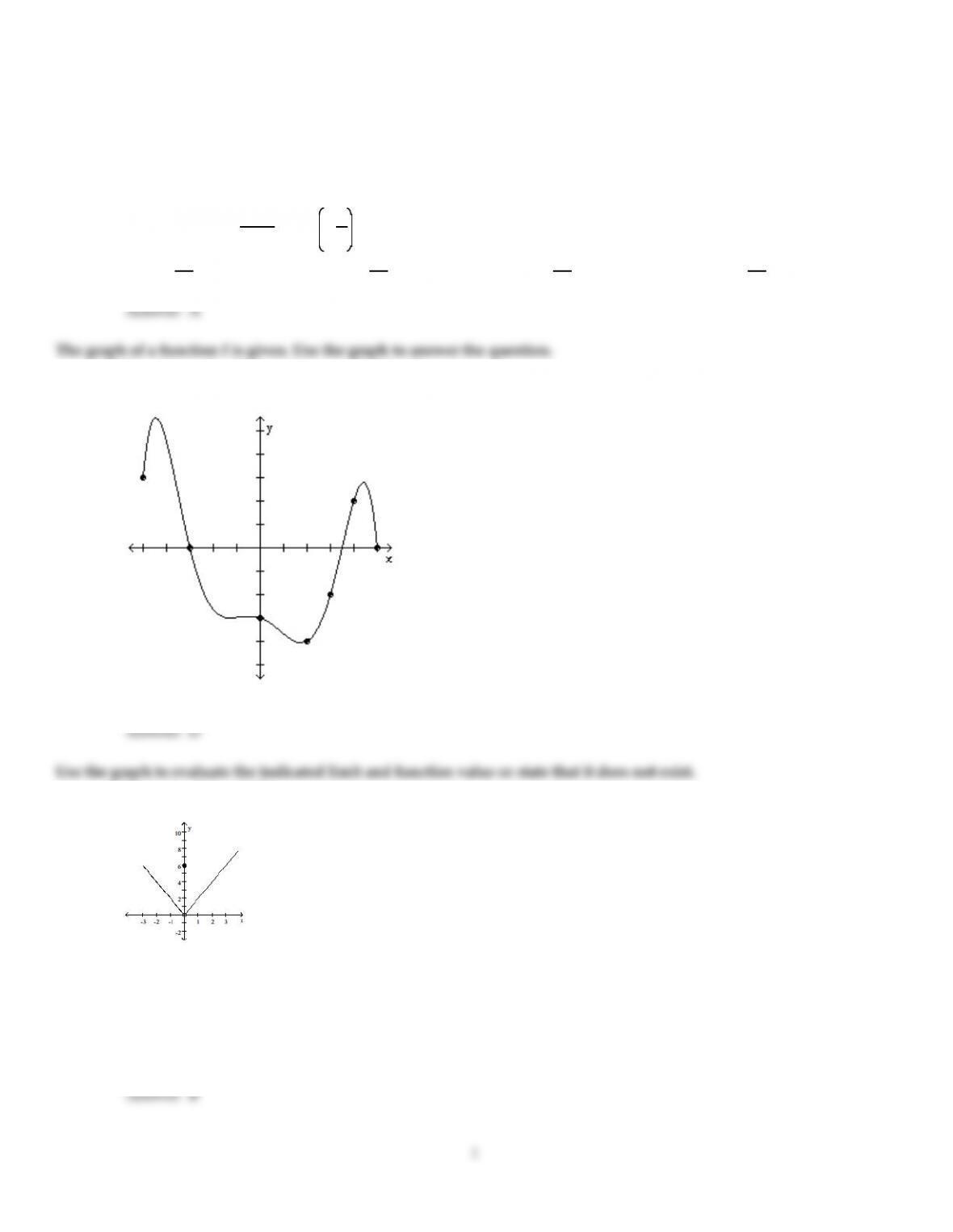
The graph of a function f is given. Use the graph to answer the question.
2)
Use the graph of f given below to find f(–10).
10
–10 10
–10
A)
16
B)
–10
C)
0
D)
6
Answer:
D
Use the graph to evaluate the indicated limit and function value or state that it does not exist.
3)
Find lim
x
0f(x) and f(0).
A)
Does not exist; 6
B)
0; 6
C)
0; does not exist
D)
6; 0
Answer:
B
1

4)
Find lim
x
0–
f(x) and lim
x
0+
f(x).
A)
3; –1
B)
3; Does not exist
C)
Does not exist; does not exist
D)
–1; 3
Answer:
A
Find the limit, if it exists.
5)
Find: lim
x–1
6x + 5
5x – 6
A)
–11
B)
–1
11
C)
1
D)
1
11
Answer:
D
6)
Given lim
x
4f(x) = – 2 and lim
x
4 g(x) = 5, find lim
x
4
[g(x) – f(x)]
– 4 f(x) .
A)
–7
8
B)
3
8
C)
7
8
D)
–3
8
Answer:
C
7)
Find: lim
x– 4
x2– 16
x + 4
A)
– 24
B)
8
C)
16
D)
–8
Answer:
D
8)
Find: lim
x
5
x – 5
x – 5
A)
–1
B)
0
C)
1
D)
Does not exist
Answer:
D
9)
Find: lim
x
3
x2– 9
x – 3 +x2+ 7
A)
10
B)
3
C)
2
D)
Does not exist
Answer:
A
2

10)
Find: lim
x
3
x – 3
x2– 3x
A)
0
B)
–1
3
C)
1
3
D)
Does not exist
Answer:
D
11)
Given lim
x
5f(x) = 4 and lim
x
5 g(x) = – 5, find lim
x
5
2f(x) + 3g(x)
3f(x) .
A)
–7
15
B)
–7
12
C)
7
12
D)
7
15
Answer:
B
12)
Evaluate the following limit
lim
x
2
1
x – 2
A)
2
B)
–
C)
D)
Does not exist
Answer:
D
13)
Let f(x) =x2– 3x – 10
x + 2 . Find lim
x–2f(x).
A)
–2
B)
5
C)
–7
D)
Does not exist
Answer:
C
14)
Let f(x) =
x2– 16
x + 4 if x > 0
x2– 16
x – 4 if x < 0
Find lim
x
0f(x).
A)
–4
B)
C)
4
D)
Does not exist
Answer:
C
15)
Let f(x) =
x2– 16
x + 4 if x > 0
x2– 16
x – 4 if x < 0
Find lim
x
0f(x)
A)
4
B)
0
C)
–4
D)
Does not exist
Answer:
C
3
16)
Let f(x) =
x2– 16
x + 4 if x > 0
x2– 16
x – 4 if x < 0
Find lim
x
0
f(x).
A)
–4
B)
–
C)
0
D)
Does not exist
Answer:
D
17)
Evaluate the following limit.
lim
x
2
1
x – 2
A)
2
B)
–
C)
D)
Does not exist
Answer:
D
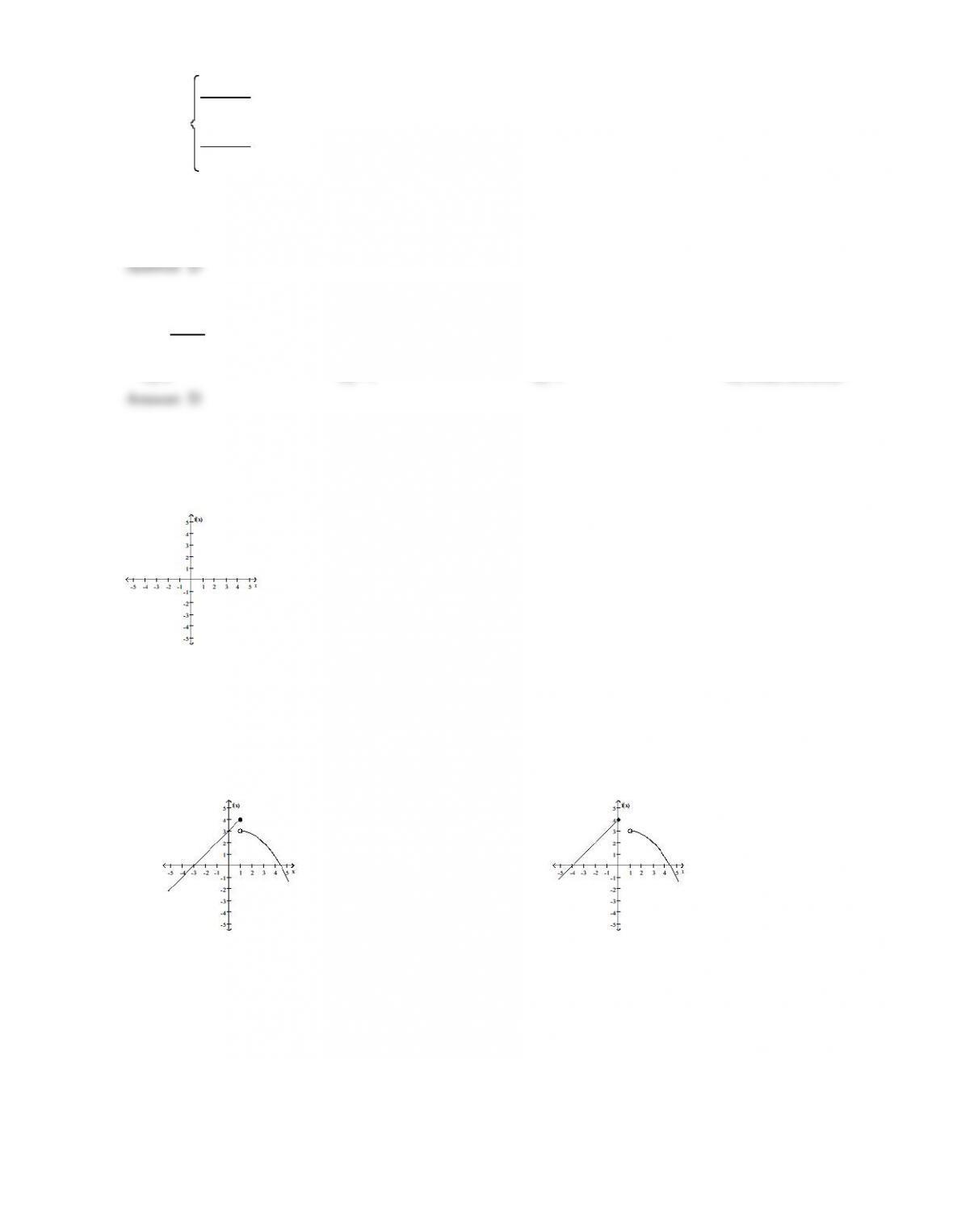
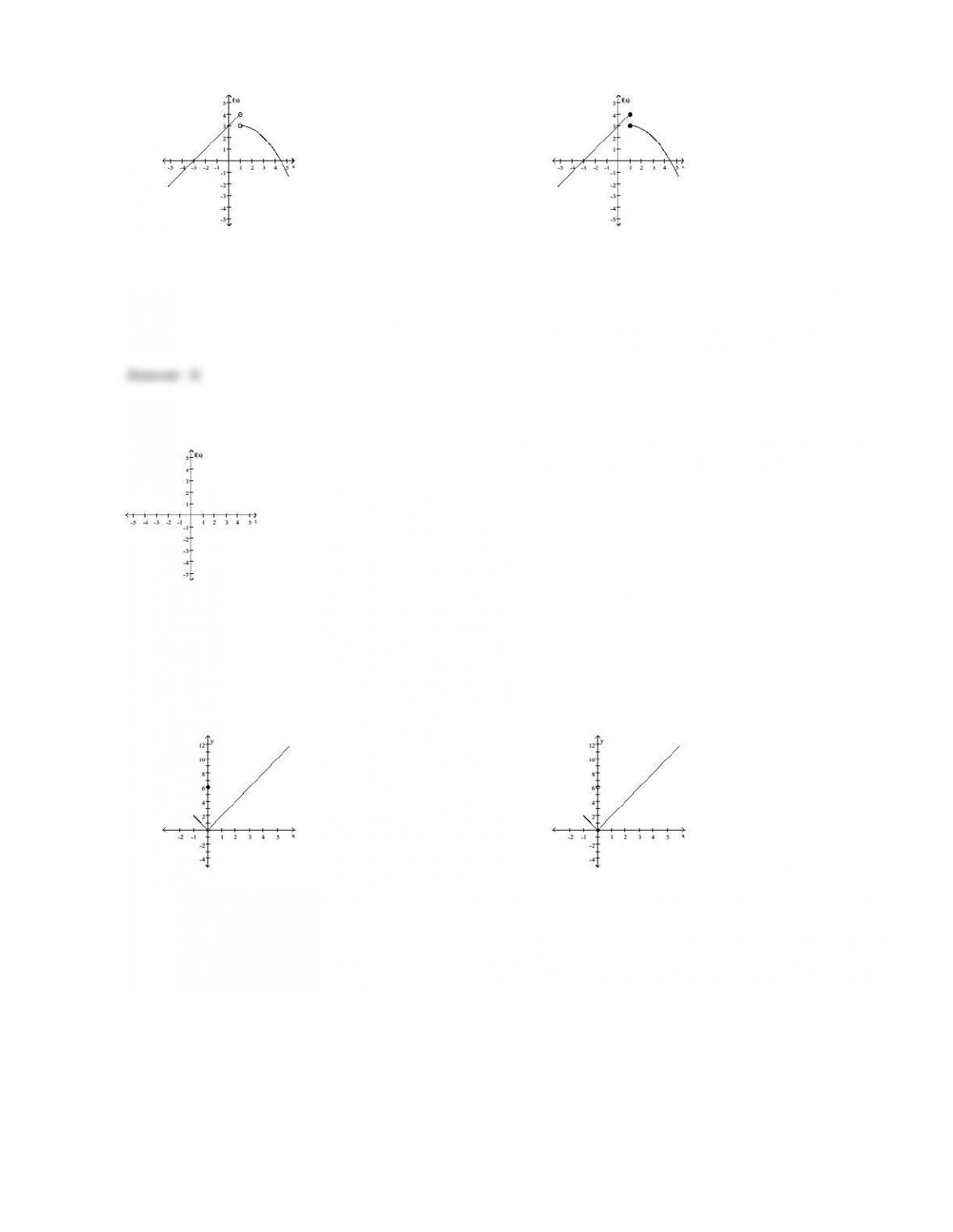
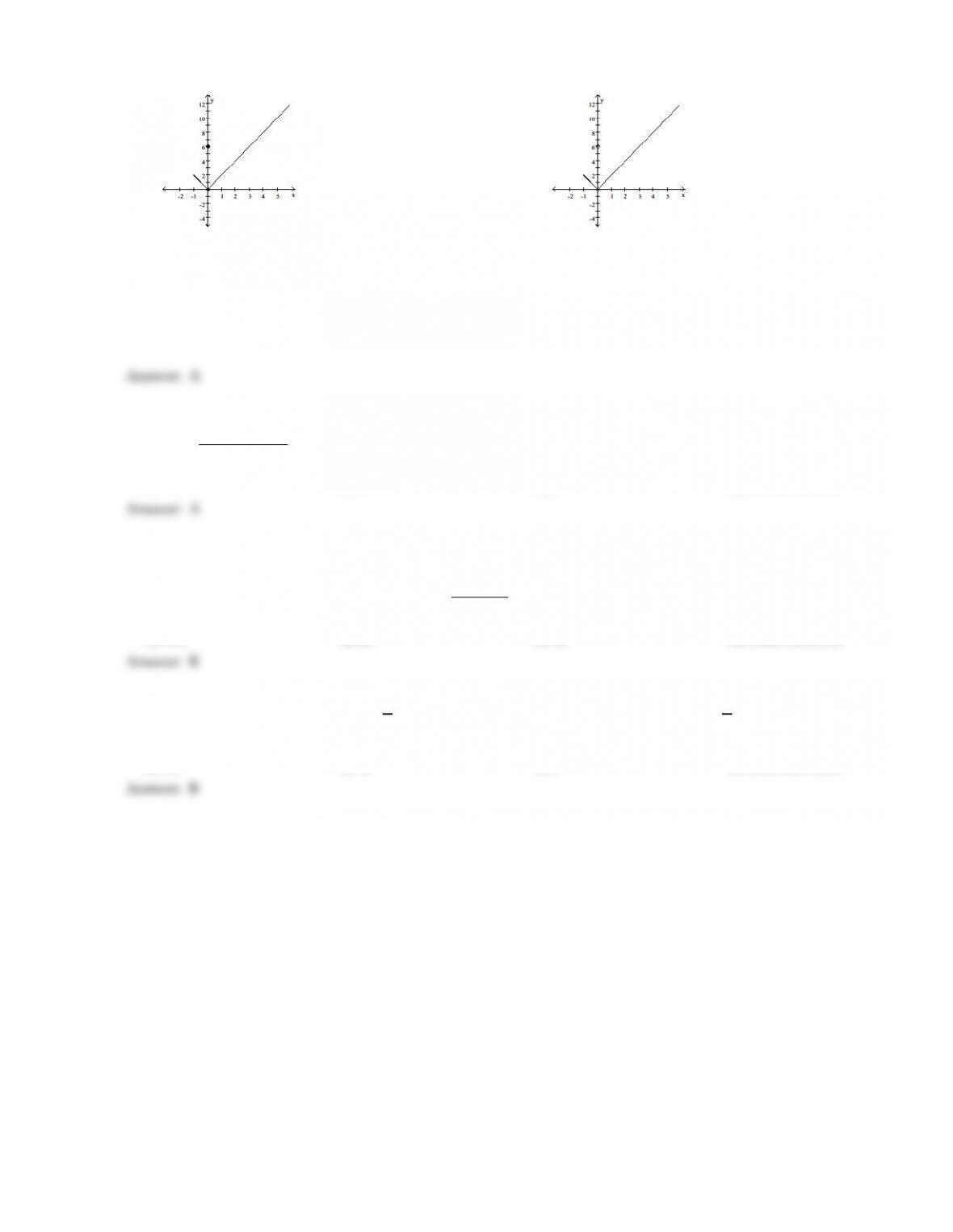
Sketch a possible graph of a function that satisfies the given conditions.
18)
f(1) = 4; lim
x
1–
f(x) = 4; lim
x
1+
f(x) = 3
A)
B)
4
C)
D)
Answer:
A
19)
f(0) = 6; lim
x
0–
f(x) = 0; lim
x
0+
f(x) = 0
A)
B)
5
C)
D)
Answer:
A
Find the limit, if it exists.
20)
Find: lim
h
0
f(7 + h) – f(7)
h for f(x) = – x + 1.
A)
–1
B)
1
C)
0
D)
Does not exist
Answer:
A
Solve the problem.
21)
A company training program determines that, on average, a new employee can do P(x) pieces of work per day
after s days of on–the–job training, where P(x) =90 + 60x
x + 5 . Find lim
x
5
P(x).
A)
105
B)
30
C)
42
D)
Does not exist
Answer:
B
22)
The cost of manufacturing a particular videotape is C(x) = 9000 + 9x, where x is the number of tapes produced.
The average cost per tape, denoted by C(x), is found by dividing C(x) by x. Find lim
x
9000 C(x).
A)
14
B)
10
C)
6
D)
Does not exist
Answer:
B
6
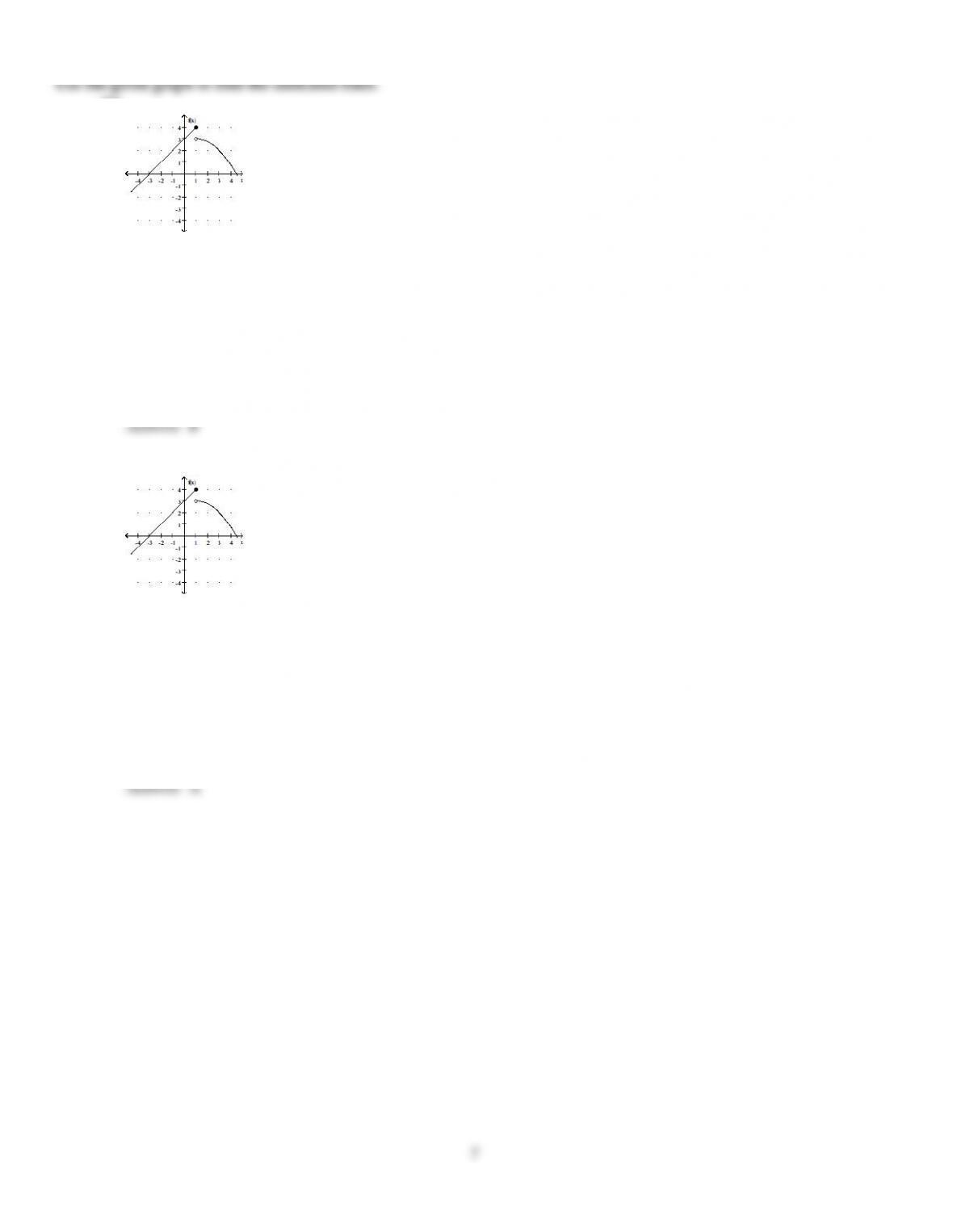
Use the given graph to find the indicated limit.
23)
Find lim
x f(x).
A)
3
B)
C)
4
D)
Answer:
B
24)
Find lim
x f(x).
A)
B)
3
C)
D)
4
Answer:
A
7
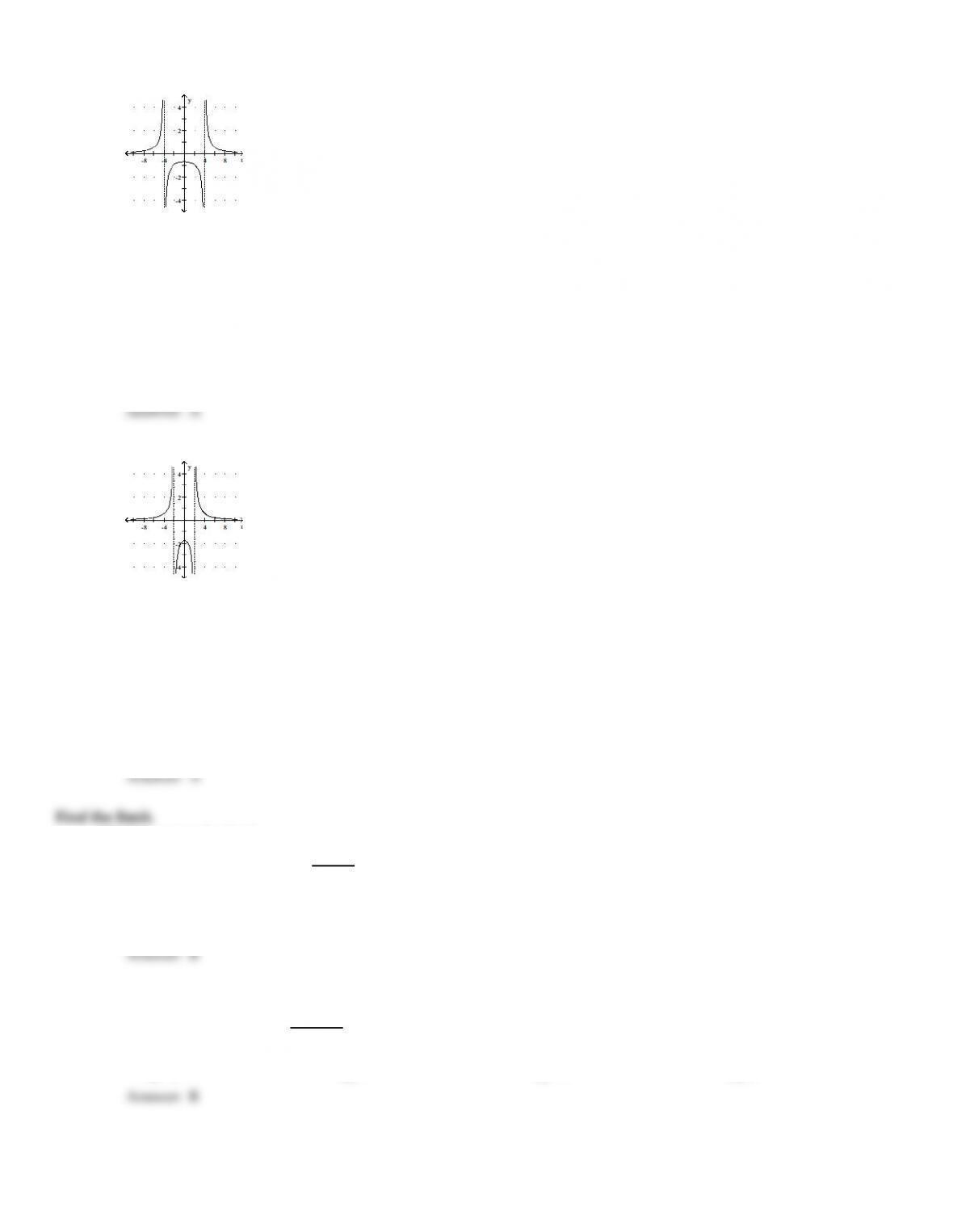
25)
lim
x
4+
f(x)
A)
B)
4
C)
D)
0
Answer:
A
26)
lim
x
2–
f(x)
A)
B)
0
C)
D)
2
Answer:
A
Find the limit.
27)
Determine the limit.
lim
x –10 –
f(x), where f(x) =1
x + 10
A)
B)
–
C)
0
D)
–1
Answer:
B
28)
Determine the limit.
lim
x
5+
f(x), where f(x) =x2
(x – 5)3
A)
–2
B)
C)
–
D)
5
Answer:
B
8
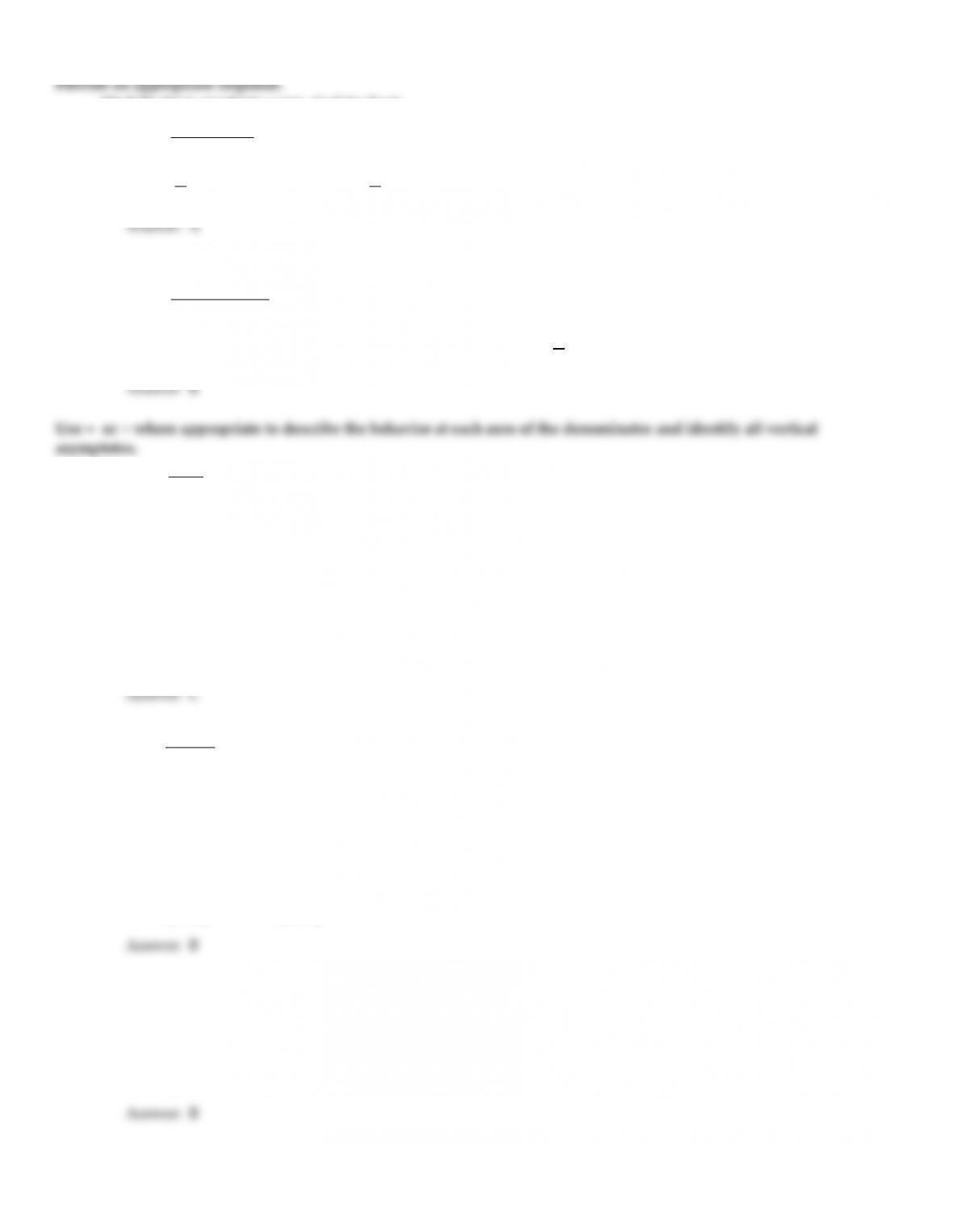
Provide an appropriate response.
29)
If the limit at infinity exists, find the limit.
lim
x
5x2+ 7x – 9
– 6x2+ 2
A)
–5
6
B)
–2
9
C)
D)
0
Answer:
A
30)
If the limit at infinity exists, find the limit.
lim
x
3x3+ 5x
4x4+ 10x3+ 2
A)
1
B)
0
C)
3
4
D)
Answer:
B
Use or
where appropriate to describe the behavior at each zero of the denominator and identify all vertical
asymptotes.
31)
g(x) =x
6 – x
A)
lim
x
6–
f(x) = ; lim
x
6+
f(x) = ; x = 6 is a vertical asymptote
B)
lim
x
6–
f(x) =
; lim
x
6+
f(x) = ; x = 0 is a vertical asymptote
C)
lim
x
6–
f(x) =
; lim
x
6+
f(x) = ; x = 6 is a vertical asymptote
D)
lim
x
6–
f(x) = ; lim
x
6+
f(x) =
; x = 6 is a vertical asymptote
Answer:
C
32)
f(x) =x2– 16
x2+ 16
A)
lim
x
4–
f(x) =
; lim
x
4+
f(x) =
; x = 0 is a vertical asymptote
B)
No zeros of denominator; no vertical asymptotes
C)
lim
x
4–
f(x) =
; lim
x
4+
f(x) = ; x = 4 is a vertical asymptote
D)
lim
x –4–
f(x) =
; lim
x –4+
f(x) = ; x = – 4 is a vertical asymptote
Answer:
B
Describe the end behavior of the function.
33)
f(x) = 5x4+ 5x + 11
A)
lim
x f(x) = ; lim
x f(x) =
B)
lim
x f(x) =
; lim
x f(x) =
C)
lim
x f(x) =
; lim
x f(x) =
D)
lim
x f(x) = ; lim
x f(x) =
Answer:
B
9

Provide an appropriate response.
34)
Find the vertical asymptote(s) of the graph of the given function.
f(x) =3x – 9
5x + 30
A)
x = – 8
B)
y = 8
C)
x = – 6
D)
y = – 3
Answer:
C
35)
Find the vertical asymptote(s) of the graph of the given function.
f(x) =x2– 100
(x – 9)(x + 3)
A)
x = 10, x = – 10
B)
x = – 9
C)
y = 9, y = – 3
D)
x = 9, x = – 3
Answer:
D
36)
Find the horizontal asymptote, if any, of the given function.
f(x) =(x – 3)(x + 4)
x2– 4
A)
x = 2, x = – 2
B)
y = 1
C)
y = 3, y = – 4
D)
None
Answer:
B
37)
Find the horizontal asymptote, if any, of the given function.
f(x) =2x3– 3x – 9
9x3– 5x + 3
A)
y = 0
B)
y =2
9
C)
y =3
5
D)
None
Answer:
B
Solve the problem.
38)
Suppose that the value V of a certain product decreases, or depreciates, with time t, in months, where
V(t) =33 –16t2
(t + 2) 2 .
Find lim
t V(t).
A)
29
B)
33
C)
16
D)
17
Answer:
D
39)
Suppose that the value V of a certain product decreases, or depreciates, with time t, in months, where
V(t) = 100 –40t2
(t + 2) 2 .
Find lim
t V(t).
A)
80
B)
40
C)
60
D)
100
Answer:
C
10
40)
Suppose that the cost C of removing p% of the pollutants from a chemical dumping site is given by
C(p) =$35,000
100 – p .
Can a company afford to remove 100% of the pollutants? Explain.
A)
No, the cost of removing p% of the pollutants is $350, which is a prohibitive amount of money.
B)
Yes, the cost of removing p% of the pollutants is $35,000, which is certainly affordable.
C)
Yes, the cost of removing p% of the pollutants is $350, which is certainly affordable.
D)
No, the cost of removing p% of the pollutants increases without bound as p approaches 100.
Answer:
D
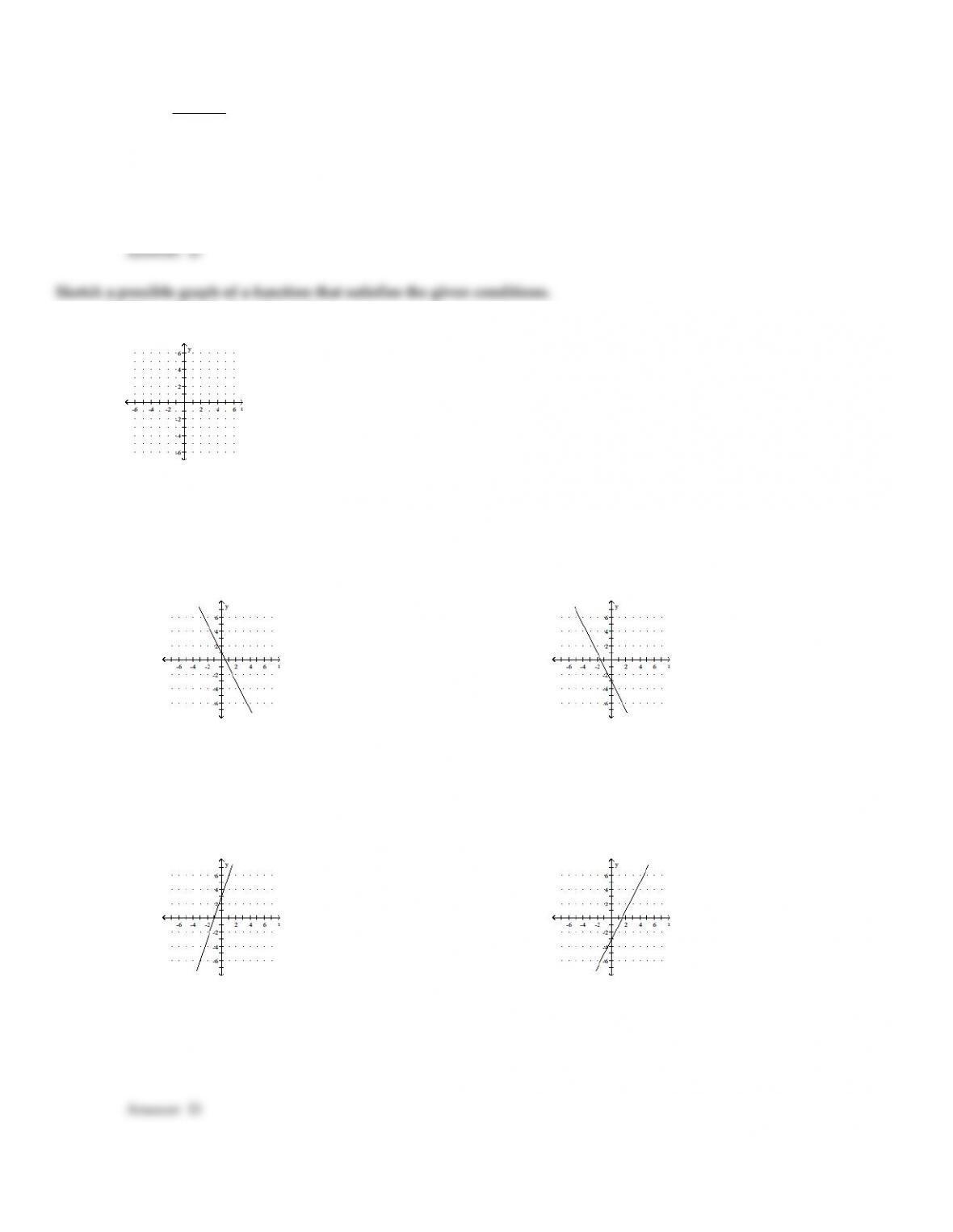
Sketch a possible graph of a function that satisfies the given conditions.
41)
f(0) = – 3 and lim
x
0 f(x) = – 3
A)
B)
C)
D)
Answer:
D
11
42)
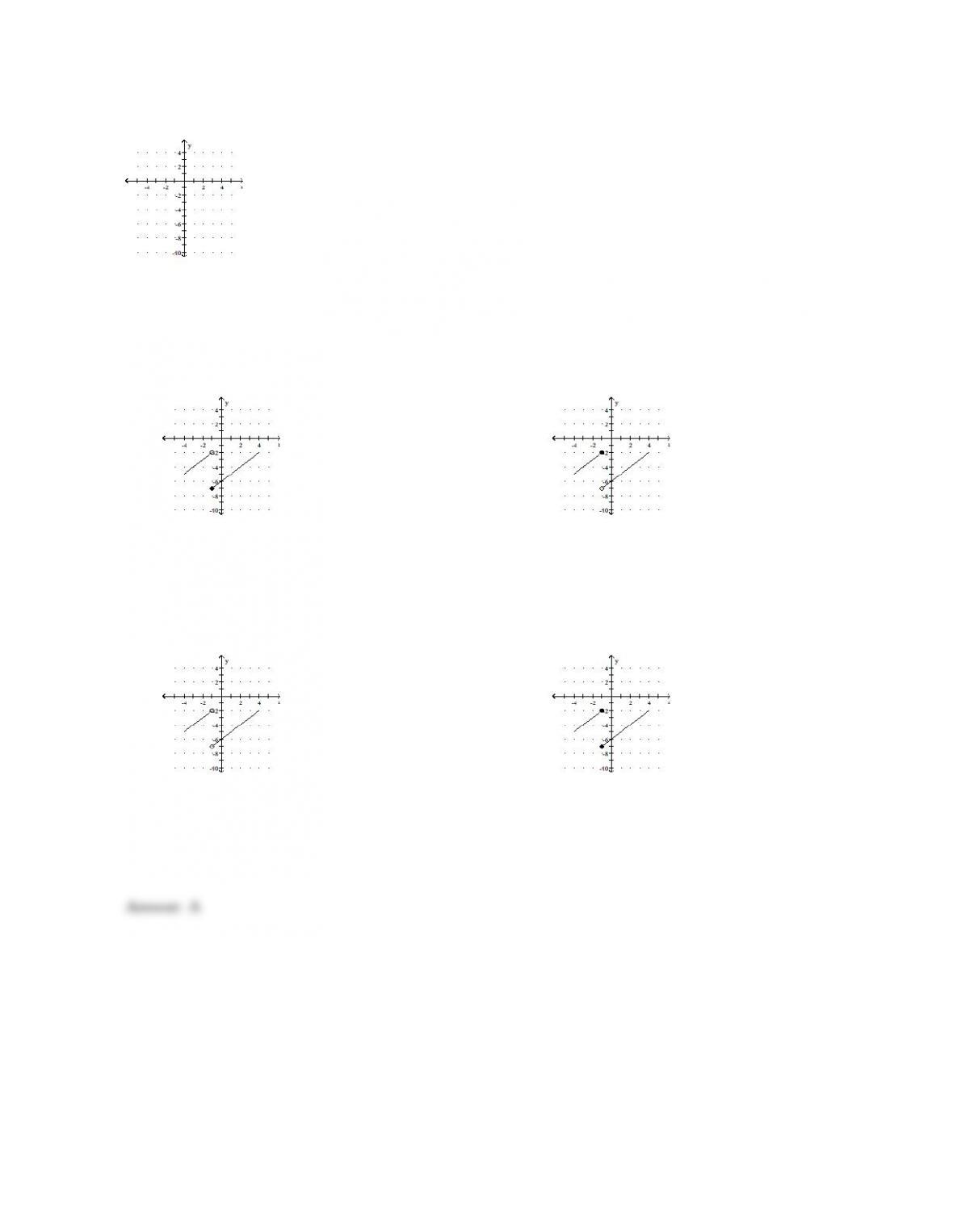
f(–1) = – 7 ; lim
x
(–1)–
f(x) = – 2; lim
x
(–1)+
f(x) = – 7
A)
B)
C)
D)
Answer:
A
12