Exam
Name___________________________________
MULTIPLE CHOICE. Choose the one alternative that best completes the statement or answers the question.
Express the proposition as an English sentence and determine whether it is true or false, where p and q are the propositions
p: “9 · 9 = 81″ q: “8 · 10 < 7 · 11
1)
p
q
A)
9 · 9 = 81 and 8 · 10 < 7 · 11; false
B)
If 9 · 9 = 81, then 8 · 10 < 7 · 11; false
C)
8 · 10 is not less than 7 · 11; true
D)
9 · 9 = 81 or 8 · 10 < 7 · 11; true
Answer:
A
2)
The contrapositive of p
q
A)
If 8 · 10 is not less than 7 · 11, then 9 · 9 is equal to 81; false
B)
If 8 · 10 is less than 7 · 11, then 9 · 9 is equal to 81; false
C)
If 8 · 10 is not less than 7 · 11, then 9 · 9 is not equal to 81; false
D)
If 8 · 10 is less than 7 · 11, then 9 · 9 is not equal to 81; false
Answer:
C
SHORT ANSWER. Write the word or phrase that best completes each statement or answers the question.
Provide an appropriate response.
3)
State the converse and contrapositive of the position, “If n is an integer that is a multiple of 15, then n is an
integer that is a multiple of 3 and a multiple of 5.”
Answer:
Converse (q
p): If n is an integer that is a multiple of 3 and a multiple of 5, then n is an integer that is a multiple
of 15.
Contrapositive (~q ~p): If n is an integer that is not a multiple of 3 and 5, then n is not a multiple of 15.
MULTIPLE CHOICE. Choose the one alternative that best completes the statement or answers the question.
Construct a truth table for the proposition.
4)
~p ~q
A)
p q (~p ~q)
T T F
T F F
F T F
F F F
B)
p q (~p ~q)
T T F
T F T
F T T
F F T
C)
p q (~p ~q)
T T F
T F F
F T F
F F T
D)
p q (~p ~q)
T T T
T F F
F T F
F F T
Answer:
C
5)
p
(p ~p)
A)
p p
(p ~p)
T T
F T
B)
p p
(p ~p)
T F
F T
C)
p p
(p ~p)
T T
F F
D)
p p
(p ~p)
T F
F F
Answer:
C
1
6)
p ~q
A)
p q p ~q
T T T
T F T
F T F
F F F
B)
p q p ~q
T T F
T F F
F T T
F F T
C)
p q p ~q
T T T
T F F
F T T
F F T
D)
p q p ~q
T T F
T F T
F T T
F F T
Answer:
D
7)
~p
(~p
s)
A)
p s ~p
(~p
s)
T T T
T F T
F T T
F F F
B)
p s ~p
(~p
s)
T T T
T F T
F T T
F F T
C)
p s ~p
(~p
s)
T T F
T F F
F T T
F F F
D)
p s ~p
(~p
s)
T T T
T F F
F T T
F F F
Answer:
A
SHORT ANSWER. Write the word or phrase that best completes each statement or answers the question.
Provide an appropriate response.
8)
Construct a truth table for the proposition and determine whether it is a contingency, a tautology, or a
contradiction: ~p
q.
Answer:
p ~p q ~p
q
T F T T
T F F F
F T T T
F T F T
Contingency
9)
Construct a truth table for the proposition and determine whether it is a contingency, a tautology, or a
contradiction: (q
p) ~q.
Answer:
q p q
p ~q (q
p) ~q
T T T F F
T F T F F
F T T T T
F F F T F
Contingency
2

10)
Construct a truth table to determine whether or not the following implication is true: ~(p
q) ~p ~q.
Answer:
p q p
q ~(p
q) ~p ~q ~p ~q
T T T F F F F
T F T F F T F
F T T F T F F
F F F T T T T
It is true since the fourth column and the seventh column are identical.
MULTIPLE CHOICE. Choose the one alternative that best completes the statement or answers the question.
Construct a truth table to decide if the two statements are equivalent.
11)
~p ~q; ~(p
q)
A)
True
B)
False
Answer:
A
12)
~p ~q; ~(p
q)
A)
True
B)
False
Answer:
A
13)
q
p; p
q
A)
True
B)
False
Answer:
B
14)
~q
p; ~q
p
A)
True
B)
False
Answer:
B
15)
~(~q); q
A)
True
B)
False
Answer:
A
Tell whether the statement is true or false.
16)
3
{6, 9, 12, 15, 18}
A)
True
B)
False
Answer:
B
17)
7
{14, 21, 28, 35, 42}
A)
True
B)
False
Answer:
A
18)
0
A)
True
B)
False
Answer:
A
19)
{all odd integers greater than –3 and less than 5} = {–1, 1, 3}
A)
True
B)
False
Answer:
A
3

Let A = {1, 3, 5, 7}; B = {5, 6, 7, 8}; C = {5, 8}; D = {2, 5, 8}; and U = {1, 2, 3, 4, 5, 6, 7, 8}. Determine whether the given statement
is true or false.
20)
C
D
A)
True
B)
False
Answer:
A
21)
U
A
A)
True
B)
False
Answer:
B
22)
{5}
D
A)
True
B)
False
Answer:
A
23)
A
A
A)
True
B)
False
Answer:
B
Let A = {6, 4, 1, {3, 0, 8}, {9}}. Determine whether the statement is true or false.
24)
{9}
A
A)
True
B)
False
Answer:
A
25)
{3, 0, 8}
A
A)
True
B)
False
Answer:
B
26)
{9}
A
A)
True
B)
False
Answer:
B
27)
{3, 0, 8}
A
A)
True
B)
False
Answer:
A
Provide an appropriate response.
28)
One of the following is false; indicate by letter which one:
A)
{4}
{3, 4, 5, 6}
B)
4
{3, 4, 5, 6}
C)
4
{3, 4, 5, 6}
D)
5
{3, 4, 5, 6}
Answer:
C
29)
Which of the following is NOT a subset of the set {p, o, 7}?
A)
7
B)
{o, 7}
C)
D)
{p, o, 7}
Answer:
A
4
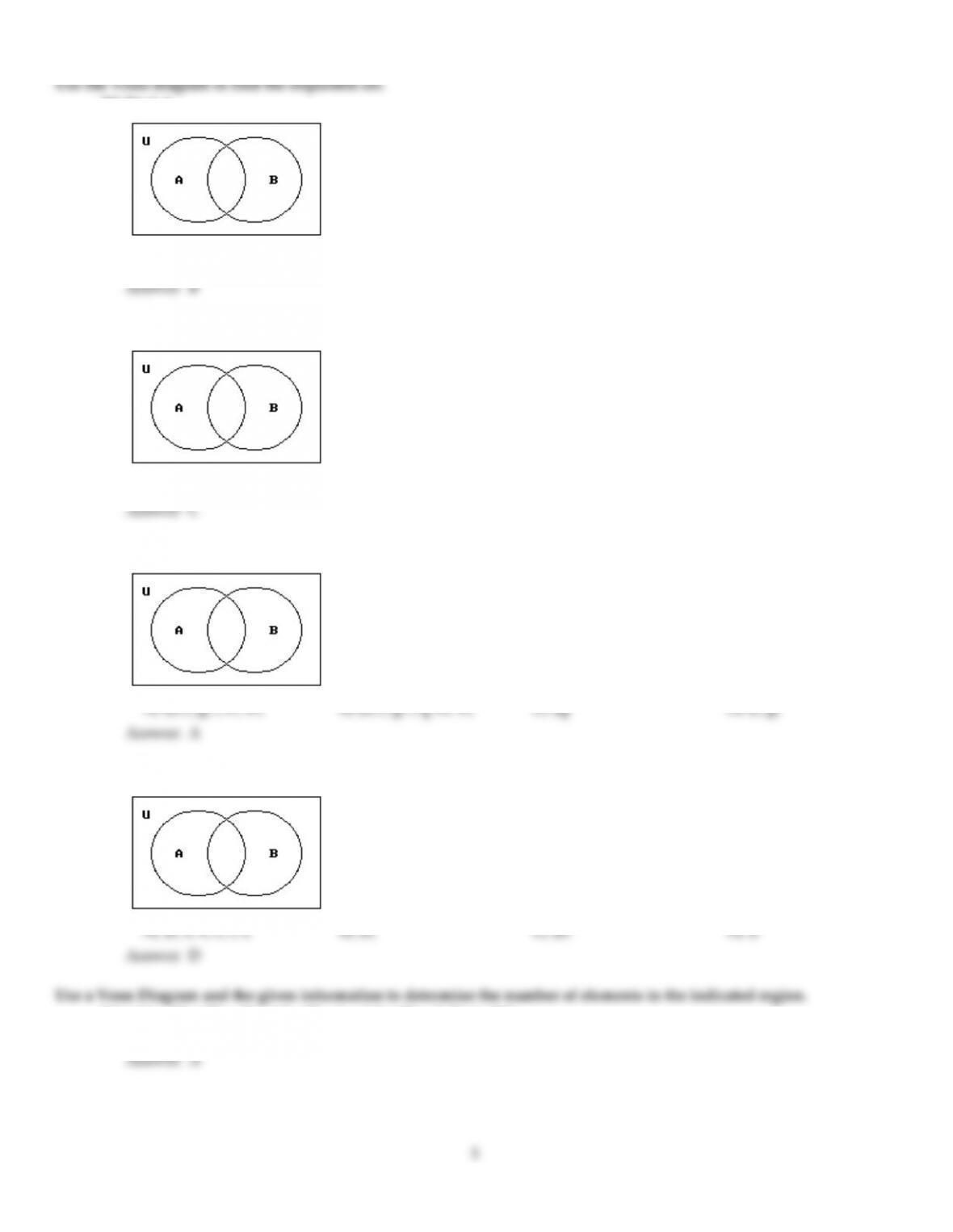
Use the Venn diagram to find the requested set.
30)
Find A.
7 x q
5
1 g
A)
{5}
B)
{7, 1, 5}
C)
{7, 1, 5, x}
D)
{5, x, q, g}
Answer:
B
31)
Find A
B.
j b a
n g w
q
A)
{a, b, g, j, q, n, w}
B)
{a, b, g, j, n, w}
C)
{b, g}
D)
{q}
Answer:
C
32)
Find A B.
i c d
m g w
q
A)
{d, c, g, i, m, w}
B)
{d, c, g, i, q, m, w}
C)
{q}
D)
{c, g}
Answer:
A
33)
Find A’
B’.
8 z r
4
3 f
A)
{8, 3, 4, z, r, f}
B)
{4}
C)
{8}
D)
Answer:
D
Use a Venn Diagram and the given information to determine the number of elements in the indicated region.
34)
n(A) = 33, n(B) = 19, n(A
B) = 1, n(A’
B’) =9. Find n(U).
A)
60
B)
64
C)
51
D)
52
Answer:
A
5

35)
n(A) = 33, n(B) = 15, n(A B) = 42, n(B‘) = 40. Find n(A
B)’.
A)
36
B)
42
C)
49
D)
13
Answer:
C
SHORT ANSWER. Write the word or phrase that best completes each statement or answers the question.
36)
Let U = {a, l, i, t, e}, A = {l, i, t},B = {l, e}, C = {a, l, i, t, e}, and D = {a, e}. Find (C B) A .
Answer:
{a, i, t, e}
MULTIPLE CHOICE. Choose the one alternative that best completes the statement or answers the question.
Determine whether the given set is finite or infinite. Consider the set N of positive integers to be the universal set, and let
A = {n
N| n > 50}
B = {n
N| n < 250}
O = {n
N| n is odd}
E = {n
N| n is even}
37)
A’
A)
finite
B)
infinite
Answer:
A
38)
A
O’
A)
finite
B)
infinite
Answer:
B
39)
B E
A)
infinite
B)
finite
Answer:
A
Determine whether the given set is disjoint or not disjoint. Consider the set N of positive integers to be the universal set, and let
A = {n
N| n > 50}
B = {n
N| n < 250}
O = {n
N| n is odd}
E = {n
N| n is even}
40)
A’
B’
A)
not disjoint
B)
disjoint
Answer:
B
41)
O
E’
A)
not disjoint
B)
disjoint
Answer:
A
Use a Venn Diagram and the given information to determine the number of elements in the indicated region.
42)
At Southern States University (SSU) there are 399 students taking Finite Mathematics or Statistics. 238 are taking
Finite Mathematics, 184 are taking Statistics, and 23 are taking both Finite Mathematics and Statistics. How
many are taking Finite Mathematics but not Statistics?
A)
192
B)
215
C)
376
D)
161
Answer:
B
6

43)
At Southern States University SSU) there are 719 students taking Finite Mathematics or Statistics. 328 are taking
Finite Mathematics, 476 are taking Statistics, and 85 are taking both Finite Mathematics and Statistics. How
many are taking Statistics but not Finite Mathematics?
A)
243
B)
391
C)
158
D)
634
Answer:
B
SHORT ANSWER. Write the word or phrase that best completes each statement or answers the question.
44)
In a marketing survey involving 1,000 randomly chosen people, it is found that 660 use brand P, 440 use brand
Q, and 220 use both brands. How many people in the survey use brand P and not brand Q?
Answer:
440
MULTIPLE CHOICE. Choose the one alternative that best completes the statement or answers the question.
Use the Venn diagram below to find the number of elements in the region.
45)
n(A)
A)
9
B)
12
C)
4
D)
17
Answer:
D
46)
n(A B)
A)
29
B)
21
C)
11
D)
14
Answer:
A
47)
n(C )
A)
29
B)
14
C)
24
D)
39
Answer:
C
48)
n(A
C)
A)
2
B)
10
C)
18
D)
37
Answer:
B
49)
n(A
B
C)
A)
44
B)
8
C)
16
D)
18
Answer:
B
50)
n((A B)
C)
A)
14
B)
11
C)
33
D)
15
Answer:
D
Use the addition principle for counting to solve the problem.
51)
If n(A) = 5, n(B) = 11 and n(A
B) = 3, what is n(A B)?
A)
14
B)
13
C)
11
D)
12
Answer:
B
7

52)
If n(A) = 40, n(B) = 117 and n(A B) = 137, what is n(A
B)?
A)
40
B)
10
C)
22
D)
20
Answer:
D
53)
If n(B) = 24, n(A
B) =5, and n(A B) = 42, find n(A).
A)
24
B)
25
C)
23
D)
21
Answer:
C
54)
If n(A) = 20, n(A B) = 58, and n(A
B) = 16, find n(B).
A)
54
B)
53
C)
55
D)
58
Answer:
A
Provide an appropriate response.
55)
Results of a survey of fifty students indicate that 30 like red jelly beans, 29 like green jelly beans, and 17 like
both red and green jelly beans. How many of the students surveyed like neither red nor green jelly beans?
A)
13
B)
12
C)
8
D)
17
Answer:
C
56)
Mrs. Bollo’s second grade class of thirty students conducted a pet ownership survey. Results of the survey
indicate that 8 students own a cat, 15 students own a dog, and 5 students own both a cat and a dog. How many
of the students surveyed own only a dog?
A)
10
B)
22
C)
15
D)
18
Answer:
A
57)
A survey of residents in a certain town indicates 170 own a dehumidifier, 130 own a snow blower, and 80 own a
dehumidifier and a snow blower. How many own a dehumidifier or a snow blower?
A)
80
B)
250
C)
170
D)
220
Answer:
D
58)
A local television station sends out questionnaires to determine if viewers would rather see a documentary, an
interview show, or reruns of a game show. There were 500 responses with the following results:
150 were interested in an interview show and a documentary, but not reruns.
20 were interested in an interview show and reruns but not a documentary
70 were interested in reruns but not an interview show.
120 were interested in an interview show but not a documentary.
50 were interested in a documentary and reruns.
30 were interested in an interview show and reruns.
40 were interested in none of the three.
How many are interested in exactly one kind of show?
A)
230
B)
220
C)
250
D)
240
Answer:
D
59)
In a group of 42 students, 22 take history, 17 take biology and 8 take both history and biology.
How many students take biology, but not history?
A)
22
B)
5
C)
17
D)
9
Answer:
D
8

60)
In a group of 42 students, 22 take history, 17 take biology and 8 take both history and biology.
How many students take neither biology nor history?
A)
8
B)
5
C)
11
D)
22
Answer:
C
61)
Suppose there are 4 trains connecting town X to town Y and 6 roads connecting town Y to town Z. In how many
ways can a person travel from X to Z via Y?
A)
10
B)
16
C)
12
D)
24
E)
36
Answer:
D
62)
A Super Duper Jean company has 3 designs that can be made with short or long length. There are 5 color
patterns available. How many different types of jeans are available from this company?
A)
30
B)
10
C)
8
D)
15
E)
25
Answer:
A
63)
A restaurant offered pizza with 3 types of crusts and 7 different toppings. How many different types of pizzas
could be offered?
A)
21
B)
9
C)
49
D)
10
E)
63
Answer:
A
64)
The access code to a house‘s security system consists of five digits. How many different codes are available if
each digit can be repeated?
A)
32
B)
45
C)
5
D)
100,000
E)
3125
Answer:
D
65)
In Virginia, each automobile license plate consists of a single digit followed by three letters, followed by three
digits. How many distinct license plates can be formed if there are no restrictions on the digits or letters?
A)
17,575,600
B)
175,7560,000
C)
17,576
D)
175,760
E)
10,757,600
Answer:
B
66)
How many different sequences of 4 digits are possible if the first digit must be 3, 4, or 5 and if the sequence may
not end in 000? Repetition of digits is allowed.
A)
5000
B)
2999
C)
1512
D)
2997
E)
2000
Answer:
D
67)
License plates are made using 3 letters followed by 3 digits. How many plates can be made if repetition of
letters and digits is allowed?
A)
308,915,776
B)
1,757,600
C)
1,000,000
D)
175,760
E)
17,576,000
Answer:
E
SHORT ANSWER. Write the word or phrase that best completes each statement or answers the question.
68)
How many nine–digit ZIP code numbers are possible if the first digit cannot be a four and adjacent digits
cannot be the same?
Answer:
99= 387,420,489
69)
How many different five–letter code words are possible from the first ten letters of the alphabet if the first letter
cannot be a vowel and adjacent letters must be different.
Answer:
45,927
9

70)
A combination lock on a suitcase has 5 wheels, each labeled with digits 1 to 8. How many 5–digit combination
lock codes are possible if no digit can be repeated?
Answer:
6,720
71)
A coin that can turn up either heads (H) or tails (T) is flipped. If a head turns up on the first toss, a spinner that
can land on any of the first 7 natural numbers is spun. If a tail turns up, the coin is flipped a second time. What
are the different possible outcomes?
Answer:
{(H, 1), (H, 2), (H, 3), (H, 4), (H, 5), (H, 6), (H, 7), (T, H), (T, T)}
72)
A person purchasing a new car has several options: 6 interior color choices, 5 exterior color choices, 2 choices of
radios, and 5 choices of body styles. How many different cars are possible if one choice is made for each option?
Answer:
(6)(5)(5)(2) = 300
73)
A test is composed of 4 multiple choice problems and 8 questions that can be answered true or false. Each
multiple choice problem has 4 choices. How many different response sheets are possible if only one choice is
marked for each question?
Answer:
(44)(28) = 65,536
MULTIPLE CHOICE. Choose the one alternative that best completes the statement or answers the question.
Evaluate.
74)
6!
A)
1440
B)
120
C)
720
D)
360
Answer:
C
75)
15!
14!
A)
7
B)
30
C)
14
D)
15
Answer:
D
76)
8!
6!
A)
8
6
B)
2!
C)
56
D)
8
Answer:
C
77)
7!
5! 2!
A)
7
B)
1
C)
42
D)
21
Answer:
D
78)
P10, 2
A)
90
B)
45
C)
8
D)
19
Answer:
A
79)
P6, 4
A)
360
B)
30
C)
2
D)
24
Answer:
A
10

80)
C8, 2
A)
720
B)
28
C)
1440
D)
4
Answer:
B
81)
C7, 0
A)
7
B)
6
C)
1
D)
720
Answer:
C
Determine whether the selection is a permutation, a combination, or neither.
82)
Mary baked 3 pies: 1 for her father, 1 for her friend Joe, and 1 for her coworkers.
A)
neither
B)
combination
C)
permutation
Answer:
C
83)
An animal trainer selects 2 of the 5 baboons to showcase on the talk show.
A)
permutation
B)
combination
C)
neither
Answer:
B
Solve the problem.
84)
How many 4–digit numbers can be formed using the digits 0, 1, 2, 3, 4, 5, 6, if repetition of digits is not allowed?
A)
24
B)
2401
C)
23
D)
840
Answer:
D
85)
How many ways can a committee of 3 be selected from a club with 12 members?
A)
1320
B)
110
C)
220
D)
6
Answer:
C
86)
In how many ways can a student work 8 out of 10 questions on an exam?
A)
45
B)
16
C)
100,000,000
D)
90
Answer:
A
87)
A pollster wants to minimize the effect the order of the questions has on a person’s response to a survey. How
many different surveys are required to cover all possible arrangements if there are 6 questions on the survey?
A)
36
B)
6
C)
720
D)
120
Answer:
C
88)
In a Power Ball lottery, 5 numbers between 1 and 12 inclusive are drawn. These are the winning numbers. How
many different selections are possible? Assume that the order in which the numbers are drawn is not important.
A)
248,832
B)
792
C)
95,040
D)
120
Answer:
B
89)
A software company employs 9 sales representatives and 8 technical representatives. How many ways can the
company select 5 of these employees to send to a computer convention if at least 4 technical representatives
must attend the convention?
A)
1440
B)
180
C)
686
D)
360
Answer:
C
11

90)
A home cooking equipment supply company employs 7 sales representatives and 6 product designers. How
many ways can this company select 4 of these employees to send to a product demonstration convention in
Oahu if at least 3 product designers must attend?
A)
168
B)
42
C)
155
D)
504
Answer:
C
91)
How many ways can a committee of 5 be selected from a club with 10 members?
A)
252
B)
30,240
C)
50
D)
100,000
Answer:
A
92)
If the police have 9 suspects, how many different ways can they select 5 for a lineup?
A)
45
B)
3024
C)
15,120
D)
126
Answer:
D
12