Exam
Name___________________________________
MULTIPLE CHOICE. Choose the one alternative that best completes the statement or answers the question.
Provide an appropriate response.
1)
The transition matrix for a Markov process is:
State
A B
State A
B0.3 0.7
0.9 0.1 = P
Find the first state matrix if the initial state is S0=.3 .7 .
A)
0.72 0.28
B)
[0.9 0.1]
C)
[0.3 0.7]
D)
[0.468 0.532]
Answer:
A
2)
The transition matrix for a Markov process is:
State
A B
State A
B0.3 0.7
0.9 0.1 = P
Find the second state matrix if the initial state is S0=0.3 0.7 .
A)
[0.72 0.28]
B)
[0.6192 0.3808]
C)
[0.3 0.7]
D)
[ 0.468 0.538]
Answer:
D
3)
The transition matrix for a Markov process is:
State
A B
State A
B0.3 0.7
0.9 0.1 = P
Find P2.
A)
0.468 0.532
0.684 0.316
B)
0.64 0.28
0.36 0.72
C)
0.72 0.36
0.28 0.64
D)
0.72 0.28
0.36 0.64
Answer:
D
4)
The transition matrix for a Markov process is:
State
A B
State A
B0.1 0.9
0.3 0.7 = P
Find P2.
A)
0.244 0.756
0.252 0.748
B)
0.72 0.28
0.36 0.64
C)
0.1 0.9
0.3 0.7
D)
0.28 0.72
0.24 0.76
Answer:
D
1

5)
Given the transition matrix:
A B C D
P =
A
B
C
D
0.4 0.3 0.2 0.1
0 1 0 0
0 0 1 0
0.2 0.5 0.1 0.2
Find P4.
A)
A B C D
P =
A
B
C
D
0.084 0.554 0.332 0.03
0 1 0 0
0 0 1 0
0.06 0.726 0.19 0.024
B)
A B C D
P =
A
B
C
D
0.4 0.3 0.2 0.1
0 1 0 0
0 0 1 0
0.2 0.5 0.1 0.2
C)
A B C D
P =
A
B
C
D
0.18 0.47 0.29 0.06
0 1 0 0
0 0 1 0
0.12 0.66 0.16 0.06
D)
A B C D
P =
A
B
C
D
0.0396 0.5942 0.3518 0.0144
0 1 0 0
0 0 1 0
0.0288 0.756 0.2044 0.0108
Answer:
D
6)
A B C
Using a graphing utility to compute powers of P =A
B
C
0.2 0.3 0.5
0.1 0.8 0.1
0.4 0.3 0.3 , find the smallest n such that the
corresponding entries in Pn and Pn+1 are, when rounded to 3 decimal places, equal.
A)
2
B)
3
C)
6
D)
11
Answer:
D
Construct the transition matrix that represents the data.
7)
If it snows today, there is a 70 percent chance of snow tomorrow; however if it does not snow today, there is a 90
percent chance that it will not snow tomorrow.
A)
0.7 0.3
0.9 0.1
B)
0.7 0.3
0.10.9
C)
0.9 0.1
0.7 0.3
D)
0.1 0.9
0.70.3
Answer:
B
8)
90 percent of the people in one generation who have a certain physical characteristic will pass that characteristic
on to the next generation. 20 percent of the people in one generation who do not have this characteristic will
pass it on to the next generation.
A)
0.8 0.2
0.1 0.9
B)
0.1 0.9
0.8 0.2
C)
0.2 0.8
0.9 0.1
D)
0.9 0.1
0.2 0.8
Answer:
D
2

9)
A new anti–gravity commuter train has been installed. It is expected that each week 90% of the riders who used
the existing system will continue to do so. Of those who traveled by car, 5% will begin to use the new
anti–gravity train. Use this information to write the transition matrix that describes this process.
T C
T
C
A)
T C
T
C0.90 0.10
0.05 0.95
B)
T C
T
C0.90 0.05
0.10 0.95
C)
T C
T
C0.95 0.10
0.05 0.90
D)
T C
T
C0.95 0.10
0.05 0.95
Answer:
A
A small town has only two dry cleaners, Fast and Speedy. Fast hopes to increase its market share by conducting an
extensive advertising campaign. The initial market share for Fast was 40% and 60% for Speedy. Solve the problem.
10)
Find the probability that a customer using Fast initially will use Fast for his second batch of clothes. Use the following
transition matrix.
Fast Speedy
Fast
Speedy 0.31 0.69
0.36 0.64
A)
0.64
B)
0.36
C)
0.31
D)
0.69
Answer:
C
11)
Find the probability that a customer using Fast initially will use Fast for his third batch of clothes. Use the following
transition matrix. Round your answer to the nearest hundredth.
Fast Speedy
Fast
Speedy 0.11 0.89
0.52 0.48
A)
0.31
B)
0.53
C)
0.47
D)
0.69
Answer:
C
Provide an appropriate response.
12)
Given the transition matrix:
A B C D A B C D
P =
A
B
C
D
0.4 0.3 0.2 0.1
0 1 0 0
0 0 1 0
0.2 0.5 0.1 0.2
P4=
A
B
C
D
0.0396 0.5942 0.3518 0.0144
0 1 0 0
0 0 1 0
0.0288 0.756 0.2044 0.0108
Find the probability of going from state A to state D in four trials.
A)
0.0396
B)
0
C)
0.3518
D)
0.0144
Answer:
D
3

13)
Given the transition matrix:
A B C D A B C D
P =
A
B
C
D
0.4 0.3 0.2 0.1
0 1 0 0
0 0 1 0
0.2 0.5 0.1 0.2
P4=
A
B
C
D
0.0396 0.5942 0.3518 0.0144
0 1 0 0
0 0 1 0
0.0288 0.756 0.2044 0.0108
Find the probability of going from state D to state A in four trials.
A)
0.3518
B)
0.0396
C)
0
D)
0.0288
Answer:
D
14)
Given the transition matrix:
A B C D A B C D
P =
A
B
C
D
0.4 0.3 0.2 0.1
0 1 0 0
0 0 1 0
0.2 0.5 0.1 0.2
P4=
A
B
C
D
0.0396 0.5942 0.3518 0.0144
0 1 0 0
0 0 1 0
0.0288 0.756 0.2044 0.0108
Find the probability of going from state C to state B in four trials.
A)
0.0144
B)
0
C)
0.756
D)
0.0396
Answer:
B
15)
A trailer rental company has rental and return facilities at both a north and south location in a city. Assume a
trailer must be returned to one or the other of these locations. If a trailer is rented at the north location, the
probability that it will be returned there is .6; if a trailer is rented at the south location, the probability it will be
returned there is .65. Assume the company rents all of its trailers each day and each trailer is rented (and
returned) only once a day. If the company starts with 50% of the trailers at each location, what is the expected
distribution (in percentages) the next day?
A)
62.5% of the trailers at the north location; 37.5% of the trailers at the south location
B)
52.5% of the trailers at the north location; 47.5% of the trailers at the south location
C)
37.5% of the trailers at the north location; 62.5% of the trailers at the south location
D)
47.5% of the trailers at the north location; 52.5% of the trailers at the south location
Answer:
D
16)
Dublin is experiencing a population movement out of the city to the suburbs. Currently 85% of the total
population live in the city with the remaining 15% living in the suburbs. It has been shown that each year 7% of
the city residents move to the suburbs, while only 1% of the suburb population move back to the city. Assuming
population remains constant for both, what percent of the total will remain in the city after 2 years. Express your
answer rounded to hundredths of a percent.
A)
73.86%
B)
79.2%
C)
31.05%
D)
26.14%
Answer:
A
17)
Laurinburg is experiencing a population movement out of the city to the suburbs. Currently 85% of the total
population live in the city with the remaining 15% living in the suburbs. It has been shown that each year 7% of
the city residents move to the suburbs, while only 1% of the suburb population move back to the city. Assuming
population remains constant for both, what percent of the total will remain in the city after 5 years. Express your
answer rounded to hundredths of a percent.
A)
35.56%
B)
39.72%
C)
64.44%
D)
60.28%
Answer:
D
4

18)
Fayetteville is experiencing a population movement out of the city to the suburbs. Currently 85% of the total
population live in the city with the remaining 15% living in the suburbs. It has been shown that each year 7% of
the city residents move to the suburbs, while only 1% of the suburb population move back to the city. Assuming
population remains constant for both, what percent of the total will remain in the suburbs after 5 years. Express
your answer rounded to hundredths of a percent.
A)
35.56%
B)
60.28%
C)
64.44
D)
39.72%
Answer:
D
19)
Decide whether or not the transition matrix is regular. Answer Yes or No.
0.3 0.7
0.9 0.1
A)
Yes
B)
No
Answer:
A
20)
Decide whether or not the transition matrix is regular. Answer Yes or No.
1 0 0
0 0 1
0 1 0
A)
Yes
B)
No
Answer:
B
21)
Decide whether or not the transition matrix is regular. Answer Yes or No.
0.7 0.3 0
0 0.4 0.6
1 0 0
A)
Yes
B)
No
Answer:
A
22)
Decide whether or not the transition matrix is regular. Answer Yes or No.
1 0
0.5 0.5
A)
Yes
B)
No
Answer:
B
23)
Decide whether or not the transition matrix is regular. Answer Yes or No.
0.61 0 0.39
0.47 0.53 0
0 0.24 0.76
A)
Yes
B)
No
Answer:
A
24)
Find the stationary matrix for the transition matrix P =0.1 0.9
0.6 0.4 .
A)
[0.16 0.36]
B)
[0.4 0.6]
C)
0.1 0.9
0.6 0.4
D)
[0.6 0.4]
Answer:
B
5
25)
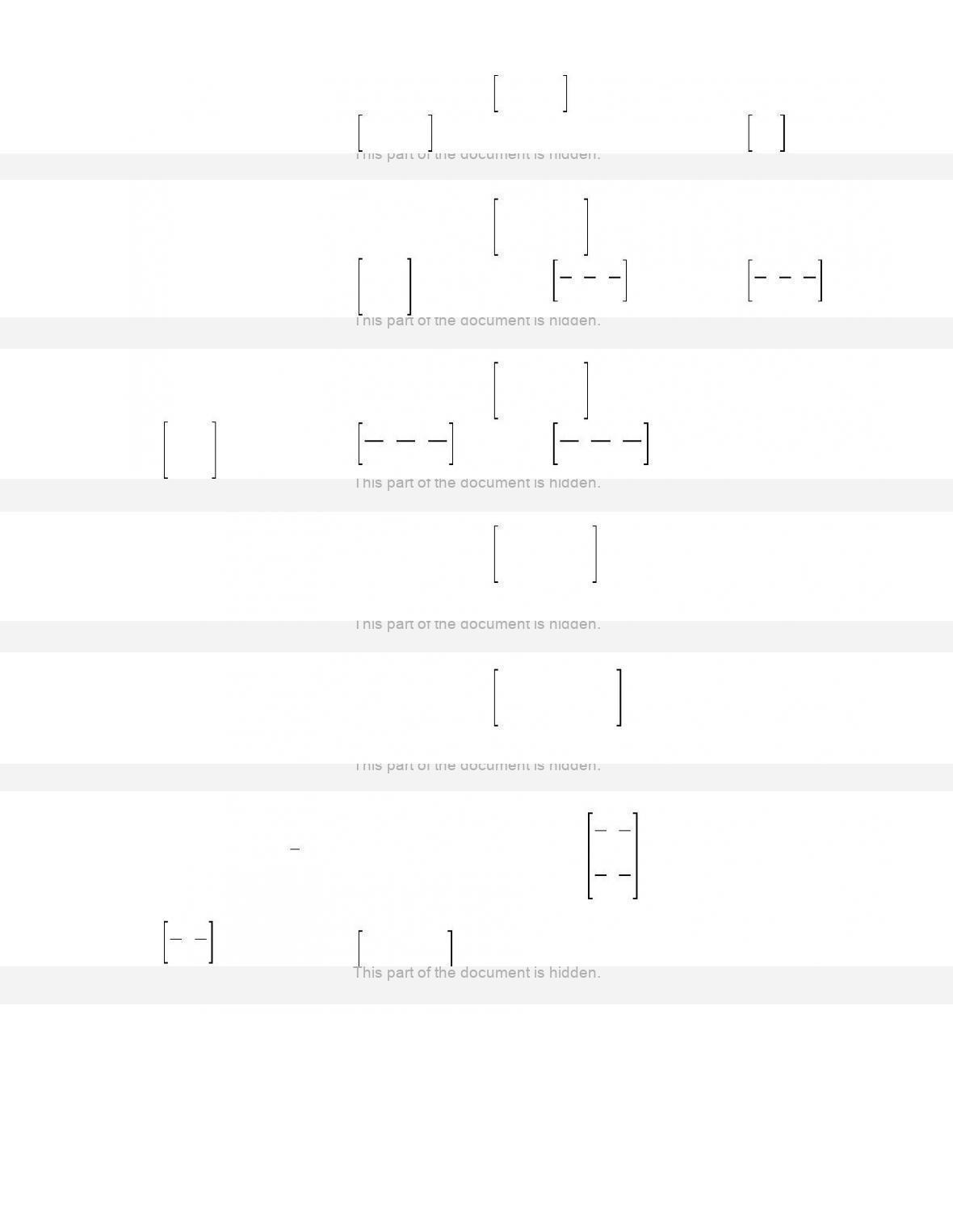
Find the stationary matrix for the transition matrix P =0.8 0.2
0.35 0.65 .
A)
[0.636 0.364]
B)
0.8 0.2
0.35 0.65
C)
[0.6 0.4]
D)
1 0
0 1
Answer:
A
26)
Find the stationary matrix for the transition matrix P =0.1 0.9 0
0.3 0.4 0.3
0.2 0.2 0.6 .
A)
[0.25 0.45 0.35]
B)
1 0 0
0 1 0
0 0 1
C)
2
94
91
3
D)
9
29
49
3
Answer:
C
27)
Find the stationary matrix for the transition matrix P =0.2 0.6 0.2
0.1 0.1 0.8
0.3 0.3 0.4 .
A)
1 0 0
0 1 0
0 0 1
B)
5
23 7
23 11
23
C)
23
523
723
11
D)
[5 7 11]
Answer:
B
28)
Find the stationary matrix for the transition matrix P =0.1 0.1 0.8
0.3 0.3 0.4
0.4 0.4 0.2
Round the numbers in your answer to the nearest hundredth.
A)
[0.17 0.29 0.54]
B)
[0.23 0.17 0.60]
C)
[0.29 0.29 0.42]
D)
[0.26 0.44 0.30]
Answer:
C
29)
Find the stationary matrix for the transition matrix P =0.80 0.10 0.10
0.15 0.80 0.05
0.20 0.70 0.10
Round the numbers in your answer to the nearest hundredth.
A)
[0.33 0.67 0]
B)
[0.44 0.48 0.08]
C)
[1 0 0]
D)
[0.33 0.40 0.27]
Answer:
B
30)
Find the limiting matrix P corresponding to the transition matrix P =
1
21
2
3
74
7
.
Round to the nearest thousandths.
A)
3
74
7
B)
0.462 0.538
0.462 0.538
C)
[0.5 0.5]
D)
[0.462 0.538]
Answer:
B
6
31)
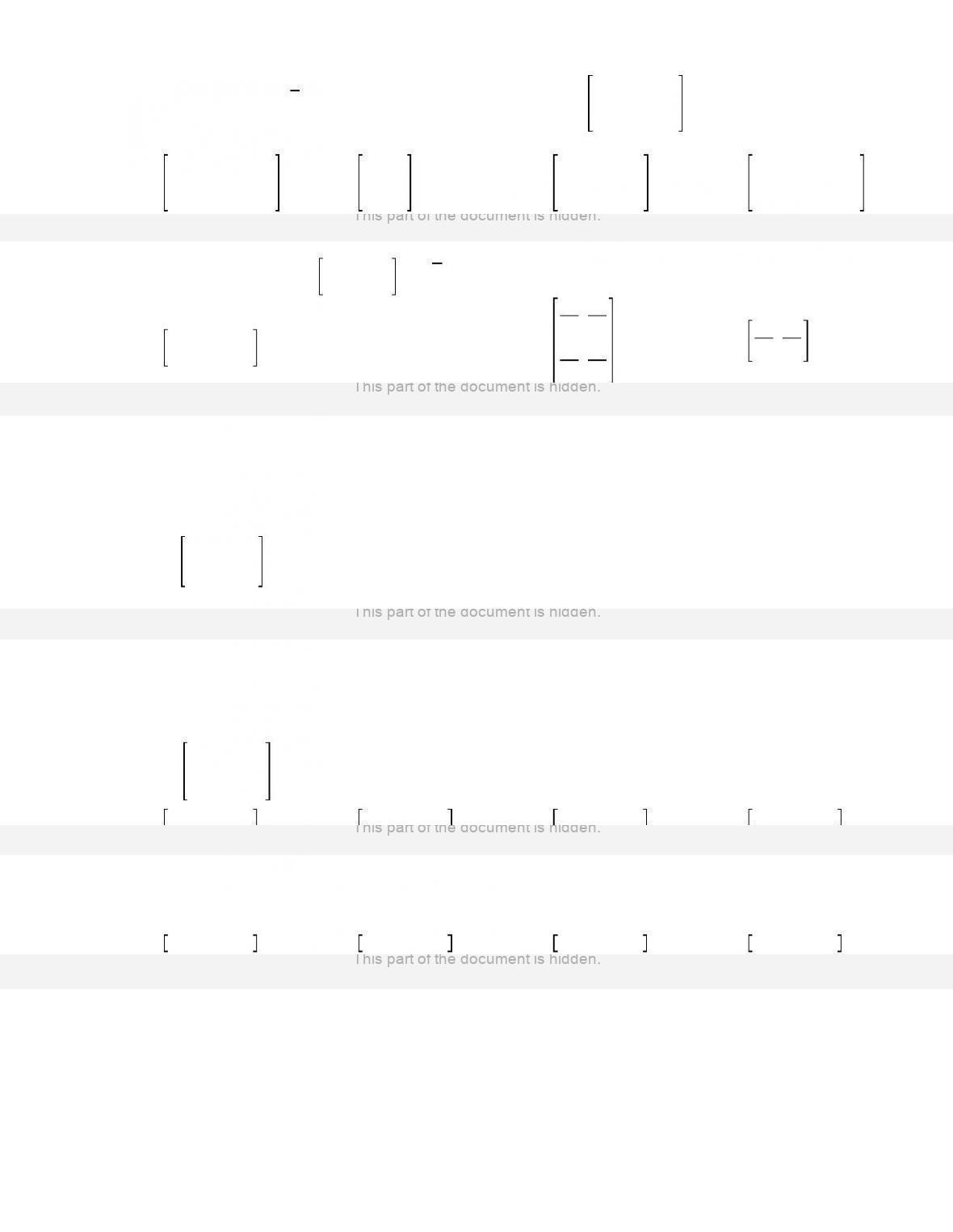
Find the limiting matrix P corresponding to the transition matrix P =0.1 0.1 0.8
0.3 0.3 0.4
0.4 0.4 0.2 .
Round to the nearest hundredths.
A)
0.36 0.36 0.28
0.28 0.28 0.44
0.24 0.24 0.52
B)
1 0 0
0 1 0
0 0 1
C)
0.1 0.1 0.8
0.3 0.3 0.4
0.4 0.4 0.2
D)
0.29 0.29 0.29
0.29 0.29 0.29
0.29 0.29 0.29
Answer:
D
32)
For the transition matrix P =0.36 0.64
0.20 0.80 find P exactly by converting P16 to fraction form.
A)
0.213 0.698
0.218 0.715
B)
[0.213 0.698]
C)
5
21 16
21
5
21 16
21
D)
5
21 16
21
Answer:
C
Solve the problem.
33)
The probability that an assembly line works correctly depends on whether the line worked correctly the last time. Find
the probability that the line will work in the long run. Round your answer as appropriate.
Works Does not
works
doesn’t
0.7 0.3
0.4 0.6
A)
0.429
B)
0.665
C)
0.571
D)
0.700
Answer:
C
34)
Weather is classified as sunny or cloudy in a certain place. What are the long–term predictions for sunny and
cloudy days? Round numbers to the nearest thousandths.
Sunny Cloudy
Sunny
Cloudy 0.6 0.4
0.2 0.8
A)
0.600 0.400
B)
0.570 0.430
C)
0.333 0.667
D)
0.667 0.333
Answer:
C
35)
Rats are kept in a cage with two compartments (A and B). Rats in A move to B with probability 0.4. Rats in B
move to A with probability 0.2. Find the long–term trend for rats in each compartment. Round numbers to the
nearest thousandth.
A)
0.333 0.667
B)
0.600 0.400
C)
0.570 0.430
D)
0.667 0.333
Answer:
A
7

Provide an appropriate response.
36)
From statistics gathered over many seasons, it was determined that the probability a basketball player will
make a basket after having made a basket on his previous attempt is .55, while the probability he will make a
basket if he missed on his previous attempt is .48. In a current game a player has made 45% of his attempted
shots. If the player shoots many more times in the game, what would be the overall percentage of baskets that
he makes in this game?
A)
52%
B)
48%
C)
49%
D)
51%
Answer:
A
37)
The probability that an assembly line operation works correctly depends on whether it worked correctly the last
time it was used. There is a 0.91 chance that the line will work correctly if it worked correctly the time before
and a 0.68 chance that it will work correctly if it did not work correctly the time before. After setting up a
transition matrix with this information, find the long–run probability that the line will work correctly.
A)
[0.883 0.117]
B)
[0.883 0.883]
C)
[0.802 0.198]
D)
[0.117 0.883]
Answer:
A
38)
The probability that a car owner will become a car renter in five years is 0.03. The probability that a renter will become
an owner in five years is 0.1. Suppose the proportions in the population are 64% owners (O), 35.5% renters (R) and .5%
neither (N) with the following transition matrix.
O R N
O
R
N
0.94 0.06 0
0.12 0.879 0.001
032 0.68
Find the long–range probabilities for the three categories.
A)
[0.94 0.879 0.001]
B)
[0.666 0.333 0.001]
C)
[0.64 0.355 0.005]
D)
[0.94 0.06 0]
Answer:
B
39)
According to data collected during one year in a large metropolitan community, 30% of commuters used public
transportation to get to work, and this rose by 4% the following year. This is modeled by the transition matrix
P P
M =P
P0.9 0.1
0.1 0.9
where P represents the percentage of people that use public transportation and P the percentage of people that do not.
Let S0= [0.3 0.7]. Find S1.
A)
[0.34 0.66]
B)
[0.66 0.34]
C)
[0.9 0.1]
D)
[0.3 0.7]
Answer:
A
8

40)
According to data collected during one year in a large metropolitan community, 30% of commuters used public
transportation to get to work, and this rose by 4% the following year. This is modeled by the transition matrix
P P
M =P
P0.9 0.1
0.1 0.9
where P represents the percentage of people that use public transportation and P the percentage of people that do not.
Let S0= [0.3 0.7]. Find S2.
Round your answer to the nearest thousandths.
A)
[0.66 0.34]
B)
[0.372 0.628]
C)
[0.628 0.372]
D)
[0.34 0.66]
Answer:
B
41)
According to data collected during one year in a large metropolitan community, 30% of commuters used public
transportation to get to work, and this rose by 4% the following year. This is modeled by the transition matrix
P P
M =P
P0.9 0.1
0.1 0.9 S0= [0.3 0.7]
where P represents the percentage of people that use public transportation and P the percentage of people that do not.
What percentage of commuters in this community will use public transportation in the long run?
A)
50%
B)
30%
C)
37.2%
D)
34%
Answer:
A
42)
A B C D
Identify the absorbing state(s) in the transition matrix P =
A
B
C
D
0 0 1 0
0 1 0 0
0 1 0 0
0 0 0 1
A)
A and D
B)
B and D
C)
C and D
D)
A and B
Answer:
B
43)
Find all absorbing states for the transition matrix, and indicate whether or not the matrix is that of an absorbing Markov
chain. 1 2 3
1
2
3
0.9 0 0.1
0 1 0
0.6 0 0.4
A)
State 3 is absorbing; matrix is an absorbing Markov chain.
B)
State 2 is absorbing; matrix is not an absorbing Markov chain.
C)
State 2 is absorbing; matrix is an absorbing Markov chain.
D)
State 3 is absorbing; matrix is not an absorbing Markov chain.
Answer:
B
9
44)
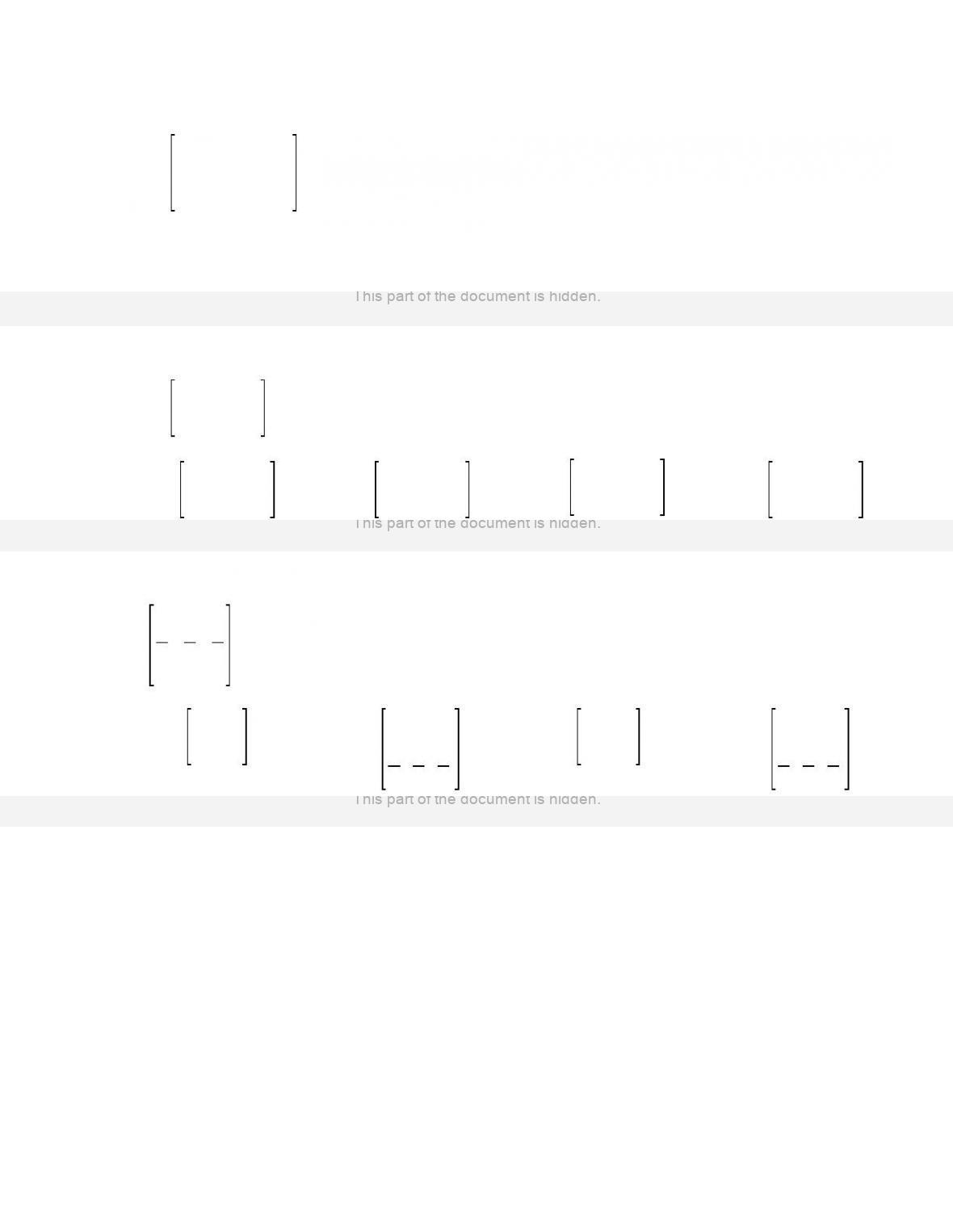
Find all absorbing states for the transition matrix, and indicate whether or not the matrix is that of an absorbing Markov
chain.
1 2 3 4
1
2
3
4
0.1 0 0.1 0.8
0 0.1 0 0
0.1 0.2 0.3 0.4
0 0 0 1
A)
State 2 is an absorbing; the matrix is an absorbing Markov chain.
B)
State 2 is an absorbing; the matrix is not an absorbing Markov chain.
C)
State 2 and 3 are absorbing; the matrix is not an absorbing Markov chain.
D)
State 2 and 3 are absorbing; the matrix is an absorbing Markov chain.
Answer:
D
45)
Find a standard form for the absorbing Markov chain with the transition matrix
A B C
A
B
C
0 0 1
0 1 0
0.2 0.6 0.2
A)
B A C
B
A
C
1 0 0
0 0 1
0.6 0.2 0.2
B)
A B C
A
B
C
0 0 1
0 1 0
0.2 0.6 0.2
C)
A B C
B
A
C
1 0 0
0 0 1
0.6 0.2 0.2
D)
B A C
A
B
C
1 0 0
0 0 1
0.6 0.2 0.2
Answer:
A
46)
Find a standard form for the absorbing Markov chain with the transition matrix
A B C
A
B
C
1 0 0
1
31
31
3
0 0 1
A)
A C B
A
C
B
1 0 0
0 1 0
3 3 3
B)
A B C
A
B
C
1 0 0
0 1 0
1
31
31
3
C)
A B C
A
B
C
1 0 0
3 3 3
0 0 1
D)
A C B
A
C
B
1 0 0
0 1 0
1
31
31
3
Answer:
D
10

47)
Find a standard form for the absorbing Markov chain with the transition matrix
A B C D
A
B
C
D
1/4 1/4 1/4 1/4
0 1 0 0
1/2 0 1/2 0
0 0 0 1
A)
D B C A
B
D
A
C
1 0 0 0
0 1 0 0
1/4 1/4 1/4 1/4
0 0 1/2 1/2
B)
A B C D
B
D
A
C
1 0 0 0
0 1 0 0
1/4 1/4 1/4 1/4
0 0 1/2 1/2
C)
A B C D
B
D
A
C
1 0 0 0
0 1 0 0
1/4 1/4 1/4 1/4
0 0 1/2 1/2
D)
B D A C
B
D
A
C
1 0 0 0
0 1 0 0
1/4 1/4 1/4 1/4
0 0 1/2 1/2
Answer:
D
48)
Find a standard form for the absorbing Markov chain with the following transition matrix :
A B C D
A
B
C
D
0.4 0.2 0.1 0.3
0 1 0 0
00.2 0.1 0.7
0 0 0 1
A)
B D C A
B
D
C
A
1 0 0 0
0 1 0 0
0.2 0.7 0.1 0
0.3 0.2 0.4 0.1
B)
B D C A
A
B
C
D
1 0 0 0
0 1 0 0
0.2 0.7 0.1 0
0.2 0.3 0.1 0.4
C)
A B C D
B
D
C
A
1 0 0 0
0 1 0 0
0.2 0.7 0.1 0
0.2 0.3 0.1 0.4
D)
B D C A
B
D
C
A
1 0 0 0
0 1 0 0
0.2 0.7 0.1 0
0.2 0.3 0.1 0.4
Answer:
D
11

49)
A B C D
For the transition matrix
A
B
C
D
0.4 0.1 0.4 0.1
0 1 0 0
0.3 0.1 0.2 0.4
0 0 0 1
, find the limiting matrix. Use fractional entries.
A)
B A C D
B
A
C
D
01
3 0 2
3
0 1 0 0
01
403
4
0 0 0 1
B)
A B C D
A
B
C
D
01
3 0 2
3
0 1 0 0
01
40 1
3
40 0 1
C)
A B C D
A
B
C
D
01
3 0 2
3
0 1 0 0
01
403
4
0 0 0 1
D)
A B C D
A
B
C
D
1 0 0 2
3
0 1 0 0
01
403
4
0 0 0 1
Answer:
C
50)
Find the fundamental matrix F for the absorbing Markov chain with the given matrix. Express your answer in
fraction form.
1 0 0
0 1 0
0.12 0.72 0.16
A)
F =11
9
B)
F =4
25
C)
F =25
21
D)
F =21
25
Answer:
C
51)
Find the fundamental matrix F for the absorbing Markov chain with the given matrix. Express your answer in
fraction form.
1 0 0
0 1 0
3
74
71
7
A)
F = [3]
B)
F =7
4
C)
F =7
3
D)
F =7
6
Answer:
D
12
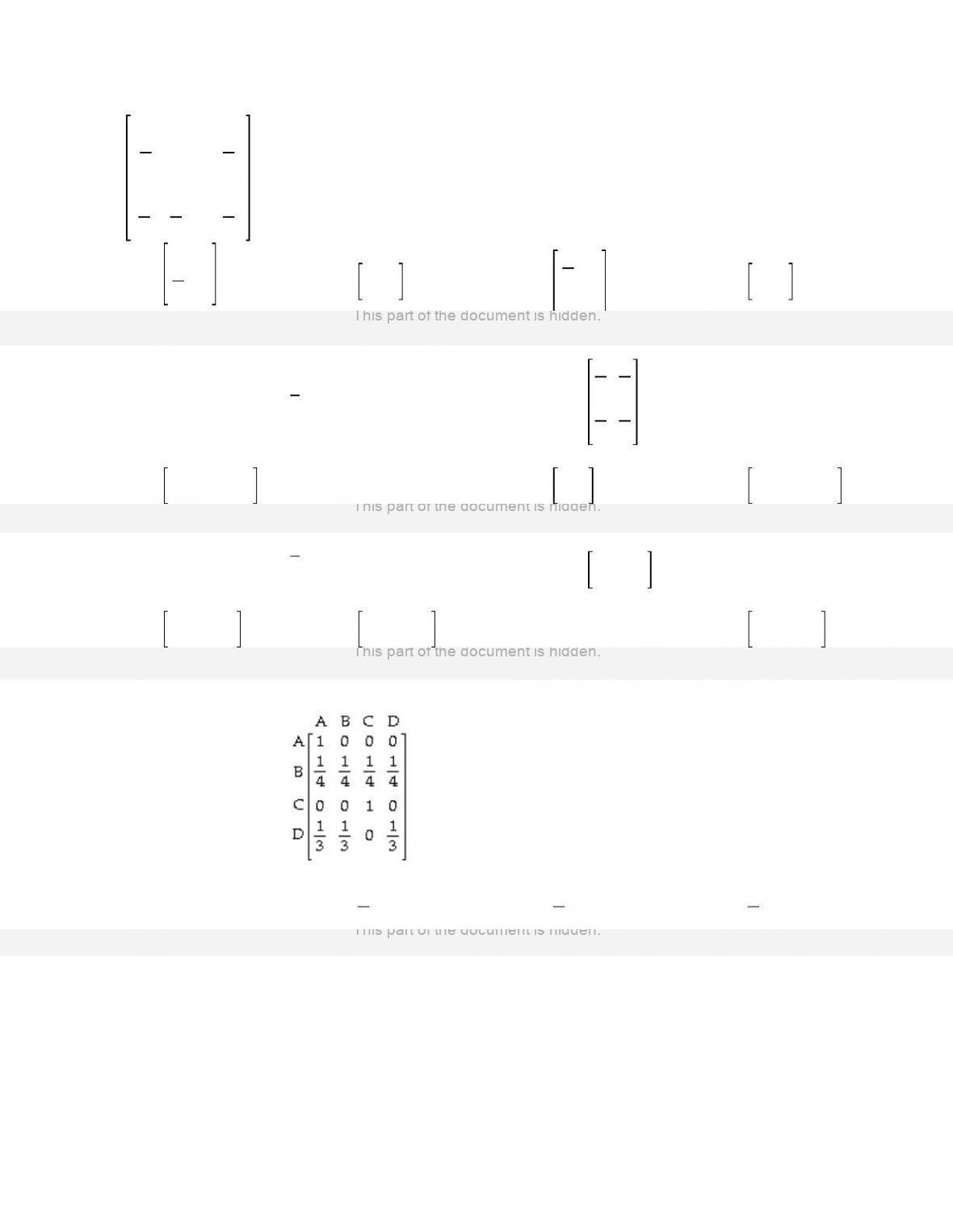
52)
Find the fundamental matrix F for the absorbing Markov chain with the given matrix. Express your answer in
fraction form.
1 0 0 0
1
20 0 1
2
0 0 1 0
1
41
201
4
A)
3 2
1
2 1
B)
2 3
2 1
C)
3
2 1
1 2
D)
3 1
2 2
Answer:
C
53)
Find the limiting matrix P corresponding to the transition matrix P =
2
31
3
1
43
4
.
Round to the nearest thousandths.
A)
0.528 0.472
0.354 0.646
B)
[0.429 0.571]
C)
1 0
0 1
D)
0.429 0.571
0.429 0.571
Answer:
D
54)
Find the limiting matrix P corresponding to the transition matrix P =0.8 0.2
0.1 0.9 .
Round to the nearest hundredths.
A)
0.45 0.55
0.28 0.72
B)
0.33 0.67
0.33 0.67
C)
[0.875 0.125]
D)
0.66 0.34
0.17 0.83
Answer:
B
55)
For the transition matrix , find the probability that if one starts in state B, one
will end up in state A over the long run.
A)
1
B)
9
5
C)
3
5
D)
4
5
Answer:
C
13

56)
A red urn contains 4 red marbles, 2 blue marbles, and 4 green marbles. A blue urn contains 2 red marbles, 2
blue marbles, and 1 green marble. A green urn contains 3 green marbles. A marble is selected from an urn, the
color is noted, and the marble is returned to the urn from which it was drawn. The next marble is drawn from
the urn whose color is the same as the marble just drawn. Thus, this is a Markov process with three states: draw
from the red urn, draw from the blue urn, or draw from the green urn.
Write the transition matrix P.
A)
G B R
P =G
B
R
0.4 0.2 0.4
0.2 0.4 0.4
0.4 0.2 0.4
B)
G B R
P =G
B
R
3 0 0
2 2 1
4 2 4
C)
G B R
P =G
B
R
1 0 0
0.2 0.4 0.4
0.4 0.2 0.4
D)
G B R
P =G
B
R
1 0 0
0 1 0
0 0 1
Answer:
C
57)
A red urn contains 4 red marbles, 2 blue marbles, and 4 green marbles. A blue urn contains 2 red marbles, 2
blue marbles, and 1 green marble. A green urn contains 3 green marbles. A marble is selected from an urn, the
color is noted, and the marble is returned to the urn from which it was drawn. The next marble is drawn from
the urn whose color is the same as the marble just drawn. Thus, this is a Markov process with three states: draw
from the red urn, draw from the blue urn, or draw from the green urn.
Find the limiting matrix P, if it exists, and describe the long–run behavior of this process.
A)
G B R
P=G
B
R
1 0 0
0.2 0.4 0.4
0.4 0.2 0.4
B)
G B R
P=G
B
R
1 0 0
0 0.1 0.4
1 0 0
C)
G B R
P=G
B
R
1 0 0
0.2 0.4 0.4
1 0 0
D)
G B R
P=G
B
R
1 0 0
1 0 0
1 0 0
Answer:
D
58)
Suppose that for a certain absorbing Markov chain the fundamental matrix is found to be
$1 $2 $3
$1
$2
$3
1.5 1.0 0.5
1.0 2.0 1.0
0.5 1.0 1.5
What is the expected number of times a person will have $3, given that she started with $1?
A)
0.5
B)
1.0
C)
2.0
D)
1.5
Answer:
A
59)
Suppose that for a certain absorbing Markov chain the fundamental matrix is found to be
$1 $2 $3
$1
$2
$3
1.5 1.0 0.5
1.0 2.0 1.0
0.5 1.0 1.5
What is the expected number of times a person will have $3, given that he started with $2?
A)
1.5
B)
1.0
C)
0.5
D)
2.0
Answer:
B
14

60)
Among patients who were improving on a certain day (in the critical care unit of a certain hospital), the
following was determined to be true on the next day: 58% were still improving; 10% were stable; 7% were
deteriorating; and 25% had been discharged. Among the patients who were stable on a certain day, the
following was determined to be true on the next day: 34% were improving; 44% were still stable; 18% were
deteriorating; 3% had been discharged; and 1% had died. Among the patients who were deteriorating on a
certain day, the following was determined to be true on the next day: 13% were improving; 42% were stable;
41% were still deteriorating; none had been discharged; and 4% had died. What is the expected number of
additional days that a patient, who is improving on that certain day, will spend in the critical care unit? Round
your answer to the nearest hundredth.
A)
4.65 days
B)
5.76 days
C)
7.53 days
D)
3.22 days
Answer:
B
15