Exam
Name___________________________________
SHORT ANSWER. Write the word or phrase that best completes each statement or answers the question.
Provide an appropriate response.
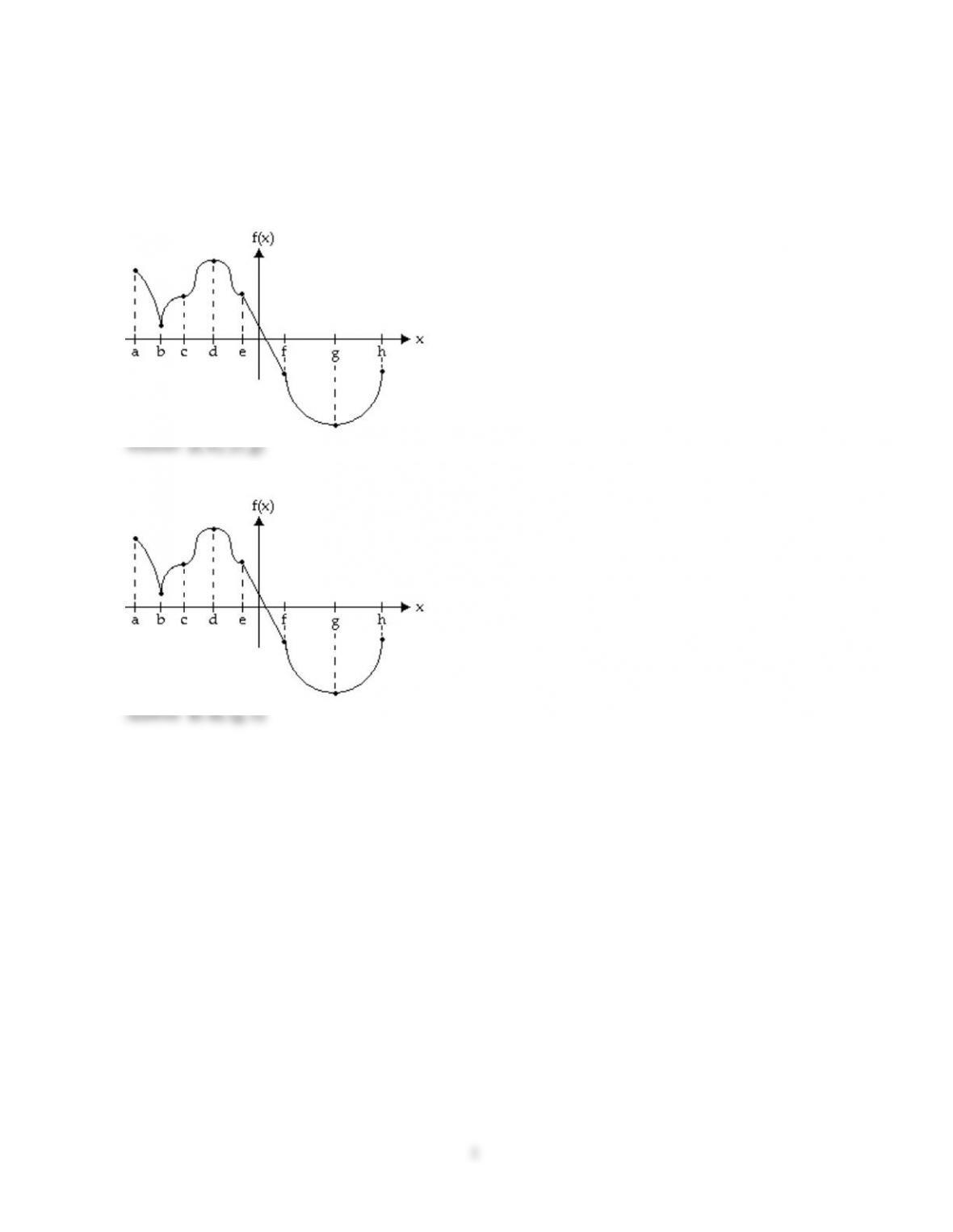
1)
Identify the intervals where f(x) is decreasing.
Answer:
(a, b), (d, g)
2)
Identify the intervals where f(x) > 0.
Answer:
(b, d), (g, h)
1
MULTIPLE CHOICE. Choose the one alternative that best completes the statement or answers the question.
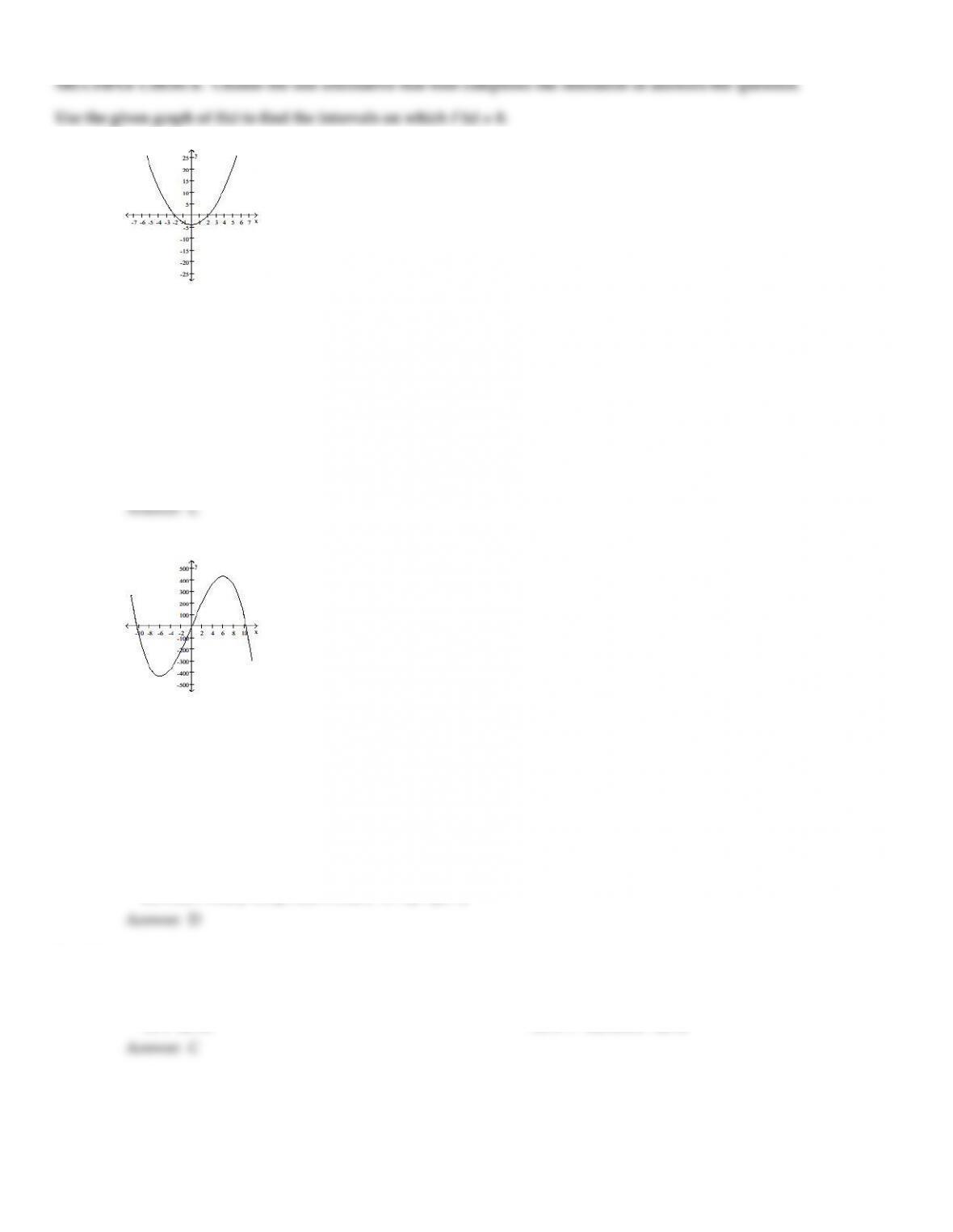
Use the given graph of f(x) to find the intervals on which f(x) > 0.
3)
A)
f(x) > 0 on [–4,
), f(x) < 0 on (–
, –4]
B)
f(x) > 0 on (–
, –2] [2,
), f(x) < 0 on [–2, 2]
C)
f(x) > 0 on [0,
), f(x) < 0 on decreasing on (–
, 0]
D)
f(x) < 0 on (–
,
)
Answer:
C
4)
A)
f(x) > 0 on (–
, –6] [6,
), f(x) < 0 on [–6, 6]
B)
f(x) > 0 on [–36, 36], f(x) < 0 on (–
, –36] [36,
)
C)
f(x) > 0 on (–
, 6], f(x) < 0 on [6,
)
D)
f(x) > 0 on [–6, 6], f(x) < 0 on (–
, –6]
[6,
)
Answer:
D
Provide an appropriate response.
5)
Determine the intervals for which the function f(x) =x3+18x2+ 2, is decreasing.
A)
( , –12) and (0,
)
B)
(0, 12) and (12,
)
C)
(–12, 0)
D)
( , –12) and (–12, 0)
Answer:
C
2
6)
Determine the interval(s) where f(x) =x2
x – 3 is decreasing.
A)
( , 0) and (6,
)
B)
(0, 3) and (6,
)
C)
(0, 6)
D)
(0, 3) and (3, 6)
Answer:
D
7)
Use a graphing utility to approximate the intervals where f(x) is decreasing and intervals where f(x) is
increasing for the function f(x) =x4–3x3–2x2+ 5x. Round your answer to two decimal places.
A)
increasing on ( , –0.82); decreasing on (–0.82, 0.62)
B)
decreasing on ( , –0.82); increasing on (–0.82, 0.62)
C)
decreasing on ( , –0.82) and (0.62, 2.45); increasing on (–0.82, 0.62) and (2.45,
)
D)
increasing on ( , –0.82) and (0.62, 2.45); decreasing on (–0.82, 0.62) and (2.45,
)
Answer:
C
8)
Use the first derivative test to determine the local extrema, if any, for the function: f(x) =3x4–6x2+ 7.
A)
local min at x = 0 and local max at x = – 1 and x = 1
B)
local max at x = 0 and local min at x = – 1 and x = 1
C)
local max at x = 1 and local min at x = 0
D)
local max at x = – 1 and local min at x = 0 and x = 1
Answer:
B
9)
Given f(x) = x +16
x, x < 0, find the values of x corresponding to local maxima and local minima.
A)
local maximum at x = – 4, local minimum at x = 4
B)
no local maximum or minimum
C)
local minimum at x = – 4 (no local maximum)
D)
local maximum at x = – 4 (no local minimum)
Answer:
D
10)
Use a graphing utility to approximate where the local extrema of the function f(x) =x4–3x3–2x2+ 5x are to
two decimal places.
A)
local max at x
0.82
B)
local min at x –0.62 and x
2.45
C)
local min at x
0.62; local max at x –0.82 and x
2.45
D)
local max at x
0.62; local min at x –0.82 and x
2.45
Answer:
D
11)
Use the first derivative test to determine the local extrema, if any, for the function: f(x) =3(x – 4)2/3 + 6.
A)
f(x) has a local minimum at x = 4.
B)
f(x) has no local extrema
C)
f(x) has a local minimum at 6
D)
f(x) has a local maximum at x = 4.
Answer:
A
12)
The critical values of f(x) = 4x3– 48x + 24 are x = – 2 and x = 2. Use the first derivative test to determine which of
the critical values correspond to a local minimum.
A)
x = – 2
B)
neither x = 2 nor x = – 2 correspond to a local minimum
C)
x = 2
D)
x = 2 and x = – 2
Answer:
C
3
13)
Use the first derivative test to determine the local extrema, if any, for the function: f(x) =x3+3x2– 24x + 6
A)
local max at x = – 4
B)
local max at x = 2 and local min at – 4
C)
local max at x = – 4 and local min at x = 2
D)
local min at x = 2
Answer:
C
14)
The critical values of f(x) = 4x3– 48x + 24 are x = – 2 and x = 2. Use the first derivative test to determine which of
the critical values correspond to a local maximum.
A)
x = 2 and x = – 2
B)
x = – 2
C)
x = 0 and x = 2
D)
x = 2
Answer:
B
SHORT ANSWER. Write the word or phrase that best completes each statement or answers the question.
15)
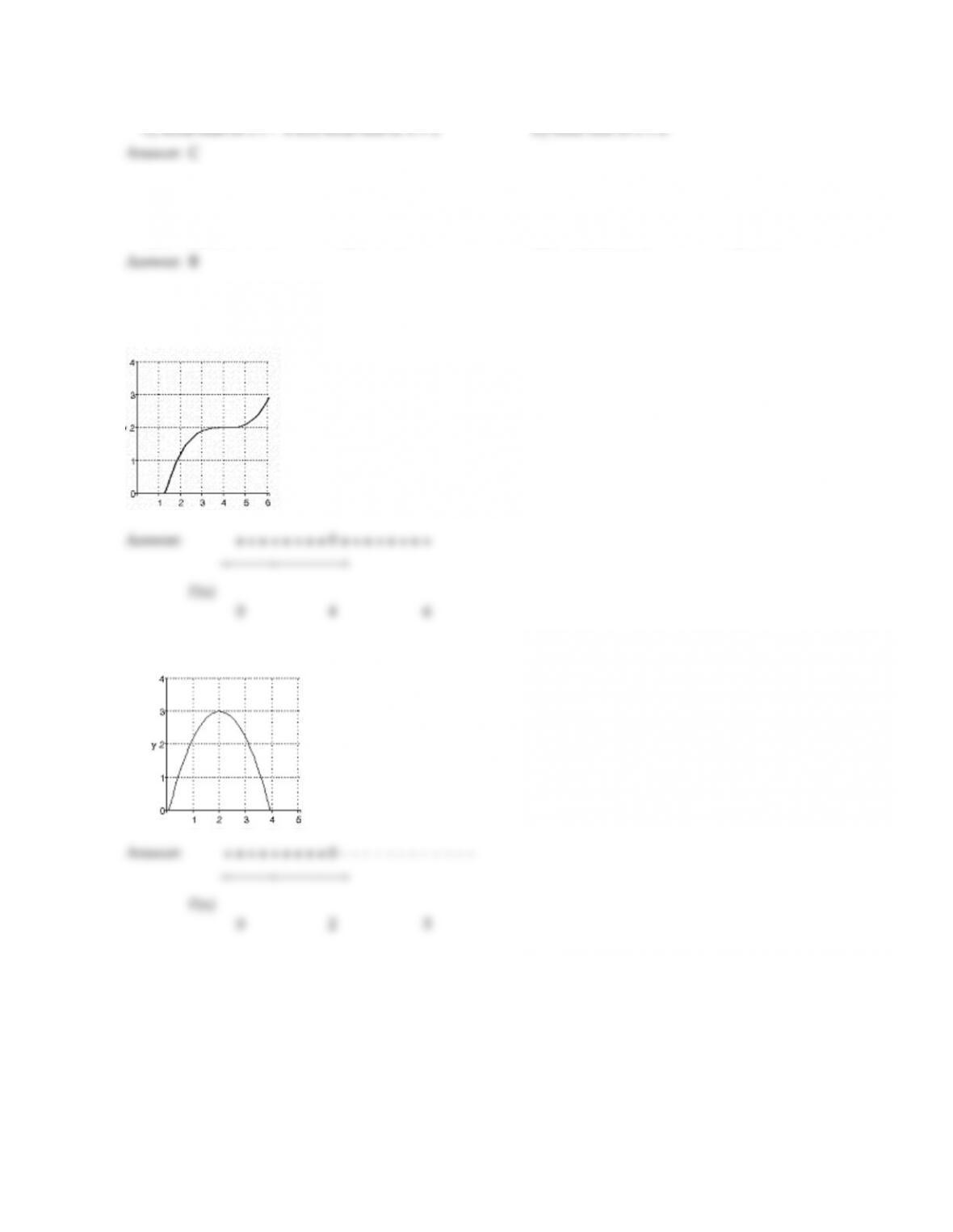
Write the sign chart that corresponds to the following graph of f(x):
Answer:
+ + + + + + + + 0 + + + + + + + +
f'(x)
0 4 6
16)
Write the sign chart that corresponds to the following graph of f(x)::
Answer:
+ + + + + + + + + 0 – – – – – – – – – – – –
f'(x)
0 2 5
4
MULTIPLE CHOICE. Choose the one alternative that best completes the statement or answers the question.
17)
Find the critical values and determine the intervals where f(x) is increasing and the intervals where f(x) is
decreasing for the function f(x) =x3+3x2– 24x + 6.
A)
decreasing on ( , –4) and (2,
); increasing on (–4, 2)
B)
increasing on ( , –4); decreasing on (–4, 2)
C)
increasing on ( , –4) and (2,
); decreasing on (–4, 2)
D)
increasing on ( , –4) and (2,
); decreasing on (–4,
)
Answer:
C
18)
Find the critical values and determine the intervals where f(x) is decreasing and the intervals where f(x) is
increasing for f(x) =3x4–6x2+ 7.
A)
decreasing on (–1, 0) and (1,
); increasing on ( , –1)
B)
decreasing on (–1, 0) and (1,
); increasing on ( , –1) and (0, 1)
C)
increasing on (–1, 0); decreasing on ( , –1) and (0, 1)
D)
increasing on (–1, 0) and (1,
); decreasing on ( , –1) and (0, 1)
Answer:
D
19)
Find the critical values and determine the intervals where f(x) is increasing and f(x) is decreasing if
f(x) = 1 +3
x+2
x2.
A)
increasing on (–4, 0); decreasing on ( , –4) and (0,
)
B)
increasing on –4
3, 0 ; decreasing on , –4
3 and (0,
)
C)
decreasing on –4
3, 0 ; increasing on , –4
3 and (0,
)
D)
decreasing on (–4, 0); increasing on ( , –4) and (0,
)
Answer:
B
20)
Find the critical values and determine the intervals where f(x) is decreasing for f(x) =3(x – 4)2/3 + 6.
A)
f(x) is decreasing on ( , 6); increasing on (6,
)
B)
f(x) is increasing on ( , 4); decreasing on (4,
)
C)
f(x) is decreasing on ( , –4); increasing on (–4,
)
D)
f(x) is decreasing on ( , 4); increasing on (4,
)
Answer:
D
Sketch a graph of the function.
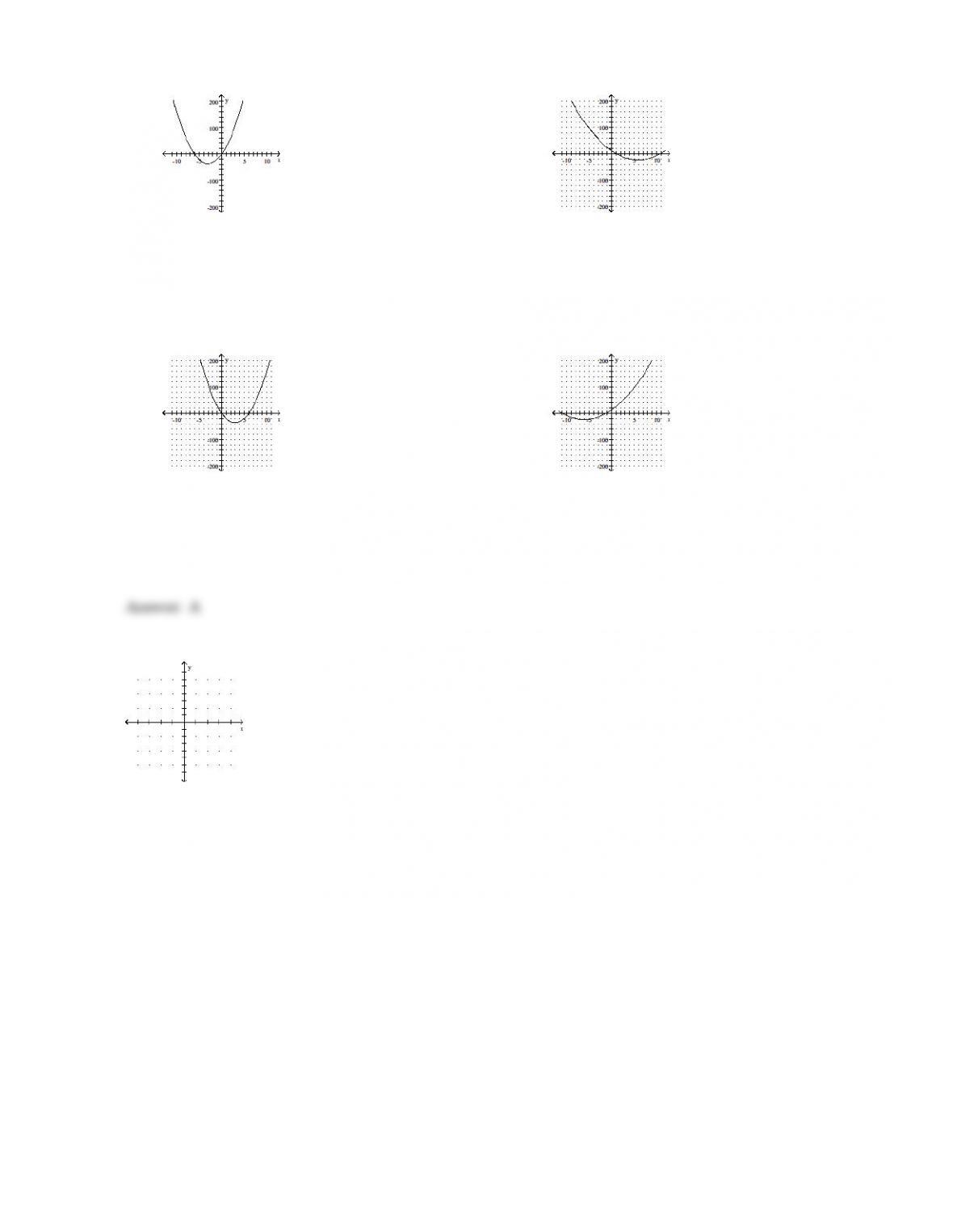
21)
f(x) =4x2+ 24x
5
A)
B)
C)
D)
Answer:
A
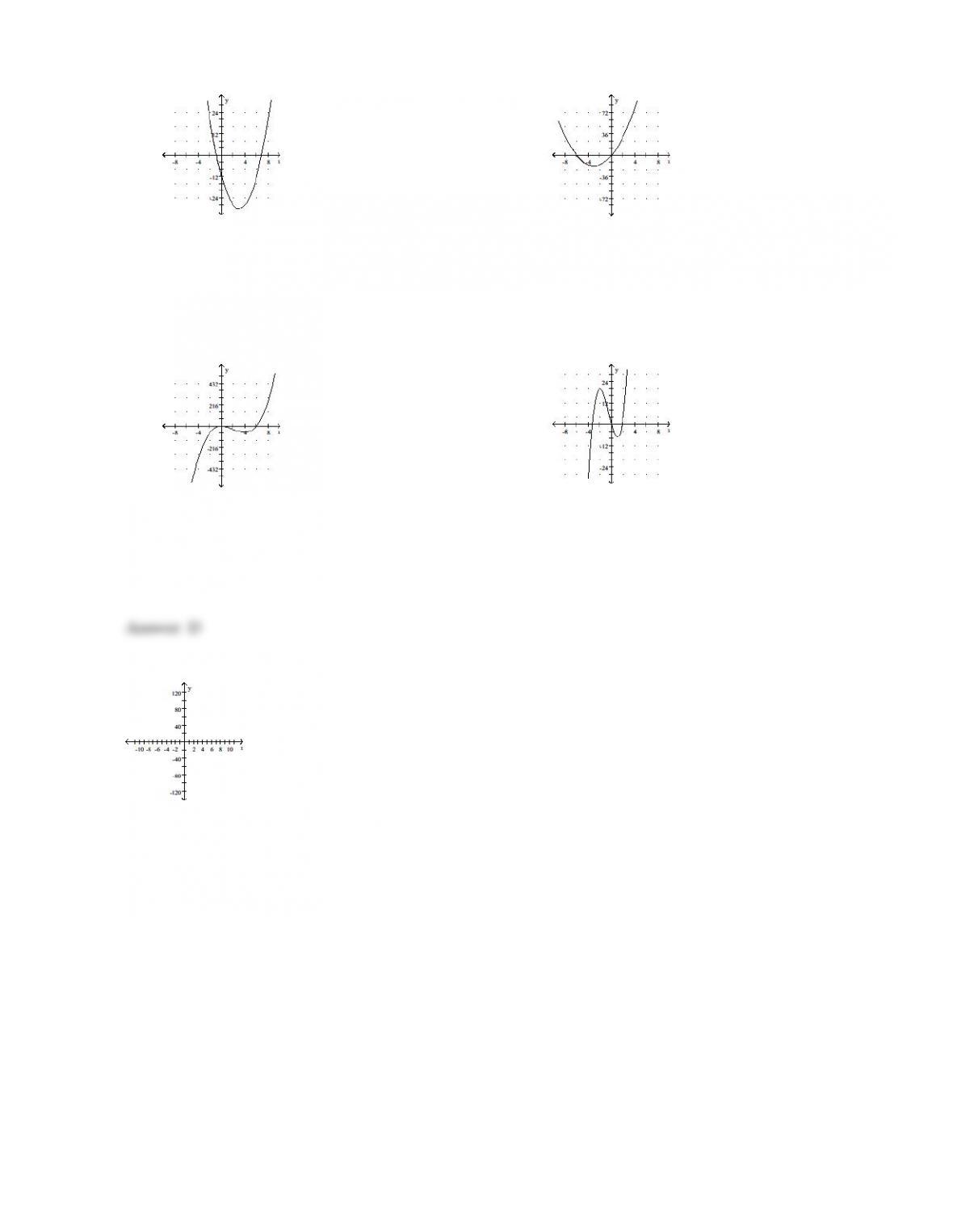
22)
f(x) = 2x3+ 3x2– 12x
6
A)
B)
C)
D)
Answer:
D
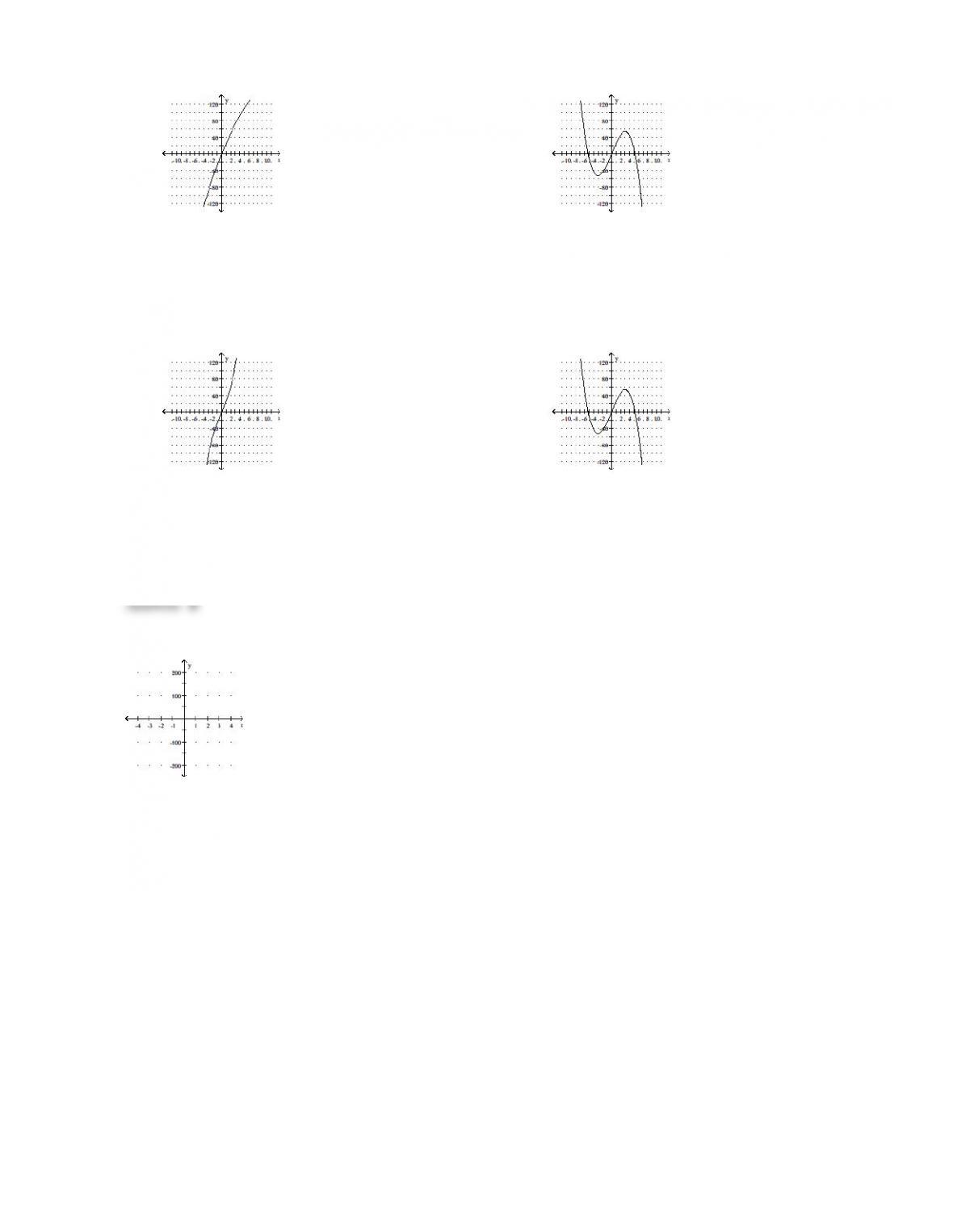
23)
f(x) =27x –x3
7
A)
B)
C)
D)
Answer:
B
24)
f(x) = 3x4–12x3
8
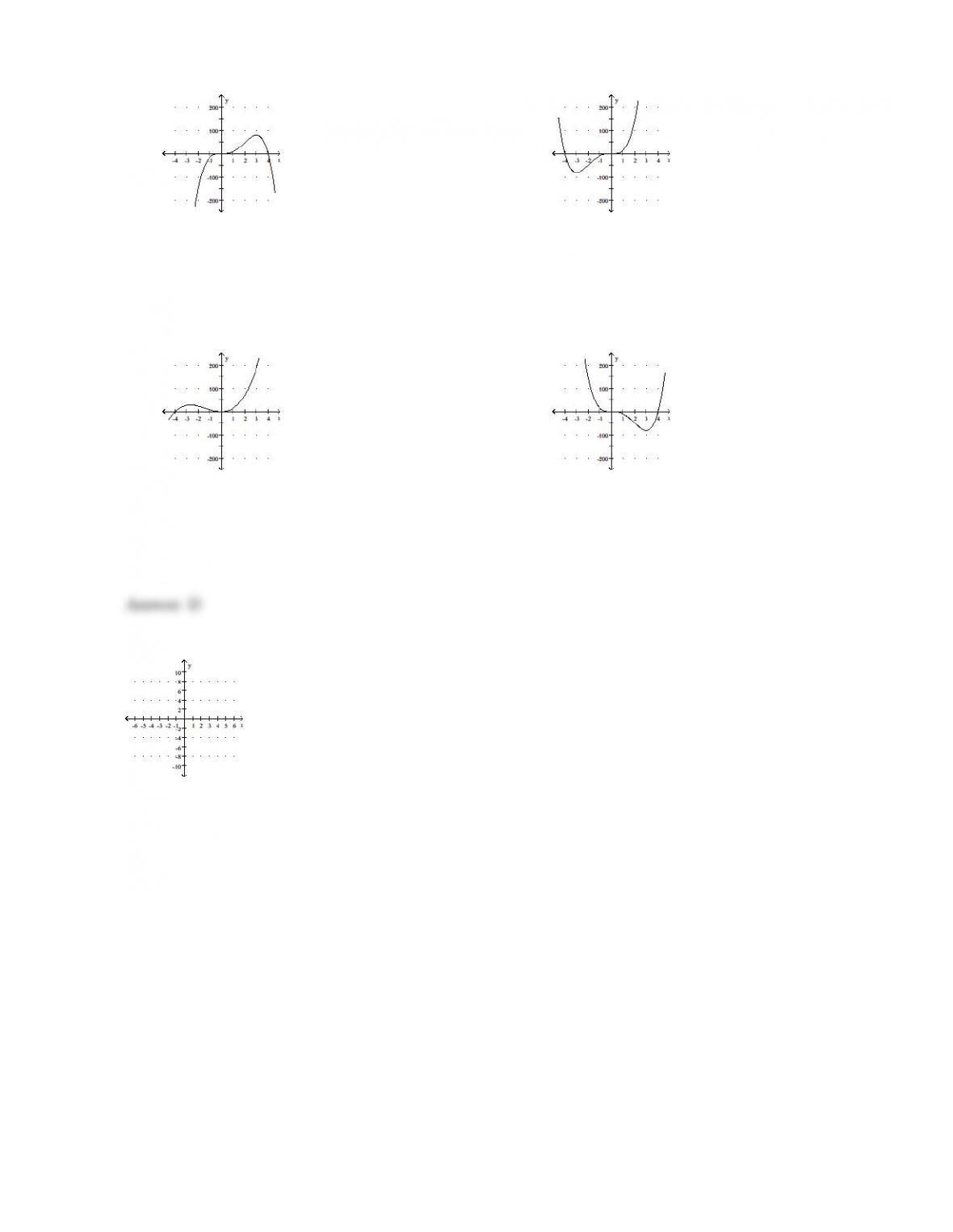
A)
B)
C)
D)
Answer:
D
25)
f(x) =x4– 2x2+2
9
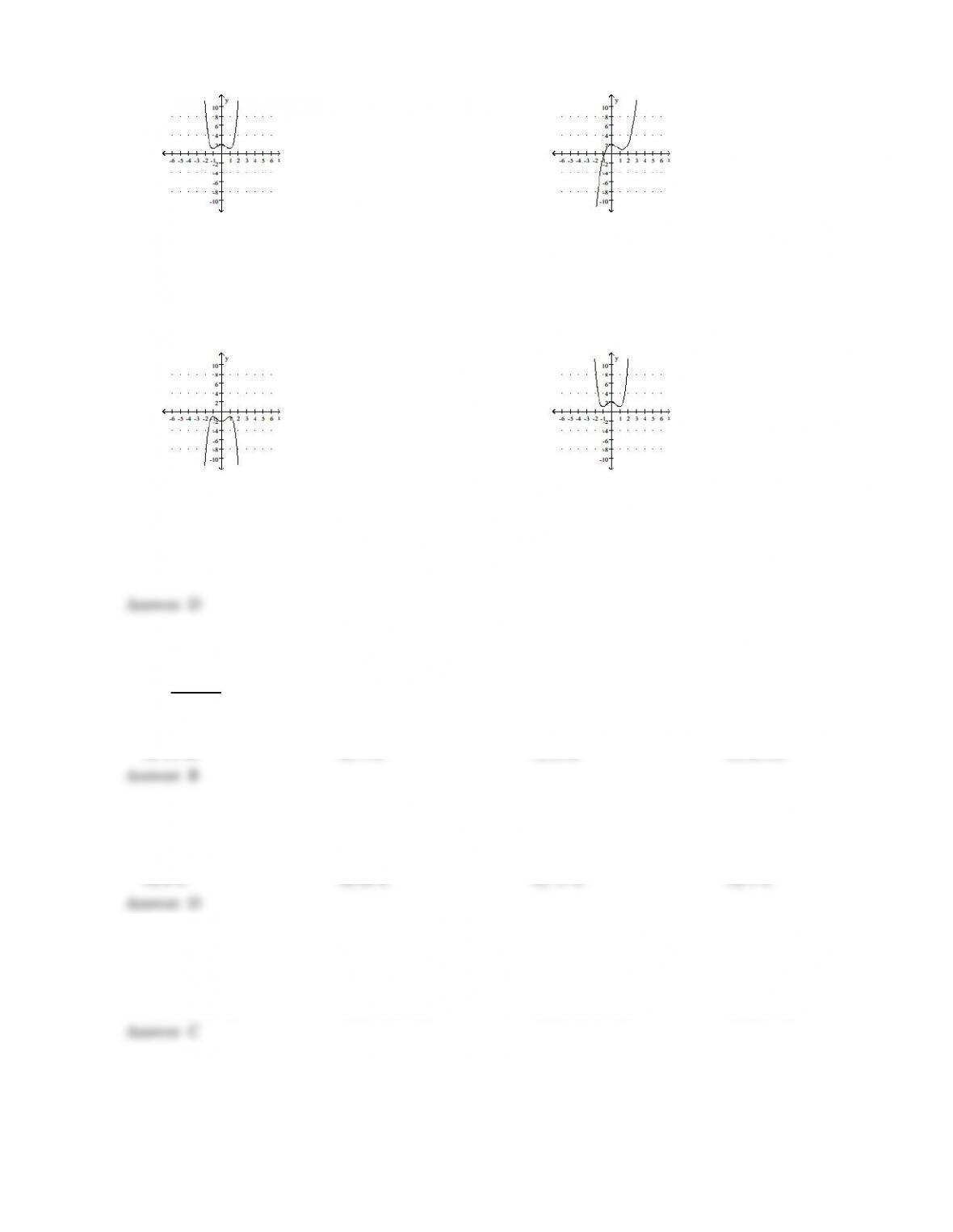
A)
B)
C)
D)
Answer:
D
Solve the problem.
26)
The percent of concentration of a certain drug in the bloodstream x hr after the drug is administered is given by
K(x) =2x
x2+ 25 . How long after the drug has been administered is the concentration a maximum? Round answer
to the nearest tenth, if necessary.
A)
1.3 hr
B)
5 hr
C)
2 hr
D)
2.5 hr
Answer:
B
27)
With x representing the water temperature in degrees Celsius, S(x) = – x3– 9x2+ 165x + 1300, 5
x 20 is an
approximation to the number of salmon swimming upstream to spawn. Find the temperature that produces the
maximum number of salmon.
A)
6°C
B)
20°C
C)
19°C
D)
5°C
Answer:
D
28)
The Olympic flame at the 1992 Summer Olympics was lit by a flaming arrow. As the arrow moved d feet
horizontally from the archer, assume that its height h(d), in feet, was approximated by the function
h(d) = – 0.002d2+ 0.7d + 6.9. Find the relative maximum of the function.
A)
(350, 129.4)
B)
(175, 61.25)
C)
(175, 68.15)
D)
(0, 6.9)
Answer:
C
10
29)
The annual revenue and cost functions for a manufacturer of grandfather clocks are approximately
R(x) =480x – 0.03x2 and C(x) =120x + 100,000, where x denotes the number of clocks made. What is the
maximum annual profit?
A)
$1,280,000
B)
$980,000
C)
$1,180,000
D)
$1,080,000
Answer:
B
30)
The cost of manufacturing x electric woks in one day is given by C(x) = 2x3–16x2+ 4x. Find the average cost
per electric wok and the interval where the average cost per electric wok is decreasing.
A)
C(x) = 6x2– 32x + 4; 0 < x < 4
B)
C(x) = 6x2– 32x + 4; x < 4
C)
C(x) = 2x2– 16x + 4; 0 < x < 4
D)
C(x) = 2x2– 32x + 4; 0 < x < 4
Answer:
C
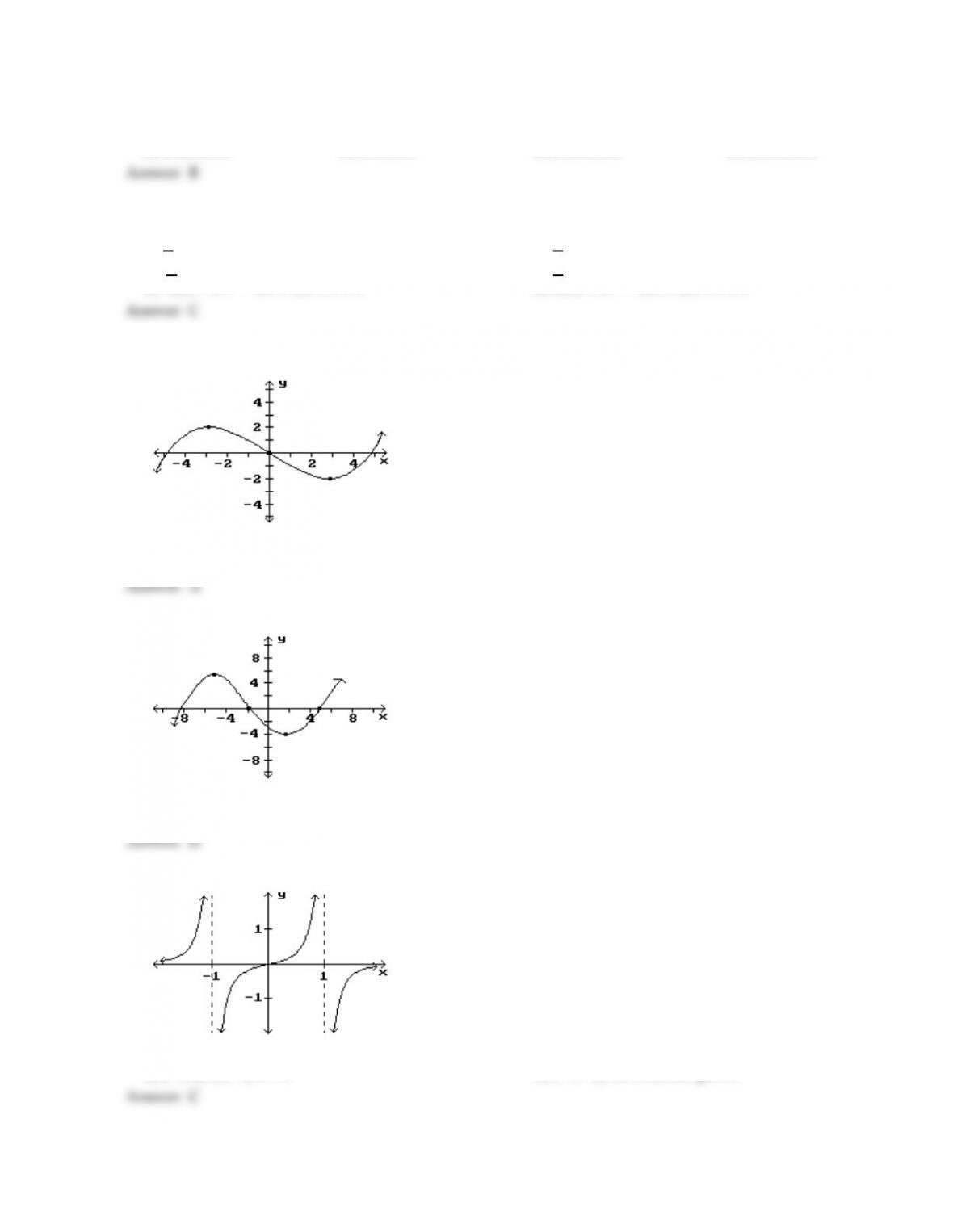
Find the intervals where the function has the indicated concavity. Give the x coordinates of inflection points.
31)
Concave upward
A)
(0,
); x = 0
B)
(–3, 3); x = 0
C)
(0,
); no inflection points
D)
(–3,
); x = 0
Answer:
A
32)
Concave downward
A)
(–2,
); x = 2
B)
(–5, 5); no inflection points
C)
(–5, 2); x = 0
D)
(–
, –2); x = – 2
Answer:
D
33)
Concave downward
A)
(–1, 0); no inflection points
B)
(–1, 0) , (1,
); x = 0 and x = 1
C)
(–1, 0) , (1,
); x = 0
D)
(–
, –1); no inflection points
Answer:
C
11
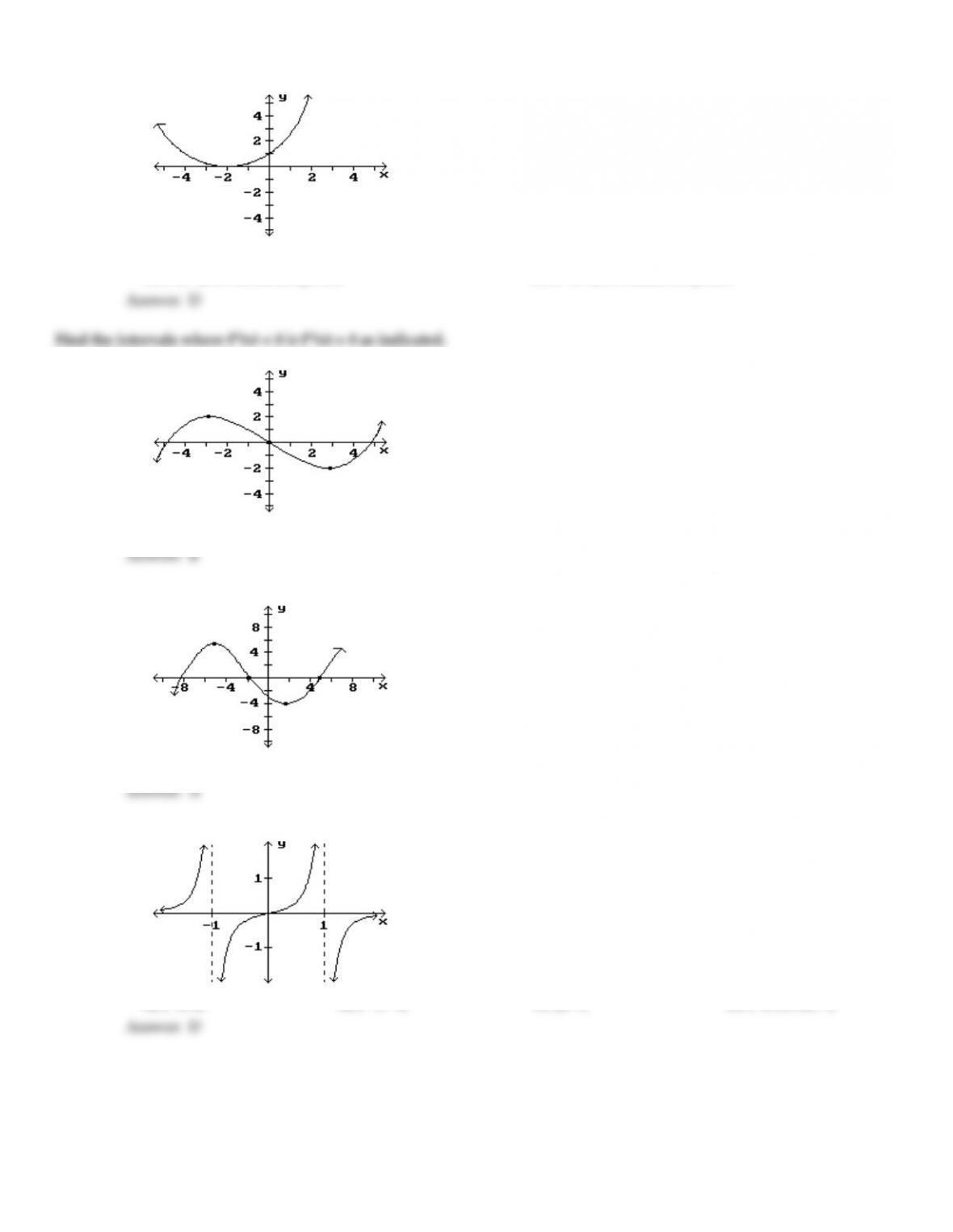
34)
Concave upward
A)
(–
,
); x = – 2
B)
(–
, –2); no inflection points
C)
(–2,
); no inflection points
D)
(–
,
); no inflection points
Answer:
D
Find the intervals where f”(x) < 0 ir f”(x) > 0 as indicated.
35)
f”(x) > 0
A)
(–3,
)
B)
(0,
)
C)
(–3, 3)
D)
(0, 3)
Answer:
B
36)
f”(x) < 0
A)
(–
, –2)
B)
(–5, 5)
C)
(–2,
)
D)
(–5, 2)
Answer:
A
37)
f”(x) < 0
A)
(–1, 0)
B)
(–
, –1)
C)
(1,
)
D)
(–1, 0) , (1,
)
Answer:
D
12
SHORT ANSWER. Write the word or phrase that best completes each statement or answers the question.
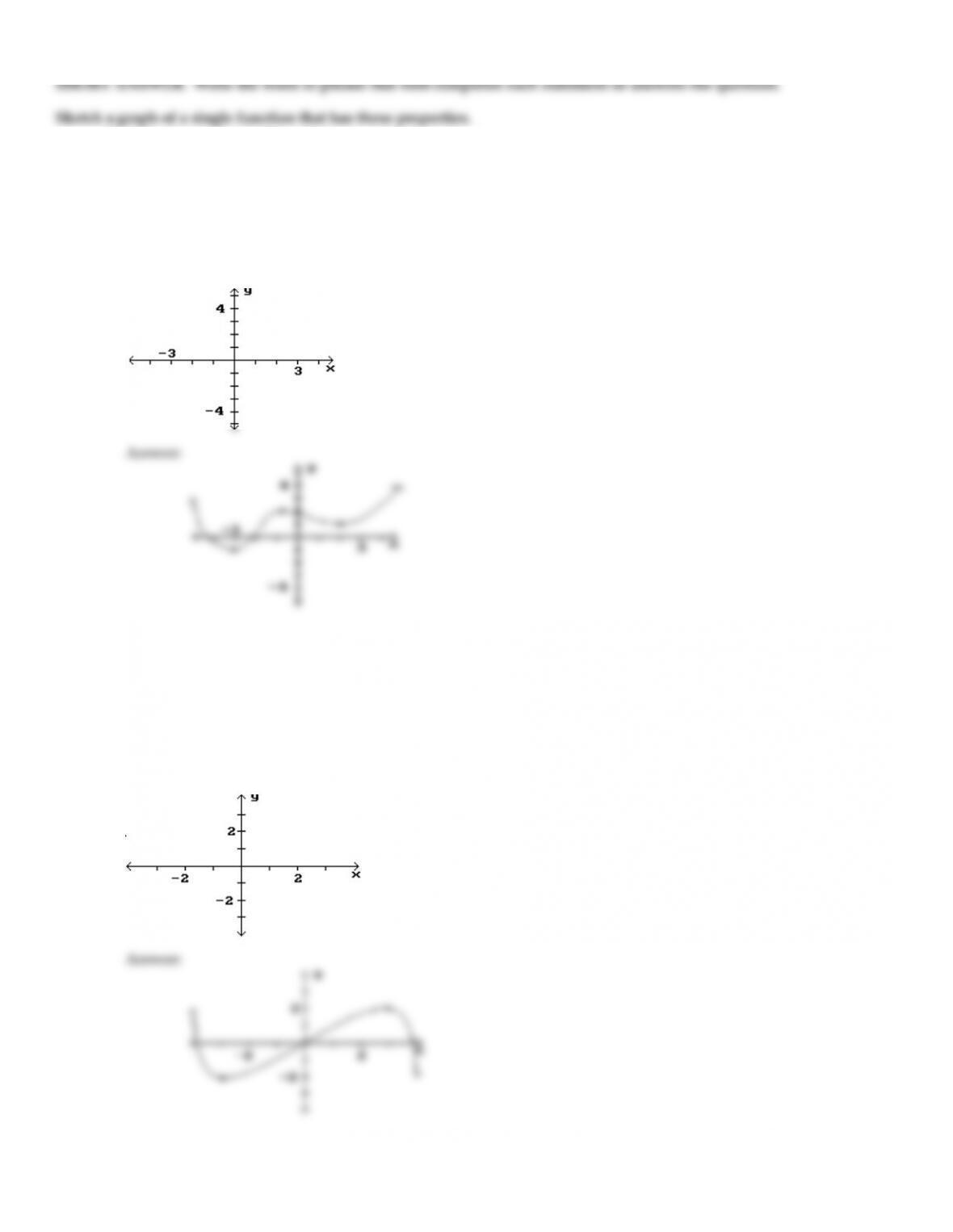
Sketch a graph of a single function that has these properties.
38)
a) Continuous and differentiable for all real numbers
b) f(x) > 0 on (–3 , –1) and ( 2 ,
)
c) f(x) < 0 on (–
, –3) and ( –1 , 2)
d) f(x) > 0 on (–
, –2) and ( 1 ,
)
e) f(x) < 0 on (–2 , 1)
f) f (–3) =f (–1) =f(2) = 0
g) f(x) = 0 at (–2 , 0) and (1, 1)
Answer:
39)
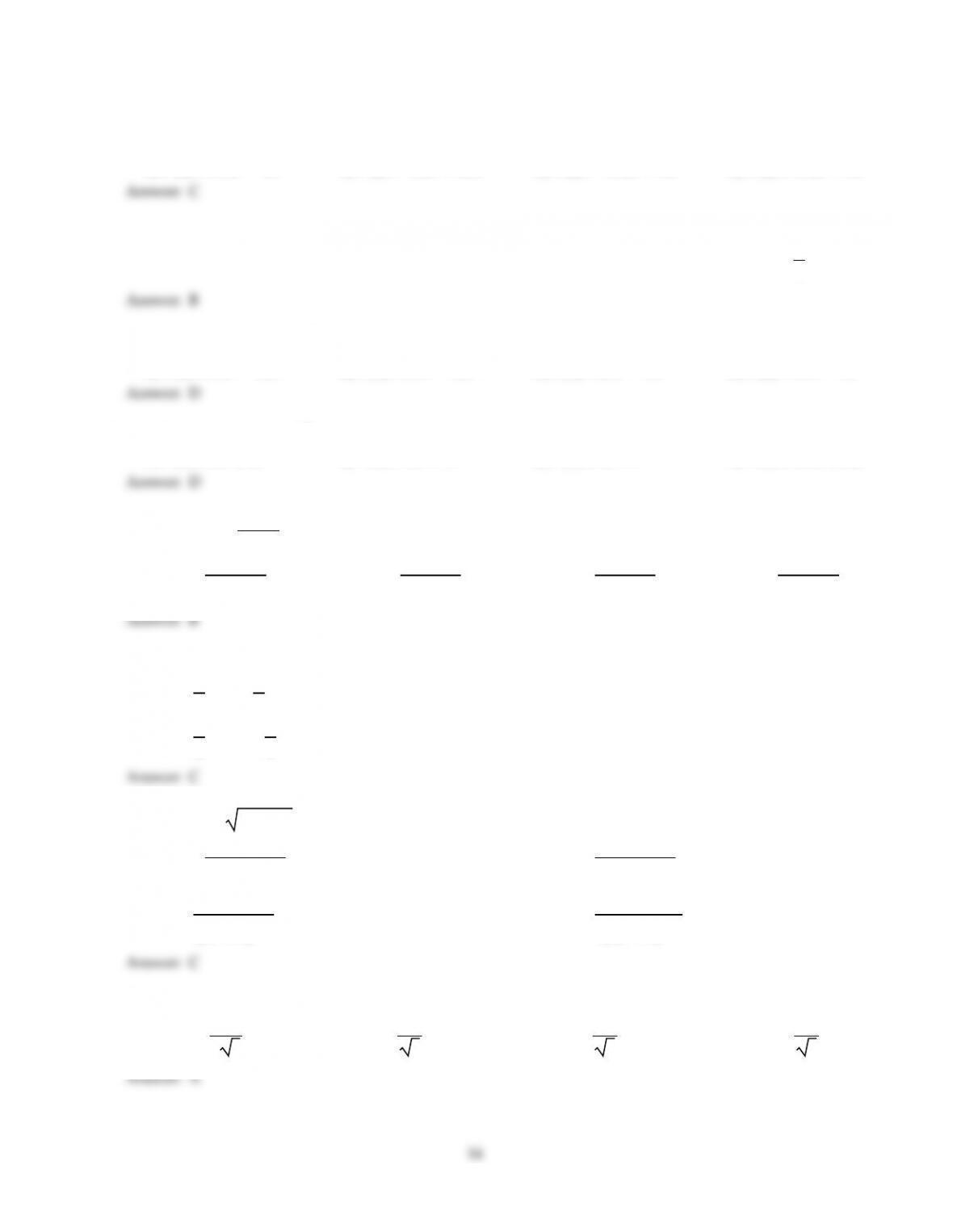
a) Continuous and differentiable for all real numbers
b) f(x) < 0 on (–
, –3 ) and ( 3 ,
)
c) f(x) > 0 on (–3 , 3)
d) f(x) > 0 on (–
, 0 )
e) f(x) < 0 on ( 0 ,
)
f) f (–3) =f(3) = 0
g) An inflection point at (0,0)
Answer:
13
MULTIPLE CHOICE. Choose the one alternative that best completes the statement or answers the question.
Provide an appropriate response.
40)
Find f”(x) for f(x) = – 7x9+ 5x2.
A)
f”(x) = 504x7– 10
B)
f”(x) = – 63x8+ 10x
C)
f”(x) = – 504x7+ 10
D)
f”(x) = 504x8+ 10
Answer:
C
41)
Find f”(x) for f(x) = 4x – 6.
A)
f”(x) = 4
B)
f”(x) = 0
C)
f”(x) = 4x3– 6x2
D)
f”(x) =4
x
Answer:
B
42)
Find f”(x) for f(x) = 5x4– 6x2+ 7.
A)
f”(x) = 60x2– 12x
B)
f”(x) = 20x2– 12x
C)
f”(x) = 20x2– 12
D)
f”(x) = 60x2– 12
Answer:
D
43)
Find f”(x) for f(x) =(4x + 5)3 .
A)
f”(x) = 24x + 30
B)
f”(x) = 12x + 15
C)
f”(x) = 4x + 5
D)
f”(x) = 384x + 480
Answer:
D
44)
Find y” for y = – 1
3x + 4 .
A)
y” = – 6
(3x + 4)3
B)
y” = – 18
(3x + 4)3
C)
y” = – 2
(3x + 4)3
D)
y” =18
(3x + 4)3
Answer:
B
45)
Find y” for y = 2 x3/2 – 6x1/2 .
A)
y” =3
2x1/2 +3
2x– 1/2
B)
y” = 3x– 1/2 + 3x– 3/2
C)
y” =3
2x– 1/2 +3
2x– 3/2
D)
y” = 3x1/2 – 3x– 1/2
Answer:
C
46)
Find y” for y =5x2+ 4 .
A)
y” = – 25x2
(5x2+ 4)3/2
B)
y” = – 25x2
(5x2+ 4)1/2
C)
y” =20
(5x2+ 4)3/2
D)
y” = – 1
4(5x2+ 4)3/2
Answer:
C
47)
Find y” for y =x4–8x1/2
A)
12x2+2
x x
B)
4x3+4
x
C)
4x3–4
x
D)
12x2–4
x
Answer:
A
14
48)
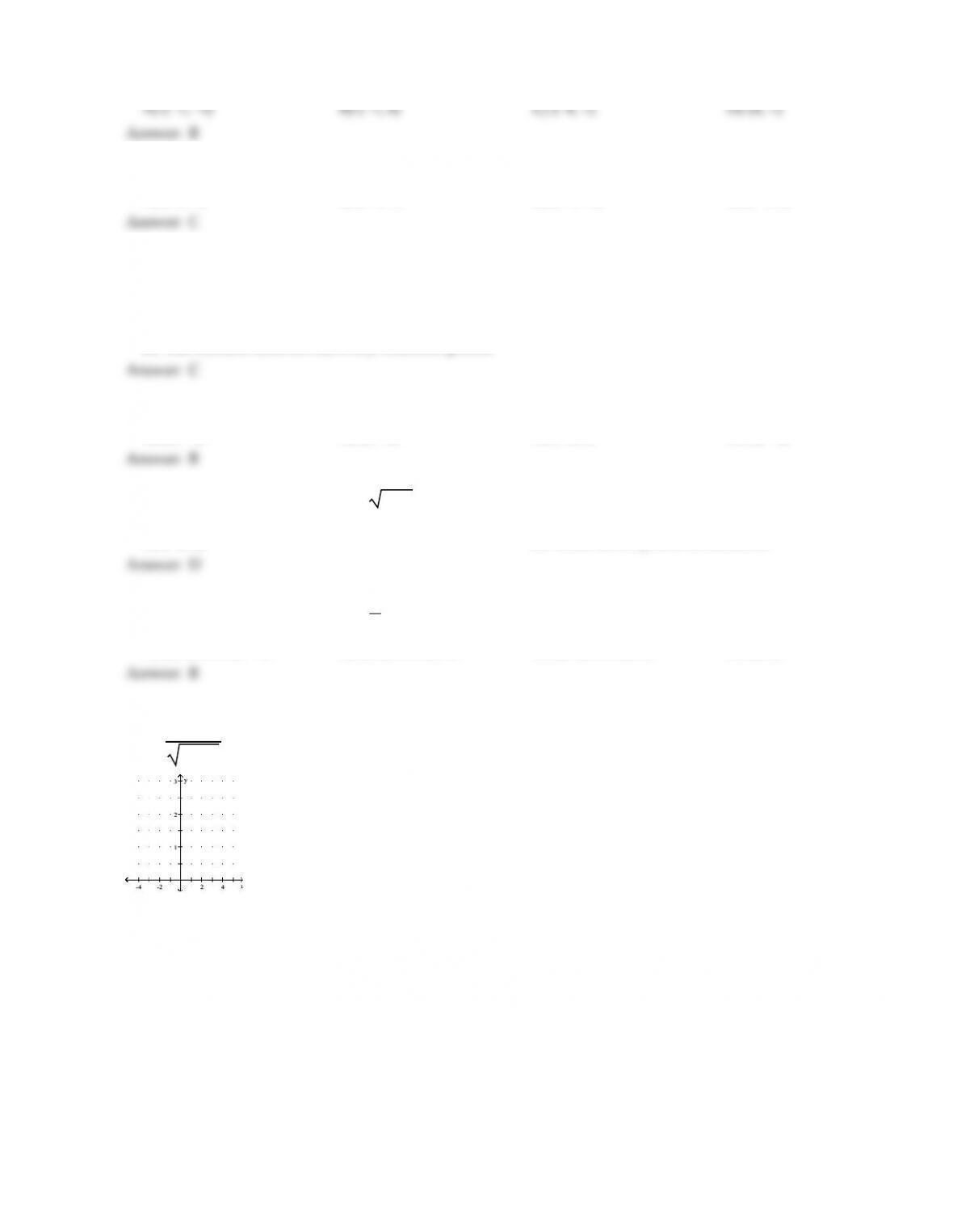
Determine the interval(s) over which f(x) = (x –4)3 is concave downward.
A)
(–
, –4)
B)
(–
, 4)
C)
(–4,
)
D)
(4,
)
Answer:
B
49)
Determine the interval(s) over which f(x) = (x +3)3 is concave upward.
A)
(–3,
)
B)
(–
,
)
C)
(–
, –3)
D)
(–
, 3)
Answer:
C
50)
Find all inflection points for f(x) =x4–10x3+24x2+ 3x + 5.
A)
Inflection points at x = 0, x = 1, x = 4
B)
Inflection points at x –0.06, x
2.43, x
5.13
C)
Inflection points at x = 1, x = 4
D)
This function does not have any inflection points.
Answer:
C
51)
Find the inflection point(s) for f(x) =x3– 6x – 1.
A)
(0, –6)
B)
(0, –1)
C)
(–1, 6)
D)
(1, –1)
Answer:
B
52)
Find the inflection point(s) for f(x) =x + 7.
A)
(–3, 2)
B)
(–7, 0)
C)
(–6, 1)
D)
There are no points of inflection.
Answer:
D
53)
Find the inflection point(s) for f(x) =1
4x4–x3+ 6.
A)
(0, 6) and (2, –4)
B)
(0, 6) and (2, 2)
C)
(0, 0) and (2, 2)
D)
(0, 0)
Answer:
B
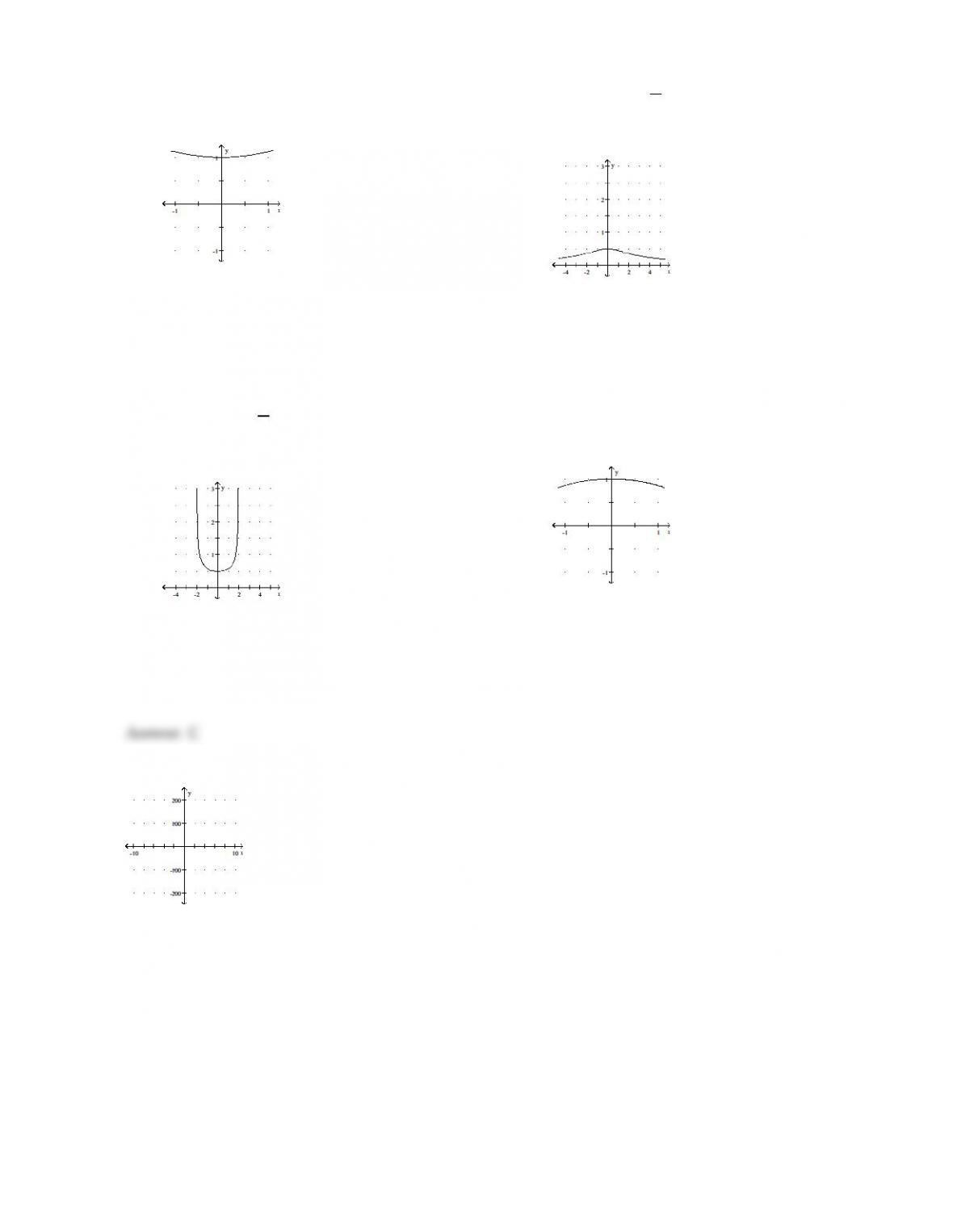
Sketch the graph and show all local extrema and inflection points.
54)
f(x) =1
4– x2
15
A)
Local min: (0, 1)
No inflection point
B)
Local max: (0, 1
2)
No inflection point
C)
Local min: (0, 1
2)
No inflection point
D)
Local max: (0, 1)
No inflection point
Answer:
C
55)
f(x) =4x2+ 16x
16
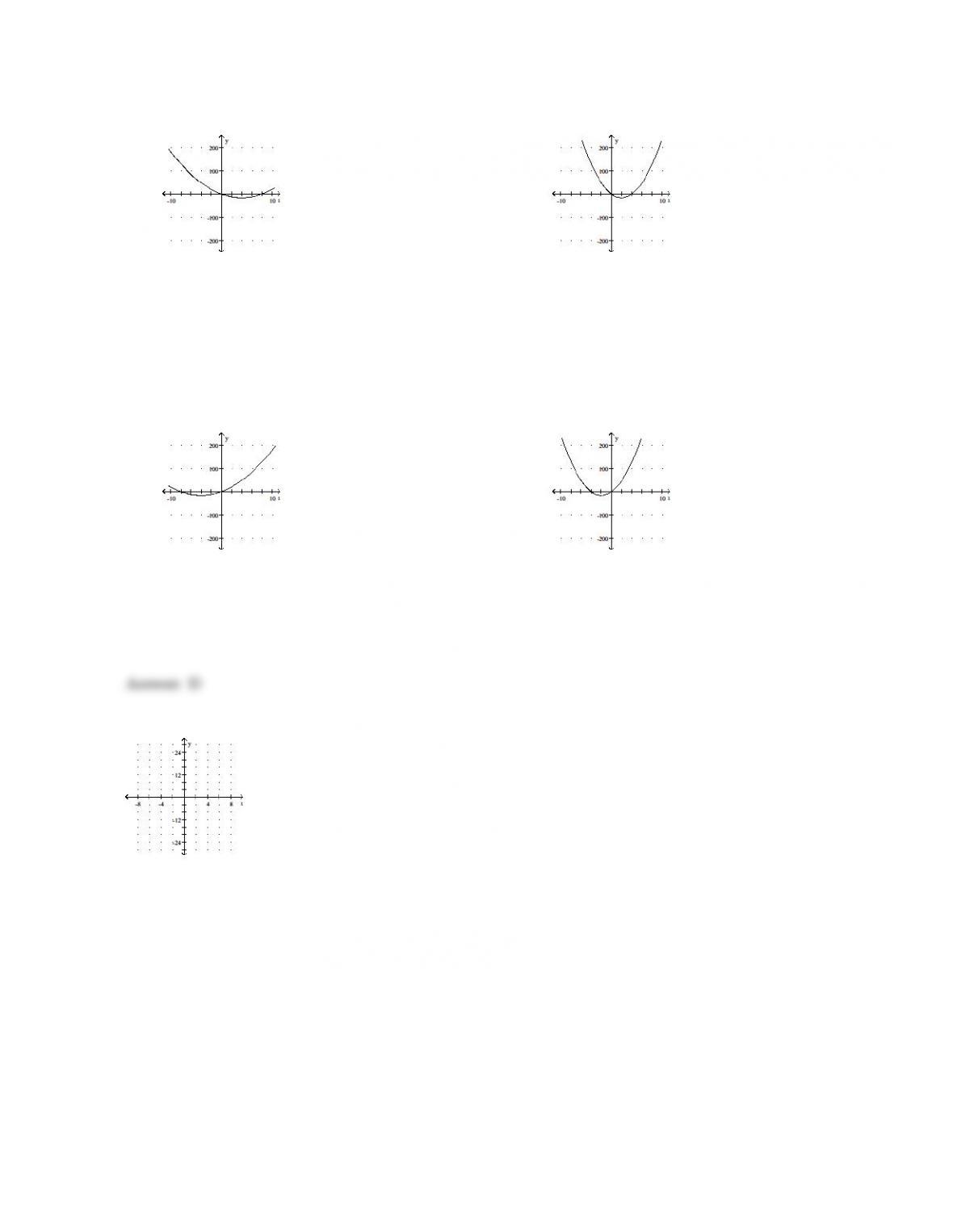
A)
Min: (4, –16)
No inflection points
B)
Min: (2, –16)
No inflection points
C)
Min: (–4, –16)
No inflection points
D)
Min: (–2, –16)
No inflection points
Answer:
D
56)
f(x) = 2x3+ 12x2+ 18x
17