
International Economics: Theory and Policy, 11e (Krugman et al.)
1) The world’s economies can be divided into four main categories according to their annual per-
capita income levels. Which one of the following is NOT one of the categories?
A) low-income
B) upper middle-income
C) high-income
D) lower middle-income
E) middle-income
2) Average per–capita GDP in the richest, most prosperous economies is ________ times that of
the average in the ________ economies.
A) 95, low (poorest) income
B) 95, lower-middle income
C) 73, lower-middle income
D) 44, low (poorest) income
E) 69, low (poorest) income
3) Compared with industrialized economies, most developing countries are poor in the factors of
production essential to modern industry. These factors are
A) capital and skilled labor.
B) capital and unskilled labor.
C) fertile land and unskilled labor.
D) fertile land and skilled labor.
E) water and capital.
4) The main factors that discourage investment in capital and skills in developing countries are
A) political instability, insecure property rights.
B) political instability, insecure property rights, misguided economic policies.
C) political instability, misguided economic policies.
D) political instability.
E) insecure property rights, misguided economic policies.

5) The per-capita GNP of the industrial group is about ________ times that of the upper middle–
income countries.
A) 6
B) 10
C) 15
D) 19
E) 2
6) When one compares per-capital output growth rates among countries
A) one needs to correct the data to account for departures from purchasing power parity.
B) such corrections are often not necessary.
C) such corrections are sometimes necessary.
D) the evidence whether such corrections are necessary are vague.
E) such corrections are not necessary.
7) Over the period 1960-2014, the United States economy grew at roughly
A) 2.1 percent.
B) 3 percent.
C) 4 percent.
D) one percent.
E) 3.5 percent.
8) Over the period 1960-2000, France grew ________ than the United States economy.
A) 2 % slower
B) 2% faster
C) more than 2% slower
D) less than 2% faster
E) more than 2% faster

9) Over the post-war era, the gaps between industrial countries’ living standards
A) disappeared.
B) stayed the same.
C) increased.
D) decreased.
E) fluctuated.
10) Over the post-war era, the gaps between countries’ living standards
A) disappeared.
B) stayed the same.
C) increased.
D) decreased.
E) changed inconsistently.
11) Over the post-war era, poorer countries grew
A) faster.
B) slower.
C) stayed the same.
D) grew faster, then grew slower.
E) No general tendency can be found.
12) Since 1960, countries in Africa have grown at rates ________ those of the main industrial
countries.
A) far below
B) far above
C) about the same
D) slightly below
E) slightly above

13) Since 1960, South Korea and Singapore enjoyed average per-capita growth rates ________
the average industrialized world.
A) far below
B) far above
C) about the same
D) slightly below
E) slightly above
14) Until recently, per-capita income increased in East Asian countries such as Hong Kong,
Singapore, South Korea, and Taiwan by ________-fold every generation
A) 2
B) 3
C) 4
D) 5
E) 1
15) Between 1960 and 2010, the annual growth rate in percent per year was the highest in
A) China.
B) United States.
C) Brazil.
D) Singapore.
E) South Korea.
16) What is the basic problem of developing countries?
A) corruption
B) murder
C) poverty
D) stock market
E) natural resources
17) How would you describe the world distribution of income?
A) persistently unequal
B) temporarily unequal
C) converging
D) fairly equal
E) completely unpredictable
18) How would you define convergence?
A) tendency for gaps between industrial countries’ per-capital incomes to narrow
B) tendency for gaps between all countries’ per-capital incomes to narrow
C) the theory that a crisis in a low-income country will spread to all countries, regardless of debt
structure
D) the theory that a crisis in a low-income country will spread to only those countries which had
lent money to the original country
E) tendency for the world distribution of income to be persistently unequal
19) Which of the following countries had a larger growth rate since 1960?
A) U.S.
B) Senegal
C) South Korea
D) Kamul
E) Colombia
20) What explains the sharply divergent long-run growth patterns?
21) Explain the theory behind convergence and why it is a “deceptively simple” theory.
6
Copyright © 2018 Pearson Education, Inc.
22) Explain what the four main categories of world economies are and give examples?
7
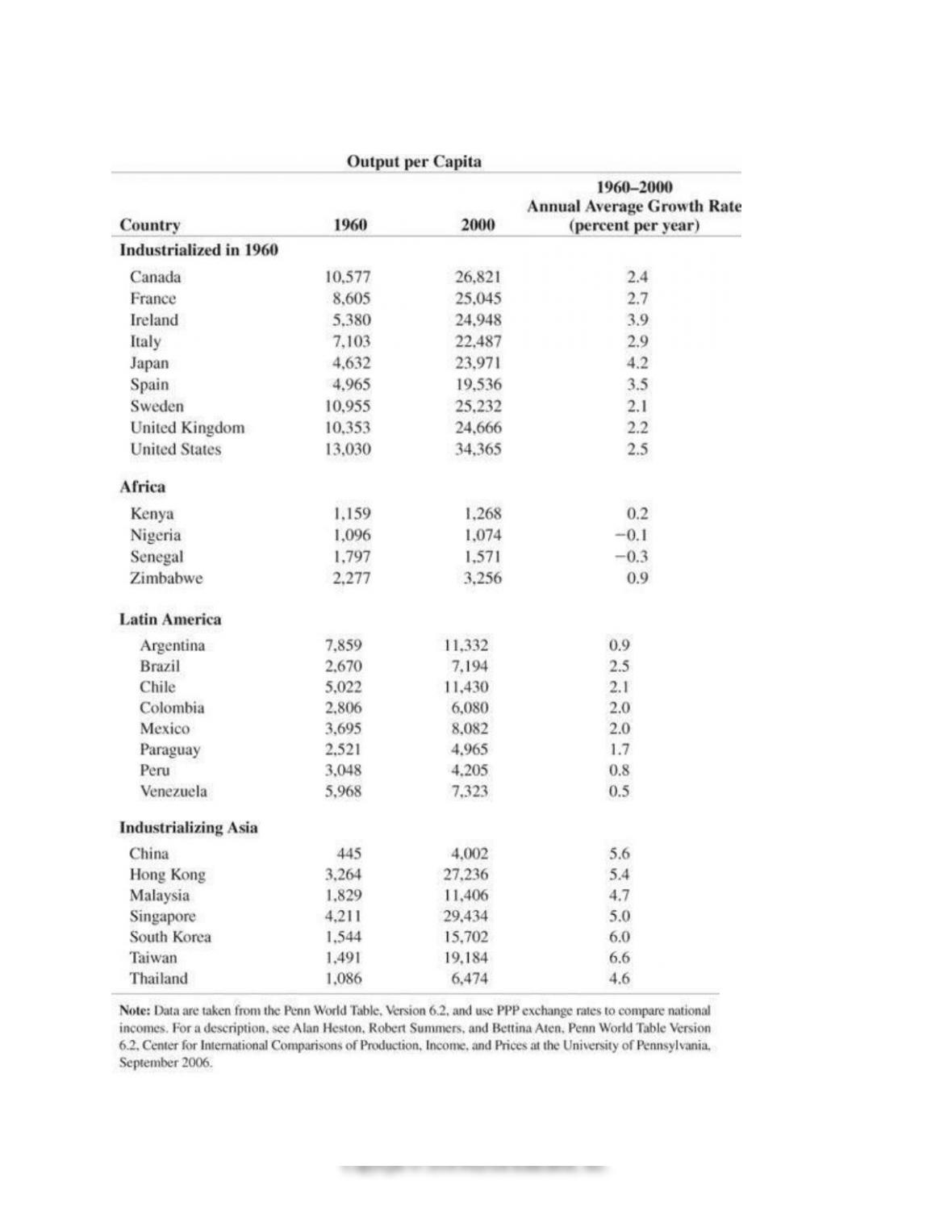
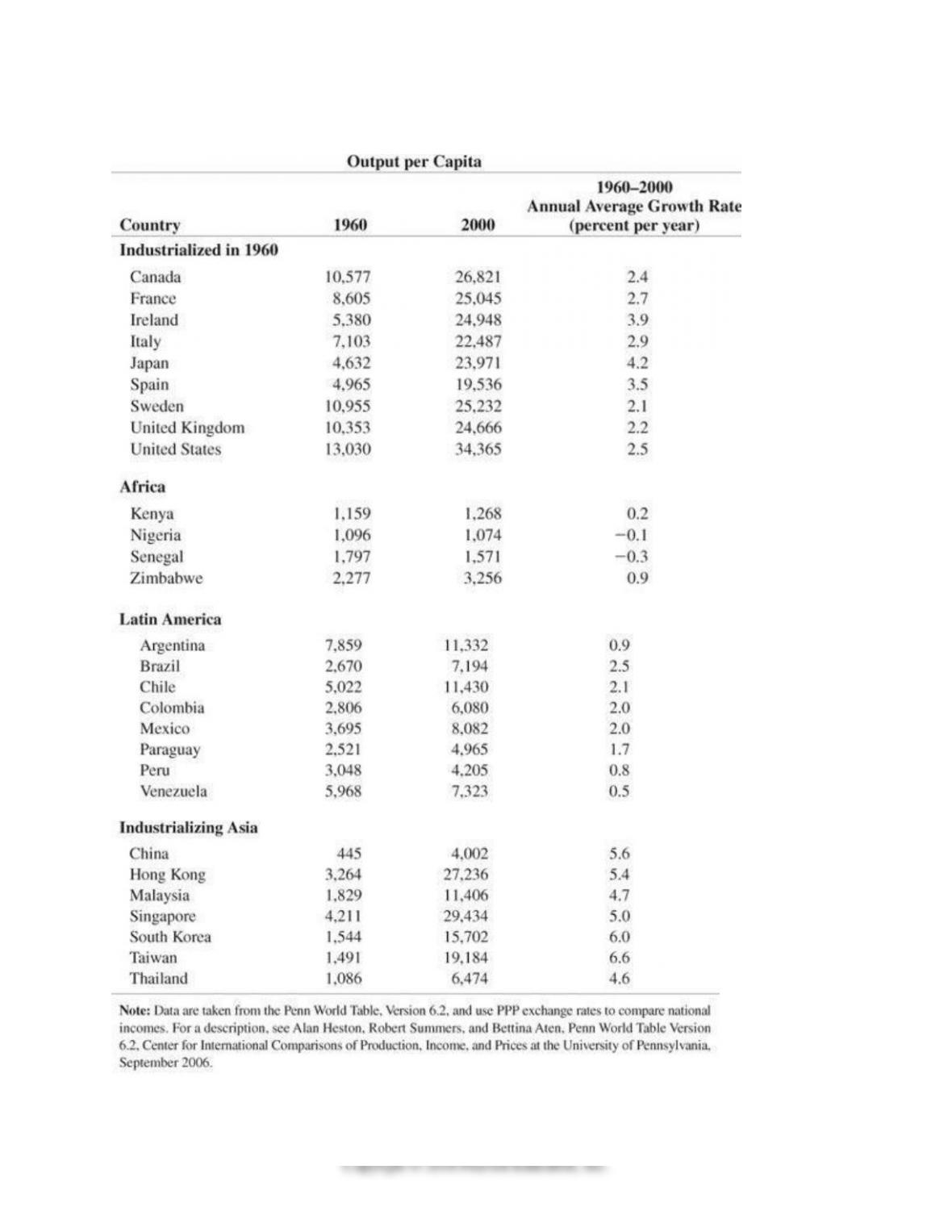
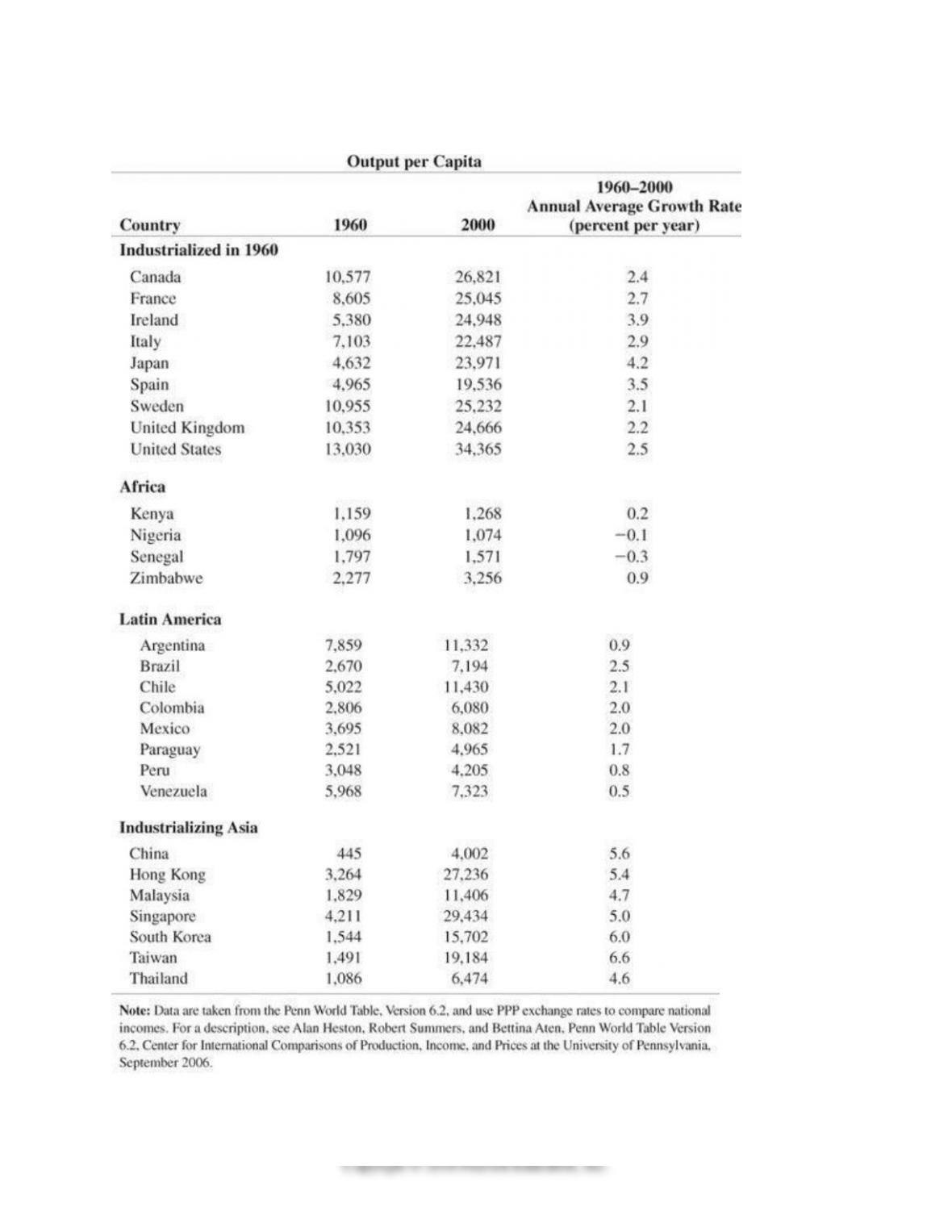
23) Please consider Table 22-2 below.
Assuming constant Annual Average Growth Rate in the future, calculate the output per capita for
the United States and South Korea for the year 2040.

8
Copyright © 2018 Pearson Education, Inc.
Answer: Since 2040 – 2000 = 2000 – 1960, then
output per capita for U.S. = 34365 * (34365 / 1544)
= 90,633
output per capita for South Korea = 15702 * (15702 / 1544)
= 159,685
Page Ref: 694-696
Difficulty: Moderate
9
24) Please consider Table 22-2 below.
At that Annual Average Growth Rate, how many years does it take for the output per capita to
double in both the United States and South Korea.
11
25) Please consider Table 22-2 below.
Assuming constant Annual Average Growth Rate in the future, determine the year in which the
United States will have the same output per capita as South Korea?
12
Copyright © 2018 Pearson Education, Inc.
Answer: (34,365) (1 + 0.025 = (15,702) (1 + 0.06
(34,365) / (15,702) = [(1.06) / (1.025)
t – 2000 = ln[(34,365) / (15,702)] / ln[(1.06) / (1.025)]
t = 2023
Page Ref: 694-696
Difficulty: Moderate
22.2 Structural Features of Developing Countries
1) While many developing countries have reformed their economies in order to imitate the
success of the successful industrial economies, the process remains incomplete and most
developing countries tend to be characterized by all of the following EXCEPT
A) seigniorage.
B) control of capital movements by limiting foreign exchange transactions connected with trade
in assets.
C) use of natural resources or agricultural commodities as an important share of exports.
D) a worse job of directing savings toward their most efficient investment uses.
E) reduced corruption and poverty due to limited underground markets.
2) In general, one would expect that life expectancies reflect international differences in income
levels. Do the data support such a claim?
A) Average life span falls as relative poverty falls.
B) Average life span increases as relative poverty falls.
C) There is no statistically significant relationship between the two.
D) The relation is not very strong.
E) The relationship looks more like a U-shape.
3) Seigniorage refers to
A) real resources a government earns when it prints money to use for spending on goods and
services.
B) nominal resources a government earns when it prints money to use for spending on goods and
services.
C) real resources a government earns when it prints money.
D) nominal resources a government earns when it prints money.
E) real resources a government earns when it issues bonds to use for spending on goods and
services.

4) In developing countries, exchange rates tend to be
A) floating with some government intervention.
B) pegged.
C) hard to tell from the data.
D) run by currency boards.
E) flexible.
5) Most developing countries have tried to
A) liberalize capital movement.
B) control capital movements.
C) Hard to tell from the data.
D) in the 1960s and 1970s control, now to liberalize.
E) in the 1960s and 1970s liberalize, now to control.
6) For many developing countries, natural resources or agricultural commodities make up
________ share of exports
A) close to no
B) an unimportant
C) an important
D) close a to 5 percent
E) close to a 10 percent
7) In general, the development of underground economic activity ________ economic efficiency
A) hinders
B) has no effect
C) aides
D) hard to tell, sometime hinders, sometimes aides
E) spikes

8) One should expect ________ relationship between annual per-capita GDP and an inverse
index of corruption.
A) a weak and negative
B) a weak and positive
C) a strong and negative
D) a strong and positive
E) an unpredictable
9) Which of the following is NOT a common characteristic of a developing country?
A) extensive direct government control of the economy
B) history of low inflation
C) many weak credit institutions
D) “pegged” exchange rates
E) agricultural commodities make up a large share of its exports
10) The relationship between annual real per-capita GDP and corruption across countries has
been found to be
A) negative.
B) positive.
C) The relationship was negative in the late 1960s but is now positive.
D) The relationship was in the late 1960s but is now negative.
E) There is no relationship between these two variables.
11) Which of the following does NOT explain why developing countries encouraged new
manufacturing industries of their own in the mid 20th century?
A) They were cut off from traditional suppliers of manufactures during WWII.
B) Former colonial areas had something to prove; they wanted to attain the same income levels
as their former rulers.
C) Leaders of these countries feared that their efforts to escape poverty would be doomed if they
continue to specialize in primary commodity exports.
D) There was political pressure to protect these industries.
E) Developing countries ran out of the natural resources that traditionally made up the majority
of their trade.
12) Which of the following are characteristic of a developing country?
A) extensive embrace of free trade policies
B) low inflation
C) high national savings
D) a current account deficit and low national savings
E) strong credit institutions
13) The real resource a government earns when it prints money and spends it on goods and
services is called
A) seigniorage.
B) control of capital movements by limiting foreign exchange transactions.
C) pure profits.
D) inflation profits.
E) greenback.
14) For many developing countries, natural resources or agricultural commodities make up a
________ share of exports.
A) large
B) moderate
C) nonexistent
D) small
E) insubstantial
15) Describe some of the features hindering developing countries from growing faster.
16) Explain the extensive economic role of government within a developing country.
1) In developing economies, national saving is often ________ relative to developed economies.
A) high
B) the same
C) hard to tell
D) low
E) low for the very poor countries and high for the more developed
2) The Convertibility Law of April 1991 in Argentina
A) pegged the Argentinean currency to the U.S. dollar at a ratio of one to one.
B) pegged the Argentinean currency to the U.S. dollar at a ratio of one to two.
C) pegged the Argentinean currency to the U.S. dollar at a ratio of one to 0.5.
D) represents an era of floating exchange rate in Argentina.
E) pegged the Argentinean currency to the British pound at a ratio of one to one.
3) The $50 billion emergency loan orchestrated by the U.S. Treasury and the IMF to Mexico in
1994
A) was a disastrous policy for Mexico.
B) avoided a disaster to the Mexican economy.
C) did not affect Mexico in the short run.
D) did not affect Mexico in the long run.
E) was ineffective both in the short and long runs.