16) Which one of the following statements is TRUE for Norway, a non-euro country?
A) Of course, owners of capital that cannot be moved cannot avoid more of the economic
stability loss due to fixed exchange rates when Norway’s economy is open to capital flows.
B) Even owners of capital that cannot be moved can avoid more of the economic stability loss
due to fixed exchange rates when Norway’s economy is open to capital flows.
C) Owners of capital that cannot be moved can avoid more of the economic stability loss due to
fixed exchange rates when Norway’s economy is closed to capital flows.
D) Even owners of capital that can be moved can avoid more of the economic stability loss due
to fixed exchange rates when Norway’s economy is closed to capital flows.
E) Only owners of capital that can be moved can avoid more of the economic stability loss due
to fixed exchange rates when Norway’s economy is open to capital flows.
17) The intersection of GG and LL determines
A) the optimal level of integration desired by Norway.
B) the maximum integration level desired by Norway.
C) the minimum level of integration that will cause Norway to join the fixed exchange rate
regime.
D) the maximum level of integration that will cause Norway to join the fixed exchange rate
regime.
E) the maximum level of integration that can aid Norway if it joins the fixed exchange rate
regime.
18) The level of fiscal federalism in the European Union is
A) too big to cushion member countries from adverse economic events.
B) too small to cushion member countries from adverse economic events.
C) appropriate to cushion member countries from adverse economic events.
D) too big relative to the one in the U.S.
E) similar in its level to that of the U.S.
19) A good measure of a country’s level of economic integration with a currency area is
A) the intersection of DD and GG.
B) the country’s price level.
C) the compatibility of economic policies.
D) the intersection of AA and GG.
E) the extent of trade between the joining country and the currency area and the ease with which
labor and capital can migrate between the joining country and the currency area.
20) A key barrier to labor mobility within Europe is
A) the laziness of Germans.
B) full employment in most European countries.
C) differences in language and culture.
D) lack of transportation.
E) the physical barriers in the landscape.
21) Which of the following statements is MOST accurate?
A) The countries of southern Europe are better endowed with capital and skilled labor than the
countries of northern Europe.
B) The countries of northern Europe are better endowed with capital and skilled labor than the
countries of southern Europe.
C) EU products that make intensive use of high-skill labor are most likely to come from
Portugal.
D) EU products that make intensive use of low-skill labor are most likely to come from Great
Britain.
E) The countries of eastern Europe are better endowed with capital and skilled labor than the
countries of western Europe.
22) A recent study by Andrew Rose of the University of California showed that, on average, two
countries that are members of the same currency union
A) trade three times as much with each other as countries that do not share a currency.
B) trade twenty times as much with each other as countries that do not share a currency.
C) trade ten times as much with each other as countries that do not share a currency.
D) trade six times as much with each other as countries that do not share a currency.
E) trade twice as much with each other as countries that do not share a currency.
23) Fiscal federalism in the EU refers to
A) one nation’s control of the monetary policy of all the other nations.
B) freedom of member countries to leave the EU at any time.
C) the transfer of economic resources from members with healthy economies to those suffering
economic setbacks.
D) one nation’s freedom to abandon the Euro and use its own currency.
E) the transfer of economic resources between members with healthy economies.
24) Which of the following best defines an optimum currency area?
A) a group of nations sharing the same currency
B) a group of regions in close proximity to each other
C) a group of regions who operate under similar economic policies
D) a group of regions with economies closely linked by factor mobility and by trade in goods
and services
E) a group of nations that engage in free trade with each other
25) Which of the following statements is MOST accurate?
A) A rise in the size and frequency of country-specific disturbances to the joining country’s
product markets raises the critical level of economic integration at which the exchange rate area
is joined.
B) A rise in the size and frequency of country-specific disturbances to the joining country’s
product markets lowers the critical level of economic integration at which the exchange rate area
is joined.
C) A decline in the size and frequency of country-specific disturbances to the joining country’s
product markets raises the critical level of economic integration at which the exchange rate area
is joined.
D) A rise in the size and frequency of country-specific disturbances to the joining country’s
product markets has no effect on the critical level of economic integration at which the exchange
rate area is joined.
E) A decline in the size and frequency of country-specific disturbances to the joining country’s
product markets does not affect the level of economic integration at which the exchange rate area
is joined.
26) Which of the following statements is MOST accurate?
A) A low degree of economic integration between a country and the fixed exchange rate area that
it joins reduces the resulting economic stability loss due to output market disturbances.
B) A high degree of economic integration between a country and the fixed exchange rate area
that it joins reduces the resulting economic stability loss due to output market disturbances.
C) A high degree of economic integration between a country and the fixed exchange rate area
that it joins increases the resulting economic stability loss due to output market disturbances.
D) A complete lack of economic integration between a country and the fixed exchange rate area
that it joins reduces the resulting economic stability loss due to output market disturbances.
E) A low degree of economic integration between a country and the fixed exchange rate area that
it joins increases the resulting economic stability loss due to output market disturbances.
27) The theory of optimum currency areas predicts that
A) floating exchange rates are most appropriate for areas closely integrated through international
trade and factor movements.
B) fixed exchange rates are most appropriate for areas that are loosely integrated through
international trade and factor movements.
C) fixed exchange rates are most appropriate for areas closely integrated through international
trade and factor movements.
D) floating exchange rates are most appropriate for all countries in Europe.
E) fixed exchange rates are most appropriate for all countries in Europe.
28) Why does the GG schedule have a positive slope?
A) The monetary efficiency gain a country gets by joining a fixed exchange rate area falls as its
economic integration with the area increases.
B) The monetary efficiency gain a country gets by joining a fixed exchange rate area rises as its
economic integration with the area decreases.
C) The monetary efficiency gain a country gets by joining a fixed exchange rate area rises as its
economic integration with the area increases.
D) The monetary efficiency gain a country gets by joining a floating exchange rate area rises as
its economic integration with the area increases.
E) The monetary efficiency gain a country gets by joining a fixed exchange rate area is constant
after their integration into the area.
29) Why does the LL schedule have a negative slope?
A) The economic stability loss from pegging to the area’s currencies rises as the degree of
economic interdependence rises.
B) The economic stability loss from pegging to the area’s currencies falls as the degree of
economic interdependence rises.
C) The economic stability loss from pegging to the area’s currencies falls as the degree of
economic interdependence falls.
D) The economic stability loss from pegging to the area’s currencies rises as the degree of
economic activity increases.
E) The economic stability loss from pegging to the area’s currencies is constant, even as the
degree of economic activity increases.
30) Compared with inter-regional trade in the he United States, intra-EU trade
A) is far greater.
B) is greater.
C) is about the same.
D) is less.
E) is far less.
31) When did the UK decide to adopt the Euro?
A) 1999
B) 2001
C) 2008
D) The UK has not adopted the Euro.
E) 2010
32) Which of the following statements is the MOST accurate?
A) Trade of EU countries with other EU countries has increased since the euro was introduced.
B) Trade of EU countries with other EU countries has decreased since the euro was introduced.
C) Trade of EU countries with other EU countries has increased in some years and decreased in
other years since the euro was introduced.
D) Trade of EU countries with other EU countries can no longer be measured since both trading
parties have the same currency.
E) Trade of EU countries with North American countries has decreased since the euro was
introduced.
21
Copyright © 2018 Pearson Education, Inc.
33) Richard Baldwin’s estimate was that the euro increased the trade level of its users by
A) only 5 percent.
B) only 9 percent.
C) over 30 percent.
D) over 50 percent.
E) only 12 percent.
34) “The costs and benefits for a country from joining a fixed-exchange rate area such as the
EMS depend on how well-integrated its economy is with those of its potential partners.” Discuss.
35) Discuss the benefits and costs of joining a fixed-exchange area.
36) Explain why when Norway unilaterally fixes its exchange rate against the euro but leaves the
krone free to float against the non-euro currencies, it is unable to keep at least some monetary
independence.
37) Explain why after, say Norway unilaterally pegs the krone to the euro, domestic money
market disturbances will no longer affect domestic output despite the continuation of float-rate
regime against non-euro currencies.
38) Explain why even owners of capital that cannot be moved can avoid more of the economic
stability loss due to fixed exchange rates when Norway’s economy is open to capital flows.
39) Explain why the oil price shocks after 1973 made countries unwilling to revive the Bretton
Woods system of fixed exchange rates. See also Chapter 19.
40) Explain why it may make sense for the United States, Japan, and Europe to allow their
mutual exchange rate to float?
41) Is Europe an optimum currency area?
42) How mobile is Europe’s labor force?
43) How much trade do currency unions create?
44) Explain what the GG-LL model tells us about the benefits of extensive trade between EU
member states and comment on the significance of similarity of economic structure in this
framework.
45) Explain the theory of optimum currency areas.
46) What is one way to offset the economic stability loss due to fixed exchange rates?
47) Using the GG-LL framework, analyze the effect of an increase in the size and frequency of
sudden shifts in the demand for a country’s exports.
48) Using the GG-LL framework, analyze the effect of Libya subsidizing the Pakistani Nuclear
programs.
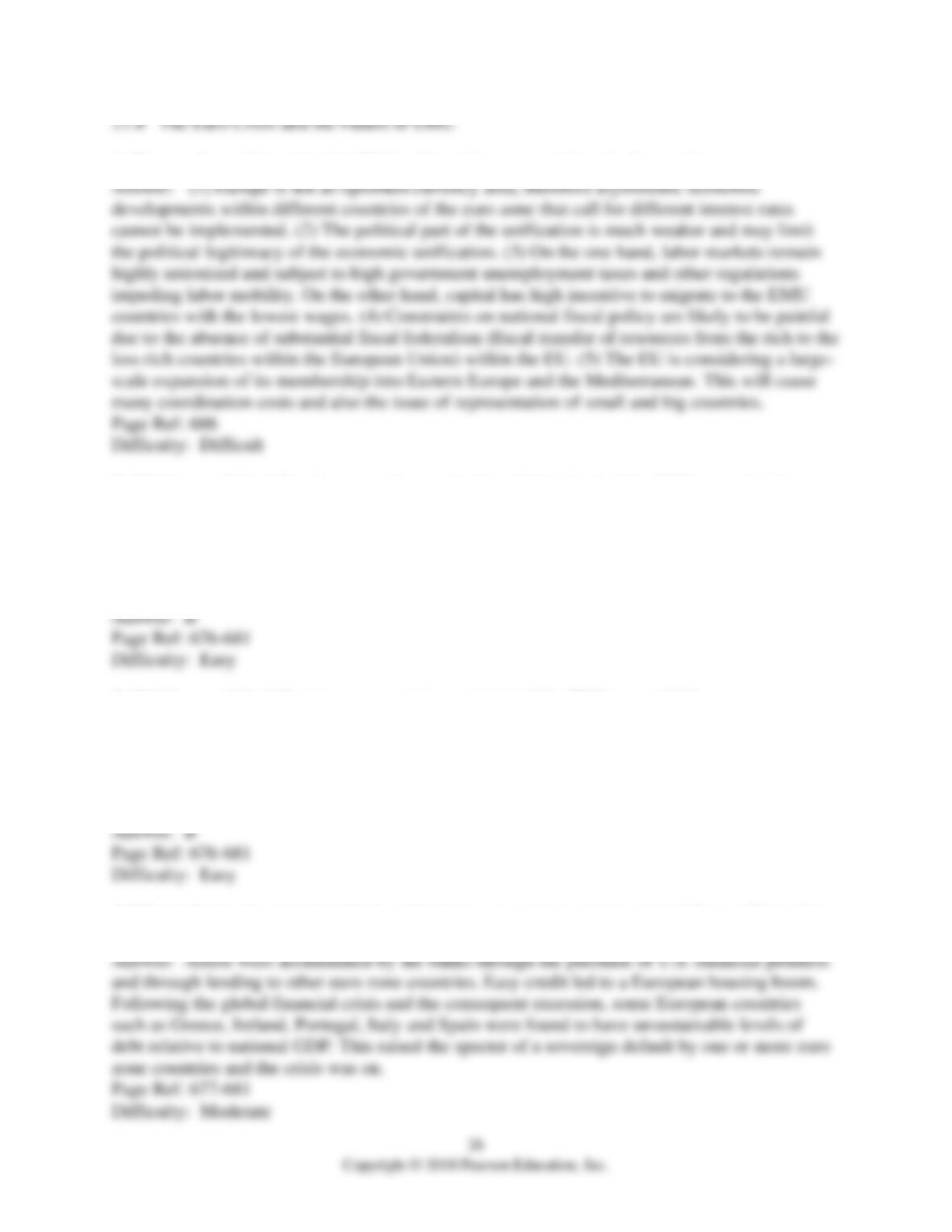
49) Draw the graph of the GG and LL schedules and explain the logic behind the slopes of each
of the schedules.
26
Copyright © 2018 Pearson Education, Inc.
21.4 The Euro Crisis and the Future of EMU
1) Discuss the problems that the EMU will continue to experience in the coming years.
2) Which one of the following countries was the “spark” that ignited the 2009 euro crisis?
A) China
B) Greece
C) England
D) Spain
E) Germany
3) Which one of the following unexpected events ignited the 2009 euro crisis?
A) accelerating hyperinflation and political upheaval
B) the prospect of a sovereign default by one or more euro zone countries
C) rising oil prices
D) revolutions in Switzerland and Belgium
E) a Chinese boycott of European products
4) What behavior by central and private banks in euro zone countries created the conditions for
the 2009 euro crisis?
5) During the 2009 euro crisis, a number of countries had private banks that had become too “big
to save.” Explain.
6) What led to the over-extension of credit by some private banks and central banks in the euro
zone prior to the 2009 euro crisis?
7) What event in 2009 ignited the euro crisis?
8) Is the United States in danger of a sovereign default because, like countries in the euro zone, it
has high current account deficits and levels of public debt?
9) How do constraints on monetary policy in the United States differ from those experienced by
euro zone countries?
10) What is the “doom loop” responsible for the rapid development and severity of the 2009 euro
crisis?
11) What is the “three-pronged approach” to organizing a banking union?
12) What is fiscal federalism?
13) Describe the single supervisory mechanism or SSM proposed by EU leaders in June of 2012.
14) Describe the policy of “outright monetary transactions” or 0MT presented by the president of
the European Central Bank in 2012.
15) Is the EU an optimum currency area? Why or why not?