International Economics: Theory and Policy, 11e (Krugman et al.)
Chapter 18 Fixed Exchange Rates and Foreign Exchange Intervention
1) Central banks often intervene in currency markets. This activity is called
A) super-pegging.
B) flexible floating.
C) currency warfare.
D) fixing exchange rates.
E) managed floating.
2) Why is it important to understand fixed exchange rates in the modern global economy?
3) Which of the following is an example of a regional currency arrangement?
A) most-favored nation status
B) free-trade zones
C) exchange rate union
D) currency cartel associations
E) agreement on commercial trade
4) Industrialized countries typically ________ their floating exchange rates. Developing
countries often ________ their floating exchange rates.
A) fix; allow markets to determine
B) manage; peg
C) allow markets to determine; fix
D) fix; manage
E) peg; manage
5) A system of managed floating exchange rates is
A) a system in which governments may attempt to moderate exchange rate movements without
keeping exchange rates rigidly fixed.
B) a system in which governments use flexible exchange rates.
C) a system in which governments are forbidden from attempts to moderate exchange rate
movements without keeping exchange rates rigidly fixed.
D) a system in which governments need to reach a prior agreement among them before they may
attempt to moderate exchange rate movements without keeping exchange rates rigidly fixed.
E) a system in which governments use extensive fiscal policy to discourage exchange rate
movements.
18.2 Central Bank Intervention and the Money Supply
1) A central bank’s international reserves consists of its holdings of
A) gold.
B) silver and gold.
C) foreign assets and gold.
D) domestic assets and precious metals.
E) foreign and domestic currency holdings.
2) The liabilities side of a central bank’s accounts consists of
A) deposits held by private banks.
B) currency in circulation.
C) deposits held by private banks and currency in circulation.
D) deposits held by foreign banks, domestic assets, and currency in circulation.
E) foreign assets and domestic assets.
3) Which one of the following statements is most correct?
A) Any central bank purchase of assets automatically results in an increase in the domestic
money supply, while any central bank sale of assets automatically causes the money supply to
decline.
B) Any central bank purchase of assets results in an increase in the domestic money supply,
while any central bank sale of assets causes the money supply to decline.
C) Any central bank purchase of assets automatically results in a decrease in the domestic money
supply, while any central bank sale of assets automatically causes the money supply to decline.
D) Any central bank purchase of assets automatically results in a decrease in the domestic
money supply, while any central bank sale of assets automatically causes the money supply to
increase.
E) Any central bank purchase of assets automatically results in an increase in the domestic
money supply, while any central bank sale of assets does not necessarily affect the money
supply.
4) Which one of the following statements is the most correct?
A) If central banks are not sterilizing and the home country has a balance of payments surplus,
any associated increase in the home central bank’s foreign assets implies an increased home
money supply.
B) If central banks are not sterilizing and the home country has a balance of payments surplus,
any associated increase in the home central bank’s foreign assets implies a decreased home
money supply.
C) If central banks are not sterilizing and the home country has a balance of payments surplus,
any associated increase in the home central bank’s foreign assets implies an increased home
money demand.
D) If central banks are not sterilizing and the home country has a balance of payments surplus,
any associated decrease in the home central bank’s foreign assets implies an increased home
money supply.
E) If central banks are not sterilizing and the home country has a balance of payments shortage,
any associated decrease in the home central bank’s foreign assets implies an increased home
money supply.
5) Which one of the following statements is most correct?
A) If central banks are not sterilizing and the home country has a balance of payments surplus,
any associated increase in a foreign central bank’s claims on the home country implies a
decreased foreign money supply.
B) If central banks are not sterilizing and the home country has a balance of payments surplus,
any associated decrease in a foreign central bank’s claims on the home country implies a
decreased foreign money demand.
C) If central banks are not sterilizing and the home country has a balance of payments surplus,
any associated decrease in a foreign central bank’s claims on the home country implies a
decreased foreign money supply.
D) If central banks are not sterilizing and the home country has a balance of payments shortage,
any associated decrease in a foreign central bank’s claims on the home country implies a
decreased foreign money supply.
E) If central banks are not sterilizing and the home country has a balance of payments shortage,
any associated decrease in a foreign central bank’s claims on the home country implies an
increased domestic money supply.
6) A balance sheet for the central bank of Pecunia is shown below:
Central Bank Balance Sheet
Assets Liabilities
Foreign assets $1,000 Deposits held by private banks $500
Domestic assets $1,500 Currency in circulation $2,000
Please write the new balance sheet if the bank sells $100 worth of foreign bonds for domestic
currency.
7) A balance sheet for the central bank of Pecunia is shown below:
Central Bank Balance Sheet
Assets Liabilities
Foreign assets $1,000 Deposits held by private banks $500
Domestic assets $1,500 Currency in circulation $2,000
Please write the new balance sheet if the bank purchased $100 in foreign bonds by writing a
check on itself.
8) A balance sheet for the central bank of Pecunia is shown below:
Central Bank Balance Sheet
Assets Liabilities
Foreign assets $1,000 Deposits held by private banks $500
Domestic assets $1,500 Currency in circulation $2,000
Please write the new balance sheet if the bank makes a sterilized transaction by selling $100 of
foreign assets for domestic currency and then purchasing $100 of domestic assets by writing a
check on itself.
9) Please define and give an example of sterilized foreign exchange intervention.
18.3 How the Central Bank Fixes the Exchange Rate
1) Under fixed exchange rate, in general
A) the domestic and foreign interest rates are equal, R = R .
B) R = R + (Ee – E)/E.
C) the foreign and domestic interest rates are unequal.
D) the expected rate of domestic currency depreciation is high.
E) the expected rate of currency depreciation is one.
2) Under fixed exchange rate, in general which one of the following statements is the MOST
accurate?
A) The following condition should hold for domestic money market equilibrium: Ms/P = L(R ,
Y).
B) The following condition should hold for domestic money market equilibrium: Md/P = L(R ,
Y).
C) The following condition should hold for domestic money market equilibrium: Ms = L(R , Y).
D) The following condition should hold for domestic money market equilibrium: P = L(R , Y).
E) The following condition should hold for domestic money market equilibrium: R*Md/P =
L(Y).
3) Which one of the following statements is the MOST accurate?
A) Under a fixed exchange rate, central bank monetary tools are powerless to affect the
economy’s money supply.
B) Under a flexible exchange rate, central bank monetary tools are powerless to affect the
economy’s money supply or its output.
C) Under a fixed exchange rate, fiscal policy tools are powerless to affect the economy’s money
supply or its output.
D) Under a fixed exchange rate, central bank monetary tools are powerless to affect the
economy’s money supply or its output.
E) Under a dirty float exchange rate, central bank monetary tools are powerless to affect the
economy’s money supply or its output.
4) What is the expected dollar rate of return on dollar deposits if today’s exchange rate is $1.10
per euro, next year’s expected exchange rate is $1.165 per euro, the dollar interest rate is 10%,
and the euro interest rate is 5%?
A) 10%
B) 11%
C) -1%
D) 0%
E) 5%
5) What are the factors affecting the demand for foreign currency?
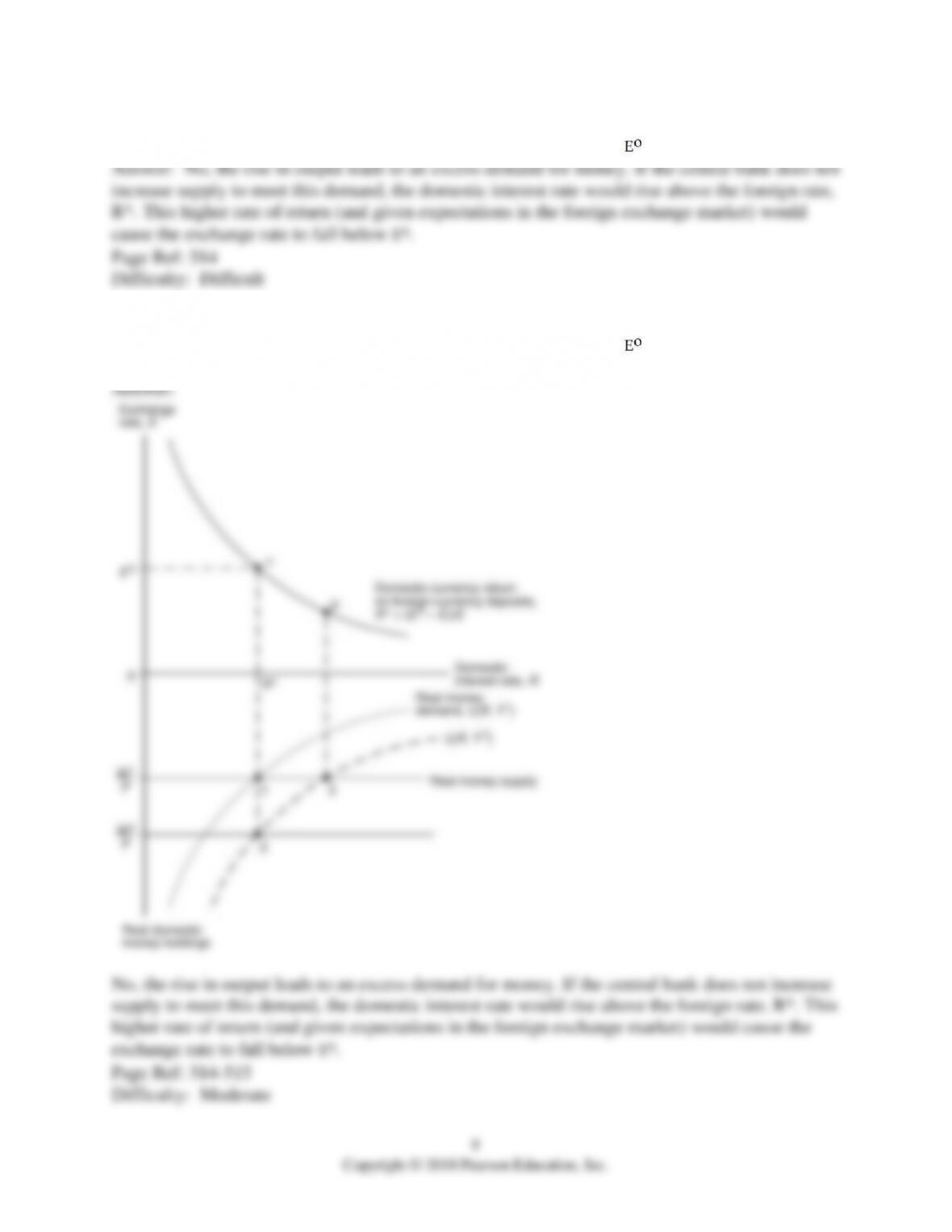
6) If the central bank does not purchase foreign assets when output increases but instead holds
the money stock constant, can it still keep the exchange rate fixed at ? Please explain.
7) If the central bank does not purchase foreign assets when output increases but instead holds
the money stock constant, can it still keep the exchange rate fixed at ? Please explain with the
aid of a figure.
18.4 Stabilization Policies with a Fixed Exchange Rate
1) By fixing the exchange rate, the central bank gives up its ability to
A) adjust taxes.
B) increase government spending.
C) influence the economy through fiscal policy.
D) depreciate the domestic currency.
E) influence the economy through monetary policy.
2) Fiscal expansion under fixed exchange rates will have what temporary effect?
A) the money supply will decrease
B) output will decrease
C) the exchange rate will increase
D) the exchange rate will decrease
E) there will be no effect
3) When a country’s currency is devalued
A) output decreases.
B) output increases and the money supply decreases.
C) the money supply decreases.
D) output decreases and the money supply increases.
E) both the output and the money supply increases.
4) Under fixed rates, which one of the following statements is the MOST accurate?
A) Monetary policy can affect only output.
B) Monetary policy can affect only employment.
C) Monetary policy can affect only international reserves.
D) Monetary policy can not affect international reserves.
E) Monetary policy can only affect money supply.
5) Under fixed rates, which one of the following statements is the MOST accurate?
A) Fiscal policy can affect output, employment and international reserves at the same time.
B) Fiscal policy can affect only employment.
C) Fiscal policy can affect only international reserves.
D) Fiscal policy can affect only output and employment.
E) Fiscal employment can affect only output and international reserves.
6) Which one of the following statements is the MOST accurate?
A) Fiscal policy has the same effect on employment under fixed and flexible exchange rate
regimes.
B) Fiscal policy affects employment less under fixed than under flexible exchange rate regimes.
C) Fiscal policy affects employment more under fixed than under flexible exchange rate regimes.
D) Fiscal policy cannot affect employment under fixed exchange rate but does affect output
under flexible exchange rate regimes.
E) Fiscal policy can affect employment under fixed exchange rate regimes, but does not affect
output under flexible exchange rate regimes.
7) Which one of the following statements is the MOST accurate?
A) Fiscal policy has the same effect on output under fixed and flexible exchange rate regimes.
B) Fiscal policy affects output more under fixed than under flexible exchange rate regimes.
C) Fiscal policy affects output less under fixed than under flexible exchange rate regimes.
D) Fiscal policy cannot affect output under fixed exchange rate but does affect output under
flexible exchange rate regimes.
E) Fiscal policy can affect output under fixed exchange rate but does not affect output under
flexible exchange rate regimes.
8) Which one of the following statements is the MOST accurate?
A) A devaluation occurs when the central bank lowers the domestic currency price of foreign
currency, E, and a revaluation occurs when the central bank raises E.
B) A devaluation occurs when the central bank raises the domestic currency price of foreign
currency, E, and a revaluation occurs when the central bank lowers E.
C) Devaluation occurs when the domestic currency price of foreign currency, E, raises and a
revaluation occurs when E is lowered.
D) A devaluation occurs when the central bank of the foreign country raises the domestic
currency price of foreign currency, E, and a revaluation occurs when the central bank of the
foreign country lowers E.
E) A devaluation occurs when the central bank raises the foreign currency price of domestic
currency, E, and a revaluation occurs when the central bank lowers E.
9) Which one of the following statements is the MOST accurate?
A) Depreciation is a rise in E when the exchange rate is fixed while devaluation is a rise in E
when the exchange rate floats.
B) Depreciation is a decrease in E when the exchange rate floats while devaluation is a rise in E
when the exchange rate is fixed.
C) Depreciation is a rise in E when the exchange rate floats while devaluation is a rise in E when
the exchange rate is fixed.
D) Depreciation is a rise in E when the exchange rate floats while devaluation is a decrease in E
when the exchange rate is fixed.
E) Depreciation is a fall in E when the exchange rate is fixed while devaluation is a fall in E
when the exchange rate floats.
10) Which one of the following statements is the MOST accurate?
A) Appreciation is a rise in E when the exchange rate floats while revaluation is a fall in E when
the exchange rate is fixed.
B) Appreciation is a fall in E when the exchange rate floats while revaluation is a fall in E when
the exchange rate is fixed.
C) Appreciation is a fall in E when the exchange rate is fixed while revaluation is a fall in E
when the exchange rate is flexible.
D) Appreciation is a fall in E when the exchange rate floats while revaluation is a rise in E when
the exchange rate is fixed.
E) Appreciation is a rise in E when the exchange rate floats while revaluation is a rise in E when
the exchange rate is fixed.
11) Which one of the following statements is the MOST accurate?
A) Devaluation reflects a deliberate government decision.
B) Depreciation reflects a deliberate government decision.
C) Devaluation reflects a deliberate government decision while depreciation is an outcome of
government actions and market forces acting together.
D) Depreciation reflects a deliberate government decision while devaluation is an outcome of
government actions and market forces acting together.
E) Devaluation and depreciation have the same meaning and the same causes.
12) Which one of the following statements is the MOST accurate?
A) Revaluation reflects an outcome of government actions and market forces acting together
while appreciation reflects a deliberate government decision.
B) Revaluation reflects a deliberate government decision while appreciation is an outcome of
government actions and market forces acting together.
C) Revaluation reflects a deliberate government decision while appreciation is an outcome of
government actions.
D) Revaluation and appreciation have the same meaning and the same causes.
E) Appreciation reflects a deliberate government decision while revaluation is an outcome of
government actions and market forces acting together.
13) Under fixed exchange rates, which one of the following statements is the MOST accurate?
A) Devaluation causes a decrease in output, a decrease in official reserves, and a contraction of
the money supply.
B) Devaluation causes a rise in output, a rise in official reserves, and an expansion of the money
supply.
C) Devaluation causes a rise in output and a rise in official reserves.
D) Devaluation causes a rise in output and an expansion of the money supply.
E) Devaluation causes a rise in official reserves, and an expansion of the money supply.
14) Under fixed exchange rates, which one of the following statements is the MOST accurate?
A) Devaluation causes a rise in output.
B) Devaluation causes a decrease in output.
C) Devaluation has no effect on output.
D) Devaluation causes a rise in output and a decrease in official reserves.
E) Devaluation causes a decrease in output and in official reserves.
15) Under fixed exchange rates, which one of the following statements is the MOST accurate?
A) Devaluation causes a reduction of the money supply.
B) Devaluation has no effect on the stock of money.
C) Devaluation causes an expansion of the money supply.
D) Devaluation causes a reduction in output.
E) Devaluation causes a reduction in official reserves.
16) The main reason(s) why governments sometimes choose to devalue their currencies is (are)
A) devaluation makes domestic goods more expensive in relation to foreign goods.
B) devaluation makes domestic services more expensive in relation to foreign services.
C) devaluation increases foreign reserves held by the central bank.
D) devaluation improves the current account and increases foreign reserves held by the central
bank.
E) devaluation hurts foreign currencies.
17) Which of the following best describes a deliberate government decision to lower the
exchange rate, E?
A) appreciation
B) depreciation
C) revaluation
D) devaluation
E) accumulation
18) Please discuss the difference between the terms devaluation and depreciation.
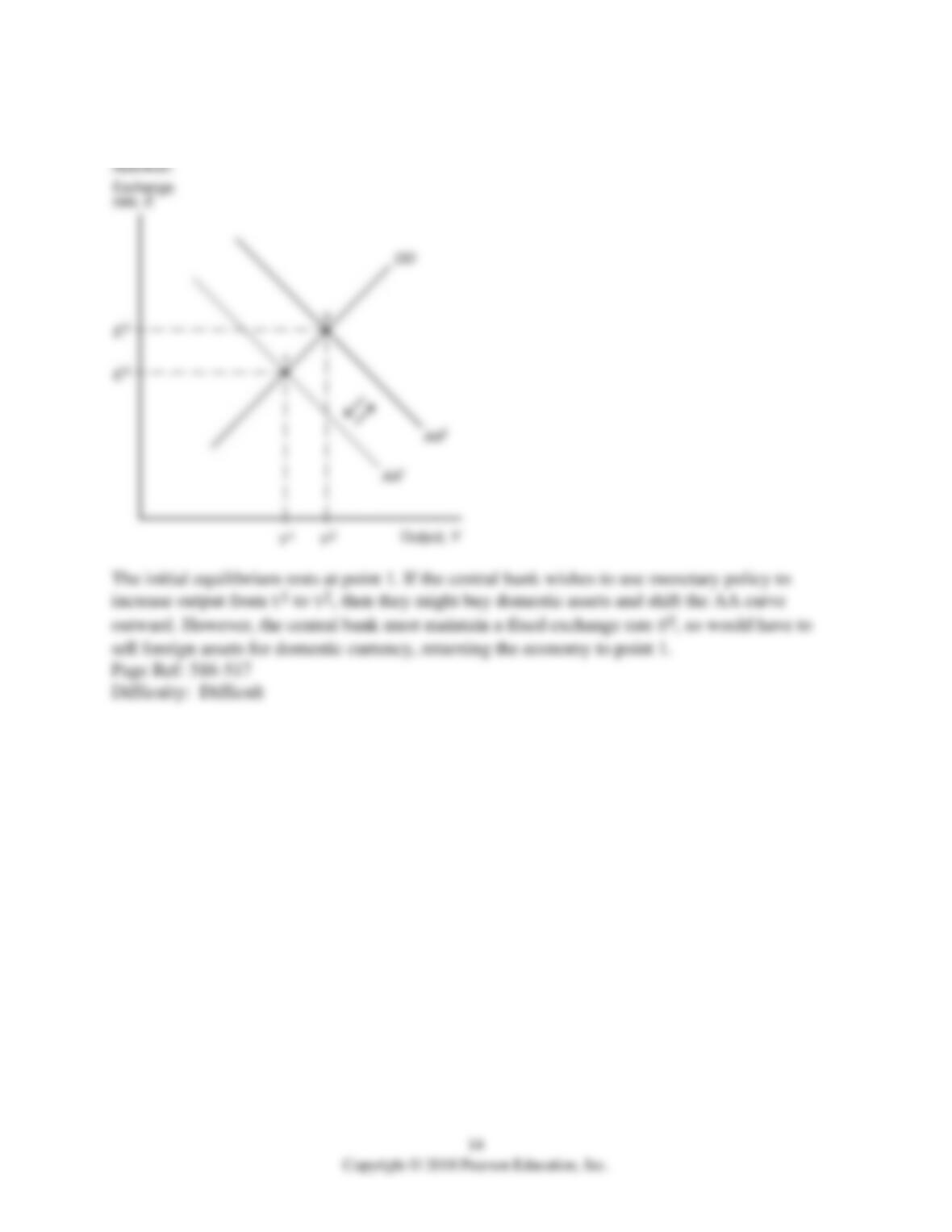
19) Use a figure to illustrate the ineffectiveness of monetary policy to spur on an economy under
a fixed exchange rate.
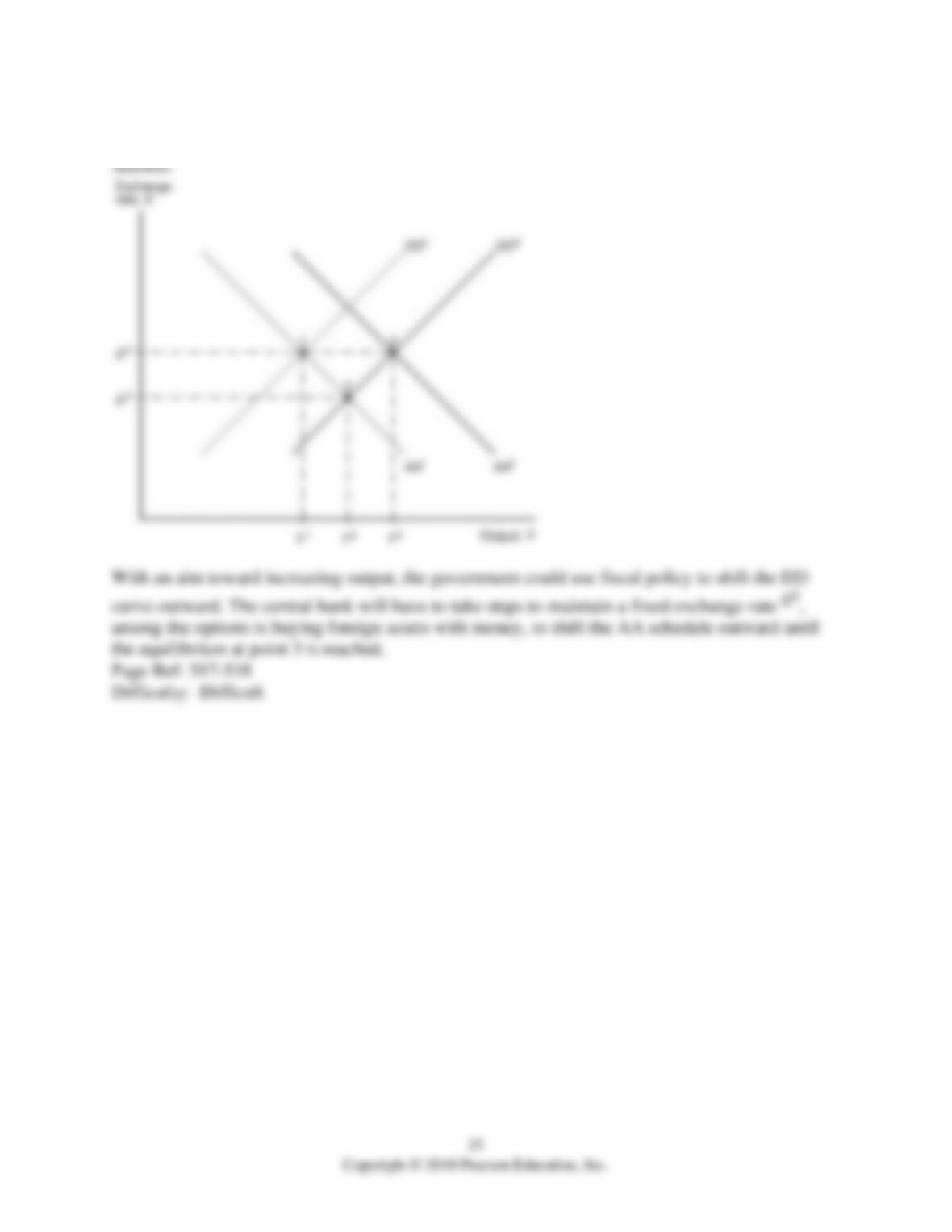
20) Use a figure to explain the potential effectiveness of fiscal policy to spur on the economy
under a fixed exchange rate.
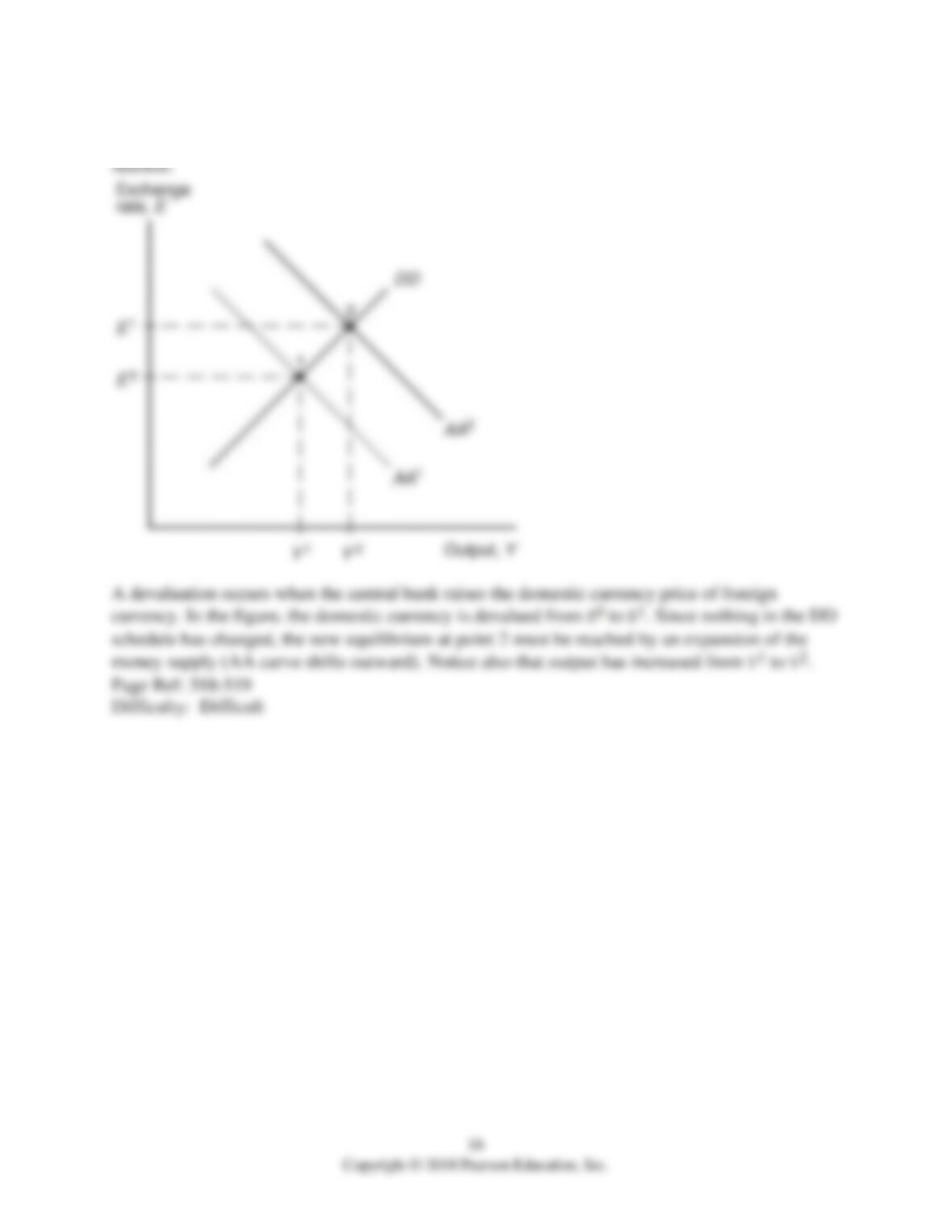
21) Define devaluation and use a figure to show the effect of a currency devaluation on the
economy.