The rise in the interest rate from to creates a momentary excess supply of real U.S.
money balances at the prevailing price level . However, since under this. Monetary
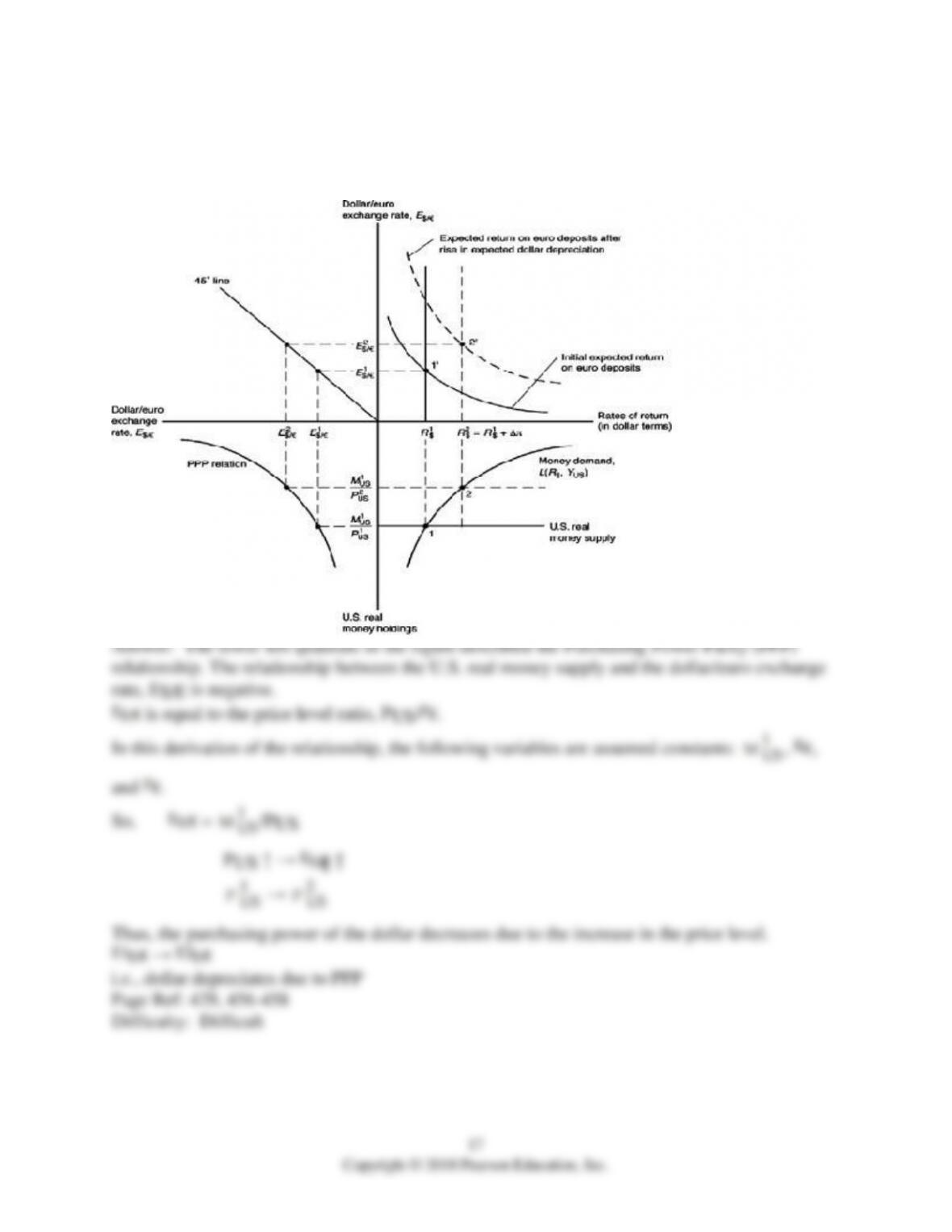
24) To answer the following question, please refer to the figure below. Concentrating only at the
lower left quadrant, discuss the relationship between the U.S. real money supply and the
dollar/euro exchange rate, E$/E.
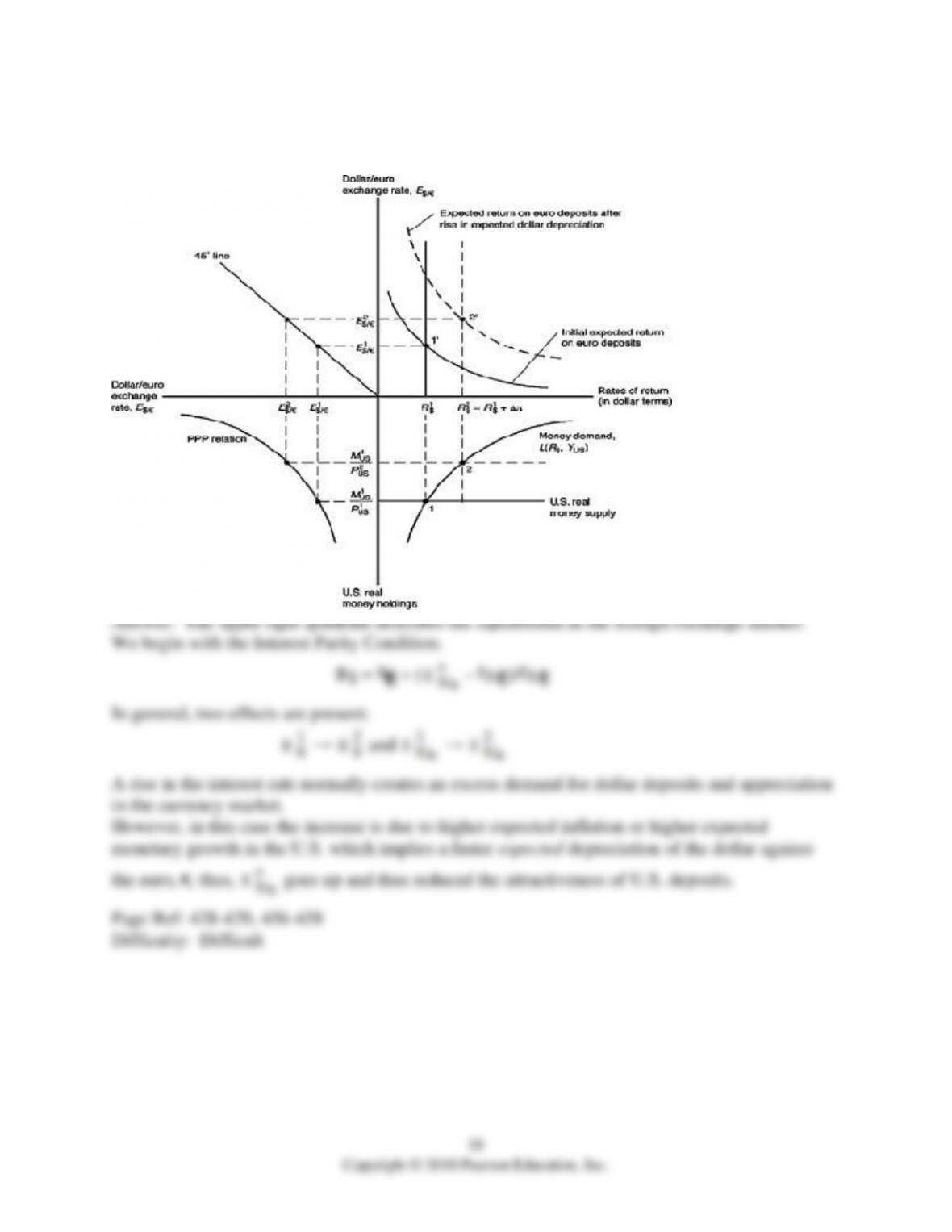
25) To answer the following question, please refer to the figure below. Concentrating only at the
upper right quadrant, discuss the foreign exchange market equilibrium.
26) Is a depreciation of the dollar/euro exchange rate correlated with a decrease in the dollar
return on U.S. deposits?
27) Does the existence of non-tradable goods allow for deviations from Purchasing power
Parity?
28) What effect do non-tradable goods have on PPP?
29) Describe the chain of events leading to exchange rate determination for the following cases:
(a) An increase in U.S. money supply
(d) Increase in growth rate of U.S. money supply
(c) Increase in world relative demand for U.S. products
(d) Increase in relative U.S. output supply
20
Copyright © 2018 Pearson Education, Inc.
Increase in world relative demand for U.S. products: E falls, and q does as well.
Increase in relative U.S. output supply: Dollar depreciates, lowers relative price of U.S.
output, rise in q, effect on E is not clear since q and Pus work in opposite directions.
Page Ref: 447
Difficulty: Difficult
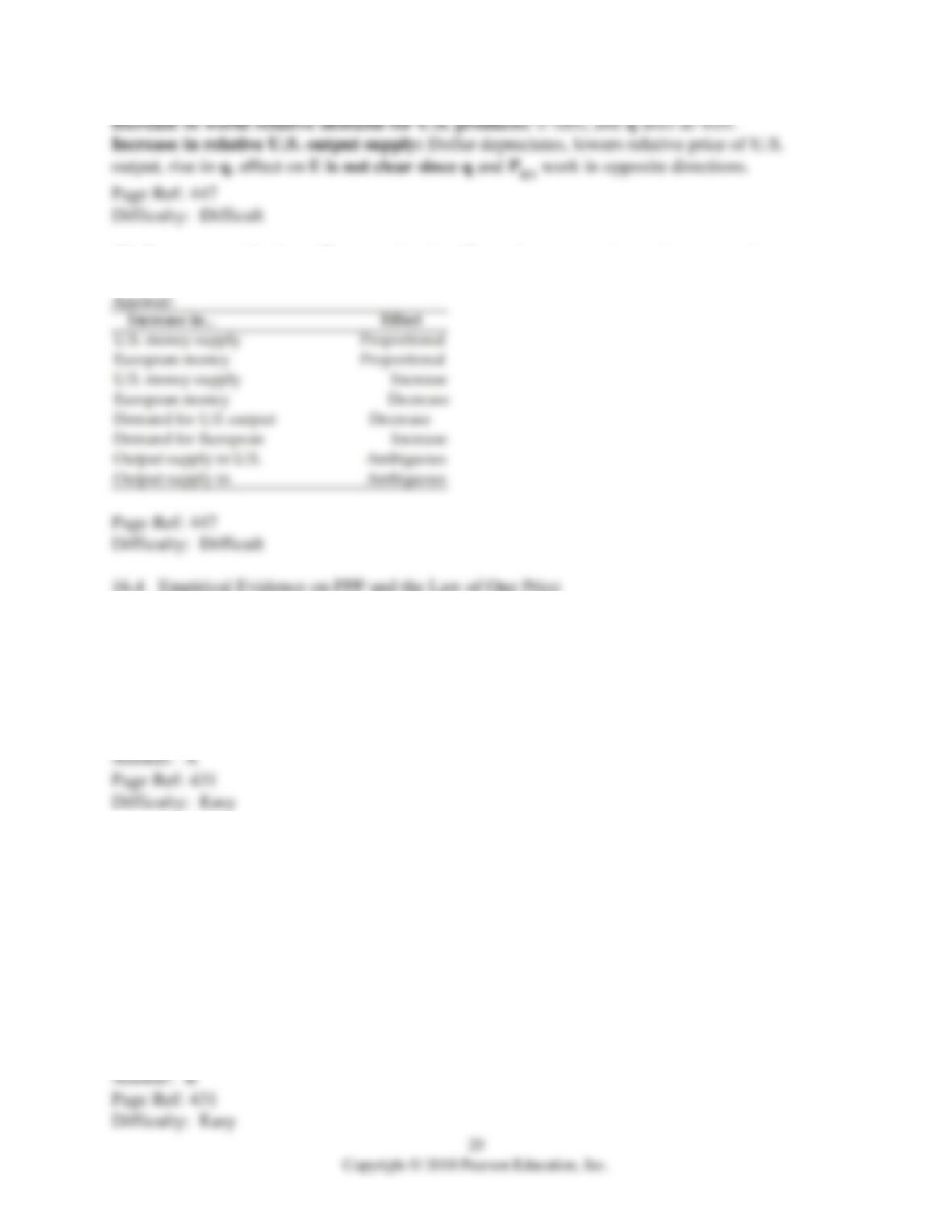
30) Construct a table that will summarize the effects of money market and output market
changes on the long-run nominal dollar/euro exchange rate
16.4 Empirical Evidence on PPP and the Law of One Price
1) In practice
A) changes in national price levels often tell us relatively little about exchange rate movements.
B) changes in national price levels raise the exchange rate.
C) changes in national price levels lower the exchange rate.
D) changes in national price levels often tell us about exchange rate movements.
E) changes in national price levels match identical changes in the exchange rate.
2) Which of the following statements is the MOST accurate?
A) The prices of identical commodity baskets, when converted to a single currency, are the same
across countries.
B) The prices of identical commodity baskets, when converted to a single currency, differ
substantially across countries.
C) The prices of identical commodity baskets, when converted to a single currency, do not differ
substantially across countries.
D) The prices of identical commodity baskets, when converted to a single currency, are often the
same across countries.
E) The prices of identical commodity baskets, when converted to a single currency, are the same
across countries more than 50% of the time.
3) Which of the following statements is the MOST accurate?
A) The law of one price does fare well in all recent studies.
B) The law of one price does fare well in many recent studies.
C) The law of one price sometimes fares well in recent studies.
D) The law of one price does not fare well in recent studies.
E) The law of one price has not been studied recently.
4) Which of the following statements is the MOST accurate?
A) Relative PPP is not a reasonable approximation to the data.
B) Relative PPP is sometimes a reasonable approximation to the data but often performs poorly.
C) Relative PPP is sometimes a reasonable approximation to the data.
D) PPP is sometimes a reasonable approximation to the data.
E) PPP is sometimes a reasonable approximation to the data but usually performs poorly.
5) What can explain the failure of relative PPP to hold in reality?
1) Which of the following are theories meant to explain “Why price levels are lower in poorer
countries”?
A) only Bhagwati-Kravis-Lipsey
B) only Balassa-Samuelson
C) only Goldberg-Knetter
D) Bhagwati-Kravis-Lipsey and Balassa-Samuelson
E) Bhagwati-Kravis-Lipsey and Goldberg-Knetter
2) In January 2013, the world’s cheapest Big Macs were sold in
A) the Philippines.
B) Russia.
C) China.
D) Malaysia.
E) the Czech Republic.
3) The PPP theory fails in reality for all of the following reasons EXCEPT
A) transport costs.
B) monopolistic or oligopolistic practices in goods markets.
C) the inflation data reported in different countries are based on different commodity baskets.
D) restrictions on trade.
E) inflation rates are unrelated to money supply growth.
4) Which one of the following statements is the MOST accurate?
A) The purchasing power of any given country’s currency will increase in countries where the
prices of non-tradable goods rise.
B) The purchasing power of any given country’s currency will fall in countries where the prices
of non-tradable goods fall.
C) The purchasing power of any given country’s currency will fall in countries where the prices
of non-tradable goods rise.
D) The purchasing power of any given country’s currency will remain constant in countries
where the prices of non-tradable goods rise.
E) The purchasing power of any given country’s currency will fall in countries where the prices
of non-tradable goods remain constant.
5) Which one of the following statements is the MOST accurate?
A) Relative price changes could not lead to PPP violations even if trade were free and costless.
B) Relative price changes could lead to PPP violations only if trade were free and costless.
C) Relative price changes could lead to PPP violations even if trade were free and costless.
D) Price changes could lead to PPP violations even if trade were free and costless.
E) Price changes could not lead to PPP violations even if trade were free and costless.
6) Which one of the following statements is the MOST accurate?
A) Departures from PPP are similar in both the short run and long run.
B) Departures from PPP are even greater in the long run than in the short run.
C) Departures from PPP are always greater in the short run than in the long run.
D) It is hard to tell whether departures from PPP are greater in the short run than in the long run.
E) Departures from PPP may often be greater in the short run than in the long run.
7) Floating exchange rates
A) systematically lead to much larger but less frequent short-run deviations from the absolute
PPP.
B) systematically lead to much larger and more frequent short-run deviations from the relative
PPP.
C) systematically lead to much smaller and less frequent short-run deviations from the relative
PPP.
D) systematically lead to much smaller but more frequent short-run deviations from the relative
PPP.
E) systematically lead to much smaller and less frequent short-run deviations from the absolute
PPP.
8) Explain why price levels are lower in poorer countries.
16.6 Beyond Purchasing Power Parity: A General Model of Long-Run Exchange Rates
1) Which of the following statements is the MOST accurate about the Law of One Price on
Scandinavian ferry lines?
A) Due to menu costs, the Law of One Price does not hold.
B) To avoid arbitrage opportunities, the Law of One Price must hold.
C) Transaction costs of exchanging currency causes the Law of One Price to fail.
D) Transportation costs between ferry lines leads to a violation of the Law of One Price.
E) The physical distance allowed the Law of One Price to hold.
2) Which of the following statements is MOST accurate?
A) The United States price level will place a relatively light weight on commodities produced
and consumed in America, while the European price level will place a relatively heavy weight on
commodities produced and consumed in Europe.
B) The United States price level will place a relatively light weight on commodities produced
and consumed in America, and the European price level will place a relatively light weight on
commodities produced and consumed in Europe.
C) The United States price level will place a relatively heavy weight on commodities produced
and consumed in America, and the European price level will place a relatively heavy weight on
commodities produced and consumed in Europe.
D) The United States price level will place a relatively heavy weight on commodities produced
and consumed in Europe, and the European price level will place a relatively heavy weight on
commodities produced and consumed in America.
E) The United States price level will place a relatively light weight on commodities produced
and consumed in Europe, and the European price level will place a relatively heavy weight on
commodities produced and consumed in America.
3) When the domestic money prices of goods are held constant
A) a nominal dollar appreciation makes U.S. goods cheaper compared with foreign goods.
B) a nominal dollar depreciation makes U.S. goods less appealing in foreign markets.
C) a nominal dollar appreciation does not affect the prices of U.S. goods.
D) a nominal dollar depreciation makes U.S. goods more expensive compared with foreign
goods.
E) a nominal dollar depreciation makes U.S. goods cheaper compared with foreign goods and a
nominal dollar appreciation makes U.S. goods more expensive compared with foreign goods.
4) An increase in the world relative demand for U.S. output causes
A) a short-run real depreciation of the dollar against the euro.
B) a long-run real appreciation of the dollar against the euro.
C) a long-run real depreciation of the dollar against the euro.
D) a short-run real appreciation of the euro against the dollar.
E) a long-run real appreciation of the euro against the dollar.
5) Which of the following statements is MOST accurate?
A) A relative expansion of U.S. output causes a long-run depreciation of the dollar against the
euro, while a relative expansion of European output causes a long-run real appreciation of the
dollar against the euro.
B) A relative decline of U.S. output causes a long-run depreciation of the dollar against the euro,
while a relative expansion of European output causes a long-run real appreciation of the dollar
against the euro.
C) A relative expansion of U.S. output causes a long-run appreciation of the dollar against the
euro, while a relative expansion of European output causes a long-run real depreciation of the
dollar against the euro.
D) A relative expansion of U.S. output causes a long-run depreciation of the dollar against the
euro, while a relative decline of European output causes a long-run real appreciation of the dollar
against the euro.
E) A relative decline of U.S. output causes a long-run depreciation of the dollar against the euro,
while a relative decline of European output causes a long-run real appreciation of the dollar
against the euro.
6) When all variables start out at their long-run equilibrium levels, the most important
determinants of long-run swings in nominal exchange rates do NOT include
A) a shift in relative money supply levels.
B) a shift in relative money supply growth rates.
C) a change in relative output demand.
D) a change in relative output supply.
E) a change in relative inflation rates.
7) Which of the following statements is MOST accurate?
A) In the output market, an increase in demand for U.S. output leads to an increase in the long–
run nominal dollar/euro exchange rate.
B) In the output market, an increase in the demand for European output leads to an increase in
the long-run nominal dollar/euro exchange rate.
C) In the output market, a decrease in demand for U.S. output leads to a decrease in the long-run
nominal dollar/euro exchange rate.
D) In the output market, an increase in the demand for European output leads to a decrease in the
long-run nominal dollar/euro exchange rate.
E) In the output market, an increase in the demand for European output leads to an increase in
the long-run nominal euro/dollar exchange rate.
8) Which of the following statements is MOST accurate?
A) In the money market, an increase in U.S. money supply level leads to a proportional increase
in the long-run nominal dollar/euro exchange rate.
B) In the money market, an increase in European money supply level leads to a proportional
increase in the long-run nominal dollar/euro exchange rate.
C) In the money market, an increase in U.S. money supply growth rate leads to a decrease in the
long-run nominal dollar/euro exchange rate.
D) In the money market, an increase in European money supply growth leads to an increase in
the long-run nominal dollar/euro exchange rate.
E) In the money market, an increase in U.S. money supply level leads to a proportional decrease
in the long-run nominal dollar/euro exchange rate.
9) In the long run
A) exchange rates obey relative PPP when all disturbances occur in the output markets.
B) exchange rates obey absolute PPP when all disturbances occur in the output markets.
C) exchange rates are unlikely to obey relative PPP when all disturbances occur in the output
markets.
D) exchange rates are unlikely to obey relative PPP when all disturbances are monetary in
nature.
E) exchange rates obey absolute PPP when all disturbances are monetary in nature.
10) Discuss the different effects on the domestic interest rates when prices are assumed flexible
and when they are assumed to be sticky.
11) What are the predictions of the PPP theory with regards to the real exchange rates?
12) What is the real exchange rate between the dollar and the euro equal to?
13) Discuss why the empirical support for PPP and the law of one price is weak in recent data.
14) Define the concept of the real exchange rate and explain how it differs from the nominal
exchange rate.
1) Interest rate differences between countries depend on
A) differences in expected inflation, but not on expected changes in the real exchange rate.
B) differences in expected changes in the real exchange rate, but not on expected inflation.
C) neither differences in expected inflation, nor on expected changes in the real exchange rate.
D) differences in expected inflation and nothing else.
E) differences in expected inflation, and on expected changes in the real exchange rate.
2) The expected rate of change in the nominal dollar/euro exchange rate is best described as
A) the expected rate of change in the real dollar/euro exchange rate minus the U.S.-Europe
expected inflation difference.
B) the expected rate of change in the real dollar/euro exchange rate plus the U.S.-Europe real
interest rate difference.
C) the expected rate of change in the real dollar/euro exchange rate plus the U.S.-Europe
expected inflation difference.
D) the expected rate of change in the real dollar/euro exchange rate minus the U.S.-Europe real
interest rate difference.
E) the expected rate of change in the real dollar/euro exchange rate plus the European expected
inflation.
16.8 Real Interest Parity
1) The expected real interest rate (re) in terms of the nominal interest rate (R) and the expected
inflation rate (πe) is given by
A) re = πe + R.
B) re = 2πe + R2.
C) re = πe + R2.
D) re = R – πe.
E) re = R2 – πe.
2) The difference between nominal and real interest rates is that
A) nominal interest rates are measured in terms of a country’s output, while real interest rates are
measured in monetary terms.
B) nominal interest rates are measured in monetary terms, while real interest rates are measured
in terms of a country’s output.
C) nominal interest rates can fluctuate, while real interest rates always remain fixed.
D) real interest rates can fluctuate, while nominal interest rates always remain fixed.
E) real interest rates are the same in every country, while nominal interest rates are different for
every country.
3) What is the real interest rate parity condition?
16.9 Appendix to Chapter 16: The Fisher Effect, the Interest Rate, and the Exchange Rate
Under the Flexible-Price Monetary Approach
1) The monetary approach to interest rates assumes that the prices of goods are ________, which
implies that a country’s currency will ________, when nominal interest rates ________ because
of ________ expected future inflation.
A) perfectly flexible; depreciate; increase; higher
B) perfectly flexible; appreciate; increase; higher
C) immutable; depreciate; increase; higher
D) immutable; appreciate; decrease; higher
E) absolutely inflexible; depreciate; decrease; higher
2) When the nominal dollar interest rate ________, money demand will ________, and the
general price level will ________.
A) increases; decrease; increase
B) increases; increase; increase
C) increases; decrease; decrease
D) increases; increase; decrease
E) decreases; increase; increase