15.6 Money, the Price Level, and the Exchange Rate in the Long Run
1) An economy’s long-run equilibrium is
A) the equilibrium that would occur if prices were perfectly flexible.
B) the equilibrium that would occur if prices were perfectly flexible and always adjusted
immediately.
C) the equilibrium that would occur if prices were perfectly flexible and always adjusted
immediately to preserve full employment.
D) the equilibrium that would occur if prices were perfectly fixed to preserve full employment.
E) the equilibrium that would occur if prices were perfectly fixed at the full employment point.
2) A permanent increase in a country’s money supply
A) causes a more than proportional increase in its price level.
B) causes a less than proportional increase in its price level.
C) causes a proportional increase in its price level.
D) leaves its price level constant in long-run equilibrium.
E) causes an inversely proportional fall in its price level.
3) A change in the level of the supply of money
A) increases the long-run values of the interest rate and real output.
B) decreases the long-run values of the interest rate and real output.
C) has no effect on the long-run values of the interest rate, but may affect real output.
D) has no effect on the long-run values of real output, but may affect the interest rate.
E) has no effect on the long-run values of the interest rate and real output.
4) Changes in the money supply growth rate
A) are neutral in the short run.
B) need not be neutral in the short run.
C) are neutral in the long run.
D) need not be neutral in the long run.
E) affect the real output of the economy.
5) A sustained change in the monetary growth rate will
A) immediately affect equilibrium real money balances by raising the money interest rate.
B) eventually affect equilibrium nominal money balances by raising the money interest rate.
C) eventually affect equilibrium real money balances by reducing the money interest rate.
D) eventually affect equilibrium real money balances by raising the real interest rate.
E) eventually affect equilibrium real money balances by raising the money interest rate.
6) Money demand behavior may
A) change as a result of demographic trends or financial innovations such as electronic cash-
transfer facilities.
B) change only as a result of demographic trends.
C) change only as a result of financial innovations such as electronic cash-transfer facilities.
D) not change as a result of demographic trends or financial innovations such as electronic cash-
transfer facilities.
E) change as a result of demographic trends but not as a result of financial innovations such as
electronic cash-transfer facilities.
7) Using year-by-year data from 1987-2007 shows that
A) there is a strong positive relation between average Latin American money-supply growth and
inflation.
B) there is a strong negative relation between average Latin American money-supply growth and
inflation.
C) there is a strong positive relation between average Latin American money-supply growth and
deflation.
D) it is difficult to find a strong positive relation between average Latin American money-supply
growth and inflation.
E) there is a weak positive relation between average Latin American money-supply growth and
inflation.
8) Which one of the following statements is the MOST accurate?
A) A permanent increase in a country’s money supply causes a proportional long-run
depreciation of its currency against foreign currencies.
B) A temporary increase in a country’s money supply causes a proportional long-run depreciation
of its currency against foreign currencies.
C) A permanent increase in a country’s money supply causes a proportional long-run
appreciation of its currency against foreign currencies.
D) A permanent increase in a country’s money supply causes a proportional short-run
depreciation of its currency against foreign currencies.
E) A permanent increase in a country’s money supply causes a proportional short-run
appreciation of its currency against foreign currencies.
9) The long run effects of money supply change has
A) an ambiguous effect on the long-run values of the interest rate or real output, a proportional
change in the price level’s long-run value in the opposite direction.
B) a proportional effect on the long-run values of the interest rate or real output, a proportional
change in the price level’s long-run value in the same direction.
C) no effect on the long-run values of the interest rate or real output, a proportional change in the
price level’s long-run value in the same direction.
D) no effect on the long-run values of the interest rate or real output, no change in the price
level’s long-run value.
E) an ambiguous effect on the long-run values of the interest rate or real output, a
disproportional change in the price level’s long-run value in the same direction.
1) What term means an explosive and seemingly uncontrollable inflation in which money loses
value rapidly and may even go out of use?
A) superinflation
B) stagflation
C) hyperinflation
D) maginflation
E) deflation
2) The most extreme inflationary conditions occurred
A) in Zimbabwe in 2008.
B) in Chile in 2012.
C) in Eastern Europe in the 1990s.
D) in Western Europe in the 1980s.
E) in Germany in 2013.
3) For main industrial countries such as Japan and the U.S.
A) there is much less month–to–month variability of the exchange rate, suggesting that price
levels are relatively sticky in the short run.
B) there is much more month-to-month variability of the exchange rate, suggesting that price
levels are relatively sticky in the short run.
C) there is almost the same month-to-month variability of the exchange rate and price levels.
D) it is hard to tell whether month–to-month variability of the exchange rate is similar to changes
in price levels.
E) there is much more month-to-month variability of the exchange rate, suggesting that price
levels are relatively sticky in the long run.
4) Which one of the following statements is the MOST accurate?
A) There is a lively academic debate over the possibility that seemingly sticky wages and prices
are in reality quite fixed.
B) There is a lively academic debate over the possibility that seemingly sticky wages and prices
are in reality much more sticky than theory assumes.
C) There is a lively academic debate over the possibility that seemingly sticky wages and prices
are in reality quite flexible.
D) There is no debate over the possibility that wages and prices are sticky in the long run.
E) There is no debate over the possibility that wages and prices are sticky in the short run.
5) During hyperinflation, exploding inflation causes real money demand to
A) fall over time, and this additional monetary change makes money prices rise even more
quickly than the money supply itself rises.
B) increase over time, and this additional monetary change makes money prices rise even more
quickly than the money supply itself rises.
C) fall over time, and this additional monetary change makes money prices decrease even more
quickly than the money supply itself rises.
D) increase over time, and this additional monetary change makes money prices decrease even
more quickly than the money supply itself rises.
E) fall over time, and this additional monetary change makes money prices decrease even less
quickly than the money supply itself rises.
6) In a classic paper, Columbia University economist Phillip Cagan drew the line between
inflation and hyperinflation at an inflation rate of
A) 50 percent per month.
B) 10 percent per month.
C) 20 percent per month.
D) 5 percent per month.
E) 25 percent per month.
7) In a classic paper, Columbia University economist Phillip Cagan drew the line between
inflation and hyperinflation at an inflation rate of
A) more than 120 percent per year.
B) more than 100 percent per year.
C) more than 200 percent per year.
D) more than 12,000 percent per year.
E) more than 1,000 percent per year.
8) In a world where the price level could adjust immediately to its new long-run level after a
money supply increase
A) the dollar interest rate would increase because prices would adjust immediately and prevent
the money supply from rising.
B) the dollar interest rate would not fall because prices would adjust immediately and prevent the
money supply from rising.
C) the dollar interest rate would fall because prices would adjust immediately and prevent the
money supply from decreasing.
D) the dollar interest rate would decrease because prices would adjust immediately and prevent
the money supply from decreasing.
E) the dollar interest rate would fall because prices would not be able to prevent the money
supply from rising.
9) After a permanent increase in the money supply
A) the exchange rate overshoots in the short run.
B) the exchange rate overshoots in the long run.
C) the exchange rate smoothly depreciates in the short run.
D) the exchange rate smoothly appreciates in the short run.
E) the exchange rate remains the same.
10) A change in the money supply creates demand and cost pressures that lead to future increases
in the price level from which main sources?
I. Excess demand for output and labor
II. Inflationary expectations
III. Raw materials prices
A) I
B) II
C) II and III
D) I and II
E) I, II, and III
11) In Zimbabwe, the government stopped the country’s hyperinflation by
A) reducing domestic monetary growth drastically.
B) returning to a gold/silver currency standard.
C) switching to foreign currencies that are relatively stable.
D) passing a law making price increases illegal.
E) implementing a new currency based on diamonds.
12) Which of the following can help to explain why higher inflation may lead to currency
appreciations?
A) The interest rate is not the prime target of monetary policy.
B) Most central banks adjust their policy interest rates expressly so as to keep inflation in check.
C) Central banks increase the money supply leading to overshooting of the exchange rate.
D) Inflation will increase the purchasing power of a currency.
E) The world market does not adjust their currency trade to reflect inflation.
13) Which one of the countries below announces inflation targets?
A) Japan
B) U.S.
C) Canada
D) Mexico
E) Nicaragua
14) Michael Woodford says the following is an advantage of interest-rate instruments for central
banks.
A) Conduct monetary policy without inflation.
B) Conduct monetary policy even if checking deposits pay interest at competitive rates.
C) Conduct monetary policy without government approval.
D) Conduct monetary policy with consumers in mind.
E) Conduct monetary policy with workers in mind.
15) Inflation targeting was initiated by which central bank in 1989?
A) U.S.
B) Japan
C) Canada
D) New Zealand
E) U.K.
16) “Although the price levels appear to display short-run stickiness in many countries, a change
in the money supply creates immediate demand and cost pressures that eventually lead to future
increase in the price level.” Discuss.
17) Explain the effects of a permanent increase in the U.S. money supply in the short run and in
the long run. Assume that the U.S. real national income is constant.
18) Explain the exchange rate over-shooting hypothesis.
19) Using figures for both the short run and the long run, show the effects of a permanent
increase in the U.S. money supply. Try to line up your figures to the short and long run equilibria
side by side. Assume that the U.S. real national income is constant.
24
Copyright © 2018 Pearson Education, Inc.
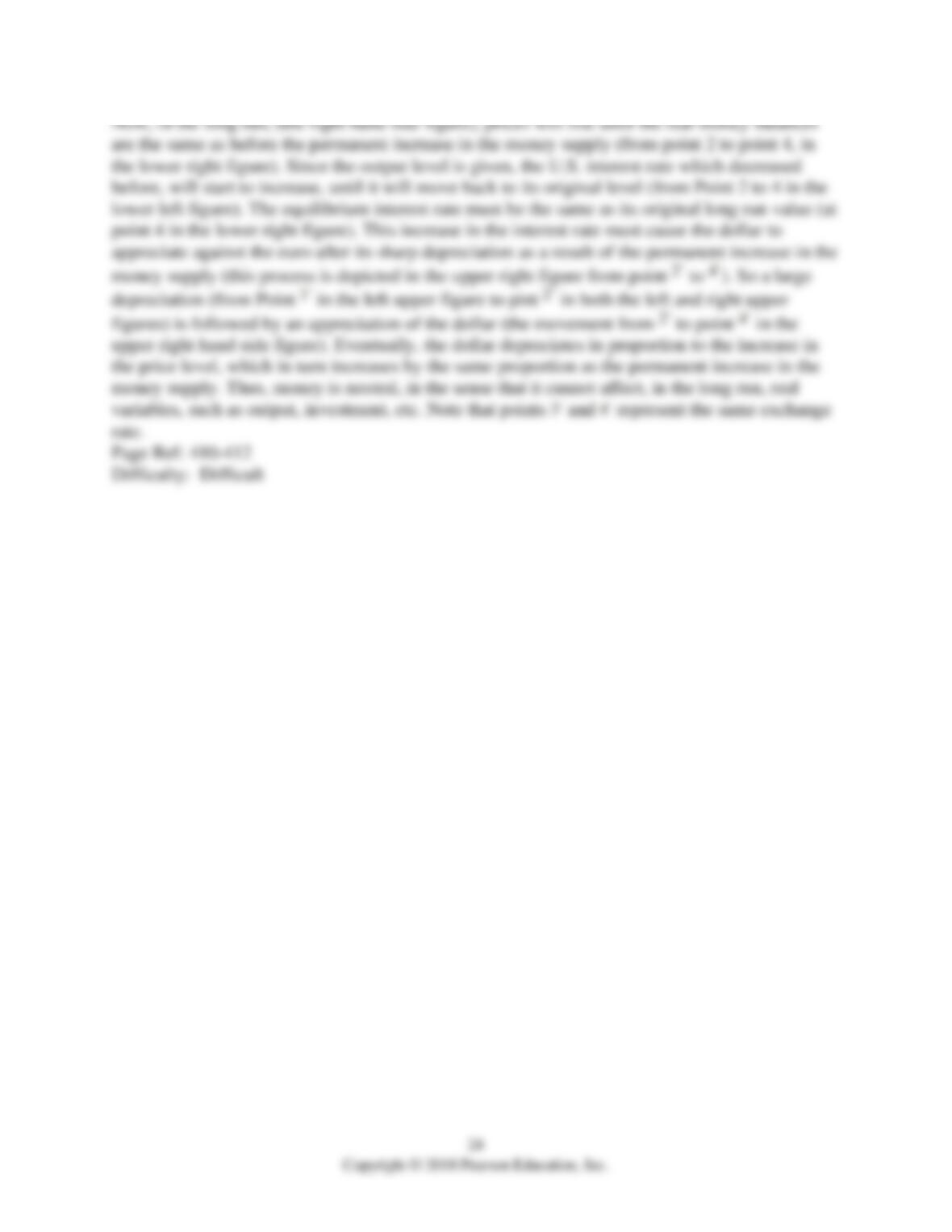
Now, in the long run, (the right hand side figure), prices will rise until the real money balances
are the same as before the permanent increase in the money supply (from point 2 to point 4, in
the lower right figure). Since the output level is given, the U.S. interest rate which decreased
before, will start to increase, until it will move back to its original level (from Point 2 to 4 in the
lower left figure). The equilibrium interest rate must be the same as its original long run value (at
point 4 in the lower right figure). This increase in the interest rate must cause the dollar to
appreciate against the euro after its sharp depreciation as a result of the permanent increase in the
money supply (this process is depicted in the upper right figure from point to ). So a large
depreciation (from Point in the left upper figure to pint in both the left and right upper
figures) is followed by an appreciation of the dollar (the movement from to point in the
upper right hand side figure). Eventually, the dollar depreciates in proportion to the increase in
the price level, which in turn increases by the same proportion as the permanent increase in the
money supply. Thus, money is neutral, in the sense that it cannot affect, in the long run, real
variables, such as output, investment, etc. Note that points and represent the same exchange
rate.
Page Ref: 410-412
Difficulty: Difficult
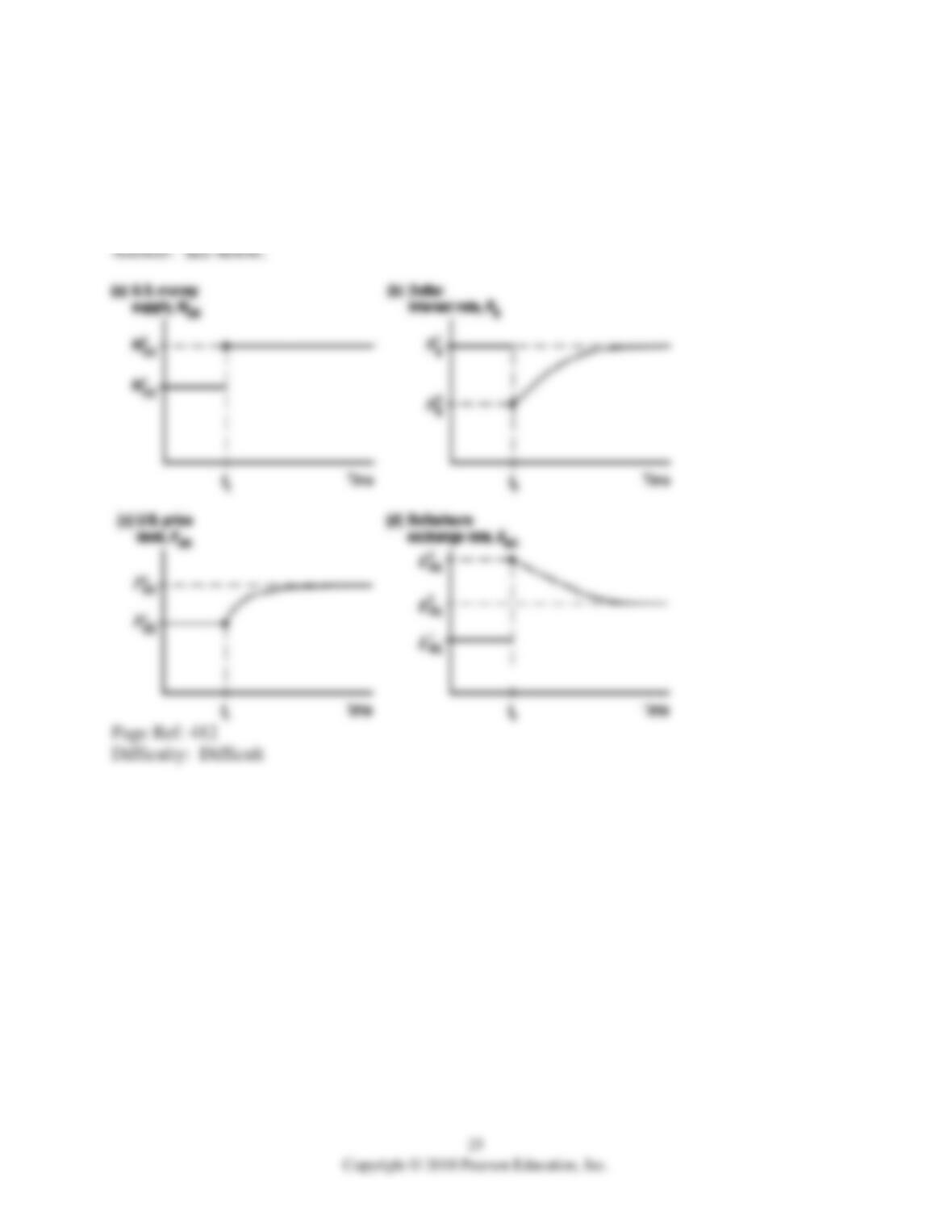
20) Using 4 different figures, plot the time paths showing the effects of a permanent increase in
the United States money supply on:
(a) U.S. Money supply
(b) The dollar interest rate.
(c) The U.S. price level
(d) The dollar/euro exchange rate