International Economics: Theory and Policy, 11e (Krugman et al.)
Chapter 14 Exchange Rates and the Foreign Exchange Market: An Asset Approach
1) How many dollars would it cost to buy an Edinburgh Woolen Mill sweater costing 50 British
pounds if the exchange rate is 1.25 dollars per one British pound?
A) 50 dollars
B) 60 dollars
C) 70 dollars
D) 62.5 dollars
E) 40 British pounds
2) How many dollars would it cost to buy an Edinburgh Woolen Mill sweater costing 50 British
pounds if the exchange rate is 1.50 dollars per one British pound?
A) 50 dollars
B) 60 dollars
C) 70 dollars
D) 80 dollars
E) 75 dollars
3) How many dollars would it cost to buy an Edinburgh Woolen Mill sweater costing 50 British
pounds if the exchange rate is 1.80 dollars per one British pound?
A) 40 dollars
B) 90 dollars
C) 50 dollars
D) 100 dollars
E) 95 dollars
4) The Japanese currency is called the
A) DM.
B) Yen.
C) Euro.
D) Dollar.
E) Pound.

5) How many British pounds would it cost to buy a pair of American designer jeans costing $45
if the exchange rate is 1.50 dollars per British pound?
A) 10 British pounds
B) 20 British pounds
C) 30 British pounds
D) 35 British pounds
E) 25 British pounds
6) How many British pounds would it cost to buy a pair of American designer jeans costing $45
if the exchange rate is 1.80 dollars per British pound?
A) 10 British pounds
B) 25 British pounds
C) 20 British pounds
D) 30 British pounds
E) 40 British pounds
7) How many British pounds would it cost to buy a pair of American designer jeans costing $45
if the exchange rate is 2.00 dollars per British pound?
A) 22.5 British pounds
B) 32.5 British pounds
C) 12.5 British pounds
D) 40 British pounds
E) 30 British pounds
8) How many British pounds would it cost to buy a pair of American designer jeans costing $45
if the exchange rate is 1.60 dollars per British pound?
A) 38.125 British pounds
B) 28.125 British pounds
C) 48.125 British pounds
D) 58.125 British pounds
E) 18.125 British pounds
9) What is the exchange rate between the dollar and the British pound if a pair of American jeans
costs 50 dollars in New York and 100 Pounds in London?
A) 1.5 dollars per British pound
B) 0.5 dollars per British pound
C) 2.5 dollars per British pound
D) 3.5 dollars per British pound
E) 2 dollars per British pound
10) What is the exchange rate between the dollar and the British pound if a pair of American
jeans costs 60 dollars in New York and 30 Pounds in London?
A) 1.5 dollars per British pound
B) 0.5 dollars per British pound
C) 2.5 dollars per British pound
D) 3.5 dollars per British pound
E) 2 dollars per British pound
11) When a country’s currency depreciates
A) foreigners find that its exports are more expensive, and domestic residents find that imports
from abroad are more expensive.
B) foreigners find that its exports are more expensive, and domestic residents find that imports
from abroad are cheaper.
C) foreigners find that its exports are cheaper; however, domestic residents are not affected.
D) foreigners are not affected, but domestic residents find that imports from abroad are more
expensive.
E) foreigners find that its exports are cheaper and domestic residents find that imports from
abroad are more expensive.
12) An appreciation of a country’s currency
A) decreases the relative price of its exports and lowers the relative price of its imports.
B) raises the relative price of its exports and raises the relative price of its imports.
C) lowers the relative price of its exports and raises the relative price of its imports.
D) raises the relative price of its exports and lowers the relative price of its imports.
E) raises the relative price of its exports and does not affect the relative price of its imports.

13) Which one of the following statements is the MOST accurate?
A) A depreciation of a country’s currency makes its goods cheaper for foreigners.
B) A depreciation of a country’s currency makes its goods more expensive for foreigners.
C) A depreciation of a country’s currency makes its goods cheaper for its own residents.
D) A depreciation of a country’s currency makes its goods cheaper.
E) An appreciation of a country’s currency makes its goods more expensive.
14) A(n) ________ of a nation’s currency will cause imports to ________ and exports to
________, all other things held constant.
A) depreciation; increase; decrease
B) appreciation; decrease; increase
C) depreciation; decrease; increase
D) appreciation; increase; increase
E) depreciation; decrease; decrease
15) If the goods‘ money prices do NOT change, an appreciation of the dollar against the pound
A) makes British sweaters cheaper in terms of American jeans.
B) makes British sweaters more expensive in terms of American jeans.
C) doesn’t change the relative price of sweaters and jeans.
D) makes American jeans cheaper in terms of British sweaters.
E) makes British jeans more expensive in Britain.
16) If the goods‘ money prices do NOT change, a depreciation of the dollar against the pound
A) makes British sweaters cheaper in terms of American jeans.
B) makes British sweaters more expensive in terms of American jeans.
C) makes American jeans more expensive in terms of British sweaters.
D) doesn’t change the relative price of sweaters and jeans.
E) makes British jeans more expensive in Britain.
17) In the year 2012, Shinzo Abe became prime minister of Japan, promising bold policies to
improve Japan’s economy. What was the focus of his policies and how did they affect Japan’s
trade position?
18) Based on the case study, “Exchange Rates, Auto Prices, and Currency Wars,” explain why
exchange rates are of critical importance to firms in the automobile industry, and how Japan has
benefited from changes in the value of the Yen.
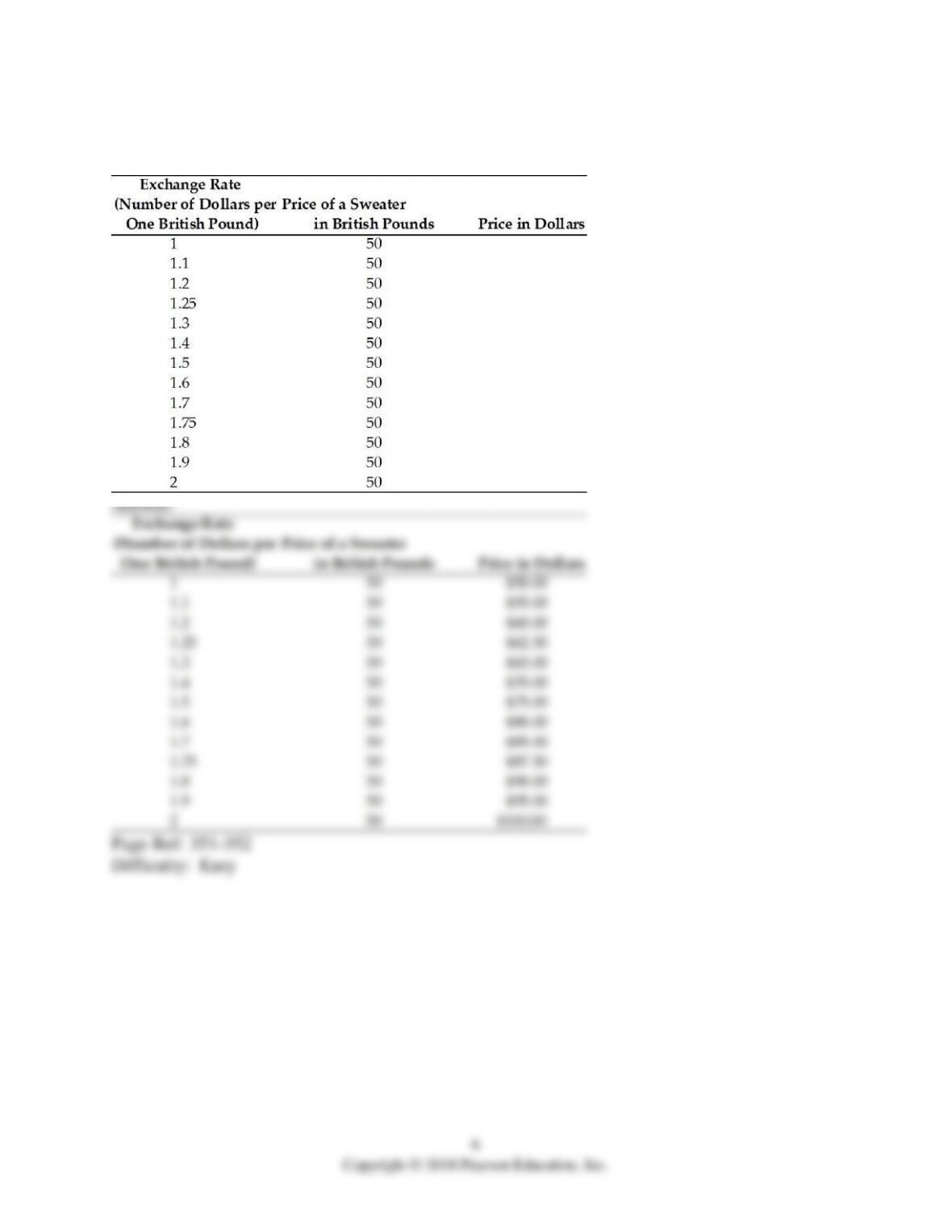
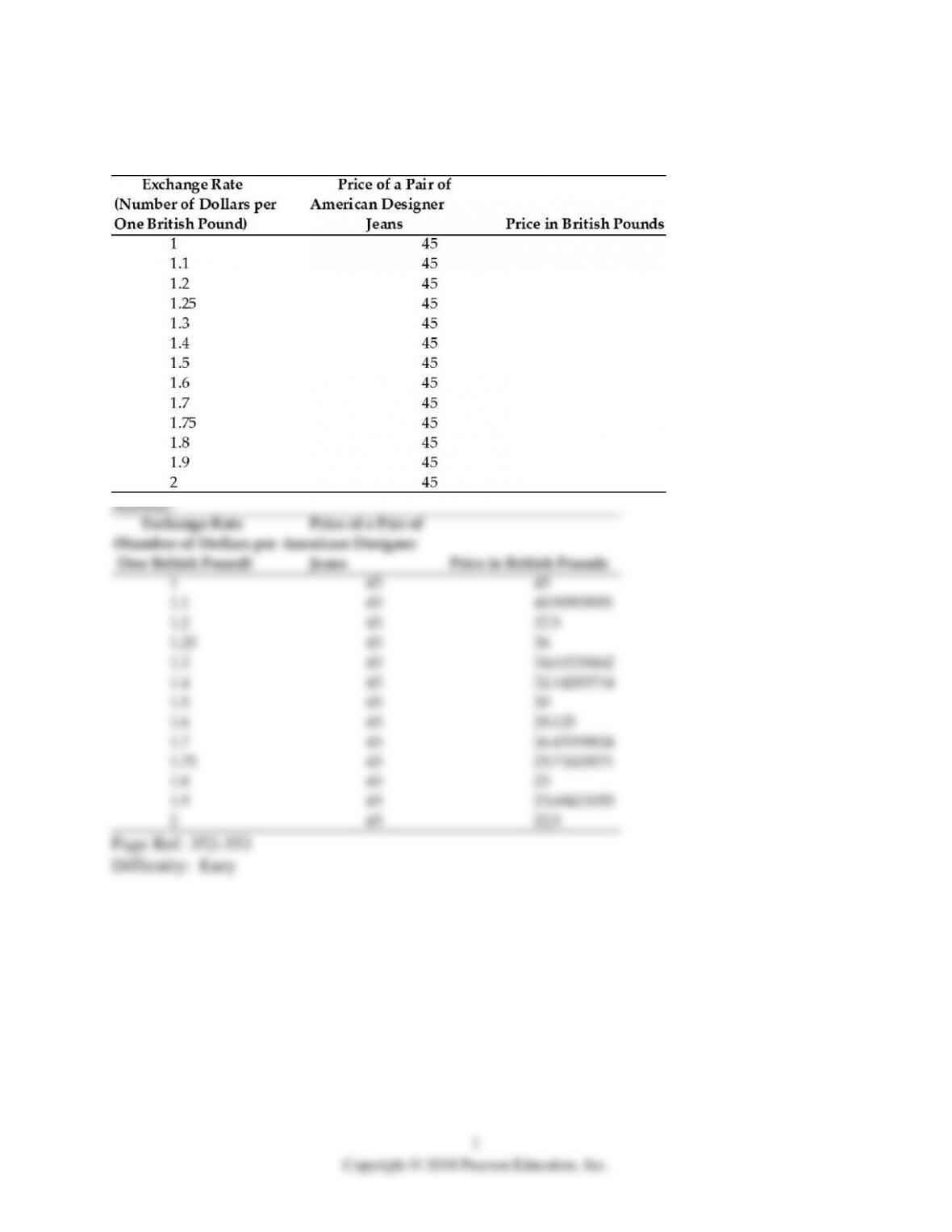
19) Compute how many dollars it would cost to buy an Edinburgh Woolen Mill sweater costing
50 British pounds for the following exchange rates.
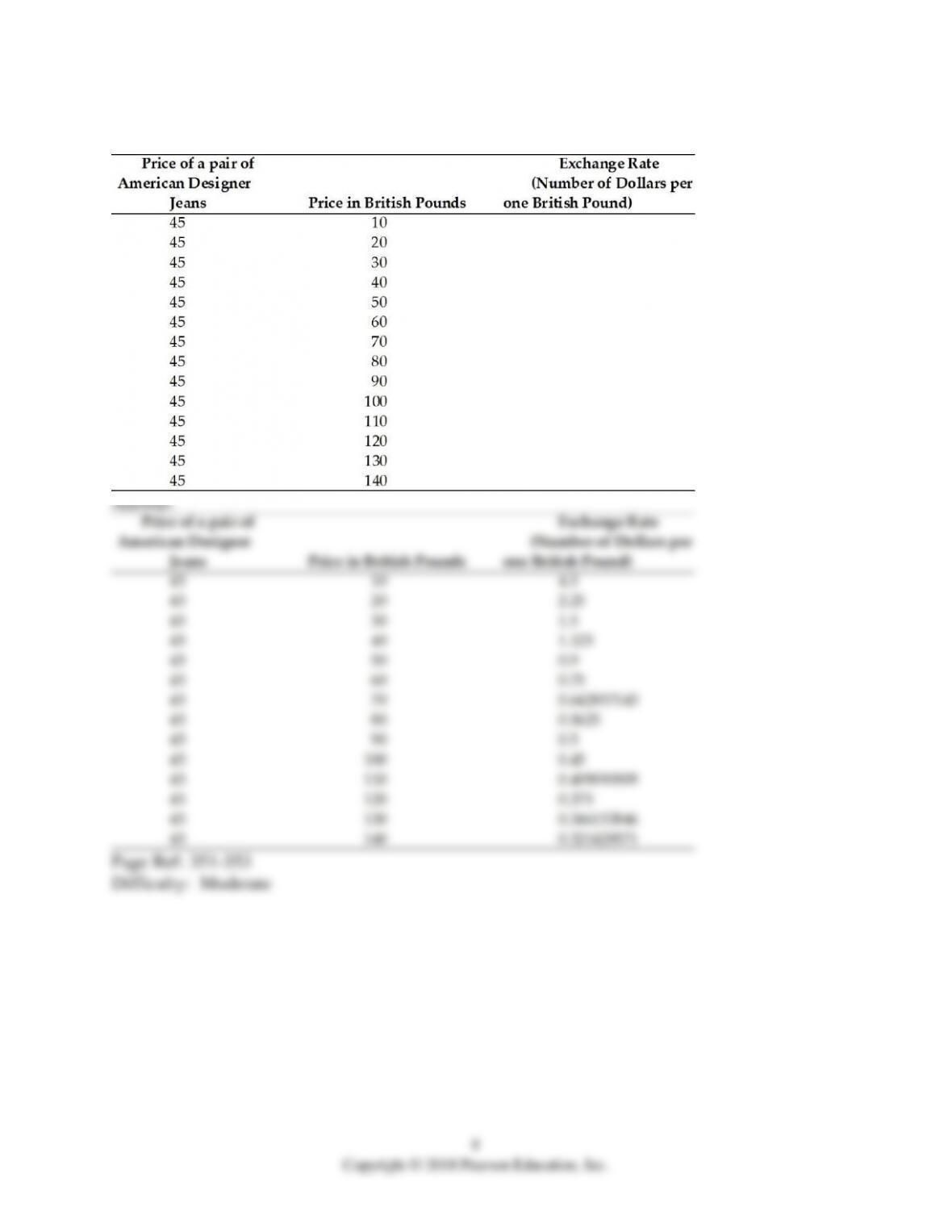
20) Compute how many British pounds it would cost to buy a pair of American designer jeans
costing $45.
21) Find the exchange rate between the dollar and the British pounds for the following cases.
9
Copyright © 2018 Pearson Education, Inc.
14.2 The Foreign Exchange Market
1) The largest trading of foreign exchange occurs in
A) New York.
B) London.
C) Tokyo.
D) Frankfurt.
E) Singapore.
2) Which of the following type of funds cater to wealthy individuals, are NOT bound by
government regulations, and are actively traded in foreign exchange markets?
A) pension funds
B) mutual funds
C) hedge funds
D) exchange funds
3) The future date on which the currencies are actually exchanged is called what?
A) the value date
B) the spot exchange date
C) the two-day window
D) the commitment date
E) the forward exchange rate
4) In 2013, about
A) 20 percent of foreign exchange transactions involved exchanges of foreign currencies for U.S.
dollars.
B) 10 percent of foreign exchange transactions involved exchanges of foreign currencies for U.S.
dollars.
C) 30 percent of foreign exchange transactions involved exchanges of foreign currencies for U.S.
dollars.
D) 40 percent of foreign exchange transactions involved exchanges of foreign currencies for U.S.
dollars.
E) 87 percent of foreign exchange transactions involved exchanges of foreign currencies for U.S.
dollars.
5) Which one of the following statements is the MOST accurate?
A) Spot exchange rates are always higher than forward exchange rates.
B) Spot exchange rates are always lower than forward exchange rates.
C) Spot exchange rates and forward exchange rates are always equal.
D) Spot exchange rates and forward exchange rates are equal when the value date and the date of
the spot transaction are the same.
E) Spot exchange rates and forward exchange rates never move closely together.
6) Forward and spot exchange rates
A) are necessarily equal.
B) do not move closely together.
C) are always such that the forward exchange rate is higher.
D) move closely together and are equal on the value date.
E) are unrelated to the value date.
7) A foreign exchange swap
A) is a spot sale of a currency.
B) is a forward repurchase of the currency.
C) is a spot sale of a currency combined with a forward repurchase of the currency.
D) is a spot sale of a currency combined with a forward sale of the currency.
E) make up a negligible proportion of all foreign exchange trading.
8) The following is an example of Radio Shack hedging its foreign currency risk:
A) needing to pay 9,000 yen per radio to its suppliers in a month, Radio Shack makes a forward–
exchange deal to buy yen.
B) needing to pay 9,000 yen per radio to its suppliers in a month, Radio Shack makes a forward–
exchange deal to sell yen.
C) needing to pay 9,000 yen per radio to its suppliers in a month, Radio Shack buys yen at a
spot-exchange 1 month from now.
D) needing to pay 9,000 yen per radio to its suppliers in a month, Radio Shack sells yen at a
spot-exchange 1 month from now.
E) needing to pay 9,000 yen per radio to its suppliers in a month, Radio Shack sells yen in a
forward-exchange deal.
9) Which of the following is NOT an example of a financial derivative?
A) forwards
B) bonds
C) swaps
D) futures
E) options
10) Which major actor is at the center of the foreign exchange market?
A) corporations
B) central banks
C) commercial banks
D) non-bank financial institutions
E) individual firms
11) Which of the following is NOT a major actor in the foreign exchange market?
A) corporations
B) central banks
C) commercial banks
D) non-bank financial institutions
E) tourists
12) By April 2013
A) only about 10 percent of foreign exchange trades were against euros.
B) only about 24 percent of foreign exchange trades were against euros.
C) only about 33 percent of foreign exchange trades were against euros.
D) only about 42 percent of foreign exchange trades were against euros.
E) only about 60 percent of foreign exchange trades were against euros.

13) Which of the following statements is TRUE about a vehicle currency?
A) It is widely used to denominate contracts made by parties who reside in the country that
issues the vehicle currency.
B) The dollar is sometimes called a vehicle currency because of its pivotal role in many foreign
exchange deals.
C) There is much skepticism that the euro will ever evolve into a vehicle currency on par with
the dollar.
D) The pound sterling, once second only to the dollar as a key international currency, is
beginning to rise in importance.
E) Vehicle currencies include nondeliverable currencies like the renminbi.
14) The action of arbitrage is
A) the process of buying a currency cheap and selling it dear.
B) the process of buying a currency dear and selling it cheap.
C) the process of buying and selling currency at the same price.
D) the process of selling currency at different prices in different markets.
E) the process of buying a currency and holding onto it to take it off the market.
15) Futures contracts differ from forward contracts in that
A) future contracts ensures you will receive a certain amount of foreign currency at a specified
future date.
B) future contracts bind you into your end of the deal.
C) future contracts allow you to sell your contract on an organized futures exchange.
D) future contracts are a disadvantage if your views about the future spot exchange rate are to
change.
E) futures contracts don’t allow you to realize a profit or a loss right away.
16) Exxon Mobil wants to pay 160,000 to a German supplier. They get an exchange rate
quotation from its own commercial bank and instructs it to debit their dollar account and pay
160,000 to the supplier’s German account. If the exchange rate quoted is $1.2 per euro, how
much is debited to Exxon Mobil’s account?
A) $160,000
B) $172,000
C) $180,000
D) $192,000
E) $150,000
17) Who are the major participants in the foreign exchange market?
18) Explain what is a “vehicle currency.” Why is the U.S. dollar considered a vehicle currency?
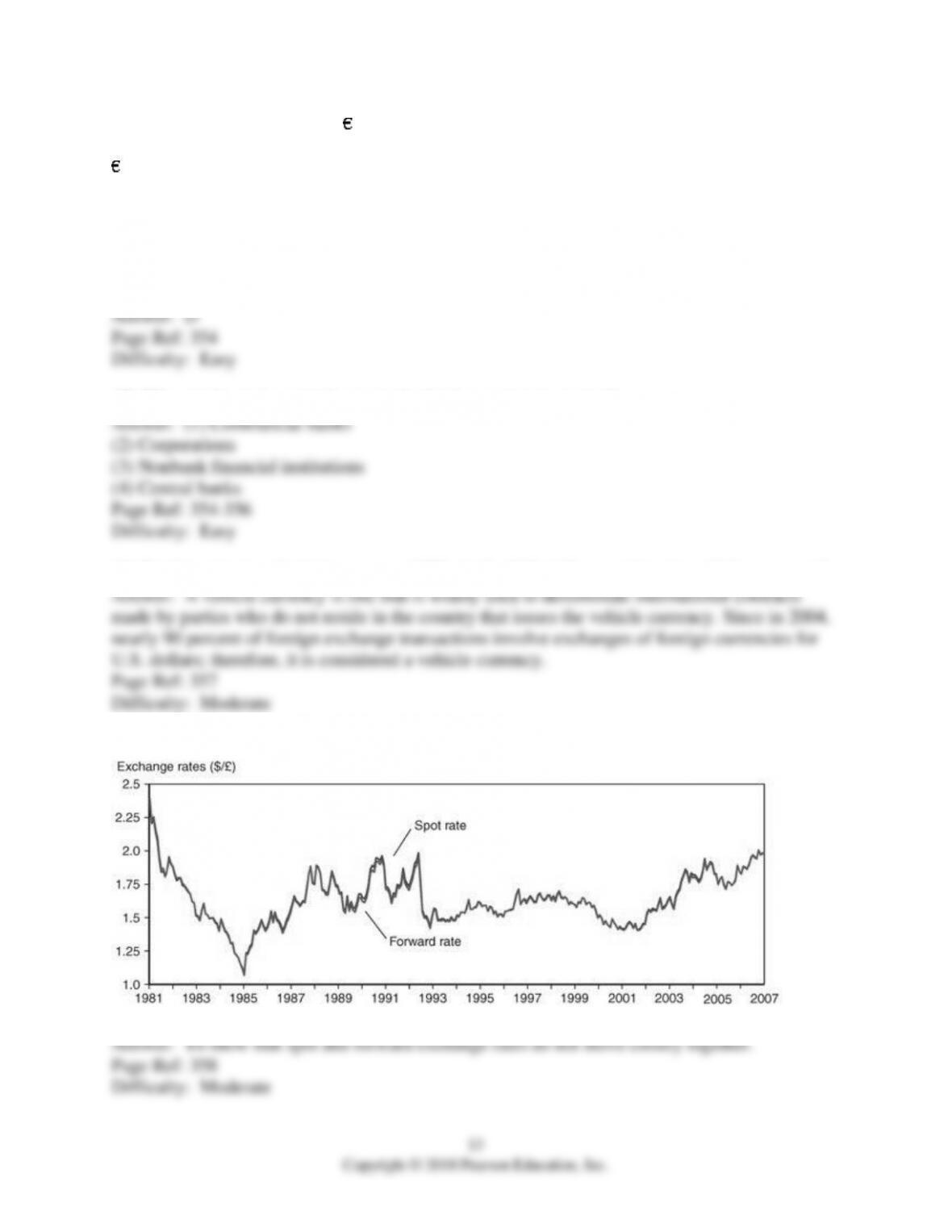
19) Explain the purpose of the following figure.
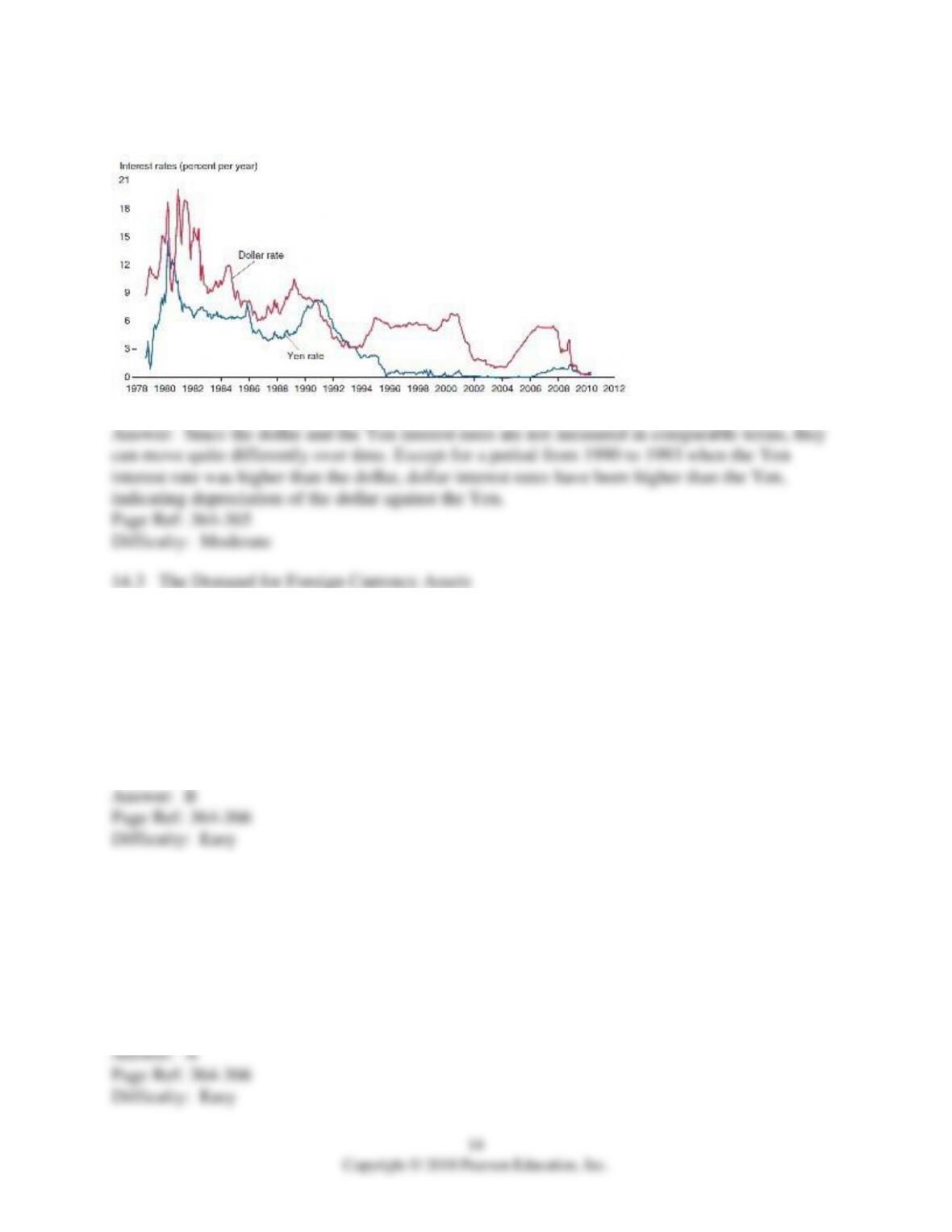
20) Explain the purpose of the following figure 14-2 from the text in the context of the interest
rates on the dollar and the Japanese Yen between 1980 and 2010.
1) What is the expected dollar rate of return on euro deposits if today’s exchange rate is $1.10 per
euro, next year’s expected exchange rate is $1.165 per euro, the dollar interest rate is 10%, and
the euro interest rate is 5%?
A) 10%
B) 11%
C) -1%
D) 0%
E) 15%
2) What is the expected dollar rate of return on dollar deposits if today’s exchange rate is $1.10
per euro, next year’s expected exchange rate is $1.165 per euro, the dollar interest rate is 10%,
and the euro interest rate is 5%?
A) 10%
B) 11%
C) -1%
D) 0%
E) 15%
3) What is the expected dollar rate of return on euro deposits if today’s exchange rate is $1.167
per euro, next year’s expected exchange rate is $1.10 per euro, the dollar interest rate is 10%, and
the euro interest rate is 5%?
A) 10%
B) 11%
C) -1%
D) 0%
4) The dollar rate of return on euro deposits is
A) approximately the euro interest rate plus the rate of depreciation of the dollar against the euro.
B) approximately the euro interest rate minus the rate of depreciation of the dollar against the
euro.
C) the euro interest rate minus the rate of inflation against the euro.
D) the rate of appreciation of the dollar against the euro.
E) the euro interest rate plus the rate of inflation against the euro.
5) If the dollar interest rate is 10 percent and the euro interest rate is 6 percent, then an investor
should
A) invest only in dollars.
B) invest only in euros.
C) be indifferent between dollars and euros.
D) invest only in dollars if the exchange rate is expected to remain constant.
E) invest only in euros if the exchange rate is expected to remain constant.
6) If the dollar interest rate is 4 percent, the euro interest rate is 6 percent, then
A) an investor should invest only in dollars.
B) an investor should invest only in euros.
C) an investor should be indifferent between dollars and euros.
D) invest only in dollars if the exchange rate is expected to remain constant.
E) invest only in euros if the exchange rate is expected to remain constant.
7) If the dollar interest rate is 10 percent, the euro interest rate is 6 percent, then
A) an investor should invest only in dollars if the expected dollar depreciation against the euro is
4 percent.
B) an investor should invest only in euros if the expected dollar depreciation against the euro is 4
percent.
C) an investor should be indifferent between dollars and euros if the expected dollar depreciation
against the euro is 4 percent.
D) an investor should invest only in dollars.
E) an investor should invest only in euros.
8) If the dollar interest rate is 10 percent and the euro interest rate is 6 percent, then
A) an investor should invest only in dollars if the expected dollar depreciation against the euro is
8 percent.
B) an investor should invest only in euros if the expected dollar depreciation against the euro is 8
percent.
C) an investor should be indifferent between dollars and euros if the expected dollar depreciation
against the euro is 8 percent.
D) an investor should invest only in dollars.
E) an investor should invest only in euros.
9) If the dollar interest rate is 10 percent, the euro interest rate is 12 percent, then
A) an investor should invest only in dollars if the expected dollar appreciation against the euro is
4 percent.
B) an investor should invest only in euros. An investor should invest only in dollars if the
expected dollar appreciation against the euro is 4 percent.
C) an investor should be indifferent between dollars and euros. An investor should invest only in
dollars if the expected dollar appreciation against the euro is 4 percent.
D) an investor should invest only in dollars.
E) an investor should invest only in euros.
10) What are the three factors that affect the demand for foreign currency?
11) Explain risk and liquidity of assets.