International Economics: Theory and Policy, 11e (Krugman et al.)
Chapter 10 The Political Economy of Trade Policy
1) The efficiency case made for free trade is that as trade distortions such as tariffs are
dismantled and removed
A) government tariff revenue will decrease, and therefore national economic welfare will
decrease.
B) government tariff revenue will decrease, and therefore national economic welfare will
increase.
C) deadweight losses for producers and consumers will decrease, hence increasing national
economic welfare.
D) deadweight losses for producers and consumers will decrease, hence decreasing national
economic welfare.
E) government tariff revenue will increase, hence increasing national economic welfare.
2) The opportunity to exploit economies of scale is one of the gains to be derived by removing
tariffs and other trade distortions. These gains will be the result of a decrease in
A) world prices of imports.
B) the consumption distortion loss triangle.
C) the production distortion loss triangle.
D) international labor mobility.
E) excessive entry and inefficient business practices.
3) Judging by the ongoing changes in tariff rates in major trading countries, the world has been
experiencing a great
A) trade liberalization.
B) surge of protectionism.
C) lack of progress in the trade-policy area.
D) move towards regional integration.
E) shift from export subsidies to specific tariffs.
4) Trade theory suggests that Japan would gain from a subsidy the United States provides its
grain farmers if the gains to Japanese consumers of wheat products more than offsets the losses
to Japanese wheat farmers. This would occur as long as Japan
A) is a net importer in bilateral trade flows with the United States.
B) is a net importer of wheat.
C) has a comparative advantage in wheat.
D) has an absolute advantage in producing wheat.
E) is involved in intra-industry trade with the United States.
5) It is argued that the United States would be foolish to maintain a free-trade stance in a world
in which all other countries exploit child or prisoner labor, or are protectionist. On the other
hand, Ricardo’s classic demonstration of the sources and effects of comparative advantage
cogently demonstrates that regardless of other country policy, free trade remains the first best
policy for a country to follow, since it will maximize its consumption possibilities (conditional
upon other country policies). Explain. Discuss the contradiction with the argument in the
preceding paragraph.
1) The optimum tariff is
A) the best tariff a country can obtain via a WTO negotiated round of compromises.
B) the tariff, which maximizes the terms of trade gains.
C) the tariff, which maximizes the difference between terms of trade gains and terms of trade
loses.
D) not practical for a small country due to the likelihood of retaliation.
E) not practical for a large country due to the likelihood of retaliation.
2) The optimum tariff is most likely to apply to
A) a small tariff imposed by a small country.
B) a small tariff imposed by a large country.
C) a large tariff imposed by a small country.
D) a large tariff imposed by a large country.
E) an ad valorem tariff on a small country.
3) The prohibitive tariff is a tariff that
A) is so high that it eliminates imports.
B) is so high that it causes undue harm to trade-partner economies.
C) is so high that it causes undue harm to import competing sectors.
D) is so low that the government prohibits its use since it would lose an important revenue
source.
E) is so low that it causes domestic producers to leave the industry.
4) The existence of marginal social benefits which are NOT marginal benefits for the industry
producing the import substitutes
A) is an argument supporting free trade and non-governmental involvement.
B) is an argument supporting the use of an optimum tariff.
C) is an argument supporting the use of market failures as a trade-policy strategy.
D) is an argument rejecting free trade and supporting governmental involvement.
E) is an argument rejecting the domestic market failure concept.
5) The domestic market failure argument is a particular case of the theory of
A) the optimum, or first-best.
B) the second best.
C) the third best.
D) the sufficing principle.
E) the efficiency case for free trade.
6) The difficulty of ascertaining the right second-best trade policy to follow
A) reinforces support for the third-best policy approach.
B) reinforces support for increasing research capabilities of government agencies.
C) reinforces support for abandoning trade policy as an option.
D) reinforces support for free-trade options.
E) reinforces support for the domestic market failure argument.
7) The reason protectionism remains strong in the United States is that
A) economists can produce any result they are hired to produce.
B) economists cannot persuade the general public that free trade is beneficial.
C) economists do not really understand how the real world works.
D) the losses associated with protectionism are diffuse, making lobbying by the public
impractical.
E) economists cannot agree on trade policy recommendations.
8) The United States appears at times to have a totally schizophrenic attitude toward
protectionism. The United States was the country that proposed the establishment of the World
Trade Organization as early as the late 1940s, and was also the only industrialized country that
refused to ratify this at that time. The United States has consistently argued on the side of
multinational free trade in GATT Rounds, and yet maintains many protectionist laws such as
those which reserve oil shipments from Alaska to U.S. flag carriers. How can you explain this
apparent lack of national consistency on this issue?
5
Copyright © 2018 Pearson Education, Inc.
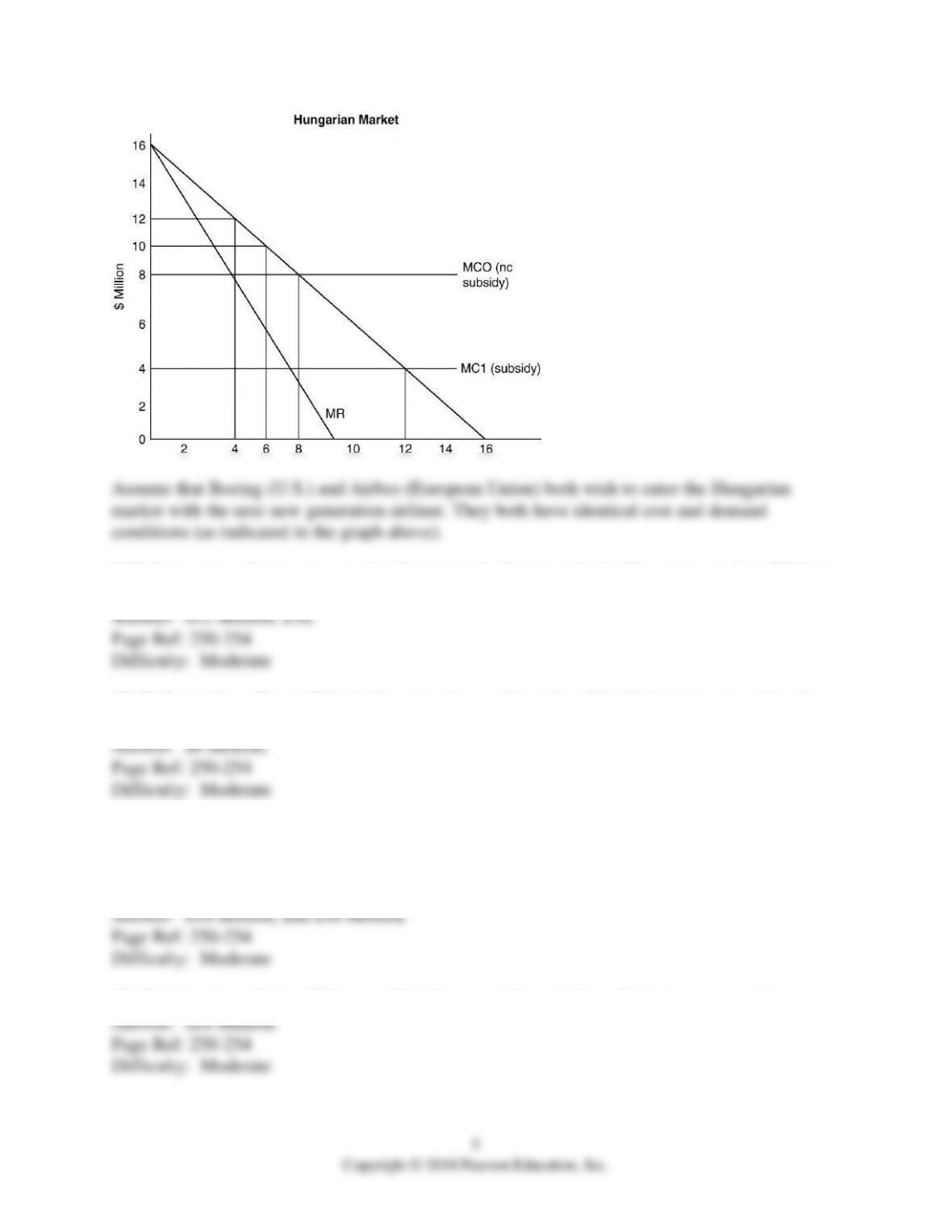
Assume that Boeing (U.S.) and Airbus (European Union) both wish to enter the Hungarian
market with the next new generation airliner. They both have identical cost and demand
conditions (as indicated in the graph above).
9) Refer to above figure. Assume that Boeing is the first to enter the Hungarian market. Without
a government subsidy what price would they demand, and what would be their total profits?
10) Refer to above figure. What is the consumer surplus enjoyed by Hungarian consumers of
Boeing aircraft in the situation?
11) Refer to above figure. Suppose the European government provides Airbus with a subsidy of
$4 for each airplane sold, and that the subsidy convinces Boeing to exit the Hungarian market.
Now Airbus would be the monopolist in this market. What price would they charge, and what
would be their total profits?
12) Refer to above figure. What would be the cost of the subsidy to European taxpayers?
13) Refer to above figure. What happens to the Consumer Surplus of Hungarian customers as a
result of this subsidy?
14) Refer to above figure. What is the revenue gain or loss for Europe as a whole (including
taxpayers)?
1) It is argued that special interest groups are likely to take over and promote protectionist
policies, which may lead to a decrease in national economic welfare. This argument leads to
A) a presumption that in practice a free trade policy is likely to be better than alternatives.
B) a presumption that trade policy should be shifted to Non-Governmental Organizations, so as
to limit taxpayer burden.
C) a presumption that free trade is generally a second-best policy, to be avoided if feasible
alternatives are available.
D) a presumption that free trade is the likely equilibrium solution if the government allows
special interest groups to dictate its trade policy.
E) a presumption that protectionist policies will better serve a country as a whole than free trade
policies.
2) The authors of the text believe that
A) second-best policy is worse than optimal policy.
B) special interest groups generally enhance national welfare.
C) national welfare is likely to be enhanced by the imposition of an optimal tariff.
D) market failure arguments tend to support free-trade policy.
E) there is no such thing as national welfare.
3) The median voter model
A) works well in the area of trade policy.
B) is not intuitively reasonable.
C) tends to result in biased tariff rates.
D) does not work well in the area of trade policy.
E) is not widely practiced in the United States.
4) The fact that trade policy often imposes harm on large numbers of people, and benefits only a
few may be explained by
A) the lack of political involvement of the public.
B) the power of advertisement.
C) the problem of collective action.
D) the basic impossibility of the democratic system to reach a fair solution.
E) a cycle of political corruption.
5) Protectionism tends to be concentrated in two sectors
A) agriculture and clothing.
B) high-tech and national security sensitive industries.
C) capital and skill intensive industries.
D) industries concentrated in the South and in the Midwest of the country.
E) financial services and manufacturing based in the Midwest.
6) Export embargoes cause greater losses to consumer surplus in the target country
A) the lesser its initial dependence on foreign produced goods.
B) the more elastic is the target country’s demand schedule.
C) the more elastic is the target country’s domestic supply.
D) the more inelastic is the target country’s supply.
E) the larger the target country’s labor force is.
7) The strongest political pressure for a trade policy that results in higher protectionism comes
from
A) domestic workers lobbying for import restrictions.
B) domestic workers lobbying for export restrictions.
C) domestic workers lobbying for free trade.
D) domestic consumers lobbying for export restrictions.
E) domestic consumers lobbying for import restrictions.
8) The average tariff rate dutiable imports in the United States is approximately
A) less than 10 % of the value of imports.
B) 15% of the value of imports.
C) 20 % of the value of imports.
D) 25% of the value of imports.
E) more than 30% of the value of imports.
9) Today U.S. protectionism is concentrated in
A) high-tech industries.
B) labor-intensive industries.
C) industries in which Japan has a comparative advantage.
D) computer intensive industries.
E) capital-intensive industries.
10) The quantitative importance of U.S. protection of the domestic clothing industry is best
explained by the fact that
A) this industry is an important employer of highly skilled labor.
B) this industry is an important employer of low skilled labor.
C) most of the exporters of clothing into the U.S. are poor countries.
D) this industry is a politically well-organized sector in the U.S.
E) the technology involved is very advanced.
11) It may be demonstrated that any protectionist policy, which effectively shifts real resources
to import competing industries or sectors will harm export industries or sectors. This may, for
example, happen by the strengthening U.S. dollar in the foreign exchange market. Would you
propose therefore that export industries lobby against protectionism in International Trade
Commission proceedings? What of consumer advocates? Discuss the pros and the problems of
such a suggestion.
1) The simple model of competition among political parties long used by political scientists tends
to lead to the practical solution of selecting the
A) optimal tariff.
B) prohibitive tariff.
C) zero (free-trade) tariff.
D) the tariff rate favored by the median voter.
E) the tariff rate supported by exporters.
2) The General Agreement on Tariffs and Trade and the World Trade Organization have resulted
in
A) termination of export subsidies applied to manufactured goods.
B) termination of import tariffs applied to manufactures.
C) termination of import tariffs applied to agricultural commodities.
D) termination of international theft of copyrights.
E) a number of rounds of multilateral trade agreements.
3) The General Agreement on Tariffs and Trade and the World Trade Organization have resulted
in
A) the establishment of universal trade adjustment assistance policies.
B) the establishment of the European Union.
C) the reciprocal trade clause.
D) reductions in trade barriers via multilateral negotiations.
E) the total protection of all intellectual property rights.
4) An issue never confronted effectively by GATT, but considered an important issue for WTO
is that of
A) the promotion of freer World trade.
B) the promotion of freer World commodity trade.
C) the promotion of freer World services trade.
D) the lowering of tariff rates.
E) the liberalization of trade.
5) The political wisdom of choosing a tariff acceptable to the median U.S. voter is
A) a good example of the principle of the second best.
B) a good example of the way in which actual tariff policies are determined.
C) a good example of the principle of political negotiation.
D) not evident in actual tariff determination.
E) usually evident in actual tariff determination.
6) A game-theory explanation of the paradox that even though all countries would benefit if each
chose free trade, in fact each tends to follow protectionist policies is
A) trade war.
B) collective action.
C) prisoner’s dilemma.
D) benefit-cost analysis.
E) rent seeking.
7) When the U.S. placed tariffs on French wine, France placed high tariffs on U.S. chickens. This
is an example of
A) deadweight losses.
B) multilateral negotiations.
C) bilateral trade negotiations.
D) international market failures.
E) a trade war.
8) Presumably, since the United States is a large country in many of its international markets, a
positive optimum tariff exists for this country. It follows therefore that when any legislator or
government official who promotes zero-tariff free trade policies, is by definition not acting in the
public’s best interest. Discuss.
9) It has been claimed that foreign governments have attempted to influence votes in the U.S.
that would promote policies of protectionism within the U.S. On the surface this appears to be
totally illogical and counter intuitive, as this would presumably lessen the possibilities of
foreigners’ exports to the U.S.
10) The U.S. producer Boeing, and the European Airbus are contemplating the next generation
mid-sized fuel efficient generation of air carrier. If both produce their respective models, then
each would lose $50 million (because the world market is just not large enough to enable either
to capture potential scale economies if they had to share the world market). If neither produce,
then each one’s net gain would of course be zero. If either one produces while the other does not,
then the producer will gain $500 million.
(a) What is the correct strategy for either company?
(b) What is the correct strategy for a government seeking to maximize national economic
welfare?
(c) If a national government decides to subsidize its aircraft producer, how high should be the
subsidy?
11) In recent cases, the U.S. placed quotas or protectionist tariffs on imported steel and imported
microchips. In both cases the damage to “downstream” industries was obvious to all and
relatively easy to quantify and demonstrate. Assuming that the U.S. lawmakers are not plain
dumb, why did they enact these protectionist policies?
12) The World Trade Organization (WTO) was organized as a successor to the
A) IMF.
B) UN.
C) UNCTAD.
D) GATT.
E) the World Bank.
13) The WTO was established by the ________ of multilateral trade negotiations.
A) Kennedy Round
B) Tokyo Round
C) Uruguay Round
D) Dillon Round
E) NAFTA Round
14) The Smoot-Hawley Tariff Act of 1930 has generally been associated with
A) falling tariffs.
B) free trade.
C) intensifying the worldwide depression.
D) recovery from the worldwide depression.
E) non-tariff barriers.
15) The World Trade Organization provides for all of the following EXCEPT
A) the usage of the most favored nation clause.
B) assistance in the settlement of trade disagreements.
C) bilateral tariff reductions.
D) multilateral tariff reductions.
E) the prevention of nontariff interventions in trade.
16) Which organization determines procedures for the settlement of international trade disputes?
A) World Bank
B) World Trade Organization
C) International Monetary Organization
D) International Bank for Reconstruction and Development
E) The League of Nations
17) The WTO’s intervention against clean air standards
A) has earned it universal approval.
B) was done in order to limit national sovereignty.
C) has resulted in much criticism.
D) has resulted in much criticism among professional economists.
E) was championed in developing countries.
1) For most developing countries
A) productivity is high among domestic workers.
B) population growth and illiteracy rates are low.
C) saving and investment levels are high.
D) agricultural goods and raw materials constitute a high proportion of domestic output.
E) pollution emissions are relatively low.
2) Developing countries have often attempted to establish cartels so as to counter the actual or
perceived inexorable downward push on the prices of their exported commodities. OPEC is the
most well known of these. How are such cartels expected to help the developing countries? At
times importing countries profess support for such schemes. Can you think of any logical basis
for such support? How are cartels like monopolies, and how are they different from monopolies.
Why is there a presupposition among economists that such schemes are not likely to succeed in
the long run?
3) The U.S. is probably the most open international market among the industrialized countries.
What then does the U.S. have to gain by joining the WTO?
4) The world trading system combines negotiated agreements that promote trade liberalization
called ________ with binding agreements called ________ that block tariff increases.
A) fiscal policies; monetary policies
B) truces; aggressions
C) free trade; enforcement contracts
D) levers; ratchets
E) wheels; walls
5) One of the major issues that arose during the Doha round of negotiations involved complaints
by ________ about ________.
A) developing countries; agricultural subsidies.
B) manufacturers; intellectual property
C) industrialized countries; enforcement of contracts
D) Eastern European countries; European Union tariffs
E) South and Central American countries; domestic content requirements
10.6 Appendix to Chapter 10: Proving That the Optimum Tariff Is Positive
1) The effect of an export tariff on a large country is to ________ the terms of trade.
A) always improve
B) sometimes improve
C) leave unchanged
D) sometimes worsen
E) always worsen
2) Assume that a country has a domestic demand curve defined as Qd = 100 – 2P and a domestic
supply curve defined as Qs = -20 + 3P. What is the autarchy equilibrium price and quantity?
3) Assume that a country has a domestic demand curve defined as Qd = 100 – 2P and a domestic
supply curve defined as Qs = -20 + 3P. What is the country’s import demand curve (Qm)?
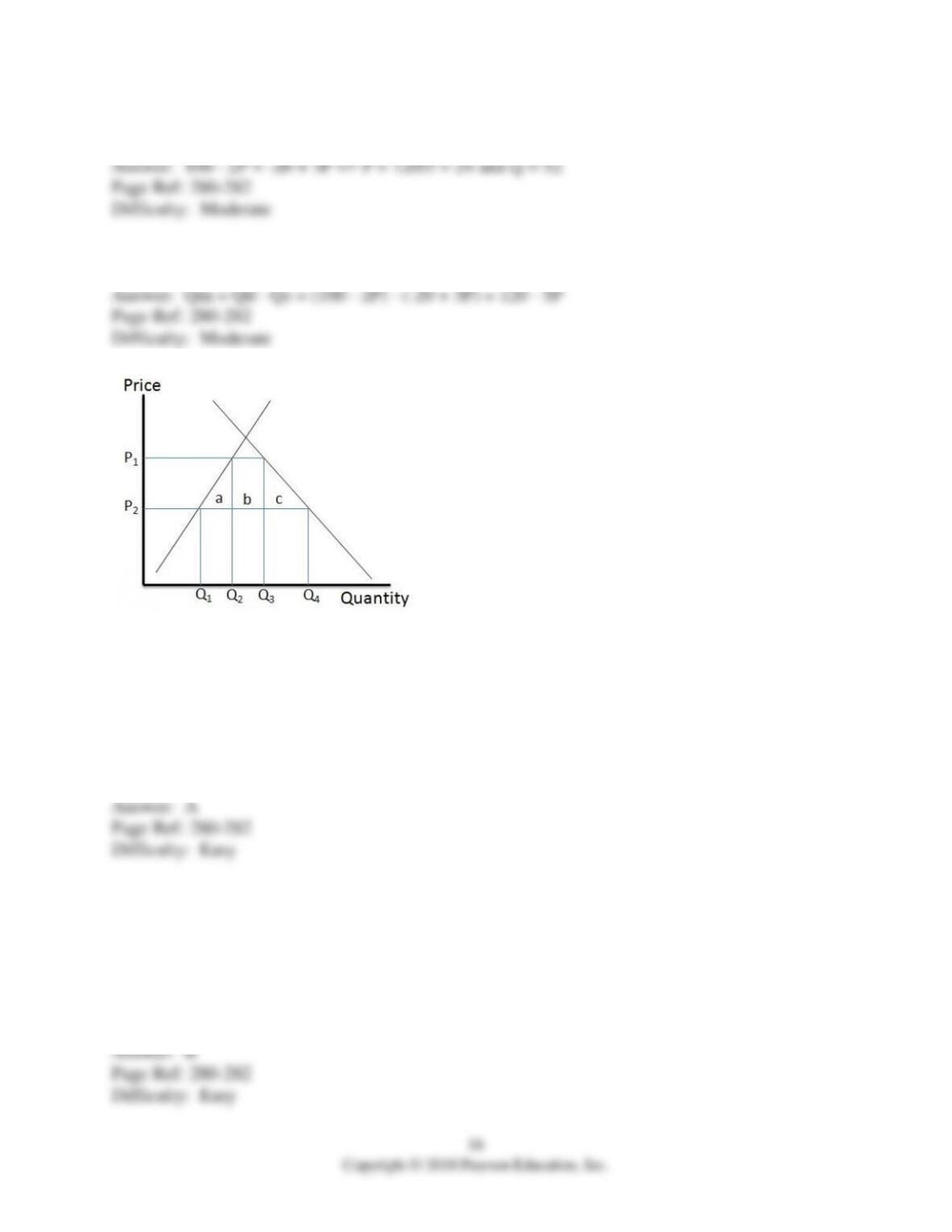
4) Refer to the figure above, which shows domestic supply and demand. If P1 is equal to P2 (the
world price) plus a tariff, then the social loss from the tariff is equal to
A) a + c
B) b
C) P1 ( Q3 – Q2)
D) P2 [(Q2 – Q1) + (Q4 – Q3)]
E) a + b + c
5) Refer to the figure above, which shows domestic supply and demand. If P1 is equal to P2 (the
world price) plus a tariff, then government revenue from the tariff is equal to
A) a + c
B) b
C) P1 ( Q3 – Q2)
D) P2 [(Q2 – Q1) + (Q4 – Q3)]
E) a + b + c