
36) A firm has arranged for a lockbox system to reduce collection time of accounts receivable.
Currently the firm has an average collection period of 43 days, an average age of inventory of 50
days, and an average payment period of 10 days. The lockbox system will reduce the average
collection period by 3 days by reducing processing, mail, and clearing float. The firm’s cash
conversion cycle ________.
A) increases by 3 days
B) decreases by 3 days
C) increases by 6 days
D) decreases by 6 days
37) The Solar Inc. has daily cash receipts of $90,000. A recent analysis of its collections
indicated that customers’ payments were in the mail for an average of 4 days. Once received,the
payments are processed in one and a half days. After payments are deposited, it takes an average
of two and a half days for these receipts to clear the banking system. If the firm’s opportunity
cost is 11%, would it be economically advisable for the firm to pay an annual fee of $8,000 to
reduce collection float by 2 days?
A) Yes, because it would only cost $8,000 to save $19,800, netting the company $11,800.
B) Yes, because it would only cost $8,000 to save $59,400, netting the company $51,400.
C) No, because it would cost $8,000 to save $880, netting the company -$7,120.
D) Yes, because it would only cost $8,000 to save $9,900, netting the company $1,900.
38) ________ float results from the delay between the time when a customer deducts a payment
from the checking account ledger and the time when the vendor actually receives the funds in a
spendable form.
A) Mail
B) Processing
C) Collection
D) Disbursement
39) Which of the following is TRUE of collection float?
A) It represents the time delay between when payment is placed in the mail and when it is
received.
B) It represents the time between receipt of a payment and its deposit into a firm’s account.
C) It results from the lapse between the time when a firm deducts a payment from its checking
account ledger and the time when funds are actually withdrawn from its account.
D) It results from the delay between the time when a customer deducts a payment from the
checking account ledger and the time when the vendor actually receives the funds in a spendable
form.
40) A customer sends payment to a post office box which is emptied by a firm’s bank daily. The
bank then processes the payments and notifies the firm of the day’s collections. This collection
technique is known as ________.
A) a direct send
B) concentration banking
C) the lockbox system
D) controlled disbursing
41) Controlled disbursing ________.
A) reduces a firm’s average collection period
B) is a popular technique for effectively managing inventory to keep its level low
C) is a popular technique for increasing payment float
D) reduces a firm’s average payment period
42) ________ float results from the lapse between the time when a firm deducts a payment from
its checking account ledger and the time when funds are actually withdrawn from its account.
A) Mail
B) Processing
C) Collection
D) Disbursement
43) ________ involves the strategic use of mailing points and bank accounts to lengthen mail
and clearing floats.
A) A direct send
B) Concentration banking
C) A lockbox
D) Controlled disbursing
44) A ________ is an unsigned check drawn on one of a firm’s bank accounts and deposited into
its account at another bank.
A) direct send
B) wire transfer
C) depository transfer check
D) preauthorized check

45) A ________ is an electronic communication that, via bookkeeping entries, removes funds
from the payer’s bank and deposits them in an account of the payee’s bank.
A) direct send
B) wire transfer
C) depository transfer check
D) preauthorized check
46) ________ are short-term money market instruments that can be easily converted into cash.
A) Preferred stocks
B) Treasury bonds
C) Accounts receivable
D) Marketable securities
47) To be truly marketable, a security must ________.
A) be highly rated by a credit rating agency
B) have the characteristics of a callable bond
C) be readily convertible into cash
D) have a maturity of 10 years or more

48) ________ are obligations of the U.S. Treasury with common maturities of 91 to 182 days
and that have a strong secondary market.
A) Treasury notes
B) Treasury bills
C) Federal agency issues
D) Banker’s acceptances
49) ________ are obligations of the U.S. Treasury with common maturities of one to ten years.
A) Treasury notes
B) Treasury bills
C) Federal agency issues
D) Banker’s acceptances
50) ________ are not obligations of the U.S. government, but most purchasers feel that they are
implicitly guaranteed by the federal government.
A) Treasury notes
B) Treasury bills
C) Federal agency issues
D) Banker’s acceptances
51) Which of the following securities is a government issue?
A) eurodollar deposits
B) repurchase agreements
C) certificate of deposits
D) federal agency issues
52) Which of the following is a short-term, unsecured promissory note issued by a corporation
with a very high credit standing?
A) negotiable certificate of deposit
B) repurchase agreement
C) money market mutual fund
D) commercial paper
53) Which of the following is an attribute of a banker’s acceptance?
A) It is an unsecured note of issuer with large denominations.
B) It has a maturity of 1 day to 3 years.
C) Its risk and return is higher than U.S. Treasury issues.
D) It is issued by a corporation with a high credit standing.

54) ________ are funds denominated in U.S. dollars and deposited in banks located outside the
United States.
A) Negotiable certificates of deposit
B) Eurodollar deposits
C) Banker’s acceptances
D) Money market mutual funds
55) A ________ is a professionally managed portfolio of marketable securities and is sold in
fractional parts.
A) negotiable certificate of deposit
B) repurchase agreement
C) money market mutual fund
D) commercial paper issue
56) Nongovernmental issues typically have slightly higher yields than government issues with
similar maturities because ________.
A) they experience little or no loss in value over time
B) of the slightly higher risk associated with them
C) the yields are guaranteed by the federal government
D) of having stronger secondary market
57) Which of the following is a nongovernmental issue?
A) eurodollar deposit
B) Treasury bill
C) Treasury bond
D) gilt fund
58) Funds on deposit at commercial banks having variable maturities and yields based on size,
maturity, and prevailing money market conditions are ________.
A) negotiable certificates of deposit
B) commercial paper
C) savings accounts
D) money market mutual funds
59) ________ float is the time that elapses between the deposit of a check by the payee and the
actual availability of funds.
A) Mail
B) Processing
C) Clearing
D) Disbursement
60) Which of the following is TRUE of a repurchase agreement?
A) It results from a bank guarantee of a business transaction; sold at discount from maturity
value.
B) It provides a return slightly below that obtainable through outright purchase of similar
marketable securities.
C) It is issued by professional portfolio management companies.
D) Its maturity period lies between 1 to 10 years.
61) The yield on commercial paper is generally higher than the yield on ________.
A) preferred stock
B) a corporate bond
C) common stock
D) a Treasury bill
62) Which of the following instruments demonstrates the safety of principal characteristic
common to marketable securities?
A) common stock
B) derivatives
C) options
D) Treasury bonds
63) A security experiencing little or no loss in value over time is said to have ________.
A) safety of return
B) safety of principal
C) safety of maturity
D) risk of payments
64) Federal agency issues ________.
A) are obligations of U.S. treasury
B) generate slightly higher returns than corporate bonds
C) generate slightly higher returns than U.S. Treasury issues
D) don’t have strong secondary market
65) Sound cash management techniques would support ________.
A) minimizing collection float, maximizing disbursement float, and minimizing the cash
conversion cycle
B) minimizing collection float, maximizing disbursement float, and minimizing the cash
turnover
C) maximizing collection float, minimizing disbursement float, and minimizing operating cash
flow
D) minimizing collection float, maximizing disbursement float, and maximizing investing cash
flow
66) A firm expects to have funds of $150,000 idle for 60 days. If the firm could purchase
marketable securities yielding 2 percent and pay brokerage fees of $1,500, the firm ________.
A) should make the investment since interest earned exceeds brokerage fees
B) should not make the investment since the required rate of return is less than the cost of
investment
C) should leave the $150,000 in cash
D) should invest the funds for more than 60 days due to the favorable rate
67) The risk of an investment in a Eurodollar deposit is partially due to ________.
A) the fact that the center of the Eurodollar market is in London
B) the fact that the majority of these deposits are not in the form of U.S. dollars
C) the presence of some foreign exchange risk
D) the fact that these instruments only pay interest at maturity
68) Which of the following is TRUE of a Eurodollar deposit?
A) Eurodollar deposits tend to provide yields below nearly all other marketable securities with
similar maturities due to their low risk.
B) Eurodollar deposits are non-negotiable and pay interest only at maturity, hence the yield is
higher than on other marketable securities with similar maturities.
C) Eurodollar deposits tend to provide yields above nearly all other marketable securities with
similar maturities due to the higher risk.
D) Eurodollar deposits tend to provide higher yields above nearly all other marketable securities
with similar maturities due to the absence of an active secondary market.
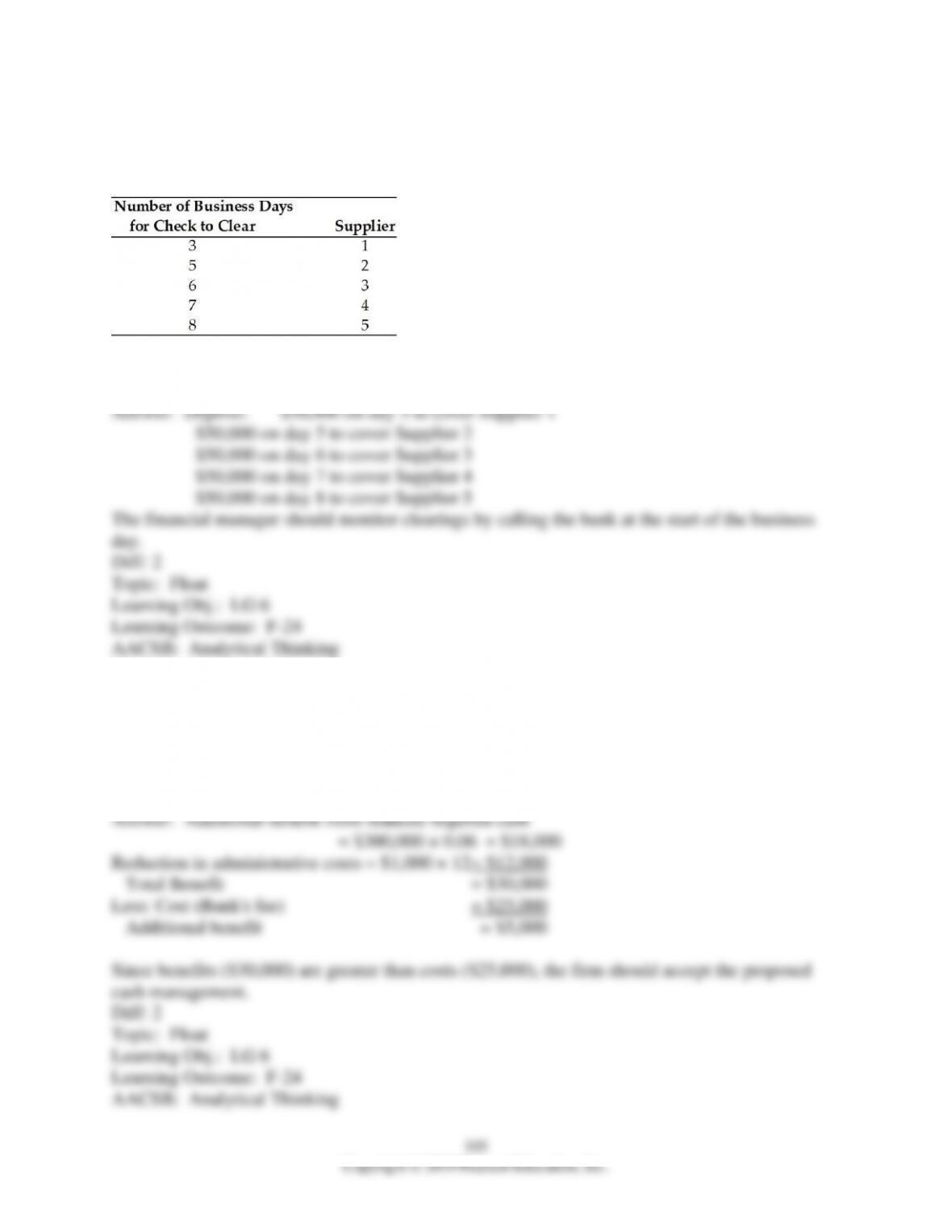
69) Danny’s Distributing, Inc. has completed an analysis of check-clearing times of five key
suppliers. On a weekly basis, the firm has a $50,000 check disbursed to each of these suppliers,
totaling $250,000. In examining the check-clearing times of each supplier, the firm revealed:
Given this information, what recommendation would you give the firm with respect to paying its
suppliers weekly? Explain.
70) Agatha Concrete Company has been offered by its bank to manage its cash at a cost of
$25,000 per year. Under the proposed cash management, the firm can reduce the cash required
on hand by $300,000. Since the bank is also doing a lot of record keeping, the firm’s
administrative cost would decrease by $1,000 per month. What recommendation would you give
the firm with respect to the proposed cash management assuming the firm’s opportunity cost is 6
percent?

71) Match each marketable security with its description.
(a) Eurodollar deposit
(b) Banker’s acceptance
(c) Federal agency issue
(d) Commercial paper
(e) Repurchase agreement
(f) Treasury bill
(g) Money market mutual fund
(h) Negotiable certificate of deposit
(i) Treasury note
1. ________ A short term, unsecured promissory note issued by a corporation.
2. ________ An obligation of the U.S. Treasury with common maturities of 91 to 182 days.
3. ________ A portfolio of marketable securities.
4. ________ An arrangement whereby a bank or securities dealer sells specific marketable
securities to a firm and agrees to purchase them in the future.
5. ________ An obligation of the U.S. Treasury with mutual maturities of between one and
seven years.
6. ________ Negotiable instrument evidencing the deposit of a certain number of dollars in a
commercial bank.
7. ________ An instrument issued by the Federal National Mortgage Association.
8. ________ Funds deposited in banks located outside the U.S. and denominated in U.S.
dollars.
9. ________ Short term credit arrangement used by businesses to finance transactions with
foreign countries or firms with unknown credit capacities.