
11
22) Discounts allowed for customers who pay their invoices early:
A) reduce the cost of the purchased inventory.
B) increase the cost of the purchased inventory.
C) are called manufacturers’ discounts.
D) are called allowances.
Question Type: Concept
23) When merchandise is purchased on account under the perpetual inventory system, the journal
entry is:
A) debit Purchases and credit Accounts Payable.
B) debit Accounts Payable and credit Inventory.
C) debit Inventory and credit Accounts Payable.
D) debit Accounts Payable and credit Purchases.
Question Type: Application
24) Wolfe Company purchases goods for resale from Coyote, Inc. The amount of the purchase is
$12,500 with terms of 3/10, n/30. Wolfe later returns $500 of the goods. Under the perpetual
inventory system, the journal entry to record the return is:
A) debit Accounts Payable – Coyote, Inc.; credit Purchase Returns and Allowances.
B) debit Purchase Returns and Allowances; credit Accounts Payable – Coyote, Inc.
C) debit Accounts Payable – Coyote, Inc.; credit Inventory.
D) debit Inventory; credit Accounts Payable – Coyote, Inc.
Question Type: Application
25) Caesar Company returned $800 of goods it had purchased from another company. The
original invoice was for $4,200, 3/10, n/30. What is the discount if Caesar pays the balance
within the discount period?
A) $126
B) $102
C) $24
D) $0
Question Type: Application

12
26) A discount offered as an inducement for prompt payment of an invoice is called a(n):
A) invoice discount.
B) purchase discount.
C) early discount.
D) cash discount.
Question Type: Concept
27) The discount period is determined by the:
A) seller of the merchandise.
B) purchaser of the merchandise.
C) customer.
D) amount of the invoice.
Question Type: Concept
28) The time period within which an invoice may be paid early to receive a discount is called
the:
A) credit period.
B) payment period.
C) discount period.
D) cash period.
Question Type: Concept
29) Under the perpetual inventory system, the account to which purchased goods are recorded is:
A) Purchases as a credit.
B) Inventory as a debit.
C) Cost of Goods Sold as a debit.
D) Purchases as a debit.
Question Type: Application
13
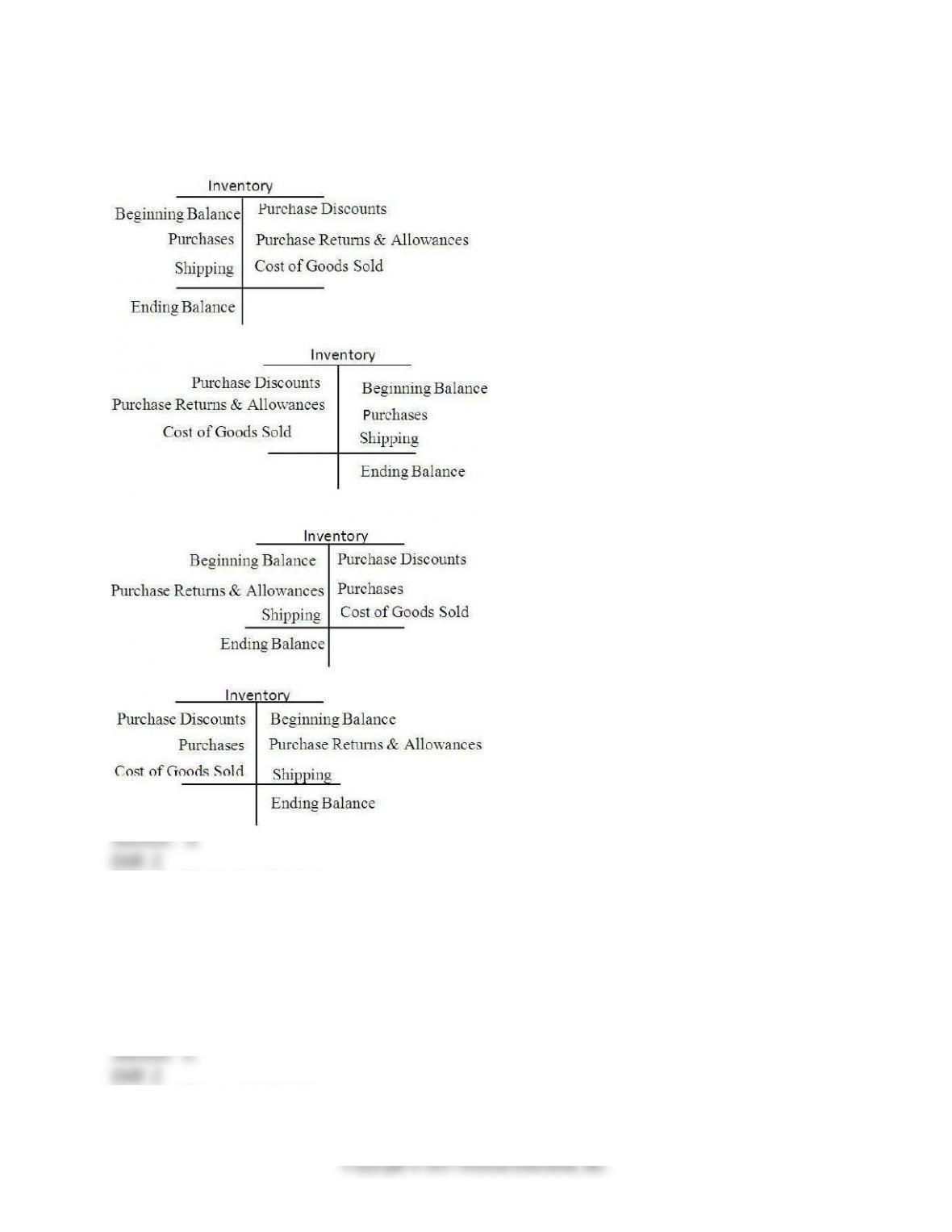
30) Under the perpetual inventory system, which of the following T-accounts correctly shows the
cost flows through the Inventory account?
A)
B)
C)
D)
Question Type: Application
31) If an invoice shows a total of $3,000 with terms 5/15, n/60, which of the following is NOT a
true statement?
A) The customer must pay $3,000 within 60 days after the date of the invoice.
B) The customer may pay $2,850 within 15 days to satisfy the bill.
C) The customer will receive a 10% discount if they pay within 60 days.
D) The customer has a discount period of 15 days.
Question Type: Application
14
32) C & S Company purchased 80 keyboards for $15 each from Keyboards–for-Less. When they
unpacked the keyboards, C & S found that 30 of the keyboards were damaged in shipping. What
is the journal entry that C & S will make to record the purchase return?
A) Debit Purchase Returns and credit Inventory, $1,200.
B) Debit Accounts Payable – Keyboards-for-Less and credit Inventory, $1,200.
C) Debit Purchase Returns and credit Inventory, $450.
D) Debit Accounts Payable – Keyboards-for-Less and credit Inventory, $450.
Question Type: Application
33) Stella, Inc. purchased 75 telescopes for $25 each from Luna Co. When they unpacked the
telescopes, Stella found that 20 of the telescopes were damaged in shipping. Luna offers to take
them back, or provide an allowance of $300. How would the journal entries differ if Stella chose
to take the allowance instead of return the telescopes?
A) The company would debit the Allowance account instead of Purchase Returns.
B) The company would debit and credit the same accounts, but for a greater amount.
C) The company would debit and credit the same accounts, but for a lesser amount.
D) There would be no difference in journal entries.
Question Type: Application
4.4 Journalize transactions for the sale of inventory
1) Sales Discounts and Sales Returns and Allowances are contra-accounts of the Sales Revenue
account.
Question Type: Concept
2) Debit card and credit card sales are counted as cash transactions.
Question Type: Concept
3) A journal entry that has more than one debit or more than one credit is known as a complex
journal entry.
Question Type: Concept
4) When a customer returns goods, the journal entry for a merchandiser using the perpetual
inventory system will include a debit to Sales Returns and Allowances and a debit to Inventory.
Question Type: Concept

15
5) When a customer accepts an allowance on unwanted goods, the journal entry for a
merchandiser using the perpetual inventory system will include a debit to Sales Returns and
Allowances and a debit to Inventory.
Question Type: Concept
6) When a customer pays within the discount period, the journal entry for the merchandiser will
include a debit to Cash and a credit to Sales Discounts.
Question Type: Concept
7) A customer purchased items on account from Silverfish, Inc. After a few days, the customer
returned the goods. Silverfish, Inc. will issue a:
A) debit memorandum.
B) return receipt.
C) credit memorandum.
D) refund check.
Question Type: Concept
8) A list of credit customers is called a(n):
A) Accounts Payable subsidiary ledger.
B) general ledger.
C) Accounts Receivable subsidiary ledger.
D) general journal.
Question Type: Concept
9) Under the perpetual inventory system, Sales Returns cause:
A) an increase in Cost of Goods Sold.
B) an increase in Revenue.
C) a decrease in Cost of Goods Sold.
D) no effect on cost of goods sold.
Question Type: Concept

16
10) Which of the following accounts is NOT used to account for merchandise sales transactions?
A) Accounts Payable
B) Accounts Receivable
C) Sales Discounts
D) Sales Returns and Allowances
Question Type: Concept
11) Sydney, a customer, purchased $350 of merchandise from Illusions, Inc. Under the perpetual
inventory system, Illusions, Inc. will record a:
A) debit to Accounts Receivable or to Cash for $350.
B) credit to Accounts Receivable or to Cash for $350.
C) credit to Cost of Goods Sold for $350.
D) debit to Sales for $350.
Question Type: Application
12) Merchandise returned by the customer for a cash refund is called a:
A) sales return.
B) sales allowance.
C) debit memorandum.
D) credit memorandum.
13) An entry that has more than one debit and/or credit is called a:
A) double entry.
B) compound entry.
C) multiple-step entry.
D) special entry.
Question Type: Concept
14) Under a perpetual inventory system, when goods are returned to the retailer from a customer:
A) Cost of Goods Sold is debited; Sales Returns and Allowances is credited.
B) Sales Returns and Allowances is debited; Cost of Goods Sold is credited.
C) Sales is debited; Cost Goods Sold is credited.
D) Inventory is debited; Sales is credited.
Question Type: Concept

17
15) The Outlet Store has cash sales for the week of $4,000 and credit sales of $2,500. The
account(s) to be debited for these transactions is/are:
A) MasterCard sales; Visa sales; and cash.
B) Cash; Accounts Receivable.
C) Cash only.
D) MasterCard sales; Visa sales.
Question Type: Concept
16) Sales is a(n) ________ account.
A) asset
B) liability
C) revenue
D) contra-
Question Type: Concept
17) Sales Returns and Allowances appear on the:
A) Balance Sheet.
B) Statement of Retained Earnings.
C) Income Statement.
D) Income Statement and Balance Sheet.
Question Type: Concept
18) Costs of Goods Sold includes which of the following?
A) The actual cost of the item
B) Administrative fees
C) Management salaries
D) Depreciation Expense
19) When a retailer sells merchandise on account, the general entry for the sales price would be:
A) debiting Accounts Receivable and crediting Sales Revenue.
B) debiting Accounts Receivable and crediting Inventory.
C) debiting Accounts Receivable and crediting Cost of Goods Sold.
D) debiting Cost of Goods Sold and crediting Sales Revenue.
Question Type: Application

18
20) The entry to record the company‘s cost of selling merchandise under a perpetual inventory
system would be a:
A) debit to Accounts Receivable and a credit to Sales.
B) debit to Inventory and a credit to Cost of Goods Sold.
C) debit to Cost of Goods Sold and a credit to Inventory.
D) debit to Cost of Goods Sold and a credit to Sales.
Question Type: Application
21) Sheldon, a customer of Comics, Inc., returned $60 of goods that were purchased on account.
Under the perpetual inventory system, Classics will record a:
A) debit to Sales Returns and Allowances and a credit to Accounts Receivable-Sheldon for $60.
B) debit to Sales Revenue and a credit to Accounts Receivable-Sheldon for $60.
C) debit to Cost of Goods Sold and a credit to Inventory for $60.
D) debit to Sales Revenue and a credit to Cost of Goods Sold for $60.
Question Type: Application
22) Archer Manufacturing had sales for the week of $3,145, of which $2,500 was on credit and
$645 in cash sales. The cost of the merchandise sold was $1,716. The journal entries would
include a:
A) debit to Cost of Goods Sold for $1,716; credit to Inventory for $1,716.
B) debit to Cash for $3,145, credit to Sales for $3,145.
C) debit to Cash for $3,145 and a credit to Cost of Goods Sold for $3,145.
D) debit to Cost of Goods Sold for $1,716; credit to Sales of $1,716.
Question Type: Application
23) When a merchandiser sells on account, which of the following accounts is NOT needed to
record the transaction?
A) Cost of Goods Sold
B) Accounts Receivable
C) Inventory
D) Cash
Question Type: Concept

19
24) Net sales is computed by taking:
A) Gross Sales – Sales Returns and Allowances + Sales Discounts.
B) Gross Sales – Sales Returns and Allowances – Sales Discounts.
C) Gross Sales + Sales Returns and Allowances + Sales Discounts.
D) Gross Sales – Cash received for sales.
Question Type: Concept
25) When a customer returns goods, the merchandiser will NOT:
A) Decrease net sales revenue
B) Decrease Cost of Goods Sold
C) Increase Accounts Receivable
D) Increase Inventory
Question Type: Concept
26) On April 1, the Caesar Coffee Company sold coffee to Charbucks for $300, with credit terms
of 2/15, n/30 Charbucks paid Caesar’s on April 10. The journal entry that Caesar would make to
record the payment would include a:
A) debit to Cash $300; credit to Accounts Receivable – Charbucks $300.
B) debit to Cash $300; credit to Sales Discounts $6; credit to Accounts Receivable – Charbucks
$294.
C) debit to Cash $294; debit to Sales Discounts $6; credit to Accounts Receivable – Charbucks
$300.
D) debit to Cash $294; credit to Accounts Receivable – Charbucks $294.
Question Type: Application
4.5 Understand shipping terms and journalize transactions for freight charges and other selling
expenses
1) FOB destination means that title passes at the time of shipment of the product to the buyer
from the seller.
Question Type: Concept
2) FOB shipping point means that title passes at the time the product is shipped from the seller.
Question Type: Concept

20
3) When a company sells goods to customers FOB destination, the company‘s delivery expense
account is credited for the cost of shipment.
Question Type: Concept
4) When a buyer purchases goods FOB shipping point, they debit Inventory for the shipping
costs.
Question Type: Concept
5) Advertising and promotion are examples of selling expenses.
Question Type: Concept
6) FOB means:
A) first on board.
B) from our buyer.
C) fee on board.
D) free on board.
Question Type: Concept
7) Transferring title refers to a:
A) change of ownership.
B) change of buyer.
C) change of seller.
D) legal document.
Question Type: Concept
8) Depreciation on the company warehouse is an example of a(n):
A) inventory expense.
B) asset expense.
C) selling expense.
D) delivery expense.
Question Type: Concept