30
Copyright © 2017 Pearson Education, Inc.
29) Office Clean Corporation has a capital structure consisting of 30 percent debt and 70 percent common
equity. Assuming the capital structure is optimal, what amount of total investment can be financed by a
$35 million addition to retained earnings without selling new common stock?
Keywords: Optimal Capital Structure, Total Capital Budget
Learning Obj.: L.O. 9.3
AACSB: Analytical Thinking
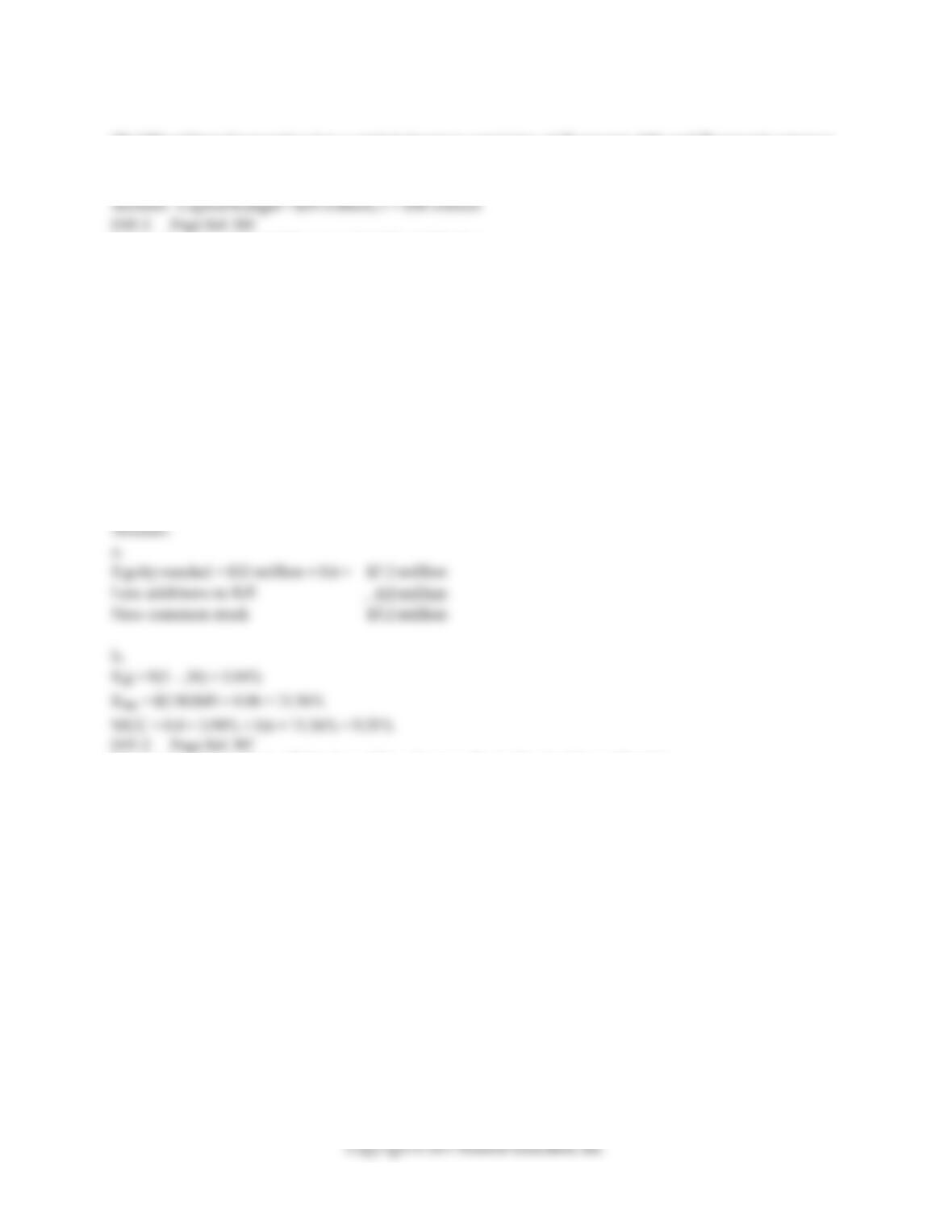
30) Last year Gator Getters, Inc. had $50 million in total assets. Management desires to increase its plant
and equipment during the coming year by $12 million. The company plans to finance 40 percent of the
expansion with debt and the remaining 60 percent with equity capital. Bond financing will be at a 9
percent rate and will be sold at its par value. Common stock is currently selling for $50 per share, and
flotation costs for new common stock will amount to $5 per share. The expected dividend next year for
Gator is $2.50. Furthermore, dividends are expected to grow at a 6 percent rate far into the future. The
marginal corporate tax rate is 34 percent. Internal funding available from additions to retained earnings is
$4,000,000.
a. What amount of new common stock must be sold if the existing capital structure is to be maintained?
b. Calculate the weighted marginal cost of capital at an investment level of $12 million.
Keywords: After-tax Cost of Debt, Cost of New Common Stock, Marginal Cost of Capital
Learning Obj.: L.O. 9.3
AACSB: Analytical Thinking
31
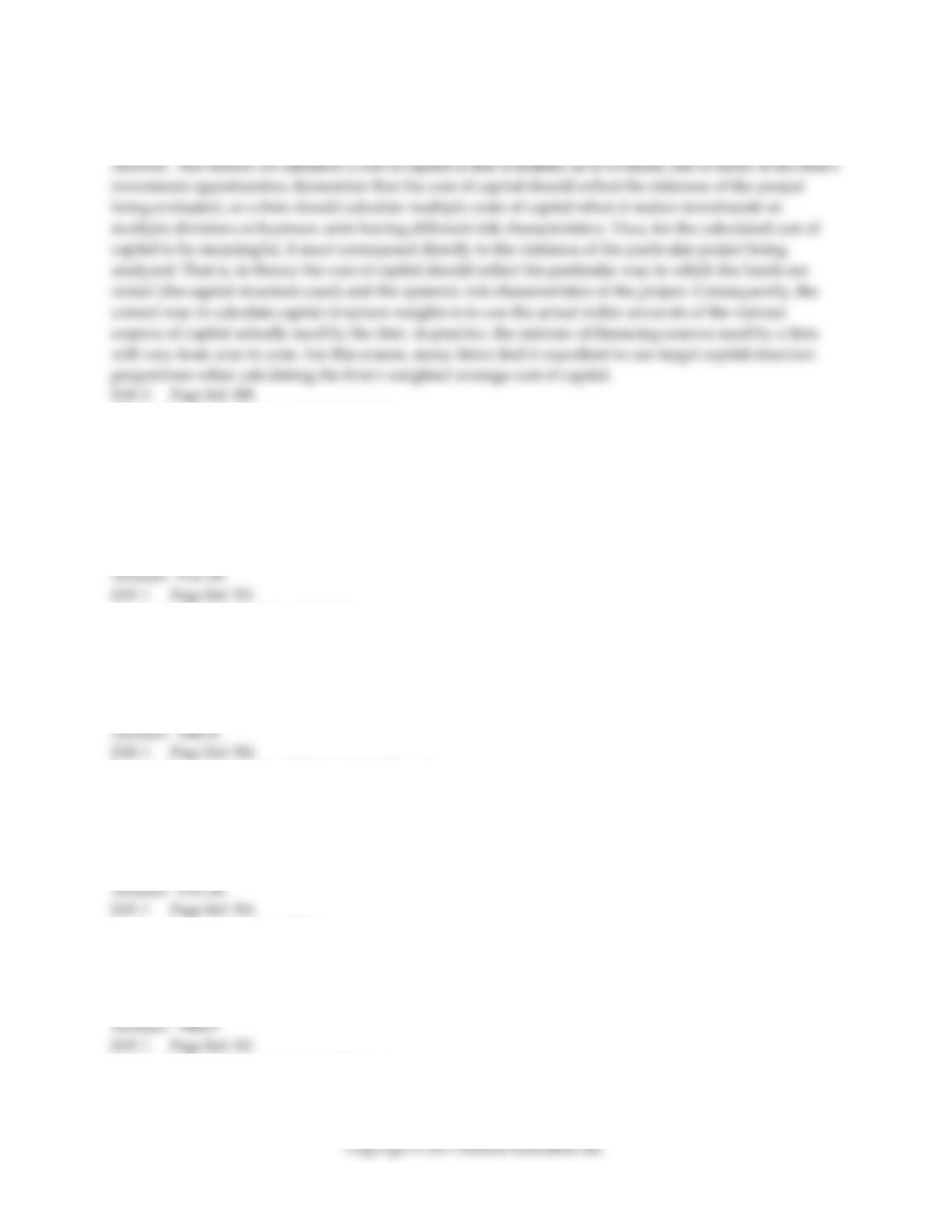
31) A firm‘s capital structure and its target capital structure proportions are important determinants of a
firm’s weighted average cost of capital. Explain.
Keywords: Capital Structure, Cost of Capital
Learning Obj.: L.O. 9.3
AACSB: Reflective Thinking
Learning Objective 9.4
1) Calculating the cost of capital for divisions within a company is not recommended because the data is
too fragmented and all divisions are part of the same company in any case.
Keywords: Divisional Costs of Capital
Learning Obj.: L.O. 9.4
AACSB: Reflective Thinking
2) The after-tax cost of debt is equal to one minus the marginal tax rate times the yield to maturity on the
firm’s outstanding debt.
Keywords: After-tax Cost of Debt, Yield to Maturity
Learning Obj.: L.O. 9.4
AACSB: Reflective Thinking
3) If the before-tax cost of debt is 7% and the firm has a 40% marginal tax rate, the after–tax cost of debt is
2.8%.
Keywords: After-tax Cost of Debt
Learning Obj.: L.O. 9.4
AACSB: Analytical Thinking
4) A firm‘s cost of capital is the required rate of return on the firm‘s average project.
Keywords: Cost of Capital, Required Return
Learning Obj.: L.O. 9.4
AACSB: Reflective Thinking

32
5) A corporate bond has a face value of $1,000 and a coupon rate of 5%. The bond matures in 15 years and
has a current market price of $925. If the corporation sells more bonds, it will incur flotation costs of $25
per bond. If the corporate tax rate is 35%, what is the after-tax cost of debt capital?
A) 3.74%
B) 4.45%
C) 5.29%
D) 6.78%
Keywords: After-tax Cost of Debt, Flotation Costs, Bond Valuation
Learning Obj.: L.O. 9.4
AACSB: Analytical Thinking
6) A corporate bond has a face value of $1,000 and a coupon rate of 9%. The bond matures in 14 years and
has a current market price of $946. If the corporation sells more bonds, it will incur flotation costs of $26
per bond. If the corporate tax rate is 35%, what is the after-tax cost of debt capital?
A) 5.57%
B) 6.56%
C) 8.18%
D) 7.31%
Keywords: After-tax Cost of Debt, Flotation Costs, Bond Valuation
Learning Obj.: L.O. 9.4
AACSB: Analytical Thinking
7) TC, Inc. has $15 million of outstanding bonds with a coupon rate of 10 percent. The yield to maturity
on these bonds is 12.5 percent. If the firm’s tax rate is 30 percent, what is relevant cost of debt financing to
TC, Inc.?
A) 13.75 percent
B) 8.75 percent
C) 7.00 percent
D) 3.75 percent
Keywords: After-tax Cost of Debt, Yield to Maturity
Learning Obj.: L.O. 9.4
AACSB: Analytical Thinking

33
8) XRT, Inc. is issuing a $1,000 par value bond that pays 8.5% interest annually. Investors are expected to
pay $1,100 for the 12-year bond. The firm will pay $50 per bond in flotation costs. What is the after-tax
cost of new debt if the firm is in the 35% tax bracket?
A) 8.23%
B) 4.55%
C) 4.70%
D) 7.45%
Keywords: After-tax Cost of Debt, Flotation Costs
Learning Obj.: L.O. 9.4
AACSB: Analytical Thinking
9) All the following variables are used in computing the cost of debt EXCEPT
A) maturity value of the debt.
B) market price of the debt.
C) number of years to maturity.
D) risk-free rate.
Keywords: After-tax Cost of Debt
Learning Obj.: L.O. 9.4
AACSB: Reflective Thinking
10) Blammo, Inc. has a target capital structure of 30% debt and 70% equity. The firm is planning to invest
in a project that will necessitate raising new capital. New debt will be issued at a before-tax yield of 14%,
with a coupon rate of 10%. The equity will be provided by internally generated funds so no new outside
equity will be issued. If the required rate of return on the firm‘s stock is 22% and its marginal tax rate is
35%, compute the firm’s cost of capital.
A) 18.00%
B) 18.13%
C) 19.68%
D) 15.55%
Keywords: Weighted Average Cost of Capital, After-tax Cost of Debt
Learning Obj.: L.O. 9.4
AACSB: Analytical Thinking

34
11) Donner, Inc. will finance a proposed investment by issuing new securities while maintaining its
optimal capital structure of 60% debt and 40% equity. The firm can issue bonds at a price of $950.00
before $15 flotation costs. The 10-year bonds will have an annual coupon rate of 8% and a face value of
$1,000. The company can issue new equity at a before-tax cost of 16% and its marginal tax rate is 34%.
What is the appropriate cost of capital to use in analyzing this project?
A) 3.63%
B) 8.77%
C) 9.97%
D) 11.81%
Keywords: After-tax Cost of Debt, Cost of New Common Stock, Weighted Average Cost of Capital
Learning Obj.: L.O. 9.4
AACSB: Analytical Thinking
12) QRM, Inc.‘s marginal tax rate is 35%. It can issue 10-year bonds with an annual coupon rate of 7% and
a par value of $1,000. After $12 per bond flotation costs, new bonds will net the company $966 in
proceeds. Determine the appropriate after-tax cost of new debt for the firm to use in a capital budgeting
analysis.
A) 2.62%
B) 4.87%
C) 7.50%
D) 7.8%
Keywords: After-tax Cost of Debt, Flotation Costs
Learning Obj.: L.O. 9.4
AACSB: Analytical Thinking

35
13) Valley Flights, Inc. has a capital structure made up of 40% debt and 60% equity and a tax rate of 30%.
A new issue of $1,000 par bonds maturing in 20 years can be issued with a coupon of 9% at a price of
$1,098.18 with no flotation costs. The firm has no internal equity available for investment at this time, but
can issue new common stock at a price of $45. The next expected dividend on the stock is $2.70. The
dividend for the firm is expected to grow at a constant annual rate of 5% per year indefinitely. Flotation
costs on new equity will be $7.00 per share. The company has the following independent investment
projects available:
Project
Initial Outlay
IRR
1
$100,000
10%
2
$10,00
8.5%
3
$50,000
12.5%
Which of the above projects should the company take on?
A) Project 3 only
B) Projects 1 and 2
C) Projects 1 and 3
D) Projects 1, 2 and 3
Keywords: Optimal Capital Budget, After-tax Cost of Debt, Cost of New Common Stock
Learning Obj.: L.O. 9.4
AACSB: Analytical Thinking
14) Mountain Retreat and Resort is undergoing a major expansion. The expansion will be financed by
issuing new 15-year, $1,000 par, 9% annual coupon bonds. The market price of the bonds is $1,070 each.
The firm’s flotation expense on the new bonds will be $50 per bond. The firm’s marginal tax rate is 35%.
What is the relevant cost of the new bonds for capital budgeting purposes?
A) 5.14%
B) 5.69%
C) 8.45%
D) 4.82%
Keywords: After-tax Cost of Debt
Learning Obj.: L.O. 9.4
AACSB: Analytical Thinking
15) Using the weighted average cost of capital as the required rate of return for every project will
A) cause a firm to reject projects that should have been accepted.
B) cause a firm to accept projects that were too risky.
C) result in maximization of shareholder wealth.
D) A and B above
Keywords: Weighted Average Cost of Capital, Accept/Reject Decision
Learning Obj.: L.O. 9.4
AACSB: Analytical Thinking

36
16) Why should firms that own and operate multiple businesses that have different risk characteristics
use business-specific, or divisional costs of capital?
A) Not all divisions have equal risk and the firm might accept projects whose returns are higher than are
deemed appropriate.
B) Not all business divisions have equal risk and the firm will likely become less risky in the future.
C) Not all lines of business have equal risk and it is likely that the firm will accept projects whose returns
are unacceptably low in relation to the risk involved.
D) Use of the same weighted average cost of capital for all divisions may result in too much money being
allocated to the least risky division.
Keywords: Divisional Costs of Capital, Weighted Average Cost of Capital
Learning Obj.: L.O. 9.4
AACSB: Reflective Thinking
17) Texas Transport has five possible investment projects for the coming year. Each project is indivisible.
They are:
Project
Investment (million)
IRR
A
$6
18%
B
$10
15%
C
$9
20%
D
$4
12%
E
$3
24%
The firm’s weighted marginal cost of capital schedule is 12 percent for up to $6 million of investment; 16
percent for between $6 million and $18 million of investment; and above $18 million the weighted cost of
capital is 18 percent. The optimal capital budget is
A) $12 million.
B) $18 million.
C) $23 million.
D) $28 million.
Keywords: Weighted Average Cost of Capital, Optimal Capital Budget
Learning Obj.: L.O. 9.4
AACSB: Analytical Thinking
37
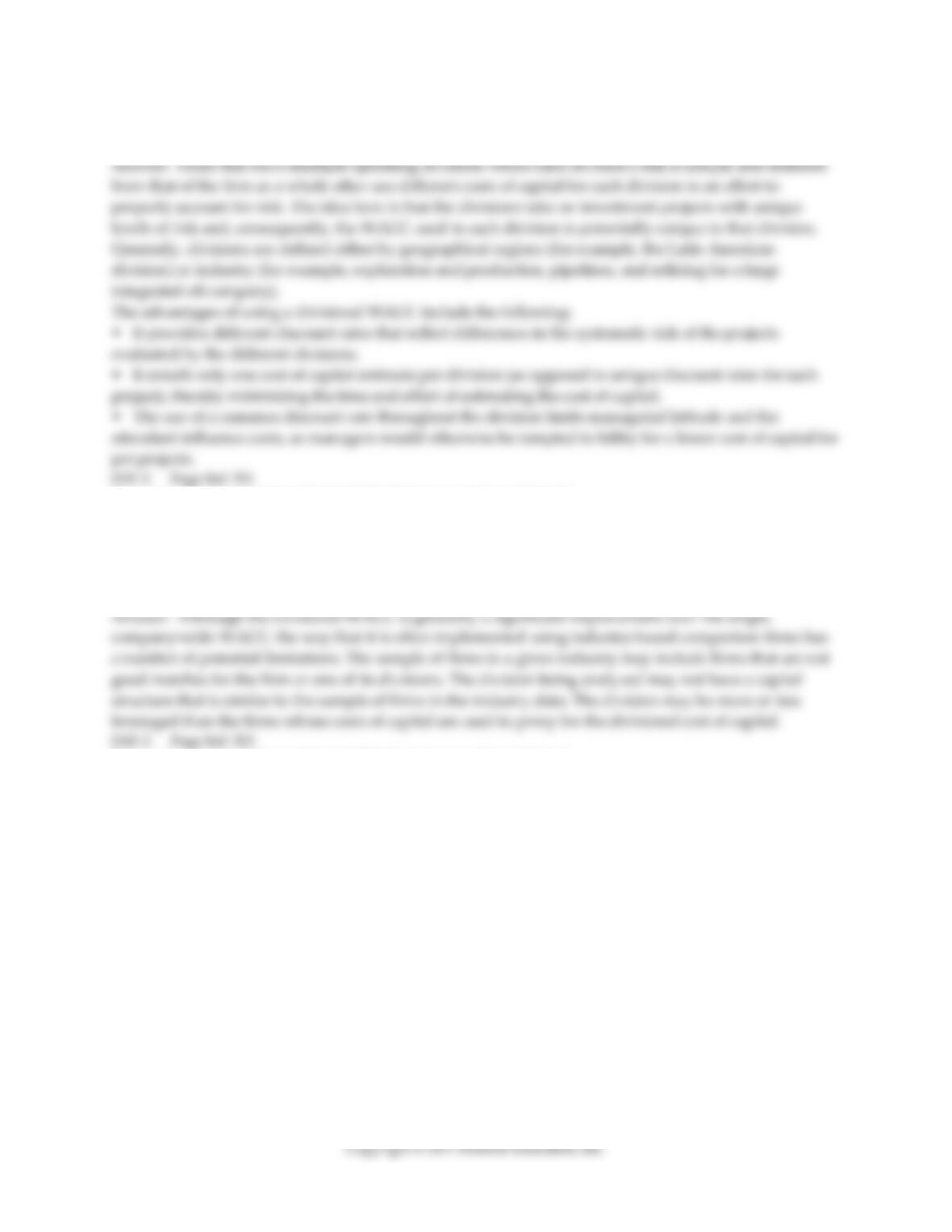
18) What are the implications for a firm’s capital investment decisions of using a company-wide cost of
capital when the firm has multiple operating divisions that have unique risk attributes and capital costs?
Keywords: Divisional Costs of Capital, Weighted Average Cost of Capital
Learning Obj.: L.O. 9.4
AACSB: Reflective Thinking
19) If a firm has decided to move from a situation in which it uses a company-wide cost of capital to
divisional costs of capital, what problems is it likely to encounter?
Keywords: Divisional Costs of Capital, Weighted Average Cost of Capital
Learning Obj.: L.O. 9.4
AACSB: Reflective Thinking