41
Please refer to Table 4-7 for the following question.
Table 4-7
Hokie Corporation Comparative Balance Sheet
For the Years Ending December 31, 2009 and 2010
(Millions of Dollars)
Assets
2009
2010
Current Assets:
Cash
$2
$10
Accounts receivable
16
12
Inventory
22
26
Total current assets
$40
$48
Gross fixed assets:
$120
$124
Less accumulated depreciation
(60)
(64)
Net fixed assets
60
60
Total assets
$100
$108
Liabilities and owners’ equity:
Current liabilities:
Accounts payable
$16
$18
Notes payable
10
10
Total current liabilities
$26
$28
Long-term debt
20
18
Owners’ equity:
Common stock
40
40
Retained earnings
14
22
Total liabilities and owners‘ equity
$100
$108
Hokie had net income of $28 million for 2010 and paid total cash dividends of $20 million to their
common stockholders.
119) Calculate the following 2010 financial ratios of Aggie Corporation using the information given in
Table 4-7:
i. current ratio
ii. acid test ratio
iii. debt ratio
iv. return on total assets
v. return on common equity
42
Copyright © 2017 Pearson Education, Inc.
Answer:
i. Current ratio = $48/$28 = 1.71
ii. Acid Test ratio = $22/$28 = 0.79
iii. Debt ratio = $46/$108 = 0.426
iv. Return on total assets = $28/$108 = 0.259
v. Return on Common Equity = $28/$62 = 0.45
Diff: 2 Page Ref: 111-128
Keywords: Ratio Analysis
Learning Obj.: L.O. 4.2
AACSB: Analytical Thinking
120) Beverly Corp. had total sales of $1,200,000 in 2010 (80 percent of its sales are credit). The company’s
gross profit margin is 25 percent, its ending inventory is $150,000, and its accounts receivable balance is
$90,000. What additional amount of cash could the firm have generated if it had increased its inventory
turnover ratio to 9.0 and reduced its average collection period to 28.21875 days?
Keywords: Inventory Turnover Ratio, Average Collection Period, Cash
Learning Obj.: L.O. 4.2
AACSB: Analytical Thinking
43
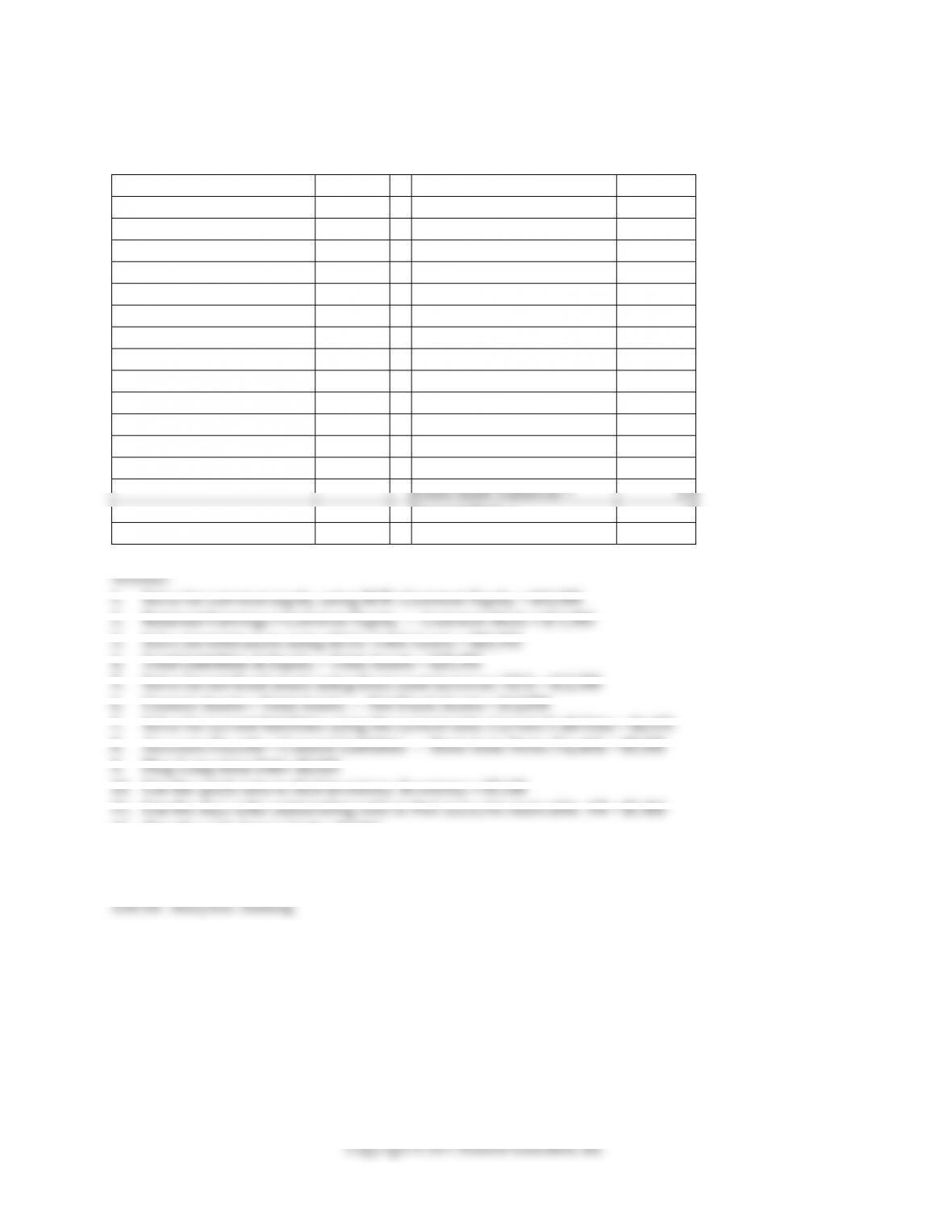
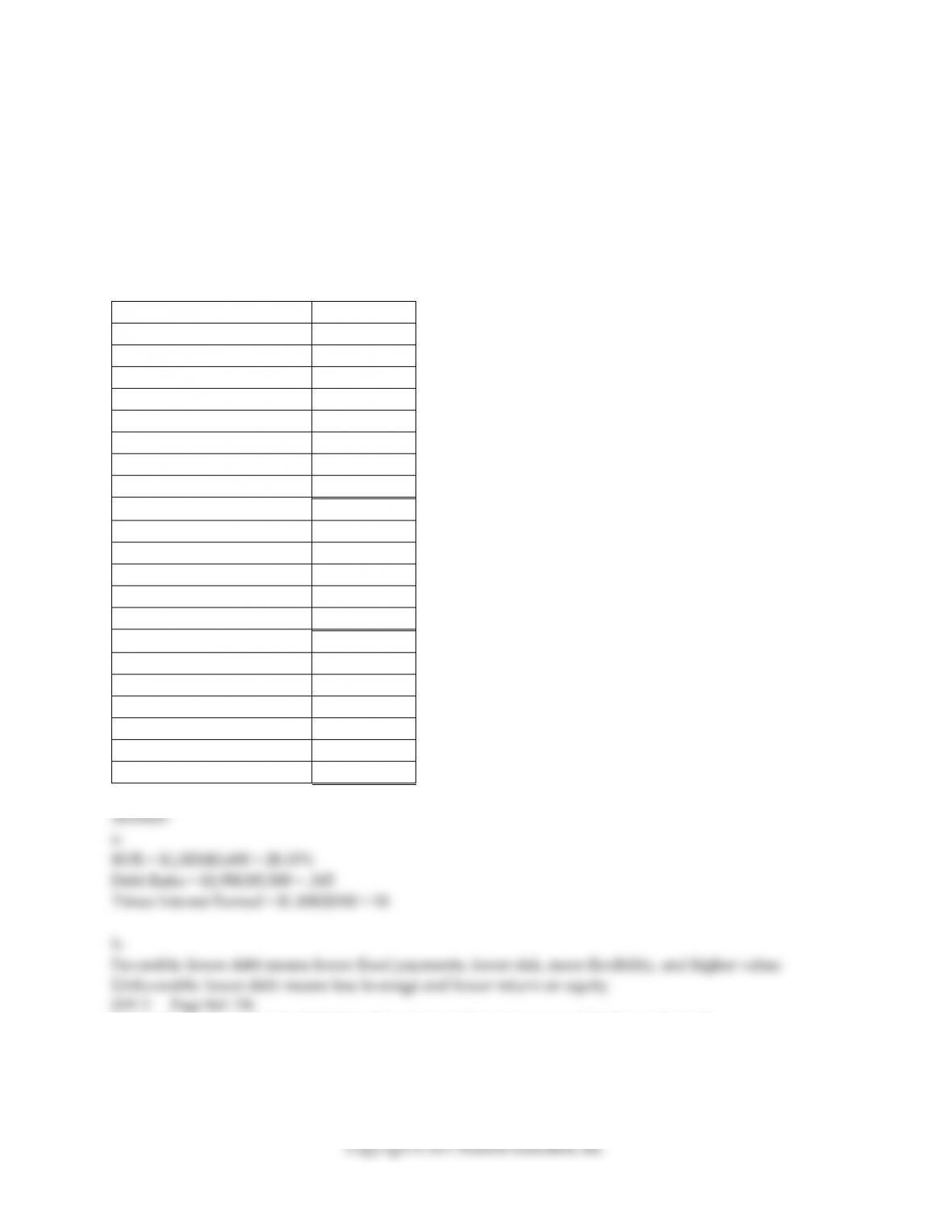
121) Complete the following balance sheet using the information given. Round account balances to the
nearest dollar.
Balance Sheet
Income Statement
Cash
Sales (All Credit)
$20,000
Accounts receivable
Cost of goods sold
10,000
Inventory
Operating expenses
6,000
Net fixed assets
Interest expense
100
Total assets
Taxes
1,365
Net income
$2,535
Accounts payable
Short-term notes payable
$1,425
Ratios:
Long-term debt
Profit Margin =
12.675%
Common stock
$5,000
Return on Equity =
15%
Retained earnings
Quick Ratio =
1.2
Total Liabilities and equity
Return on Total Assets =
10%
Fixed Asset Turnover =
1.6
Current Ratio =
2
Days Sales Outstanding =
45
12. Plug the cash figure: Cash = $5,244
Keywords: Ratio Analysis, Balance Sheet Equation
Learning Obj.: L.O. 4.2
45
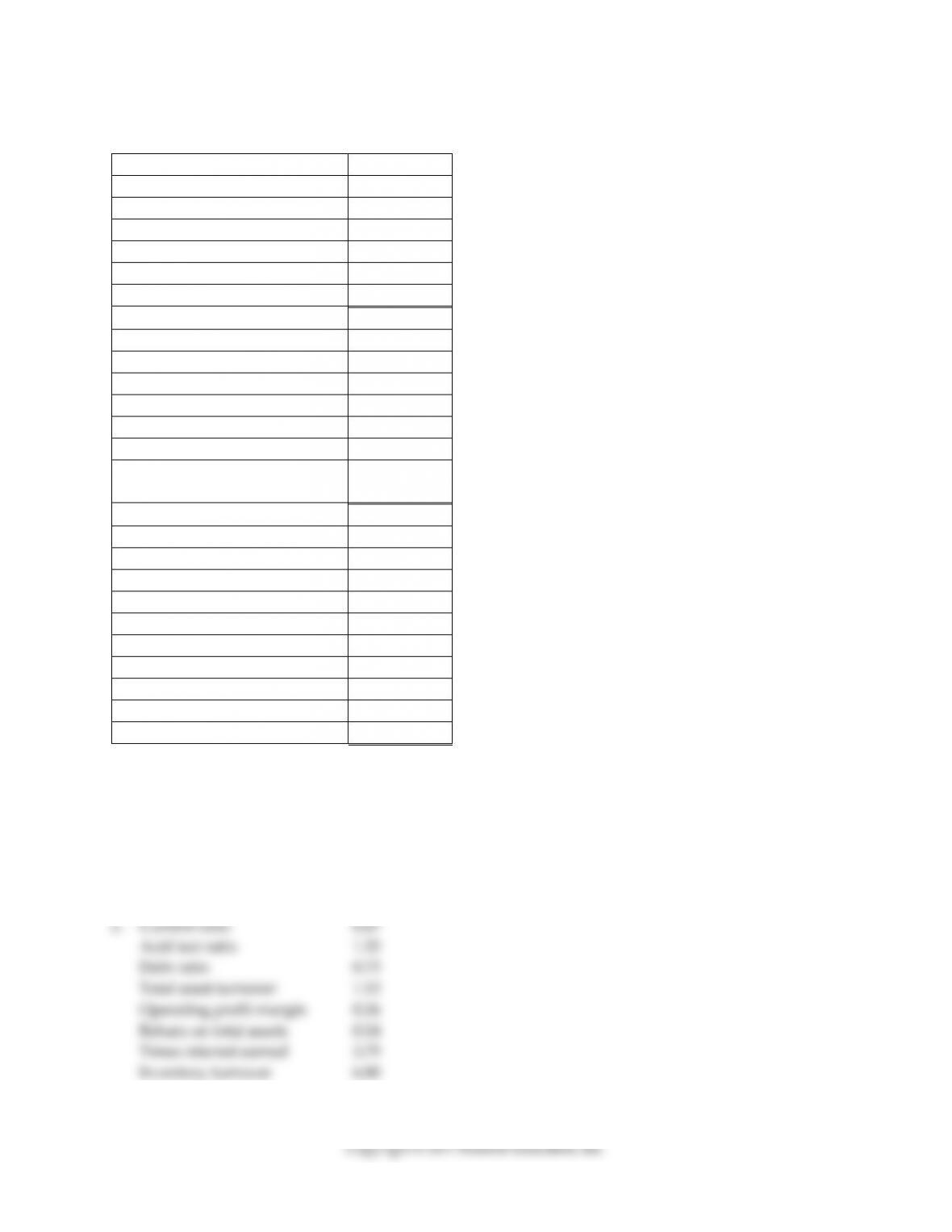
123) a. Using the financial statements for GMT Enterprises for 2010 (given below), calculate the return
on equity, the debt ratio, and the times interest earned ratio.
b. Suppose the industry average debt ratio is 50%. Give one reason why the debt ratio for GMT
Enterprises may be considered favorable, and give one reason why the debt ratio for GMT Enterprises
may be considered unfavorable.
GMT Enterprises
2010 Financial Statements
Income Statement ($)
Sales
10,000
Operating expenses
8,200
EBIT
1,800
Interest expense
100
EBT
1,700
Taxes (40%)
680
Net income
1,020
Balance Sheet ($)
Current assets
1,500
Fixed assets
4,000
Total assets
5,500
Accounts payable
900
Accruals
600
Long-term debt
400
Common stock
2,100
Retained earnings
1,500
Total liabilities & equity
5,500
Keywords: Return on Equity, Debt Ratio, Times Interest Earned, Leverage, Risk-Return Tradeoff
Learning Obj.: L.O. 4.2
AACSB: Analytical Thinking
46
124) The balance sheet and income statement for Johnson and Breakwater is presented below.
Balance Sheet (000)
Cash
$500
Accounts receivable
1,500
Inventories
500
Current assets
2,500
Net fixed assets
5,000
Total Assets
7,500
Accounts payable
1,200
Bank note
300
Total current liabilities
1,500
long-term debt
4,000
Common stock
300
Retained earnings
1,700
Total liabilities and owners‘
equity
$7,500
Income Statement (000)
Net sales
$8,500
Cost of goods sold
(3,400)
Gross profit
5,100
Operating expenses
(2,900)
Net operating income
2,200
Interest expense
(580)
Earnings before taxes
1,620
Income tax (34%)
(551)
Net income
$1,069
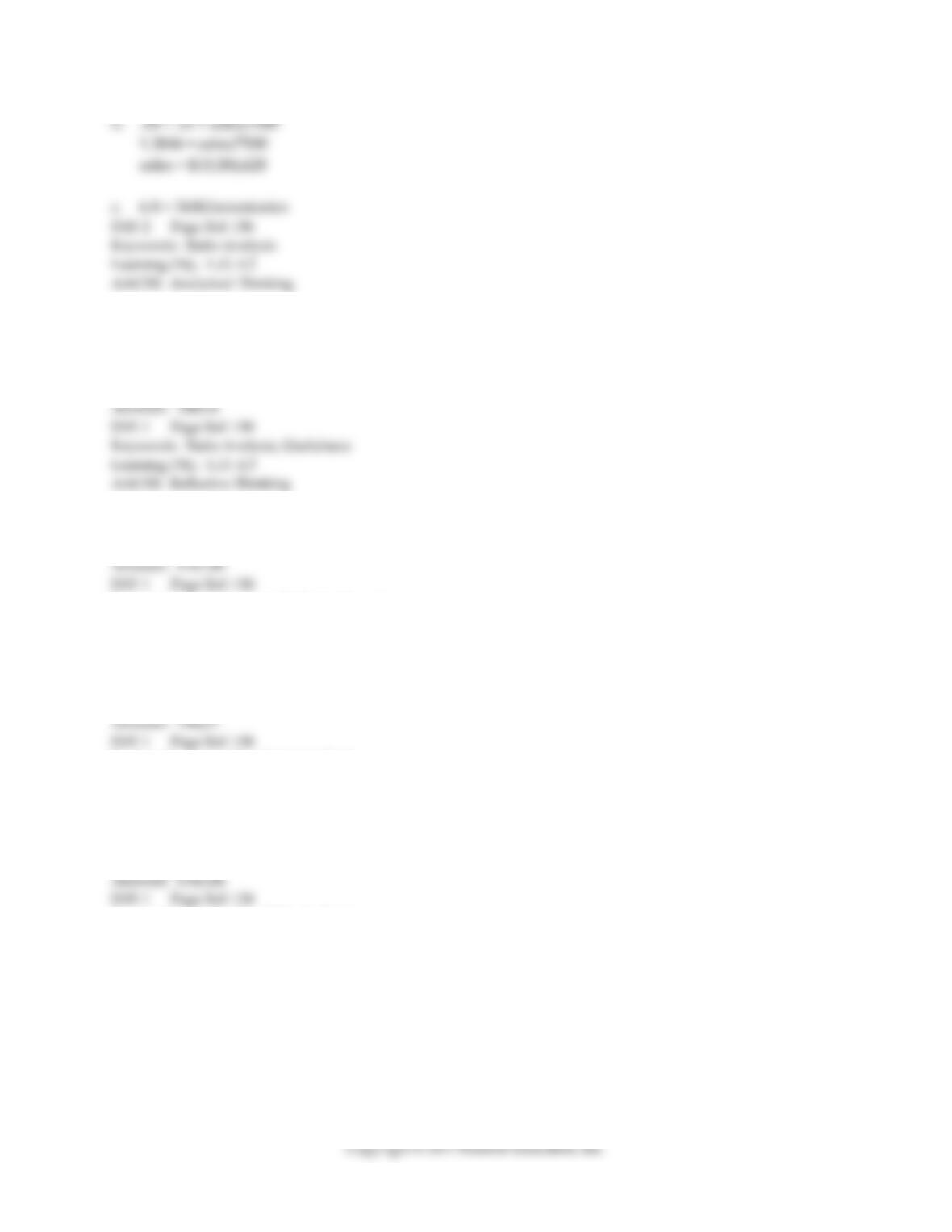
a. Compute the following ratios: Current ratio, Acid test ratio, Debt ratio, Total asset turnover,
Operating profit margin, Return on total investments, Times interest earned, Inventory turnover.
b. All other things equal, compute the dollar amount of sales needed to achieve an 18% return on total
assets for the coming year.
c. Given Johnson‘s inventory turnover ratio, find a way of computing the current level of inventory
given this ratio and assuming the current level of inventories is unknown. Set up but do not solve.
Answer:
47
Copyright © 2017 Pearson Education, Inc.
b. .18 = .13 × sales/7500
1.3846 = sales/7500
sales = $10,384,620
c. 6.8 = 3400/inventories
Diff: 2 Page Ref: 136
Keywords: Ratio Analysis
Learning Obj.: L.O. 4.2
AACSB: Analytical Thinking
Learning Objective 4.3
1) Financial ratios are used by personnel in marketing, human resources, and other groups within a firm,
not just by the finance and accounting personnel.
2) It is commonly accepted that the industry average for a ratio is the ideal goal for a financial manager to
achieve.
Keywords: Ratio Analysis, Industry Average
Learning Obj.: L.O. 4.3
AACSB: Reflective Thinking
3) Seasonality causes comparability problems in ratio analysis. A common solution is to use an average
account balance as opposed to an ending account balance.
Keywords: Seasonality, Ratio Analysis
Learning Obj.: L.O. 4.3
AACSB: Reflective Thinking
4) Seasonality is introduced into financial ratios by averaging monthly account balances, and thus it is
recommended that ending account balances be used.
Keywords: Seasonality, Ratio Analysis
Learning Obj.: L.O. 4.3
AACSB: Reflective Thinking
48
5) Discuss five limitations to ratio analysis.
Keywords: Ratio Analysis, Limitations
Learning Obj.: L.O. 4.3
AACSB: Reflective Thinking
6) How could an analyst determine whether a company’s ratio is good or bad?
Keywords: Ratio Analysis, Benchmarks, Trend Analysis
Learning Obj.: L.O. 4.3
AACSB: Reflective Thinking
49
7) When comparing a firm to its peers, why is it difficult to determine the industry to which the firm
belongs? Why should you be careful when comparing a firm with industry norms?
Keywords: Ratio Analysis, Industry Average
Learning Obj.: L.O. 4.3
AACSB: Reflective Thinking
8) Why do differences in the accounting practices of firms limit the usefulness of financial ratios?
Keywords: Ratio Analysis, Limitations
Learning Obj.: L.O. 4.3
AACSB: Reflective Thinking