
31
89) High Inc. has an accounts receivable turnover ratio of 7.3. Low Company has an accounts receivable
turnover ratio of 5. Assuming that High and Low have the same sales level, which of the following
statements is correct?
A) High’s average collection period is less than Low’s.
B) Low‘s average collection period is less than High’s.
C) High has a higher accounts receivable balance on average than does Low Company.
D) Low Company has (on average) a lower accounts receivable balance than does High.
Keywords: Accounts Receivable Turnover, Average Collection Period
Learning Obj.: L.O. 4.2
AACSB: Reflective Thinking
90) Jeter Industries has an accounts receivable turnover ratio of 4.5. If Jeter has an accounts receivable
balance of $100,000, what is Jeter‘s average daily credit sales?
A) $745.23
B) $1,232.88
C) $22,222.22
D) $1,893.45
Keywords: Accounts Receivable Turnover, Daily Credit Sales, Accounts Receivable
Learning Obj.: L.O. 4.2
AACSB: Analytical Thinking
91) Acme Incorporated has a debt ratio of .42, noncurrent liabilities of $20,000 and total assets of $70,000.
What is Acme‘s level of current liabilities?
A) $8,400
B) $9,400
C) $12,348
D) $10,600
Keywords: Debt Ratio, Balance Sheet Equation, Current Liabilities
Learning Obj.: L.O. 4.2
AACSB: Analytical Thinking
92) WRJ has a debt ratio of .4, current liabilities of $18,000, and total assets of $120,000. What is the level of
WRJ’s total liabilities?
A) $22,000
B) $48,000
C) $58,000
D) $63,934
Keywords: Debt Ratio, Balance Sheet Equation, Total Liabilities
Learning Obj.: L.O. 4.2
AACSB: Analytical Thinking
32
93) John Box Inc. has an annual interest expense of $30,000 and pays income tax equal to 40 percent of
taxable income (EBT). John Box’s times-interest-earned ratio is 4.2. What is John Box‘s net income?
A) $96,000
B) $57,000
C) $126,000
D) $57,600
Keywords: Net Income, Times Interest Earned Ratio
Learning Obj.: L.O. 4.2
AACSB: Analytical Thinking
94) Standard Inc. has an annual interest expense of $40,000. If Standard‘s times-interest-earned ratio is 3.0,
what is Standard’s Earnings Before Taxes (EBT)?
A) $47,000
B) $80,000
C) $120,000
D) $160,000
Keywords: Times Interest Earned Ratio, Earnings Before Taxes
Learning Obj.: L.O. 4.2
AACSB: Analytical Thinking
33
Please refer to Table 4-5 for the following questions.
Table 4-5
Yen Inc.
Balance Sheet
2009
2010
Cash
$8,000
$12,200
Accounts receivable
12,000
13,000
Inventories
9,000
10,000
Land
20,000
20,000
Other fixed assets
16,000
19,800
Accumulated depreciation
(4,000)
(5,000)
Total assets
$61,000
$70,000
Accounts payable
$11,000
$12,000
Long-term Bonds
24,000
24,000
Common stock
14,000
14,000
Retained earnings
12,000
20,000
Liabilities & Equity
$61,000
$70,000
Yen Inc.
Income Statement
For the year ended December 31, 2010
Sales
$196,000
Cost of goods sold
(140,000)
Gross profit
$56,000
Operating expenses
(26,000)
Depreciation
(2,000)
EBIT
28,000
Interest expense
(2,000)
EBT
26,000
Taxes
(9,000)
Net Income
$17,000
95) Based on the information contained in Tables 4-5, what was the total amount of Yen’s common stock
dividend for 2010?
A) $17,000
B) $12,800
C) $9,000
D) $8,000
Keywords: Common Stock Dividends, Retained Earnings
Learning Obj.: L.O. 4.2
AACSB: Analytical Thinking
96) Based on the information contained in Tables 4-5, what was Yen‘s quick ratio at the end of 2010?
34
A) 2.10
B) 1.43
C) 2.93
D) 1.79
Keywords: Quick Ratio
Learning Obj.: L.O. 4.2
AACSB: Analytical Thinking
97) Based on the information contained in Tables 4-5, what was Yen‘s return on common equity for 2010?
A) 50.0%
B) 85.0%
C) 121.4%
D) 24.3%
Keywords: Return on Equity
Learning Obj.: L.O. 4.2
AACSB: Analytical Thinking
98) Based on the information contained in Tables 4-5, what was Yen‘s operating profit margin for 2010?
A) 26.50%
B) 21.34%
C) 14.29%
D) 11.67%
Keywords: Operating Profit Margin
Learning Obj.: L.O. 4.2
AACSB: Analytical Thinking
99) Which of the following does NOT provide an indication of liquidity?
A) quick ratio
B) debt ratio
C) inventory turnover
D) average collection period
Keywords: Liquidity, Quick Ratio, Inventory Turnover, Average Collection Period
Learning Obj.: L.O. 4.2
AACSB: Reflective Thinking

35
100) WPM, Inc. has current assets of $8,000,000, current liabilities of $4,000,000, inventory of $1,320,000,
and sales of $12,000,000. What is the acid test ratio?
A) 2.0
B) 1.67
C) 0.22
D) 0.1
Keywords: Acid-test Ratio
Learning Obj.: L.O. 4.2
AACSB: Analytical Thinking
101) An inventory turnover ratio of 7.2 compared to an industry average of 5.1 is likely to indicate that
A) the firm has higher sales than the industry average.
B) the firm is selling a product mix that includes more high margin items.
C) the firm is managing its inventory inefficiently.
D) the firm‘s products are in inventory for fewer days before they are sold than is average for the
industry.
Keywords: Inventory Turnover Ratio
Learning Obj.: L.O. 4.2
AACSB: Reflective Thinking
102) A firm that wants to know if it has enough cash to meet its bills would be most likely to use which
kind of ratio?
A) liquidity
B) leverage
C) efficiency
D) profitability
Keywords: Liquidity Ratios
Learning Obj.: L.O. 4.2
AACSB: Reflective Thinking
103) Which of the following ratios would be the most useful to assess the risk associated with a firm being
able to pay off its short-term line of credit?
A) return on equity
B) the acid test ratio
C) the operating profit margin
D) the fixed asset turnover
Keywords: Liquidity, Acid Test Ratio
Learning Obj.: L.O. 4.2
AACSB: Reflective Thinking

36
104) During the past year the growth corporation increased its sales from $1,000,000 to $2,000,000 and its
EBIT from $250,000 to $400,000. The result of this growth will be
A) a higher operating profit margin and higher net income.
B) a lower operating profit margin and lower net income.
C) a lower operating profit margin and higher net income.
D) a higher P/E ratio.
Keywords: Operating Profit Margin, Net Income
Learning Obj.: L.O. 4.2
AACSB: Reflective Thinking
105) RBW Corp. has cash of $48,000; short-term notes payable of $35,000, accounts receivable of $100,000;
accounts payable of $120,000; inventories of $200,000; and accruals of $90,000. What is RBW‘s current
ratio?
A) 1.57
B) 2.71
C) 1.42
D) 0.64
Keywords: Current Ratio, Current Assets, Current Liabilities
Learning Obj.: L.O. 4.2
AACSB: Analytical Thinking
106) Which of the following ratios would be the best way to determine how customers are paying for
their purchases?
A) inventory turnover
B) total asset turnover
C) current ratio
D) average collection period
Keywords: Average Collection Period
Learning Obj.: L.O. 4.2
AACSB: Reflective Thinking
107) Rural Hydroponics has total equity of $560,000; sales of $2,250,000; current assets of $700,000; and
total liabilities of $435,000. What is Rural Hydroponics’ total asset turnover?
A) 4.02
B) 3.21
C) 2.26
D) 5.51
Keywords: Total Asset Turnover, Balance Sheet Equation
Learning Obj.: L.O. 4.2
AACSB: Analytical Thinking

37
108) TransSystems Inc. has a total equity of $560,000; sales of $2,250,000; total assets of $995,000; and
current liabilities of $310,000. What is TransSystems Inc.’s debt ratio?
A) 55.4%
B) 43.7%
C) 31.2%
D) 66.7%
Keywords: Debt Ratio, Balance Sheet Equation
Learning Obj.: L.O. 4.2
AACSB: Analytical Thinking
109) SNL has sales of $2,250,000; a gross profit of $825,000; total operating costs of $620,000; income taxes
of $74,800; total assets of $995,000; and interest expense of $18,000. What is SNL’s times-interest-earned
ratio?
A) 1.3
B) 11.4
C) 8.1
D) 45.8
Keywords: Times Interest Earned, EBIT
Learning Obj.: L.O. 4.2
AACSB: Analytical Thinking
110) Which of the following has the most significant influence on return on equity?
A) common dividends
B) principal payments
C) accruals
D) operating income
Keywords: Return on Equity
Learning Obj.: L.O. 4.2
AACSB: Reflective Thinking
111) Denver Systems has total assets of $1,000,000; common equity of $400,000; a gross profit of $800,000;
total operating expenses of $620,000; interest expense of $20,000; income taxes of $74,000; and preferred
dividends of $30,000. What is Denver Systems’ return on equity?
A) 7.5%
B) 20.0%
C) 21.5%
D) 14.0%
Keywords: Return on Equity, Income Statement, Net Income
Learning Obj.: L.O. 4.2
AACSB: Analytical Thinking

38
112) Assume that a firm issues a six-month note to purchase inventory. Which of the following is true if
the current ratio before the purchase is 1.0?
A) The firm’s current ratio must decrease.
B) The firm’s quick ratio will stay the same.
C) The firm’s current ratio will increase.
D) The firm‘s quick ratio might decrease.
Keywords: Current Ratio, Quick Ratio
Learning Obj.: L.O. 4.2
AACSB: Reflective Thinking
113) Which of the following is true if a firm wishes to collect its accounts faster by imposing stricter credit
terms on its customers?
A) The firm’s average collection period is likely to fall.
B) The firm’s accounts receivable turnover might rise.
C) The firm’s sales might decrease.
D) all of the above
Keywords: Credit Policy, Accounts Receivable Turnover, Average Collection Period
Learning Obj.: L.O. 4.2
AACSB: Reflective Thinking
114) Bill’s Bike Shop has a return on assets of 12%. Anton’s assets = $100 while Anton‘s owner’s equity =
$40 and its debt equals $60. What is Bill’s return on equity?
A) 18%
B) 20%
C) 30%
D) 12%
Keywords: Return on Equity, Return on Assets
Learning Obj.: L.O. 4.2
AACSB: Analytical Thinking
115) All of the following will improve a firm’s liquidity position EXCEPT
A) increase accounts receivable turnover.
B) increase inventory turnover.
C) increase the average collection period.
D) increase long-term debt and invest the money in marketable securities.
Keywords: Liquidity, Average Collection Period
Learning Obj.: L.O. 4.2
AACSB: Reflective Thinking
39
116) A company borrows $10,000 and puts the money into its checking account. This transaction will
increase the company’s current ratio if prior to the transaction the company‘s current ratio was
A) equal to one.
B) greater than one.
C) less than one.
D) greater than or less than one, but not equal to one.
Keywords: Current Ratio
Learning Obj.: L.O. 4.2
AACSB: Reflective Thinking
117) Blanton Corporation increased its financial leverage during 2010 by taking out a loan and using the
proceeds to buy back common stock. At the end of 2010, the corporation reported higher earnings per
share and higher return on equity. However, its stock price declined. Discuss why this may happen.
Keywords: Return on Equity
Learning Obj.: L.O. 4.2
AACSB: Reflective Thinking
40
Please refer to Table 4-6 for the following question.
Table 4-6
Financial Data for Springfield Power Co. as of December 31, 2010:
Inventory
$300,000
Long-term debt
500,000
Interest expense
25,000
Accumulated depreciation
450,000
Cash
280,000
Net sales (all credit)
1,800,000
Common stock
900,000
Accounts receivable
325,000
Operating expense (incl. depr. exp. and taxes)
625,000
Notes payable-current
200,000
Cost of goods sold
1,100,000
Plant and equipment
1,400,000
Accounts payable
180,000
Marketable securities
80,000
Accrued wages
45,000
Retained earnings
190,000
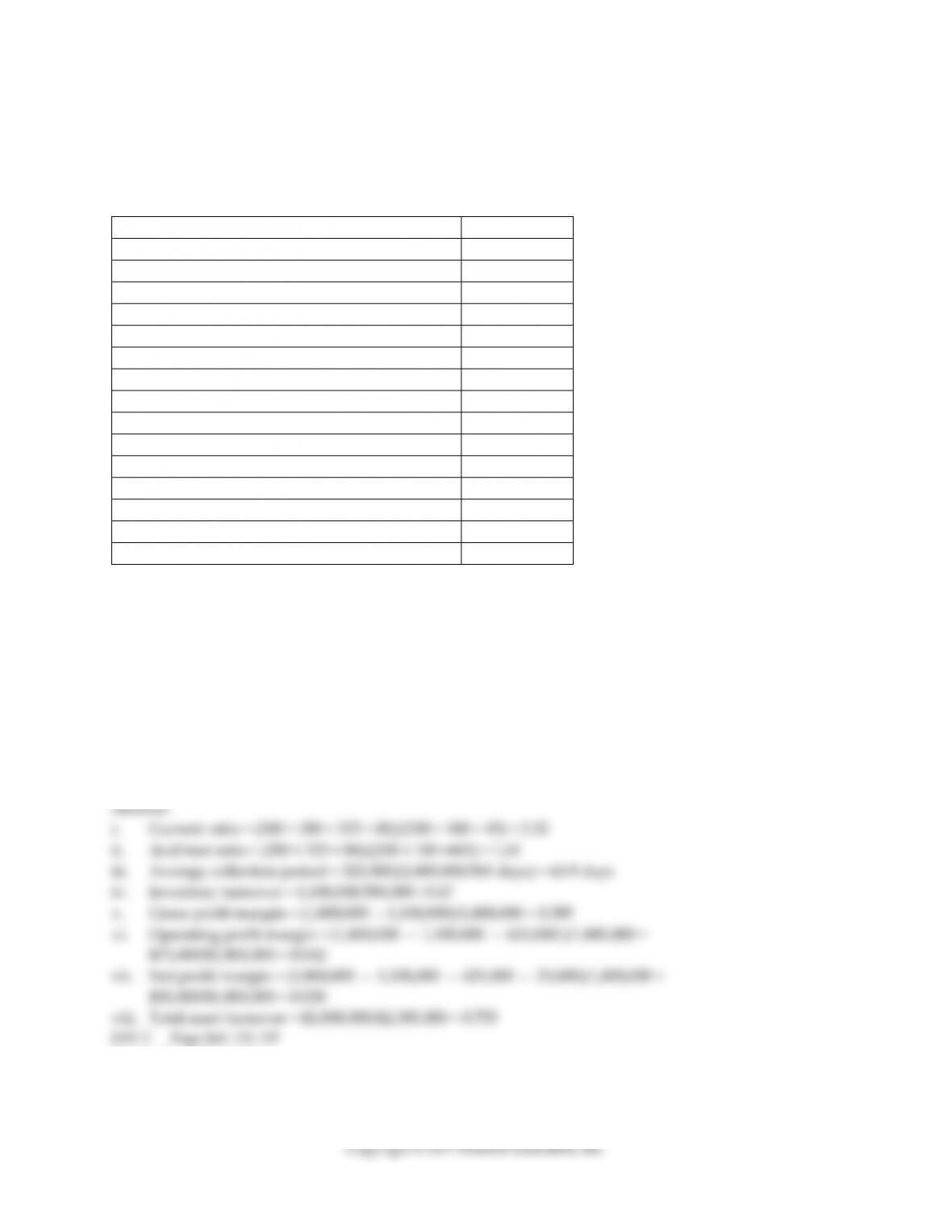
118) From the information presented in Table 4-6, calculate the following ratios for the Springfield Power
Co.
i. current ratio
ii. acid test ratio
iii. average collection period
iv. inventory turnover
v. gross profit margin
vi. operating profit margin
vii. net profit margin
viii. total asset turnover
Keywords: Ratio Analysis
Learning Obj.: L.O. 4.2
AACSB: Analytical Thinking