31
21) A firm paid dividends of $10,000, paid interest of $20,000, reduced debt principal outstanding (paid
off debt) in the amount of $100,000, and sold new stock for $150,000. What was the firm’s cash flow from
financing activities?
A) +$20,000 ($20,000 flowed into the firm)
B) -$20,000 ($20,000 flowed out of the firm)
C) +$280,000 ($280,000 flowed into the firm)
D) -$280,000 ($280,000 flowed out of the firm)
Keywords: Free Cash Flow
Learning Obj.: L.O. 3.3
AACSB: Analytical Thinking
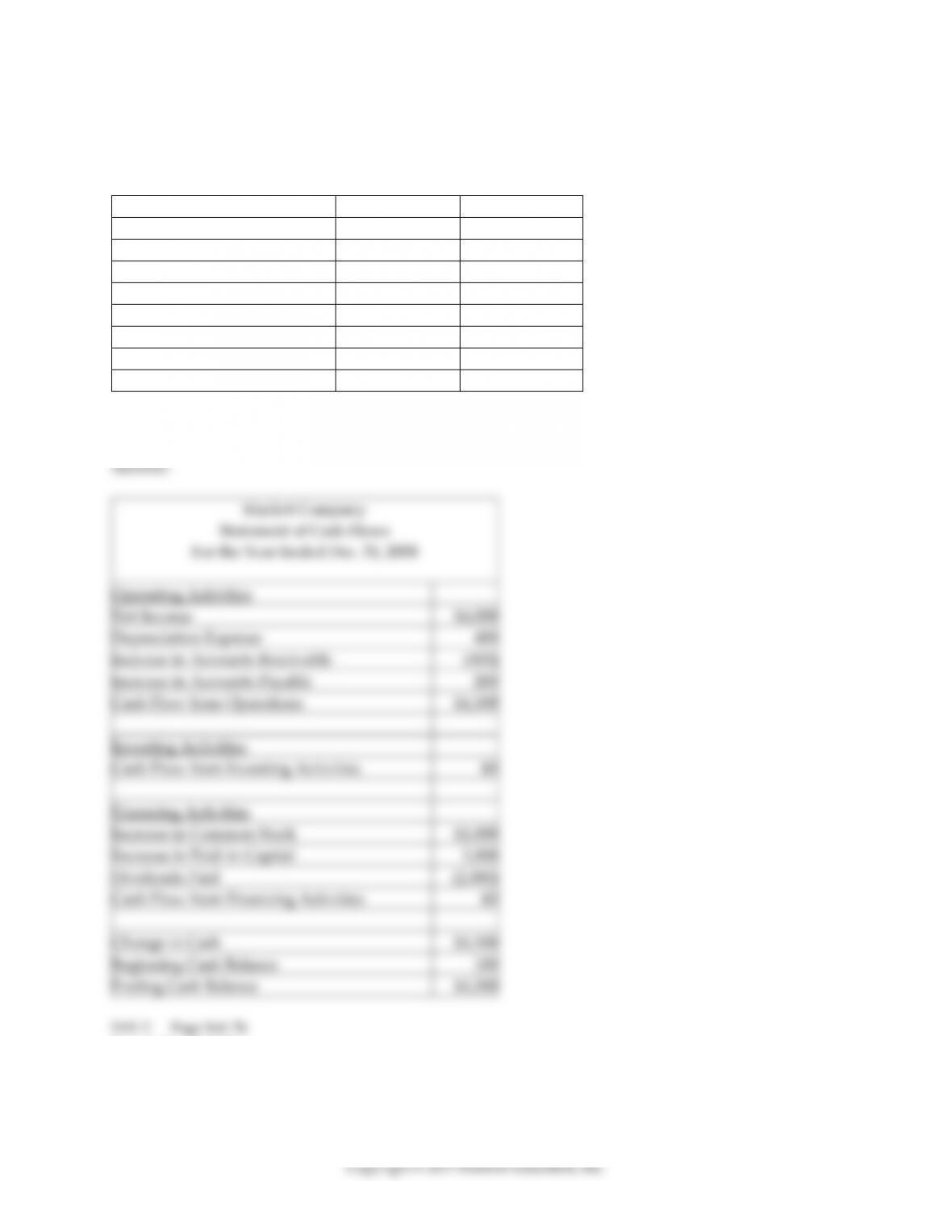
22) Table 3-3
Marlett Company
Financial Information
December 2009
December 2010
Net Income
$2,000
$4,000
Accounts receivable
750
1,250
Accumulated depreciation
1,000
1,400
Common stock
4,500
5500
Paid-in capital
7,500
8500
Retained earnings
1,500
3,500
Accounts payable
750
950
Based on the information in Table 3-3, prepare a statement of cash flows for 2010. Assume that there were
no changes in any other asset or liability accounts, and that the ending cash balance for 2009 was $100.
Operating Activities
Net Income
Increase in Accounts Receivable
Increase in Accounts Payable
Cash Flow from Operations
Investing Activities
Cash Flow from Investing Activities
Financing Activities
Increase in Common Stock
Increase in Paid-in-Capital
Dividends Paid
Cash Flow from Financing Activities
Beginning Cash Balance
Ending Cash Balance
33
23) Is it possible for a company that has negative net income and negative operating cash flow to end the
year with an increase in cash and an increase in stock price? Explain your answer.
Keywords: Cash Flow
Learning Obj.: L.O. 3.3
AACSB: Reflective Thinking
24) Mr. Wizard’s Magic Shoppe had the following condensed balance sheet at the end of operation for
2010:
Mr. Wizard‘s Magic Shoppe
Balance Sheet
December 31, 2010
Cash
$40,000
Current Liabilities
$35,000
Other current assets
60,000
Long-term Notes Payable
40,000
Total current assets
$100,000
Bonds Payable
50,000
Investments
$25,000
Capital Stock
150,000
Fixed assets (net)
110,000
Retained earnings
80,000
Land
$120,000
Total assets
$355,000
Total Liabilities and Equity
$355,000
During 2011, the following occurred
a. Mr. Wizard‘s sold some of its investments for $13,000 which resulted in a gain of
$300 after taxes. The gain (net of taxes) has been included in the company‘s 2011 net income.
b. Additional land for a plant expansion was purchased for $25,000.
c. Bonds payable were paid in the amount of $10,000.
d. An additional $35,000 in capital stock was issued.
e. Dividends of $15,000 were paid to stockholders.
f. Net income for 2011 was $48,000 after allowing for $15,000 in depreciation.
g. A second parcel of land was purchased through the issuance of $10,000 in bonds,
and $5,000 in long-term notes payable.
Required:
a. Prepare a statement of cash flows for the year ended 12/31/2011.
(check figure: ending cash balance = $72,500)
b. Prepare a condensed balance sheet for Mr. Wizard’s at December 31, 2011.
34
Copyright © 2017 Pearson Education, Inc.
Answer:
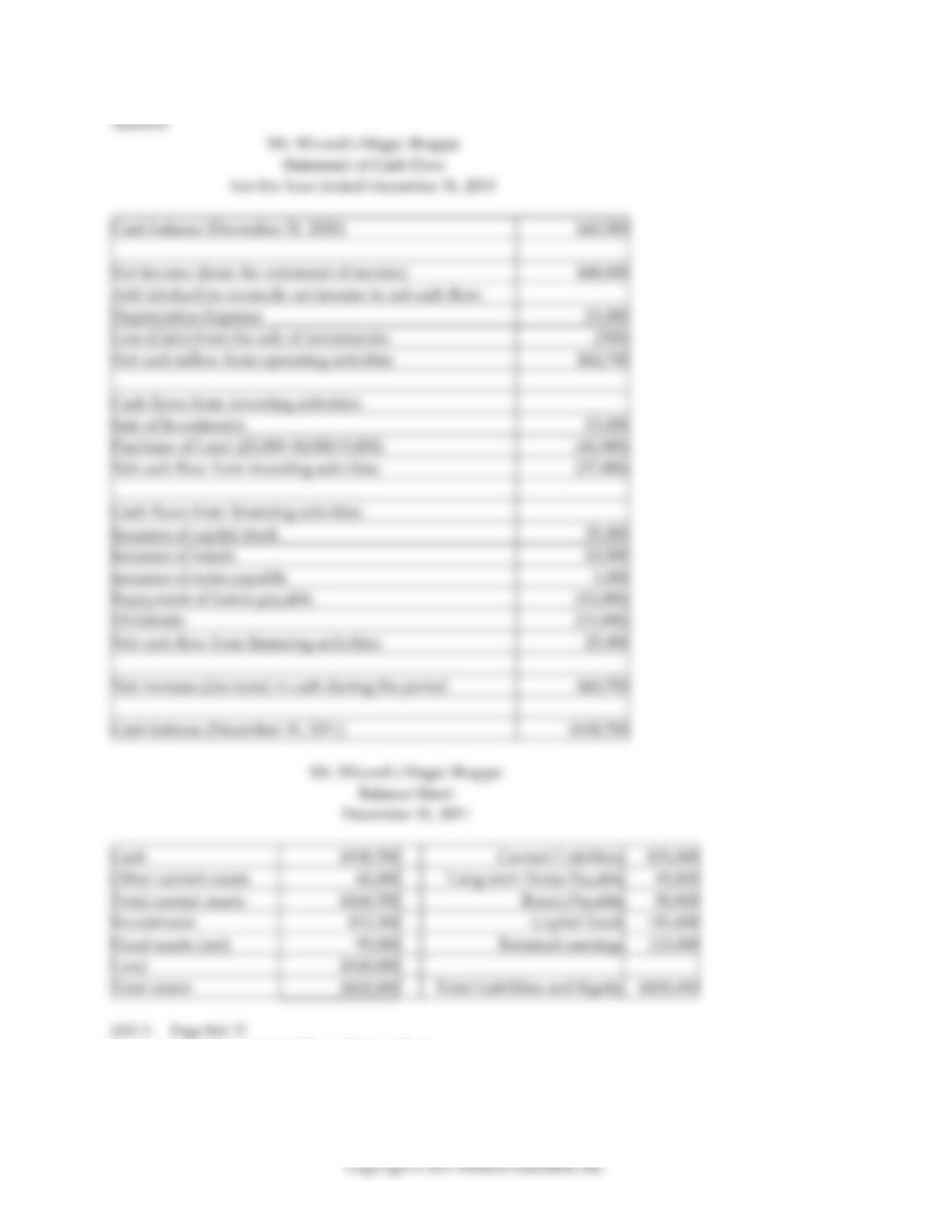
Mr. Wizard‘s Magic Shoppe
Statement of Cash Flow
For the Year Ended December 31, 2011
Cash balance (December 31, 2010)
$40,000
Net Income (from the statement of income)
$48,000
Add (deduct) to reconcile net income to net cash flow:
Depreciation Expense
15,000
Loss (Gain) from the sale of investments
(300)
Net cash inflow from operating activities
$62,700
Cash flows from investing activities:
Sale of Investments
13,000
Purchase of Land (25,000+10,000+5,000)
(40,000)
Net cash flow from investing activities:
(27,000)
Cash flows from financing activities:
Issuance of capital stock
35,000
Issuance of bonds
10,000
Issuance of notes payable
5,000
Repayment of bonds payable
(10,000)
Dividends
(15,000)
Net cash flow from financing activities:
25,000
Net increase (decrease) in cash during the period
$60,700
Cash balance (December 31, 2011)
$100,700
Mr. Wizard‘s Magic Shoppe
Balance Sheet
December 31, 2011
Cash
$100,700
Current Liabilities
$35,000
Other current assets
60,000
Long-term Notes Payable
45,000
Total current assets
$160,700
Bonds Payable
50,000
Investments
$12,300
Capital Stock
185,000
Fixed assets (net)
95,000
Retained earnings
113,000
Land
$160,000
Total assets
$428,000
Total Liabilities and Equity
$428,000
Diff: 3 Page Ref: 71
Keywords: Statement of Cash Flows, Balance Sheet
Learning Obj.: L.O. 3.3
AACSB: Analytical Thinking
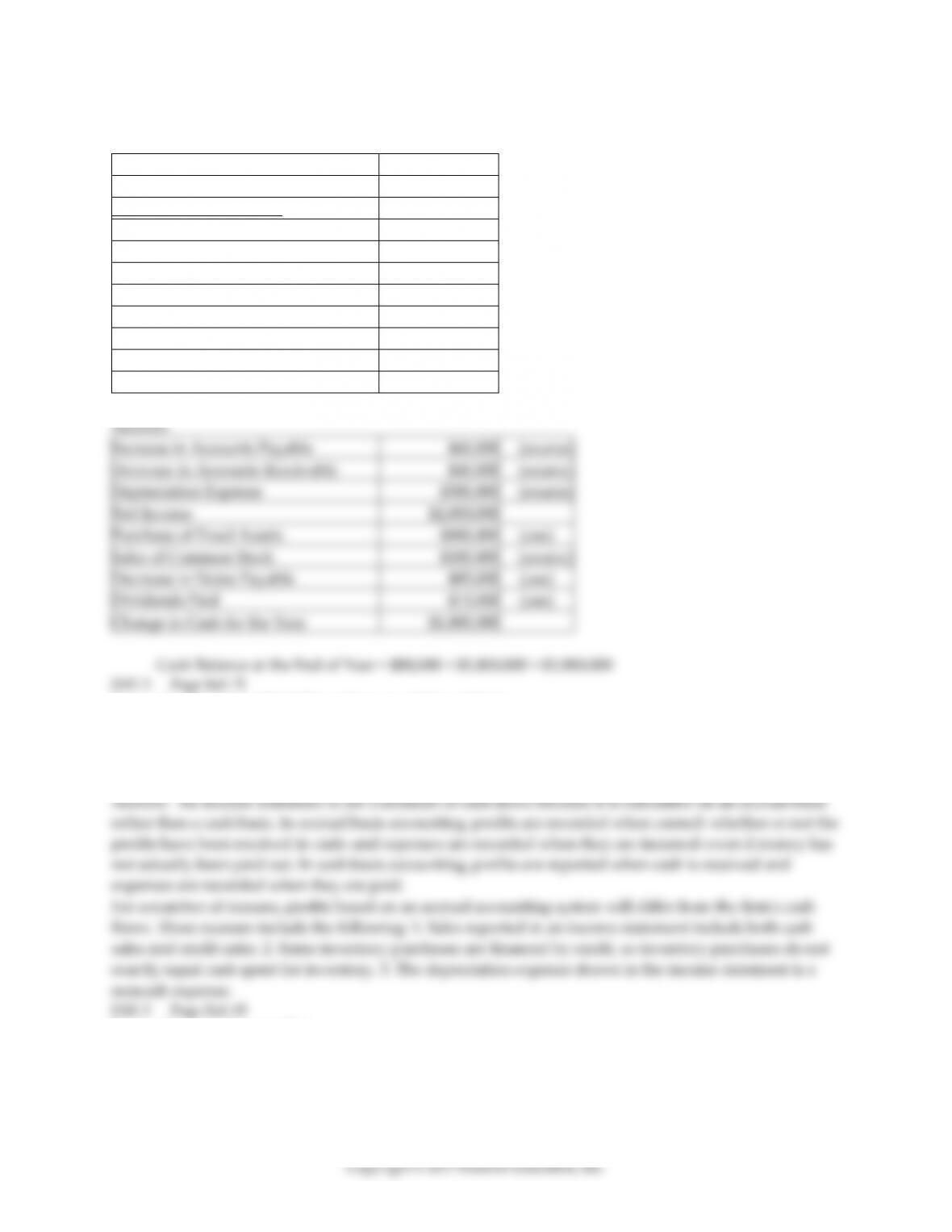
25) Given the information below, calculate the company‘s cash balance at the end of the year.
Cash Balance at Beginning of Year
$80,000
Activity During the Year
Increase in Accounts Payable
$60,000
Decrease in Accounts Receivable
$40,000
Depreciation Expense
$500,000
Net Income
$2,000,000
Purchase of Fixed Assets
$800,000
Sales of Common Stock
$100,000
Decrease in Notes Payable
$85,000
Dividends Paid
$15,000
Decrease in Accounts Receivable
$40,000
Depreciation Expense
$500,000
Net Income
Purchase of Fixed Assets
Sales of Common Stock
$100,000
Dividends Paid
$15,000
Change in Cash for the Year

36
Copyright © 2017 Pearson Education, Inc.
Learning Objective 3.4
1) Generally Accepted Accounting Principles (GAAP) is a set of principle-based accounting standards
established by the Financial Accounting Standards Board (FASB).
Keywords: GAAP and IFRS
Learning Obj.: L.O. 3.4
AACSB: Reflective Thinking
2) International Financial Reporting Standards (IFRS) is a set of principle-based accounting standards that
were established by the International Accounting Standards Board (IASB).
Keywords: GAAP and IFRS
Learning Obj.: L.O. 3.4
AACSB: Reflective Thinking
3) Which of the following statements about International Financial Reporting Standards (IFRS) is NOT
true?
A) IFRS sets out broad and general principles that accountants should follow when preparing financial
statements.
B) IFRS leaves LESS room for discretion than GAAP does.
C) IFRS offers simplicity but also possibly more leeway for accounting malpractice than does GAAP.
D) In 2008, the Securities and Exchange Commission (SEC) announced its plan to convert U.S. companies
from GAAP to IFRS.
Keywords: GAAP and IFRS
Learning Obj.: L.O. 3.4
AACSB: Reflective Thinking
4) Which of the following statements about Generally Accepted Accounting Principles (GAAP) is NOT
true?
A) GAAP is a set of rule-based accounting standards established by the Financial Accounting Standards
Board (FASB).
B) GAAP sets out the standards, conventions, and rules that accountants must follow when preparing
audited financial statements.
C) GAAP is complex, providing more than 150 “pronouncements” as to how to account for different types
of transactions.
D) All of the statements above are true.
Keywords: GAAP and IFRS
Learning Obj.: L.O. 3.4
AACSB: Reflective Thinking
37
5) What are the differences between GAAP and IFRS?
Keywords: GAAP and IFRS
Learning Obj.: L.O. 3.4
AACSB: Reflective Thinking
Learning Objective 3.5
1) When a company sells a piece of equipment or land, any gain (sales price less the book value of the
asset or residual value) is thought to be a capital gain.
Keywords: Tax Effect, Sale of Old Asset, Book Value
Learning Obj.: L.O. 3.5
AACSB: Reflective Thinking
2) Rogue Corp. has sales of $4,250,000; the firm’s cost of goods sold is $2,500,000; and its total operating
expenses are $600,000. The firm’s interest expense is $250,000, and the corporate tax rate is 40%. What is
Rogue’s tax liability?
A) $258,000
B) $260,000
C) $360,000
D) $600,000
Keywords: Tax Liability, Interest Expense
Learning Obj.: L.O. 3.5
AACSB: Analytical Thinking
38
3) The income statement for Simpson, Inc. indicates that tax expense was $30,000. The balance sheet
indicates that taxes payable for the same year increased by $5,000. What amount did Simpson, Inc.
actually pay in taxes during this year?
A) $15,000
B) $20,000
C) $25,000
D) Cannot be determined without the cash balance
Keywords: Tax Expense, Taxes Payable, Accrual vs. Cash Accounting
Learning Obj.: L.O. 3.5
AACSB: Analytical Thinking
4) How is taxable income computed?
Keywords: Earnings Before Taxes, Operating Income, Financing Costs
Learning Obj.: L.O. 3.5
AACSB: Reflective Thinking
5) Why should we be more concerned with the marginal tax rate rather than the average tax rate?
Keywords: Marginal Tax Rate
Learning Obj.: L.O. 3.5
AACSB: Reflective Thinking
Learning Objective 3.6
1) It is possible for two companies to have the same financial performance, but their financial statements
can be different, depending on how and when the managers choose to report certain transactions.
Keywords: GAAP
Learning Obj.: L.O. 3.6
AACSB: Reflective Thinking
39
2) In the United States, financial statements are prepared following the Financial Accounting Standards
Board’s generally accepted accounting principles (GAAP).
Keywords: GAAP
Learning Obj.: L.O. 3.6
AACSB: Reflective Thinking
3) What are the limitations of financial statements?
Keywords: Financial Statements
Learning Obj.: L.O. 3.6
AACSB: Reflective Thinking
Learning Objective 3.7
1) Computing the change in long-term assets or net capital spending, it involves computing the change in
net fixed assets and other long-term assets.
Keywords: Capital Budgeting
Learning Obj.: L.O. 3.7
AACSB: Reflective Thinking
2) Cash flows between investors and the firm, what we call financing cash flows, occur in one of four
ways EXCEPT:
A) Pay stock dividend.
B) Pay interest to lenders.
C) Pay dividends to stockholders.
D) Increase or decrease interest-bearing debt.
Keywords: Financing Cash Flow
Learning Obj.: L.O. 3.7
AACSB: Reflective Thinking