
41
30) Plato Industries’ projected sales for the first six months of 2012 are given below:
Jan.
$250,000
April
$300,000
Feb.
$340,000
May
$350,000
Mar.
$280,000
June
$380,000
20% of sales are collected in cash at time of sale, 50% are collected in the month following the sale, and
the remaining 30% are collected in the second month following the sale. Cost of goods sold is 85% of
sales. Purchases are made in the month prior to the sales, and payments for purchases are made in the
month of the sale. Total other cash expenses are $70,000/month. The company‘s cash balance as of
February 28, 2012 will be $10,000. Excess cash will be used to retire short-term borrowing (if any). Plato
has no short term borrowing as of February 28, 2012. Ignore any interest on short-term borrowing. The
company must have a minimum cash balance of $40,000 at the beginning of each month. What is Plato
Industries’ ending cash balance (before borrowing) in March?
A) $12,000
B) $8,000
C) $3,000
D) ($28,000)
Keywords: Cash Budget, Cash Balance
Learning Obj.: L.O. 14.3
AACSB: Analytical Thinking
31) Plato Industries’ projected sales for the first six months of 2012 are given below:
Jan.
$250,000
April
$300,000
Feb.
$340,000
May
$350,000
Mar.
$280,000
June
$380,000
20% of sales are collected in cash at time of sale, 50% are collected in the month following the sale, and
the remaining 30% are collected in the second month following the sale. Cost of goods sold is 85% of
sales. Purchases are made in the month prior to the sales, and payments for purchases are made in the
month of the sale. Total other cash expenses are $70,000/month. The company‘s cash balance as of
February 28, 2012 will be $10,000. Excess cash will be used to retire short-term borrowing (if any). Plato
has no short term borrowing as of February 28, 2012. Ignore any interest on short-term borrowing. The
company must have a minimum cash balance of $40,000 at the beginning of each month. Plato’s projected
cumulative short-term borrowing as of April 30, 2012?
A) $25,000
B) $33,000
C) $50,000
D) $60,000
Keywords: Cash Budget, Cumulative Borrowing
Learning Obj.: L.O. 14.3
AACSB: Analytical Thinking

42
32) Fielding Wilderness Outfitters had projected its sales for the first six months of 2010 to be as follows:
Jan.
$250,000
April
$300,000
Feb.
$340,000
May
$350,000
Mar.
$280,000
June
$380,000
Cost of goods sold is 60% of sales. Purchases are made and paid for two months prior to the sale. 40% of
sales are collected in the month of the sale, 40% are collected in the month following the sale, and the
remaining 20% in the second month following the sale. Total other cash expenses are $40,000/month. The
company‘s cash balance as of March 1st, 2010 is projected to be $40,000, and the company wants to
maintain a minimum cash balance of $15,000. Excess cash will be used to retire short-term borrowing (if
any exists). Fielding has no short-term borrowing as of March 1st, 2010. Assume that the interest rate on
short-term borrowing is 1% per month. What is Fielding’s projected total receipts (collections) for April?
A) $124,000
B) $180,000
C) -$4,000
D) $36,000
Keywords: Cash Budget, Cash Receipts
Learning Obj.: L.O. 14.3
AACSB: Analytical Thinking
33) Rawhide Outfitters had projected its sales for the first six months of 2012 to be as follows:
Jan.
$50,000
April
$180,000
Feb.
$60,000
May
$240,000
Mar.
$100,000
June
$240,000
Cost of goods sold is 60% of sales. Purchases are made and paid for two months prior to the sale. 40% of
sales are collected in the month of the sale, 40% are collected in the month following the sale, and the
remaining 20% in the second month following the sale. Total other cash expenses are $40,000/month. The
company‘s cash balance as of March 1st, 2012 is projected to be $40,000, and the company wants to
maintain a minimum cash balance of $15,000. Excess cash will be used to retire short-term borrowing (if
any exists). The firm has no short-term borrowing as of March 1st, 2012. Assume that the interest rate on
short-term borrowing is 1% per month. What was Rawhides’ projected loss for March?
A) $184,000
B) $110,000
C) $84,000
D) none of the above
Keywords: Cash Budget, Net Change in Cash
Learning Obj.: L.O. 14.3
AACSB: Analytical Thinking

43
34) Rawhide Outfitters had projected its sales for the first six months of 2012 to be as follows:
Jan.
$50,000
April
$180,000
Feb.
$60,000
May
$240,000
Mar.
$100,000
June
$240,000
Cost of goods sold is 60% of sales. Purchases are made and paid for two months prior to the sale. 40% of
sales are collected in the month of the sale, 40% are collected in the month following the sale, and the
remaining 20% in the second month following the sale. Total other cash expenses are $40,000/month. The
company‘s cash balance as of March 1st, 2012 is projected to be $40,000, and the company wants to
maintain a minimum cash balance of $15,000. Excess cash will be used to retire short-term borrowing (if
any exists). Fielding has no short-term borrowing as of March 1st, 2012. Assume that the interest rate on
short-term borrowing is 1% per month. How much short term financing is needed by March 30, 2012?
A) $110,000
B) $15,000
C) $70,000
D) $85,000
Keywords: Cash Budget, Short-term Financing
Learning Obj.: L.O. 14.3
AACSB: Analytical Thinking
35) LPD Logistics, Inc.’s projected sales for the first six months of 2010 are given below.
Jan.
$300,000
April
$350,000
Feb.
$350,000
May
$500,000
Mar.
$475,000
June
$400,000
20% of sales are collected in the month of the sale, 75% are collected in the month following the sale, and
5% are written off as uncollectible. Cost of goods sold is 80% of sales. Purchases are made the month prior
to the sales and are paid during the month the purchases are made (i.e. goods sold in March are bought
and paid for in February). Total other cash expenses are $35,000/month. The company‘s cash balance as of
February 1, 2010 will be $30,000. Excess cash will be used to retire short-term borrowing (if any). LPD has
no short term borrowing as of February 28, 2010. Assume that the interest rate on short-term borrowing is
1% per month. The company must have a minimum cash balance of $20,000 at the beginning of each
month. What is LPD‘s projected total disbursements for April?
A) $422,918
B) $435,686
C) $398,833
D) $375,655
Keywords: Cash Disbursements, Cash Budget
Learning Obj.: L.O. 14.3
AACSB: Analytical Thinking

44
36) LPD Logistics, Inc.‘s projected sales for the first six months of 2010 are given below.
Jan.
$300,000
April
$350,000
Feb.
$350,000
May
$500,000
Mar.
$475,000
June
$400,000
20% of sales are collected in the month of the sale, 75% are collected in the month following the sale, and
5% are written off as uncollectible. Cost of goods sold is 80% of sales. Purchases are made the month prior
to the sales and are paid during the month the purchases are made (i.e. goods sold in March are bought
and paid for in February). Total other cash expenses are $35,000/month. The company‘s cash balance as of
February 1, 2010 will be $30,000. Excess cash will be used to retire short-term borrowing (if any). LPD has
no short term borrowing as of February 28, 2010. Assume that the interest rate on short-term borrowing is
1% per month. The company must have a minimum cash balance of $20,000 at the beginning of each
month. What is LPD‘s projected gross profit for April?
A) ($50,000)
B) $70,000
C) $100,000
D) $110,550
Keywords: Cash Budget, Gross Profit
Learning Obj.: L.O. 14.3
AACSB: Analytical Thinking
37) LPD Logistics, Inc.‘s projected sales for the first six months of 2010 are given below.
Jan.
$300,000
April
$350,000
Feb.
$350,000
May
$500,000
Mar.
$475,000
June
$400,000
20% of sales are collected in the month of the sale, 75% are collected in the month following the sale, and
5% are written off as uncollectible. Cost of goods sold is 80% of sales. Purchases are made the month prior
to the sales and are paid during the month the purchases are made (i.e. goods sold in March are bought
and paid for in February). Total other cash expenses are $35,000/month. The company‘s cash balance as of
February 1, 2010 will be $30,000. Excess cash will be used to retire short-term borrowing (if any). LPD has
no short term borrowing as of February 28, 2010. Assume that the interest rate on short-term borrowing is
1% per month. The company must have a minimum cash balance of $20,000 at the beginning of each
month. What is LPD‘s projected total receipts (collections) for March?
A) $357,500
B) $310,000
C) $456,000
D) $475,000
Keywords: Cash Budget, Cash Receipts
Learning Obj.: L.O. 14.3
AACSB: Analytical Thinking

45
38) LPD Logistics, Inc.‘s projected sales for the first six months of 2010 are given below.
Jan.
$300,000
April
$350,000
Feb.
$350,000
May
$500,000
Mar.
$475,000
June
$400,000
20% of sales are collected in the month of the sale, 75% are collected in the month following the sale, and
5% are written off as uncollectible. Cost of goods sold is 80% of sales. Purchases are made the month prior
to the sales and are paid during the month the purchases are made (i.e. goods sold in March are bought
and paid for in February). Total other cash expenses are $35,000/month. The company‘s cash balance as of
February 1, 2010 will be $30,000. Excess cash will be used to retire short-term borrowing (if any). LPD has
no short term borrowing as of February 28, 2010. Assume that the interest rate on short-term borrowing is
1% per month. The company must have a minimum cash balance of $20,000 at the beginning of each
month. What is LPD‘s projected cumulative borrowing as of March 1, 2010?
A) $110,000
B) $90,000
C) $70,000
D) -0-
Keywords: Cash Budget, Cumulative Borrowing
Learning Obj.: L.O. 14.3
AACSB: Analytical Thinking
39) LPD Logistics, Inc.‘s projected sales for the first six months of 2010 are given below.
Jan.
$300,000
April
$350,000
Feb.
$350,000
May
$500,000
Mar.
$475,000
June
$400,000
20% of sales are collected in the month of the sale, 75% are collected in the month following the sale, and
5% are written off as uncollectible. Cost of goods sold is 80% of sales. Purchases are made the month prior
to the sales and are paid during the month the purchases are made (i.e. goods sold in March are bought
and paid for in February). Total other cash expenses are $35,000/month. The company‘s cash balance as of
February 1, 2010 will be $30,000. Excess cash will be used to retire short-term borrowing (if any). LPD has
no short term borrowing as of February 28, 2010. Assume that the interest rate on short-term borrowing is
1% per month. The company must have a minimum cash balance of $20,000 at the beginning of each
month. What is LPD‘s projected cash balance as of April 1, 2010?
A) ($48,600)
B) ($58,036)
C) $14,238
D) $21,400
Keywords: Cash Budget, Cash Balance
Learning Obj.: L.O. 14.3
AACSB: Analytical Thinking

46
40) Which of the following would NOT be found in a cash budget?
A) interest expense
B) taxes
C) depreciation
D) cash sales
Keywords: Cash Budget, Depreciation
Learning Obj.: L.O. 14.3
AACSB: Reflective Thinking
41) Is it possible for the cash budget and the pro forma income statement to have different results?
A) yes, because revenues and expenses included in each statement are different
B) yes, because revenues and expenses are accounted for over different time periods
C) no, because they contain the same variables, while just using different formats
D) no, because the cash budget and the pro forma income statement provide forecasts for the same time
period
Keywords: Cash Budget, Pro Forma Income Statement
Learning Obj.: L.O. 14.3
AACSB: Reflective Thinking
42) The cash budget consists of all the following factors EXCEPT
A) cash receipts.
B) cash disbursements.
C) new financing needed.
D) net income.
Keywords: Cash Budget
Learning Obj.: L.O. 14.3
AACSB: Reflective Thinking
43) Which of the following items does NOT belong in a cash budget?
A) rent
B) taxes
C) depreciation
D) wages and salaries
Keywords: Cash Budget, Depreciation
Learning Obj.: L.O. 14.3
AACSB: Reflective Thinking

47
44) In what way does a cash budget provide management with better information about financing
requirements than a pro forma balance sheet?
A) A pro forma cash budget gives greater details about the depreciation of fixed assets.
B) A pro forma cash budget not only delineates the financing that is needed but it also pinpoints in
greater detail when the financing is needed.
C) A pro forma cash budget utilizes superior methods in determining a firm’s income tax liability for the
planned period.
D) A pro forma cash budget does not offer better information to management regarding financing than a
pro forma balance sheet.
Keywords: Cash Budget, Pro Forma Balance Sheet
Learning Obj.: L.O. 14.3
AACSB: Reflective Thinking
45) A budget
A) records the amount and timing of the firm‘s past financing needs.
B) provides a basis for taking corrective action in the event that budgeted figures do not match actual or
realized figures.
C) remains independent of the human resource performance evaluation task.
D) only makes sense for annual periods of time.
Keywords: Budget
Learning Obj.: L.O. 14.3
AACSB: Reflective Thinking
48
46) The treasurer for Chic Man Clothing must decide how much money the company needs to borrow in
July. The balance sheet for June 30, 2010 is presented below:
Chic Man Clothing Balance Sheet
June 30, 2010
Cash
$87,000
Accounts payable
$550,000
Marketable securities
123,000
Long-term debt
350,000
Accounts receivable
360,000
Common stock
130,000
Inventory
300,000
Retained earnings
270,000
Total current assets
870,000
Total liabilities and
stockholders’ equity
1,300,000
Fixed assets
430,000
Total assets
$1,300,000
The company expects sales of $400,000 for July. The company has observed that 25% of its sales is for cash
and that the remaining 75% is collected in the following month. The company plans to purchase $345,000
of new clothing. Usually 70% of purchases is for cash and the remaining 30% of purchases is paid in the
following month. Salaries are $135,000 per month, lease payments are $35,000 per month, and
depreciation charges are $20,000 per month. The company plans to purchase a new van for $60,000 in July
and sell its marketable securities for $123,000. If the company must maintain a minimum cash balance of
$25,000, how much money must the company borrow in July?
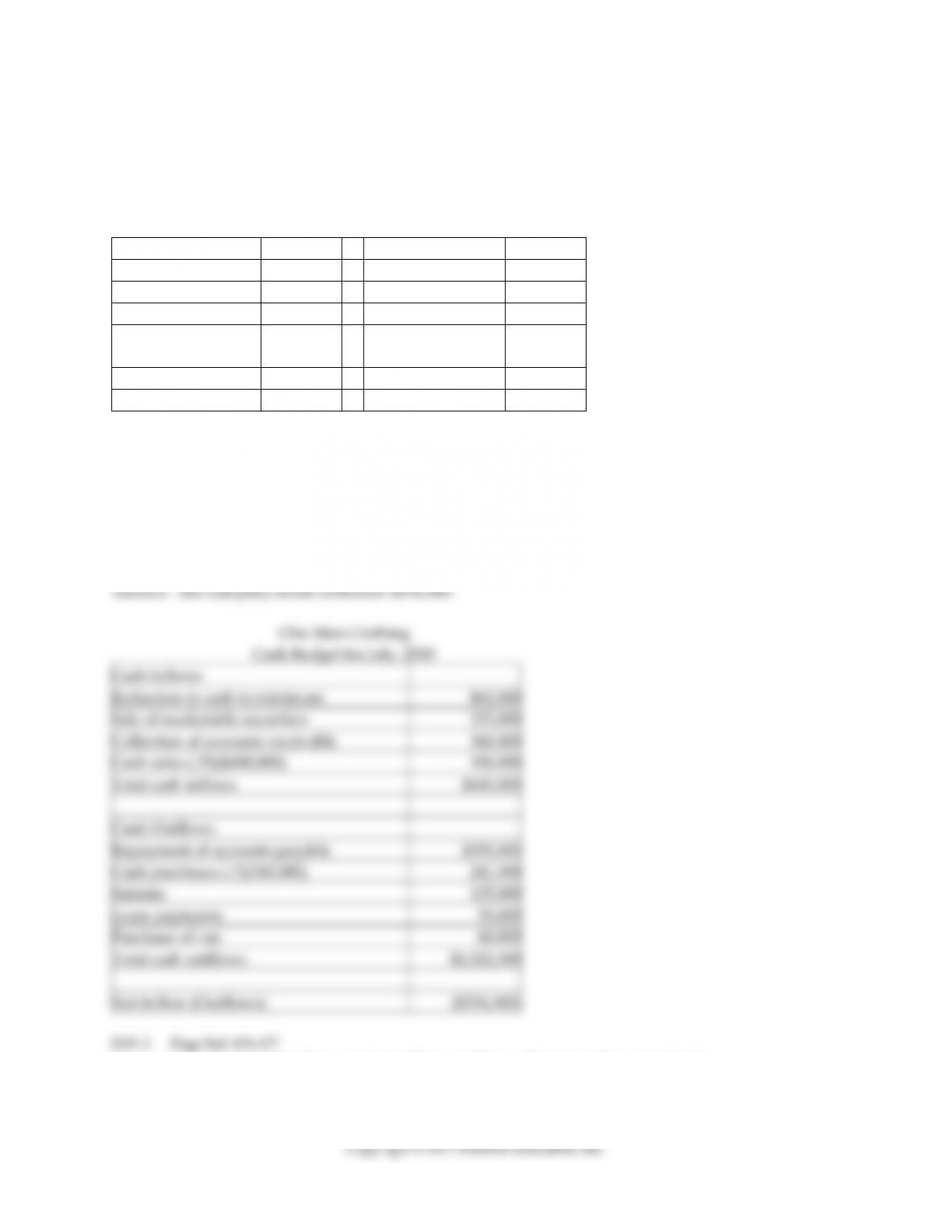
Cash Inflows
Reduction in cash to minimum
$62,000
Sale of marketable securities
123,000
Collection of accounts receivable
360,000
Cash sales (.25)($400,000)
100,000
Total cash inflows
$645,000
Cash Outflows
Repayment of accounts payable
$550,000
Cash purchases (.7)(345,000)
241,500
Salaries
135,000
Lease payments
35,000
Purchase of van
60,000
Total cash outflows
$1,021,500
Net Inflow (Outflows)
($376,500)
Diff: 2 Page Ref: 474-477
Keywords: Cash Budget, Net Change in Cash, Minimum Balance, Short-term Borrowing Needs
Learning Obj.: L.O. 14.3
AACSB: Analytical Thinking

49
47) CBD Computer Inc. is attempting to estimate its needs for funds during each of the months covering
the third quarter of 20XX. Pertinent information is given below:
a. Past and estimated future sales for 20XX:
April $80,000 July $90,000
May 95,000 August 130,000
June 70,000 September 110,000
October 140,000
b. Rent expense is $2,500 per month.
c. A quarterly interest payment on $100,000 in 7% notes payable is to be paid during September, 20XX.
d. Wages and salaries are estimated as follows:
July $8,000
August 10,000
September 12,000
Payments are made within the month in which the wages are earned.
e. Sixty percent of sales are for cash, with the remaining 40% collected in the month following the sale.
f. CBD pays 80% of the sales price for merchandise and makes payment in the same month in which the
sales occur, although purchases are made in the month prior to the anticipated sales.
g. CBD plans to pay $7,500 in cash for a new forklift truck in July.
h. Short-term loans can be obtained at the end of each month at 13% annual interest with interest paid
during each month for which the loan is outstanding.
i. CBD’s ending cash balance for June 30, 200X is $67,000:
the minimum balance the firm wishes to have in any month is $35,000.
Required: Set up a cash budget for CBD for the quarter ended September 30, 20XX.
50
Copyright © 2017 Pearson Education, Inc.
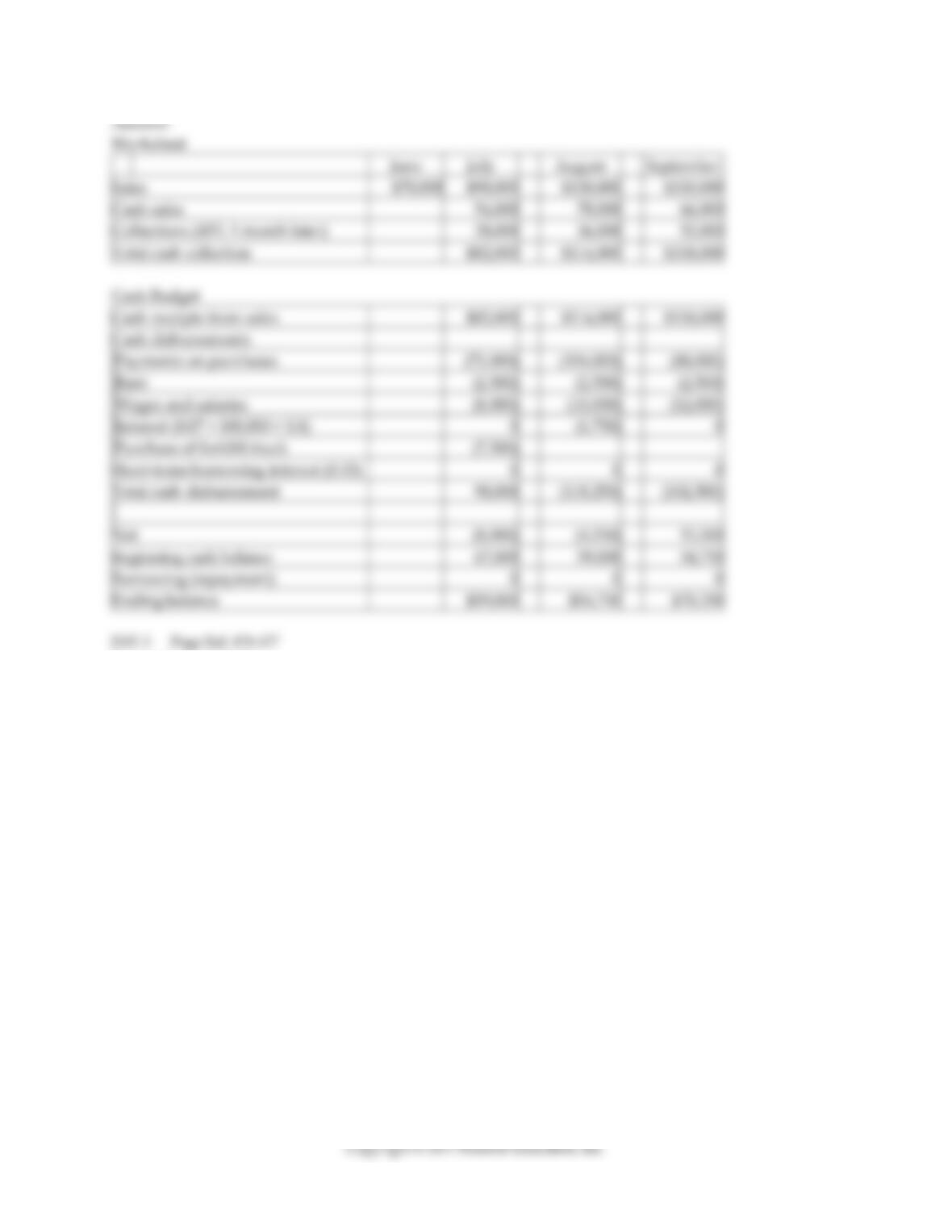
Answer:
Worksheet
June
July
August
September
Sales
$70,000
$90,000
$130,000
$110,000
Cash sales
54,000
78,000
66,000
Collections (40% 1 month later)
28,000
36,000
52,000
Total cash collection
$82,000
$114,000
$118,000
Cash Budget
Cash receipts from sales
$82,000
$114,000
$118,000
Cash disbursements
Payments on purchases
(72,000)
(104,000)
(88,000)
Rent
(2,500)
(2,500)
(2,500)
Wages and salaries
(8,000)
(10,000)
(12,000)
Interest (0.07 × 100,000 × 1/4)
0
(1,750)
0
Purchase of forklift truck
(7,500)
Short-term-borrowing interest (0.13)
0
0
0
Total cash disbursement
90,000
(118,250)
(102,500)
Net
(8,000)
(4,250)
15,500
Beginning cash balance
67,000
59,000
54,750
Borrowing (repayment)
0
0
0
Ending balance
$59,000
$54,750
$70,250
Diff: 3 Page Ref: 474-477
Keywords: Cash Budget
Learning Obj.: L.O. 14.3
AACSB: Analytical Thinking