21
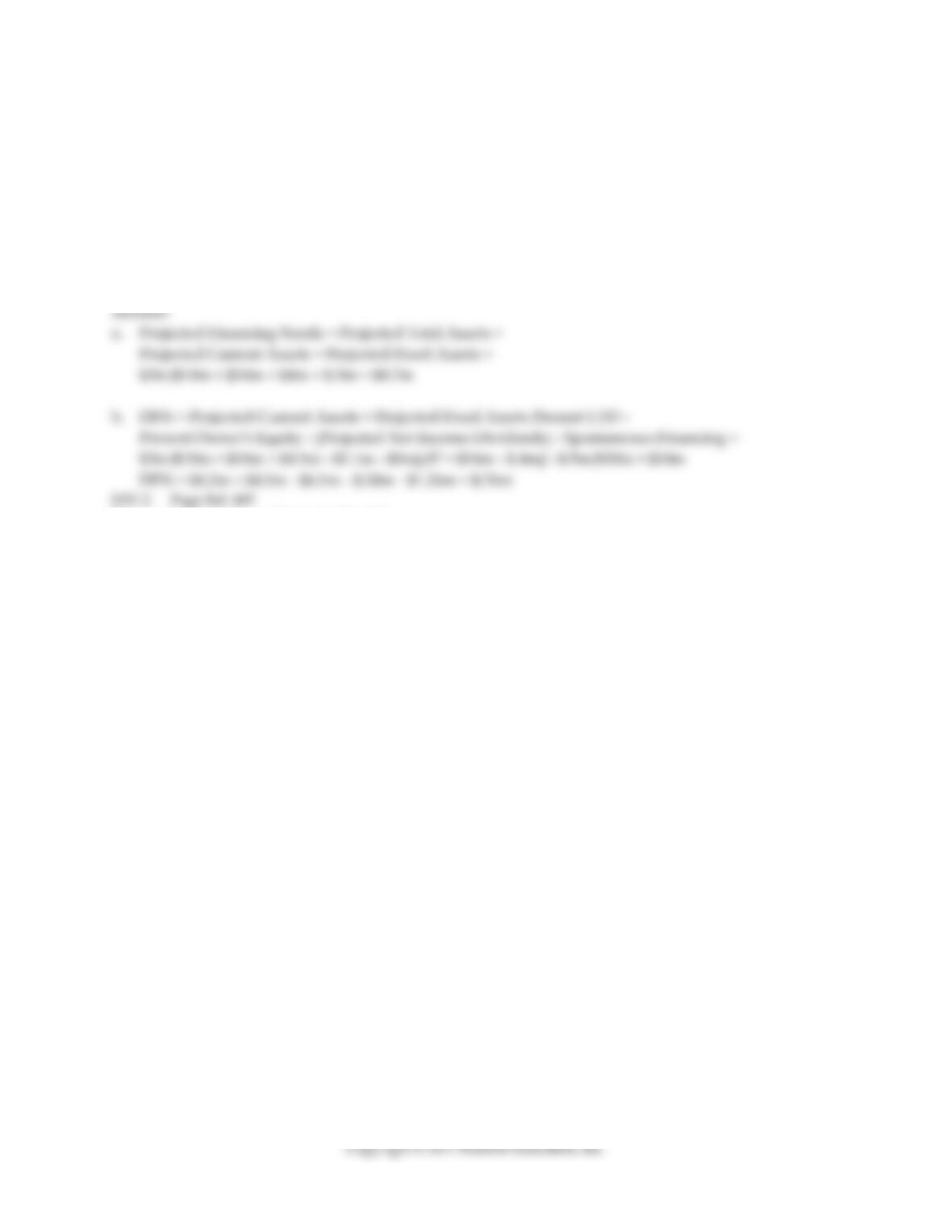
81) Lindsey Insurance Co. has current sales of $10 million and predicts next year’s sales will grow to $14
million. Current assets are $3 million and fixed assets are $4 million. The firm’s net profit margin is 7
percent after taxes. Presently, Lindsey has $900,000 in accounts payable, $1.1 million in long-term debt,
and $5 million (including $2.5 million in retained earnings) in common equity. Next year, Lindsey
projects that current assets will rise in direct proportion to the forecasted sales, and that fixed assets will
rise by $500,000. Lindsey also plans to pay dividends of $400,000 to common shareholders.
a. What are Lindsey‘s total financing needs for the upcoming year?
b. Given the above information, what are Lindsey‘s discretionary financing needs?
Keywords: Discretionary Financing Needed
Learning Obj.: L.O. 14.1
AACSB: Analytical Thinking
22
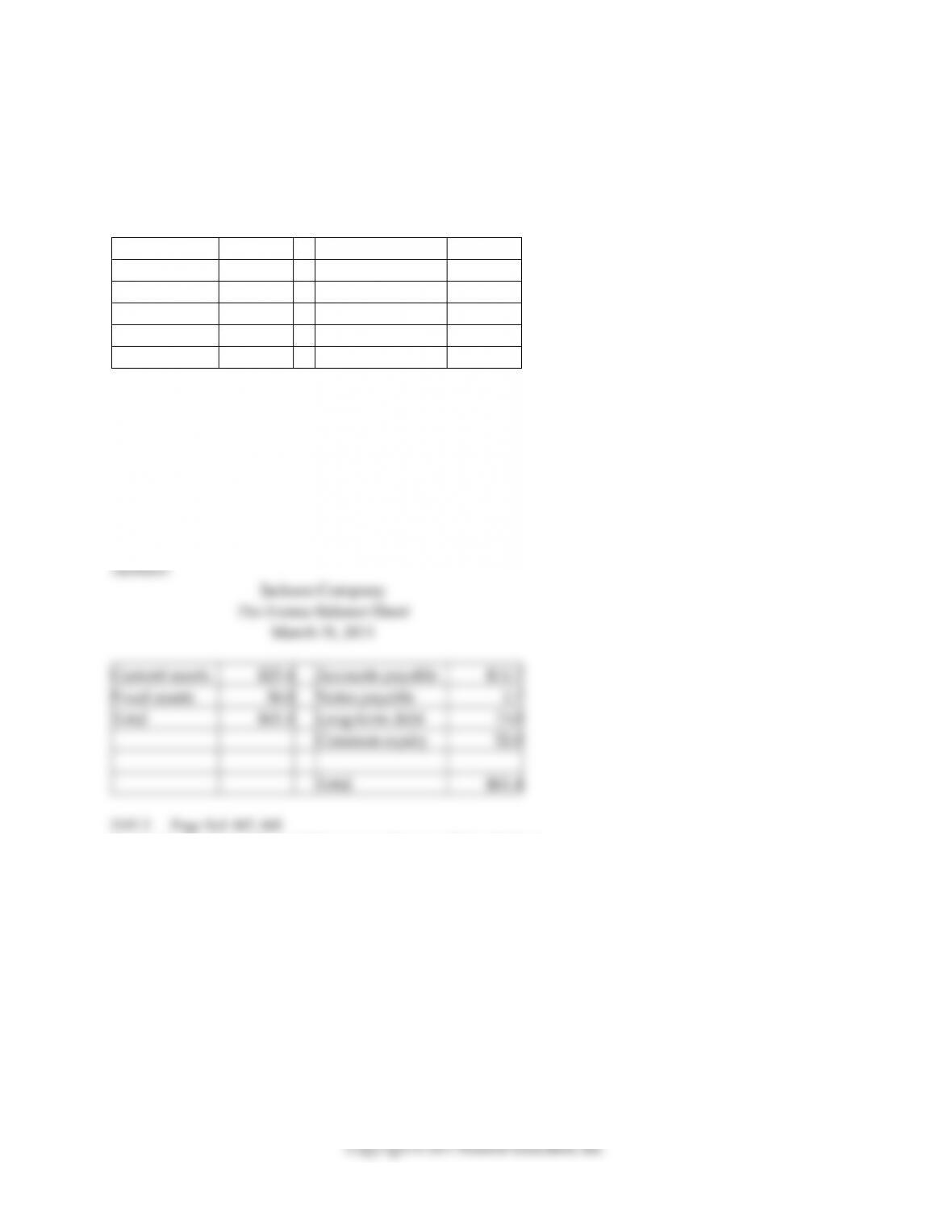
82) The balance sheet of the Emery Company is presented below:
Emery Company Balance Sheet
March 31, 2010
(Millions of Dollars)
Current assets
$18
Accounts payable
$9
Fixed assets
38
Notes payable
0
Total
$56
Long-term debt
15
Common equity
32
Total
$56
For the year ending March 31, 2010, Jackson had sales of $58 million. The common stockholders receive
all net earnings of the firm in the form of cash dividends, leaving no funds from earnings available to the
firm for expansion (assume that depreciation expense is just equal to the cost of replacing worn-out
assets).
Construct a pro forma balance sheet for March 31, 2011 for an expected level of sales of $75.4 million.
Assume current assets and accounts payable vary as a percent of sales, and fixed assets remain at the
present level. Use notes payable as discretionary financing.
Current assets
$23.4
Accounts payable
$11.7
Fixed assets
38.0
Notes payable
2.7
Total
$61.4
Long-term debt
15.0
Common equity
32.0
Total
$61.4
Diff: 2 Page Ref: 467, 468
Keywords: Pro Forma Financial Statements, Percent of Sales Method
Learning Obj.: L.O. 14.1
AACSB: Analytical Thinking
23
Copyright © 2017 Pearson Education, Inc.
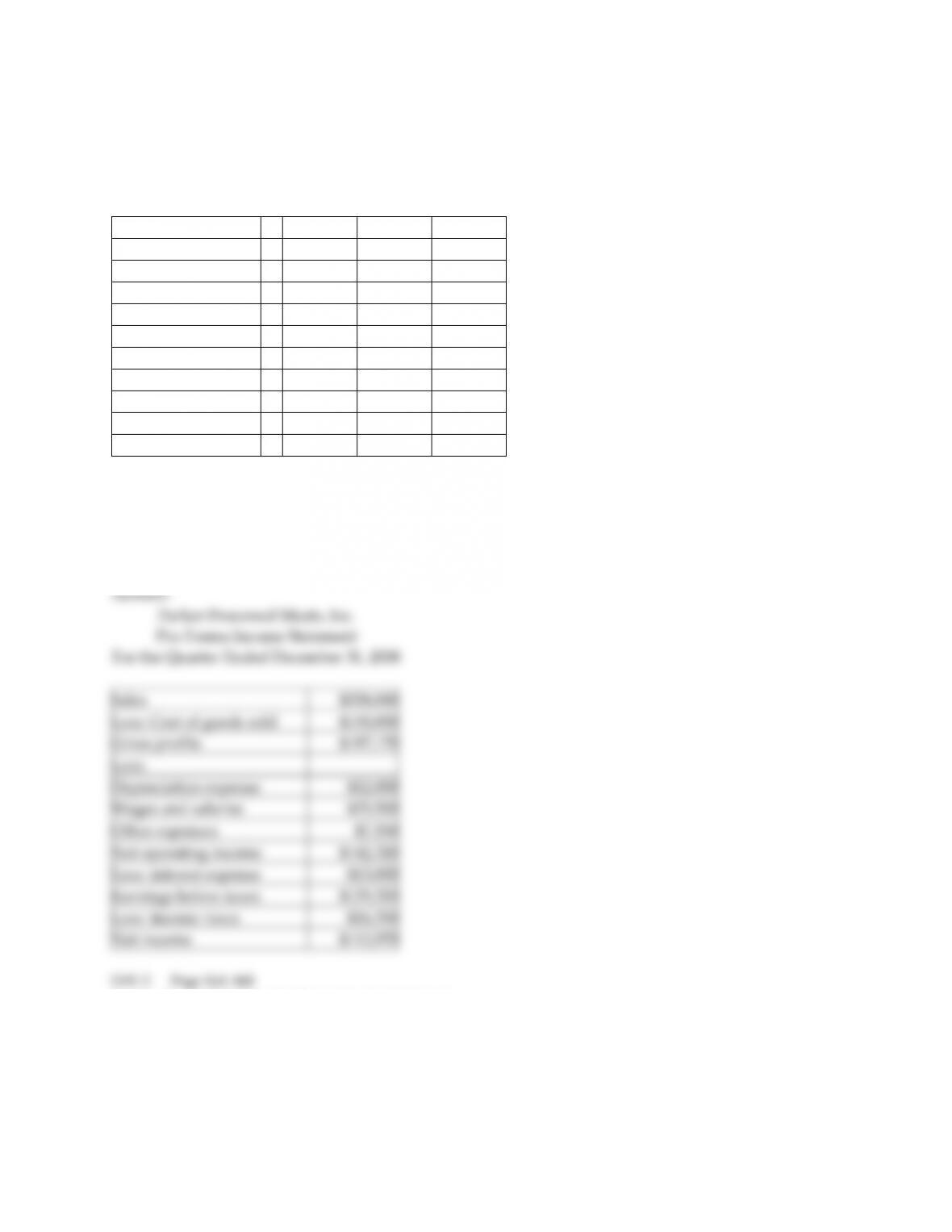
83) The cash budget for Parker Processed Meats, Inc. is given below for the fourth quarter of 2010:
Parker Processed Meats, Inc.
Cash Budget for the Three Months Ending December 31, 2010
Cash receipts
Oct.
Nov.
Dec.
Total collections
$37,050
$48,075
$69,750
Cash disbursements:
Purchases
$45,780
$50,800
$54,250
Wages and salaries
$8,500
$8,500
$8,500
Other expenses
$4,025
$2,350
$975
Taxes
$16,350
Total disbursements
$54,000
$57,375
$78,165
The expected sales for the period are as follows:
Oct.: $116,000 Nov.: $127,000 Dec.: $95,000
The total depreciation expense for the period will be $12,000.
An interest payment on outstanding debt of $13,000 will be made in December. Using the information
given above, construct a pro forma income statement for the final quarter of 2010.
Sales
$338,000
Less: Cost of goods sold
$150,830
Gross profits
$187,170
Less:
Depreciation expense
$12,000
Wages and salaries
$25,500
Other expenses
$7,350
Net operating income
$142,320
Less: interest expense
$13,000
Earnings before taxes
$129,320
Less: Income taxes
$16,350
Net income
$112,970
Diff: 2 Page Ref: 468
Keywords: Cash Budget, Pro Forma Income Statement
Learning Obj.: L.O. 14.1
AACSB: Analytical Thinking
24
Copyright © 2017 Pearson Education, Inc.
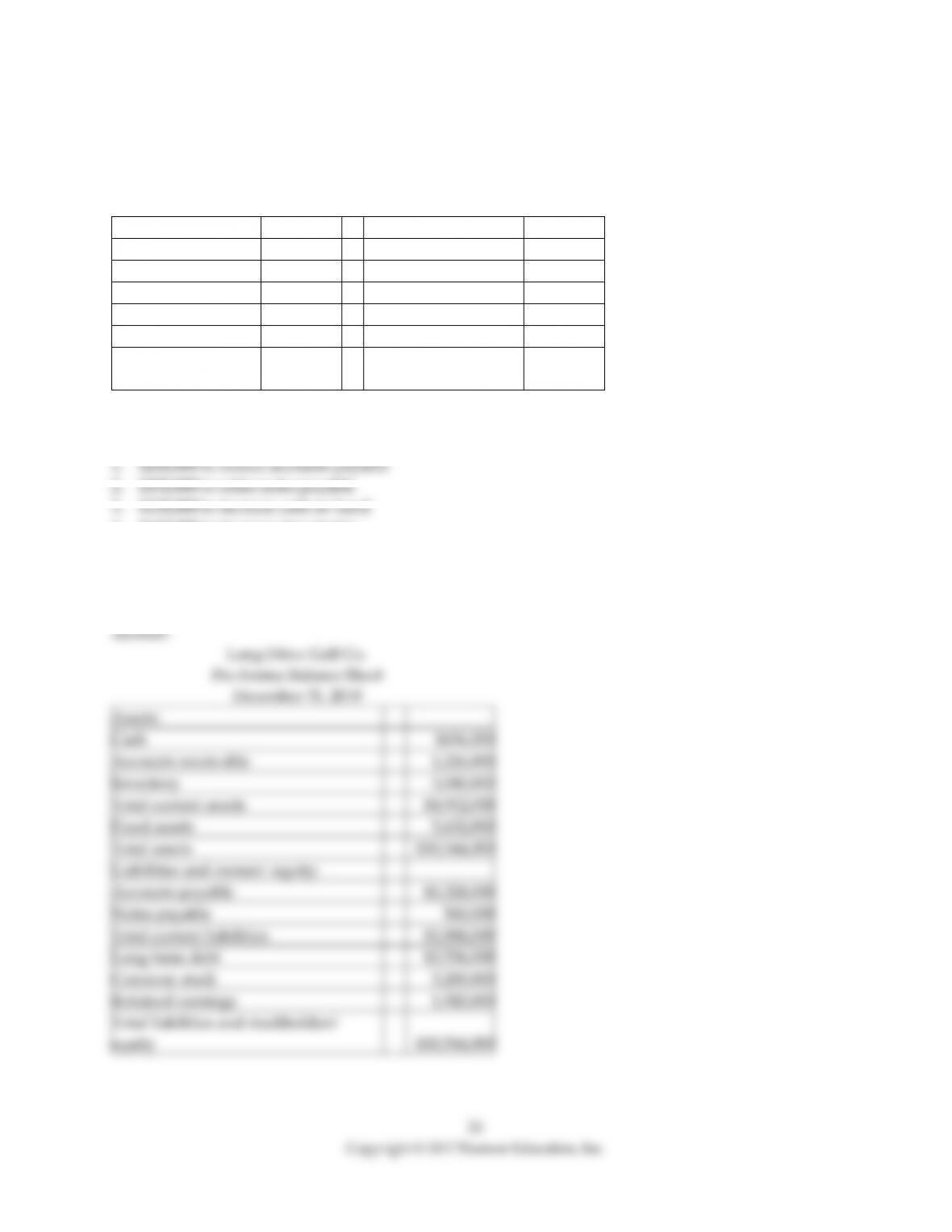
84) The balance sheet for the Long Drive Golf Company on September 30, 2010 is presented below:
Long Drive Golf Company Balance Sheet
September 30, 2010
Cash
$528,000
Accounts payable
$1,568,000
Accounts receivable
1,216,000
Notes payable
752,000
Inventory
2,400,000
Total current liabilities
2,320,000
Fixed assets
5,632,000
Long-term debt
2,336,000
Common stock
3,200,000
Total assets
$9,776,000
Retained earnings
1,920,000
Total liabilities and
stockholders’ equity
$9,776,000
The treasurer of the firm wants to issue $1,200,000 in long-term bonds to be used as follows:
4. $640,000 to increase inventories
a. Assuming that the loan is obtained, construct a pro forma balance sheet for December 31, 2010, for
Long Drive Golf Company that reflects the use of the funds provided.
b. Was the liquidity of Long Drive Golf Company improved by the loan?
Assets:
Cash
$656,000
Accounts receivable
1,216,000
Inventory
3,040,000
Total current assets
$4,912,000
Fixed assets
5,632,000
Total assets
$10,544,000
Liabilities and owners’ equity:
Accounts payable
$1,328,000
Notes payable
560,000
Total current liabilities
$1,888,000
Long-term debt
$3,536,000
Common stock
3,200,000
Retained earnings
1,920,000
Total liabilities and stockholders’
equity
$10,544,000
26
Copyright © 2017 Pearson Education, Inc.
Answer:
ZYX Corporation
Pro Forma Income Statement
September, 2010
Sales
$300,000
Total cost of goods sold
150,000
Gross profit
$150,000
Depreciation
(20,000)
General administrative expenses
(30,000)
Lease payments
(10,000)
Operating income
$90,000
Taxes
(36,000)
Net income
$54,000
ZYX Corporation
Cash Budget
September, 2010
Cash Inflows
Collections from September sales
$60,000
Collections from August sales
280,000
Collections from July sales
50,000
Total cash inflows
$390,000
Cash Outflows
Labor and raw materials
$150,000
General administrative expenses
30,000
Lease payments
10,000
Total cash outflows
$190,000
Net Inflow (Outflows)
$200,000
Diff: 2 Page Ref: 468
Keywords: Percent of Sales Method, Pro Forma Income Statement, Cash Budget
Learning Obj.: L.O. 14.1
AACSB: Analytical Thinking
27
86) Amalgamated Enterprises is planning to purchase some new equipment. With this new equipment,
the company expects sales to increase from $8,000,000 to $10,000,000. A portion of the financing for the
purchase of the equipment will come from a $1,000,000 new common stock issue. The company knows
that its current assets, fixed assets, accounts payable, and accrued expenses increase directly with sales.
The company‘s net profit margin on sales is 8 percent, and the company plans to pay 40 percent of its
after-tax earnings in dividends. A copy of the company’s current balance sheet is given below.
Amalgamated Enterprises Balance Sheet
Current assets
$3,000,000
Fixed assets
12,000,000
Total assets
$15,000,000
Accounts payable
$4,000,000
Accrued expenses
1,000,000
Long-term debt
3,000,000
Common stock
2,000,000
Retained earnings
5,000,000
Total liabilities and net
worth
$15,000,000
Prepare a pro forma balance sheet for Amalgamated for next year.
Present Level
(Mil)
Percent of
Sales
Projected Based on
Sales of $10 Mil
Current assets
$3
0.375
$3.75
Fixed assets
12
1.500
15.00
Total assets
$15
$18.75
Accounts payable
$4
0.50
$5.00
Accrued expenses
1
0.125
1.25
Long-term debt
3
a.
4.02d
Common stock
2
a.
3.00b
Retained earnings
5
a.
5.48c
Total liabilities and net worth
$15
$18.75
Notes:
a. Not applicable. These accounts are assumed not to vary directly with sales.
b. The company issued $1M in new common stock.
c. The increase in retained earnings is equal to net profit minus dividends paid.
Increase in retained earnings = (.08)($10M)(1-.40) = $.48M
d. The long-term debt on the projected balance sheet is equal to total assets minus accounts payable,
accrued expenses, common stock, and retained earnings.
Long-term debt = $18.75M = $5.0M – $1.25M – $3.0M – $5.48M = $ 4.02M
28
Copyright © 2017 Pearson Education, Inc.
Diff: 2 Page Ref: 468
Keywords: Percent of Sales Method, Pro Forma Balance Sheet
Learning Obj.: L.O. 14.1
AACSB: Analytical Thinking
87) What is the percent of sales method of financial forecasting?
Keywords: Percent of Sales Method
Learning Obj.: L.O. 14.1
AACSB: Reflective Thinking
88) What are some examples of spontaneous and discretionary sources of financing?
Keywords: Discretionary Financing Needed, Spontaneous Liabilities, Retained Earnings
Learning Obj.: L.O. 14.1
AACSB: Reflective Thinking
Learning Objective 14.2
1) When economies of scale exist, the percent of sales method will overestimate the assets required and
therefore overestimate the amount of discretionary financing needed.
Keywords: Economies of Scale, Discretionary Financing Needed
Learning Obj.: L.O. 14.2
AACSB: Reflective Thinking
2) If a firm currently has excess capacity, then using the percent of sales method to forecast its fixed asset
balance will likely result in an overestimate of the fixed asset balance and an inflated amount of
discretionary financing needed.
Keywords: Excess Capacity, Percent of Sales Method, Discretionary Financing Needed
Learning Obj.: L.O. 14.2
AACSB: Reflective Thinking

29
3) AFB, Inc. is expecting sales to increase by 20% next year, but its net fixed assets are expected to remain
at their current level. This is an example of
A) economies of scale.
B) lumpy assets.
C) spontaneous financing.
D) discretionary financing.
Keywords: Lumpy Assets, Percent of Sales Method
Learning Obj.: L.O. 14.2
AACSB: Reflective Thinking
4) Southeast Wood Products, Inc. reports sales of $20,000,000 and inventory of $4,000,000. Southeast’s
inventory possesses significant economies of scale. Therefore, if the firm’s sales increase by 10%,
Southeast‘s inventory will ________ and if Southeast’s sales decrease by 10%, Southeast’s inventory will
________.
A) increase by more than 10%; increase by more than 10%
B) decrease by more than 10%; decrease by more than 10%
C) increase by more than 10%; decrease by less than 10%
D) increase by less than 10%; decrease by less than 10%
Keywords: Economies of Scale, Percent of Sales Method
Learning Obj.: L.O. 14.2
AACSB: Analytical Thinking
5) MDX Sales Corp. is expecting a 10% increase in sales next year. MDX has an inventory balance of
$1,000,000 and uses the percent of sales forecasting method. Which of the following could explain why
the inventory forecast of $1,100,000 might be too high?
A) The current inventory balance of $1,000,000 is lower than usual because of a one-time end of year fire
sale.
B) The company is going to change its depreciation method in the coming year.
C) The growth in sales could be as high as 15%.
D) A fixed amount of inventory is required to do business, so inventory doesn’t increase proportionally
with sales.
Keywords: Percent of Sales Method, Inventory, Base Stock
Learning Obj.: L.O. 14.2
AACSB: Analytical Thinking

30
6) The percent of sales method does not accurately estimate the balances for lumpy assets. Which of the
following statements best describes the possible errors?
A) If excess capacity exists, the percent of sales method will overestimate asset requirements.
B) The percent of sales method consistently underestimates the forecasted balances of lumpy assets.
C) The percent of sales method consistently overestimates the forecasted balances of lumpy assets.
D) If fixed assets are utilized at full capacity currently, the percent of sales method will underestimate the
forecasted fixed asset balance.
Keywords: Lumpy Assets, Percent of Sales Method, Excess Capacity
Learning Obj.: L.O. 14.2
AACSB: Reflective Thinking
7) The accuracy of the percent of sales forecast method is impaired if
A) scale economies are present for assets.
B) assets must be purchased in discrete quantities.
C) asset needs are independent of sales level.
D) All of the above impair the accuracy of the percent of sales forecast method.
Keywords: Percent of Sales Method, Economies of Scale, Lumpy Assets
Learning Obj.: L.O. 14.2
AACSB: Reflective Thinking
8) The term “lumpy asset” means
A) the same thing as assets that exhibit scale economies.
B) assets that can be purchased in incremental units.
C) assets that have economies of scale but not economies of scope.
D) assets that must be purchased in discrete quantities.
Keywords: Lumpy Asset
Learning Obj.: L.O. 14.2
AACSB: Reflective Thinking