
39
21) Cyberco Corporation has 5 million shares of stock outstanding. Cyberco’s after-tax profits are $15
million and the corporation’s stock is selling at a price-earnings multiple of 10, for a stock price of $30 per
share. Cyberco management issues a 25% stock dividend.
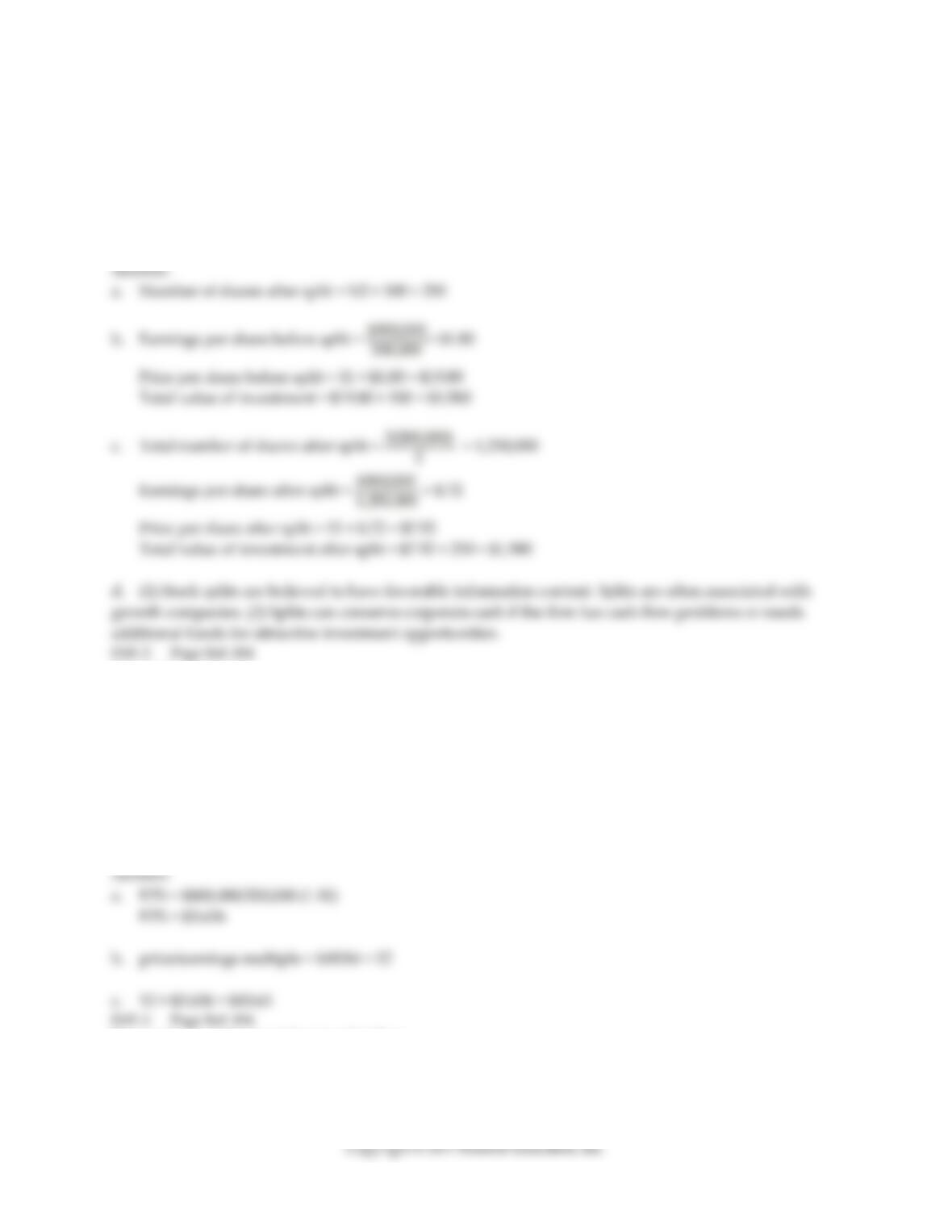
a. Calculate Cyberco’s earnings per share before and after the stock dividend.
b. Suppose an investor owns 100 shares of Cyberco before the stock dividend. Use the price earnings
multiple to estimate the value of the investor’s holdings both before and after the dividend.
c. Comment on the results of the stock dividend for current shareholders.
Keywords: Stock Dividend, Earnings Per Share, Price-Earnings Multiple
Learning Obj.: L.O. 13.4
AACSB: Analytical Thinking
40
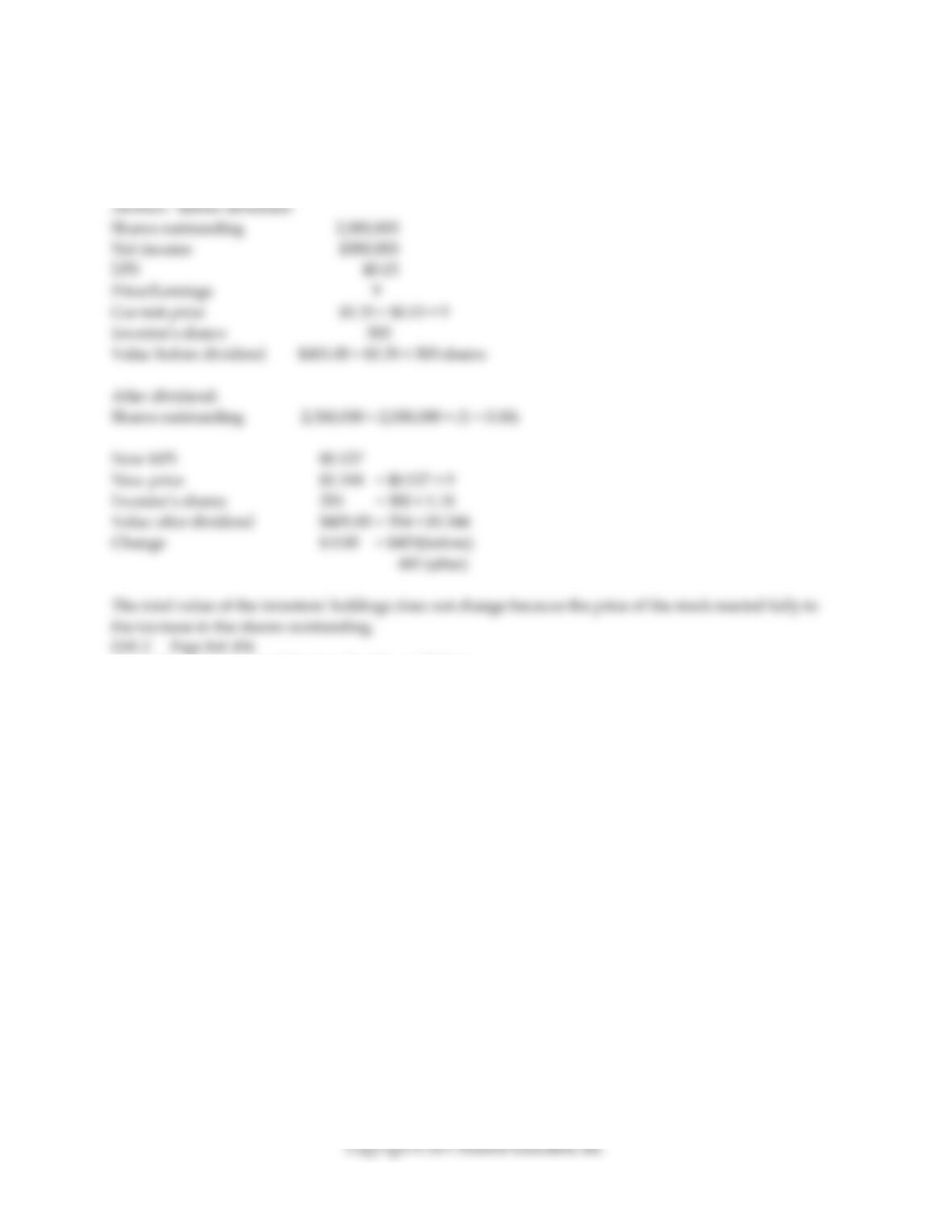
22) Dryden, Corp. has 500,000 shares of common stock outstanding, a P/E ratio of 11, and $900,000
earnings available for common stockholders. The board of directors has just voted a 5:2 stock split.
a. If you had 100 shares of stock before the split, how many shares will you have after the split?
b. What was the total value of your investment in Dryden stock before the split?
c. What should be the total value of your investment in Dryden stock after the split?
d. In view of your answers to (b) and (c) above, why would a firm’s management want to have a stock
split?
Keywords: Stock Split
Learning Obj.: L.O. 13.4
AACSB: Analytical Thinking
23) Ted Tech Inc. is offering a 10% stock dividend. The firm currently has 200,000 shares outstanding and
after-tax profits of $800,000. The current price of the stock is $48.
a. Calculate the new earnings per share.
b. What is the original price/earnings multiple?
c. Providing that the price/earnings multiple stays the same, what will the new stock price be after the
stock dividend?
Keywords: Stock Dividend, Earnings Per Share
Learning Obj.: L.O. 13.4
AACSB: Analytical Thinking
41
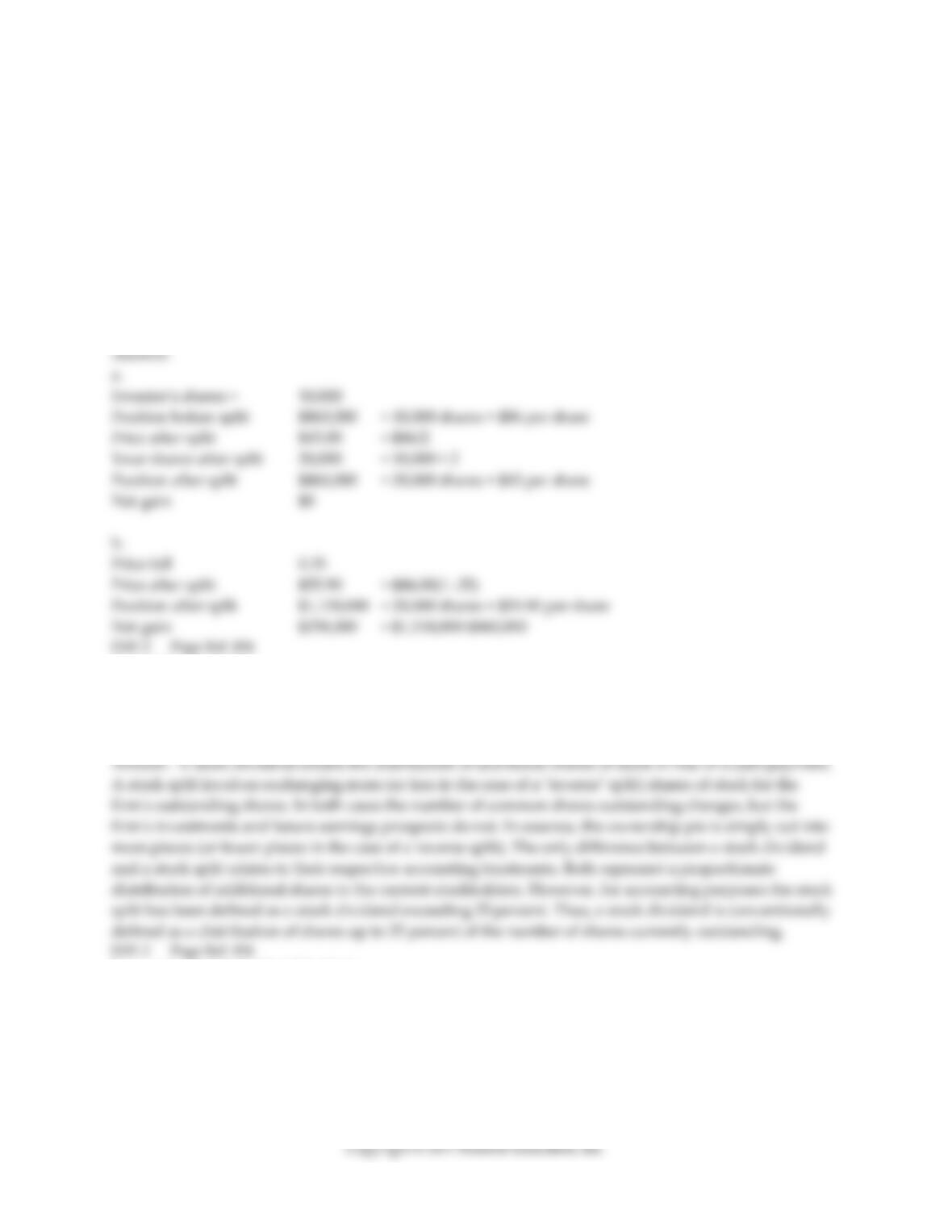
24) Outpost has 2 million shares of common stock outstanding; net income is $300,000; the P/E ratio is 9;
and management is considering an 18% stock dividend. What will be the expected effect on the price of
the common stock? If an investor owns 300 shares in the company, how does this change his total value?
Explain.
Keywords: Stock Dividend, Earnings Per Share, P/E Ratio
Learning Obj.: L.O. 13.4
AACSB: Analytical Thinking
42
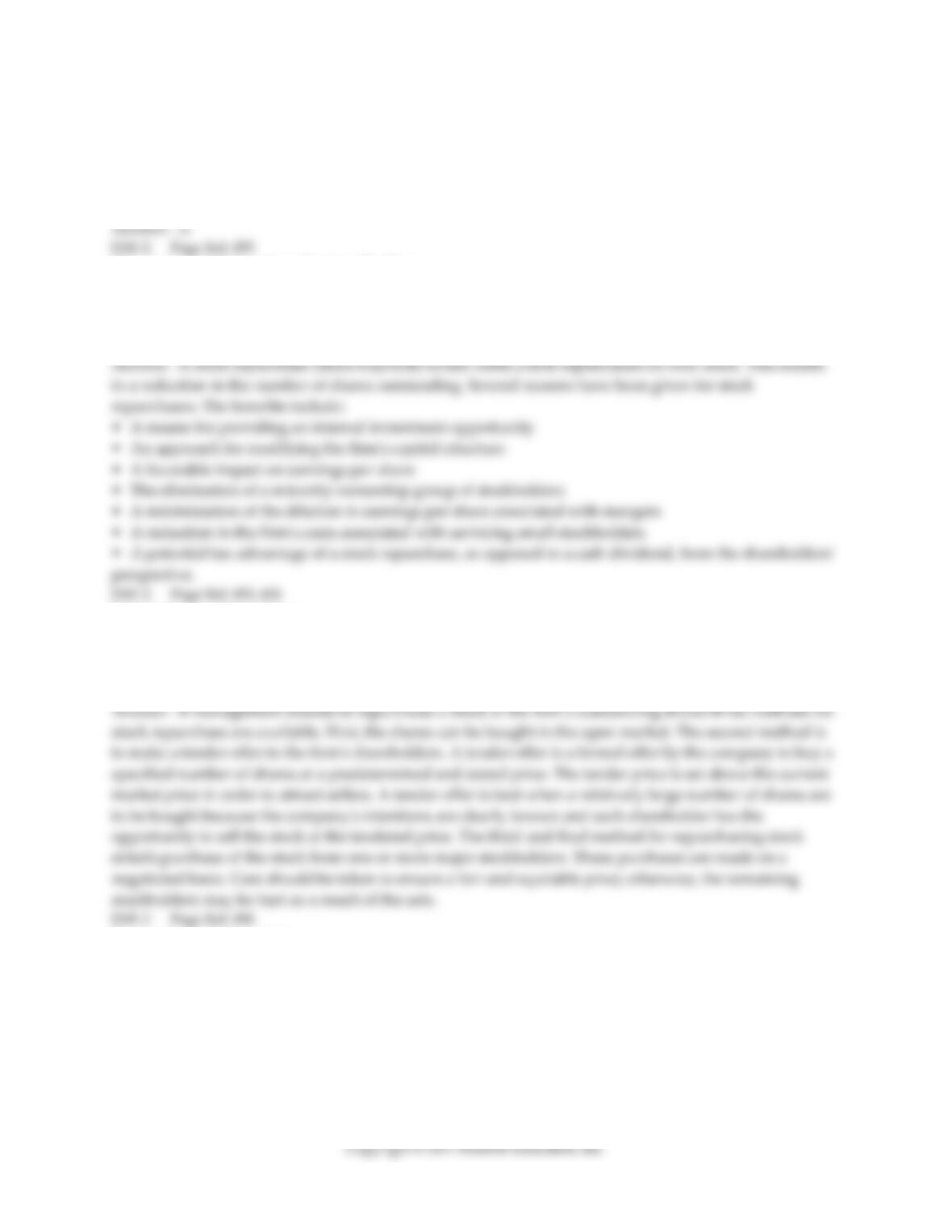
25) Kelly owns 10,000 shares in McCormick Spices, which currently has 500,000 shares outstanding. The
stock sells for $86 on the open market. McCormick’s management has decided on a two-for-one split.
a. Will Kelly’s financial position change after the split, assuming that the stock’s price will fall
proportionately?
Trevor Corporation – Stock Split
Market price $86.00
Split multiple 2
Shares outstanding 500,000
b. Assuming only a 35% decrease in the stock price, what will be Kelly‘s value after the split?
Keywords: Stock Split
Learning Obj.: L.O. 13.4
AACSB: Analytical Thinking
26) What is the difference between a stock split and a stock dividend?
Keywords: Stock Split, Stock Dividend
Learning Obj.: L.O. 13.4
AACSB: Reflective Thinking

43
27) What managerial logic might lie behind a stock split or a stock dividend?
Answer: A logic behind a stock split or a stock dividend could be based on the informational content of
the dividend-split announcement. Stock dividends and splits have generally been associated with
companies that have growing earnings. The announcement of a stock dividend or split has therefore been
perceived as favorable news. The empirical evidence, however, fails to verify these conclusions. Most
studies indicate that investors are perceptive in identifying the true meaning of such a distribution. If the
stock dividend or split is not accompanied by a positive trend in earnings and increases in cash
dividends, price increases surrounding the stock dividend or split are insignificant. Therefore, we should
be suspicious of the assertion that a stock dividend or split can help increase investors’ net worth.
Diff: 2 Page Ref: 455
Keywords: Stock Split, Stock Dividend
Learning Obj.: L.O. 13.4
AACSB: Reflective Thinking
Learning Objective 13.5
1) From the shareholders‘ perspective, a stock repurchase has a potential tax advantage over the payment
of a cash dividend.
Keywords: Stock Repurchase, Dividend
Learning Obj.: L.O. 13.5
AACSB: Reflective Thinking
2) Stock repurchases do not alter a company‘s capital structure since all of the purchased shares are
retired and no longer outstanding.
Keywords: Stock Repurchase, Capital Structure
Learning Obj.: L.O. 13.5
AACSB: Reflective Thinking
3) Shareholders may prefer a share repurchase program to dividends because dividends are subject to
taxation and increasing value per share due to repurchase programs is tax deferred.
Keywords: Stock Repurchases, Taxes
Learning Obj.: L.O. 13.5
AACSB: Reflective Thinking
4) A stock repurchase plan that involves issuing long-term debt to fund the purchase of the company’s
stock may be used as a way to alter a corporation‘s capital structure.
Keywords: Stock Repurchase, Capital Structure
Learning Obj.: L.O. 13.5
AACSB: Reflective Thinking

44
5) A stock repurchase plan can be viewed as both a financing decision and an investment decision.
Keywords: Stock Repurchase
Learning Obj.: L.O. 13.5
AACSB: Reflective Thinking
6) SEC regulations require that corporate stock repurchases must be done in the open market so that all
shareholders have an equal opportunity to sell their shares.
Keywords: Stock Repurchase
Learning Obj.: L.O. 13.5
AACSB: Reflective Thinking
7) One potential reason for a share repurchase is
A) to increase the power of a minority group of shareholders.
B) maximize the dilution in earnings associated with a merger.
C) a reduction in the firm‘s cost associated with servicing small stockholders.
D) to signal the market that the firm’s stock price is too high.
Keywords: Share Repurchase
Learning Obj.: L.O. 13.5
AACSB: Reflective Thinking
8) All of the following are potential benefits of stock repurchases EXCEPT
A) a means for providing an internal investment opportunity.
B) an approach for maintaining the existing capital structure while still making a distribution to
shareholders.
C) a favorable impact on earnings per share.
D) the elimination of a minority ownership group of stockholders.
Keywords: Stock Repurchase
Learning Obj.: L.O. 13.5
AACSB: Reflective Thinking
9) Which of the following statements concerning stock repurchases is MOST correct?
A) Increasingly companies are using stock repurchases to distribute cash to their shareholders, but
dividends remain the primary means to distribute cash.
B) Companies currently spend more money on stock buybacks than on dividend payments.
C) Repurchasing stock is strictly a financing decision made by the corporation.
D) A tender offer is the only way to complete a stock repurchase due to SEC rules.
Keywords: Stock Repurchase
Learning Obj.: L.O. 13.5
AACSB: Reflective Thinking

45
10) Stock repurchases may be used for all of the following EXCEPT
A) a means for providing an internal investment opportunity.
B) to improve earnings per share.
C) to decrease the corporation‘s debt ratio.
D) to eliminate a minority ownership group of stockholders.
Keywords: Stock Repurchase
Learning Obj.: L.O. 13.5
AACSB: Reflective Thinking
11) Which of the following strategies may be used to alter a firm’s capital structure toward a higher
percentage of debt compared to equity?
A) stock dividend
B) stock split
C) maintain a low dividend payout ratio
D) stock repurchase
Keywords: Stock Repurchase
Learning Obj.: L.O. 13.5
AACSB: Reflective Thinking
12) A stock repurchase may be viewed as
A) a dividend decision when the firm has excess cash.
B) a financing decision when the firm wants to alter its capital structure.
C) an operating leverage decision.
D) both A and B.
Keywords: Stock Repurchase, Dividend Decision, Financing Decision
Learning Obj.: L.O. 13.5
AACSB: Reflective Thinking
13) All of the following are methods available to a corporation that desires to repurchase stock EXCEPT
A) offer to employees who own an interest in the firm.
B) open market.
C) tender offer to all existing stockholders.
D) offer to one or more major stockholders on a negotiated basis.
Keywords: Stock Repurchase
Learning Obj.: L.O. 13.5
AACSB: Reflective Thinking
46
14) Which of the following will result from a stock repurchase?
A) Earnings per share will rise.
B) Number of shares will increase.
C) Corporate cash is conserved.
D) Ownership is diluted.
Keywords: Stock Repurchase, Earnings Per Share
Learning Obj.: L.O. 13.5
AACSB: Reflective Thinking
15) Identify three reasons why a firm might buy back its own common stock shares.
Keywords: Stock Repurchase
Learning Obj.: L.O. 13.5
AACSB: Reflective Thinking
16) Within the context of a stock repurchase, what is meant by a tender offer?
Keywords: Stock Repurchase
Learning Obj.: L.O. 13.5
AACSB: Reflective Thinking