11
Copyright © 2017 Pearson Education, Inc.
43) Low dividends may increase stock value according to the
A) bird-in-the-hand theory.
B) information effect.
C) impact of agency costs.
D) tax bias in favor of capital gains.
Keywords: Tax Bias
Learning Obj.: L.O. 13.2
AACSB: Reflective Thinking
44) The “bird-in-the-hand” dividend theory suggests that
A) high dividends increase stock value because shareholders believe they can earn a higher return than
the company.
B) high dividends increase stock value because shareholders are more certain of the dividend yield than
of potential future capital gains.
C) high dividends increase stock value because capital markets are inefficient and dividends are the only
sure way to get money from an equity investment.
D) high dividends decrease stock value because dividend payments take money out of the corporate
“nest” and reduce the ability of the corporation to function effectively.
Keywords: “Bird–in-the-hand” Dividend Theory
Learning Obj.: L.O. 13.2
AACSB: Reflective Thinking
45) Which of the following supports the “bird-in-the-hand” dividend theory?
A) Investors prefer dividends to capital gains because of the time value of money.
B) Increasing a firm’s dividends transfers risk and ownership from the current shareholders to new
owners.
C) Investment decisions are not influenced by dividend policy.
D) Capital mix decisions are not influenced by dividend policy.
Keywords: “Bird–in-the-hand” Dividend Theory
Learning Obj.: L.O. 13.2
AACSB: Reflective Thinking
46) The residual dividend theory suggests that dividends will only be paid
A) if the tax rate on capital gains is higher than the tax rate on dividends.
B) if the corporation has more positive NPV projects than it can fund.
C) if interest rates available to shareholders are higher than the required return on the company’s stock.
D) if current retained earnings exceed the equity portion of the firm‘s capital budget.
Keywords: Residual Dividend Theory
Learning Obj.: L.O. 13.2
AACSB: Reflective Thinking
12
47) Dividend changes may be used by management as a credible communication tool to signal investors
about future earnings under which of the following dividend policy theories?
A) the clientele effect
B) the residual dividend theory
C) the information effect
D) the expectations theory
Keywords: Information Effect, Signaling Theory
Learning Obj.: L.O. 13.2
AACSB: Reflective Thinking
48) The payment of dividends may indirectly result in closer monitoring of management’s investment
activities, thus increasing shareholder value by
A) reducing agency costs.
B) increasing information asymmetry.
C) increasing a company‘s amount of free cash flow.
D) reducing auditing fees.
Keywords: Agency Costs, Monitoring
Learning Obj.: L.O. 13.2
AACSB: Analytical Thinking
49) AFB, Inc. declared a dividend of $2 per share, which was an increase of 25% from the prior year, yet
AFB, Inc. stock declined by 3% the day of the announcement. DAS, Inc. declared a dividend of $2 per
share, which was the same as the prior year, and its stock increased in value by 2% on the day of the
announcement. These events could be most readily explained by the
A) information effect.
B) clientele effect.
C) expectations theory.
D) residual dividend theory.
Keywords: Expectations Theory
Learning Obj.: L.O. 13.2
AACSB: Reflective Thinking
13
50) All of the following factors support the proposition that dividend policy matters EXCEPT
A) investors desire to minimize and defer taxes, and capital gains get preferential tax treatment over
dividend income.
B) perfect capital markets.
C) information asymmetry exists between shareholders and managers.
D) flotation costs significantly increase the cost of new common stock compared to retained earnings.
Keywords: Dividend Policy, Perfect Capital Markets, Information Effects, Flotation Costs, Tax Effects
Learning Obj.: L.O. 13.2
AACSB: Reflective Thinking
51) An increase in flotation costs will most likely result in which of the following?
A) smaller dividend payments so that less external equity financing is needed
B) larger dividend payments so shareholders are able to earn their required returns
C) larger dividend payments to offset higher taxes paid by investors
D) no change in dividend policies because flotation costs are paid by purchasers of common stock
Keywords: Flotation Cost, Dividend Policy
Learning Obj.: L.O. 13.2
AACSB: Analytical Thinking
52) High dividends may increase stock values due to all of the following reasons EXCEPT
A) dividends are more certain than capital gains.
B) higher dividends are used to signal higher expected future earnings.
C) dividends are used as a tool to minimize agency costs.
D) higher dividends allow companies to increase their proportion of external equity financing.
Keywords: Dividend Policy, Flotation Costs, External Equity Financing
Learning Obj.: L.O. 13.2
AACSB: Analytical Thinking
53) According to the clientele effect,
A) companies should have dividend payout ratios of either 100% or 0%.
B) companies should avoid making capricious changes in their dividend policies.
C) companies should change their dividend policies to please their target group of investors.
D) even if capital markets are perfect, dividend policy still matters.
Keywords: Clientele Effect
Learning Obj.: L.O. 13.2
AACSB: Reflective Thinking
14
54) According to the perfect markets approach to dividend policy,
A) other things equal, the greater the payout ratio, the greater the share price of the firm.
B) the price of a share of stock is unrelated to dividend policy.
C) the firm should retain earnings so stockholders will receive a capital gain.
D) the firm should pay a dividend only after current equity financing needs have been met.
Keywords: Perfect Markets, Dividend Irrelevance Theory
Learning Obj.: L.O. 13.2
AACSB: Reflective Thinking
55) According to the residual theory of dividends,
A) dividends are a residual after investment financing needs have been met.
B) earnings remaining after payment of preferred stock dividends should be paid to common
stockholders.
C) dividend payments are a constant percentage of earnings per share.
D) a dividend is the residual above the payout ratio.
Keywords: Residual Dividend Theory
Learning Obj.: L.O. 13.2
AACSB: Reflective Thinking
56) All of the following may influence a firm’s dividend payment EXCEPT
A) investment opportunities.
B) investor transaction costs.
C) common stock par value.
D) flotation costs.
Keywords: Dividend Policy, Investment Opportunities, Investor Transact
Learning Obj.: L.O. 13.2
AACSB: Reflective Thinking
57) In perfect capital markets there
A) is no informational content assigned to a particular dividend policy.
B) are no income taxes.
C) are no flotation costs.
D) all of the above
Keywords: Perfect Capital Markets, Information Effects, Tax Effects, Flotation Costs
Learning Obj.: L.O. 13.2
AACSB: Reflective Thinking
15
58) A justification for no dividend payments that would be pleasing to shareholders could be
A) insufficient cash available for dividend payments.
B) positive NPV investment projects that require the firm to retain cash for investment purposes.
C) an investor clientele that prefers current liquidity.
D) cash will be used for a stock dividend.
Keywords: Low Dividend Payments
Learning Obj.: L.O. 13.2
AACSB: Analytical Thinking
59) Which of the following statements would be consistent with the dividend irrelevance theory?
A) There is no relationship between a firm’s dividend policy and the value of its common stock.
B) Perfect capital markets are assumed to exist which allow investors to buy and sell stock without
incurring any transaction costs.
C) Investors are indifferent whether stock returns come from dividend income or capital gains income.
D) All of the above
Keywords: Dividend Irrelevance Theory
Learning Obj.: L.O. 13.2
AACSB: Reflective Thinking
60) Which of the following statements would be consistent with the bird-in-the-hand dividend theory?
A) Investors are indifferent whether stock returns come from dividend income or capital gains income.
B) Dividends are more certain than capital gains income.
C) Wealthy investors prefer corporations to defer dividend payments because capital gains produce
greater after-tax income.
D) Dividends are less certain than capital gains.
Keywords: “Bird–in-the-hand” Dividend Theory
Learning Obj.: L.O. 13.2
AACSB: Reflective Thinking
61) Which of the following statements would be consistent with the residual dividend theory?
A) Wealthy investors prefer corporations to defer dividend payments because capital gains produce
greater after-tax income.
B) Dividends are more certain than capital gains.
C) Dividends should only be paid if a firm has profits in excess of the amount needed to finance the
current year’s capital investments.
D) Investors are indifferent whether stock returns come from dividend income or capital gains income.
Keywords: Residual Dividend Theory
Learning Obj.: L.O. 13.2
AACSB: Reflective Thinking
16
62) Assume that a firm has a steady record of paying high dividends for years. A new management team
decided to cut the current year‘s dividend in half without disclosing why. The market value of the stock
fell 35% on the day the dividend cut was announced. Which of the following would best explain the stock
market’s reaction to the announcement?
A) empirical theory
B) dividend irrelevance theory
C) residual dividend theory
D) information effect
Keywords: Information Effect
Learning Obj.: L.O. 13.2
AACSB: Reflective Thinking
63) Assume that a firm has a steady record of paying stable dividends for years. Market analysts had
expected management to increase the dividend by 7.5% in the latest quarter. However, management
announced a 15% increase in the current year’s dividend. The market value of the stock rose 20% on the
day of the announcement. Which of the following would best explain the stock market‘s reaction to the
announcement?
A) expectations theory
B) dividend irrelevance theory
C) residual dividend theory
D) agency theory
Keywords: Expectations Theory
Learning Obj.: L.O. 13.2
AACSB: Reflective Thinking
64) Assume that the tax on dividends and the tax on capital gains is the same. All else equal, what would
a prudent investor prefer?
A) The prudent investor would be indifferent between receiving dividends or capital gains.
B) The prudent investor would prefer dividends—a dollar today is always worth more than a dollar to be
received in the future.
C) The prudent investor would prefer capital gains—the capital gain tax liability can be deferred until
gains are realized.
D) More information is needed.
Keywords: Tax Deferral, Capital Gains Taxation, Clientele Effect
Learning Obj.: L.O. 13.2
AACSB: Analytical Thinking

17
65) Which of the following is (are) true?
A) In general, the higher the number of positive NPV investment opportunities for a firm, the lower the
dividend payout ratio.
B) If the clientele effect is correct, firms should follow a constant dividend payout ratio policy.
C) According to the informational content of dividends, an increase in dividends is always a positive
signal.
D) In industries with volatile earnings, the residual dividend policy results in the most consistent
dividend stream.
Keywords: Dividend Payout Ratio, Positive NPV Projects, Internal Financing
Learning Obj.: L.O. 13.2
AACSB: Reflective Thinking
66) Which of the following is true if dividend policy is irrelevant?
A) Perfect capital markets exist.
B) The clientele effect exists.
C) The information effect exists.
D) Tax deferral on capital gains exists.
Keywords: Dividend Irrelevance Theory, Perfect Capital Markets
Learning Obj.: L.O. 13.2
AACSB: Reflective Thinking
67) The “bird-in-the-hand dividend theory” supports which view of the effect of dividend policy on
company value?
A) A firm’s dividend policy is irrelevant.
B) High dividends increase stock values.
C) Low dividends increase stock values.
D) Constant dividends increase stock values.
Keywords: “Bird–in-the-hand” Dividend Theory
Learning Obj.: L.O. 13.2
AACSB: Reflective Thinking
68) The viewpoint that low dividends increase stock value is based on which of the following principles?
A) time value of money
B) risk-return trade-off
C) taxes bias business decisions
D) the agency problem
Keywords: Taxes, Dividend Policy
Learning Obj.: L.O. 13.2
AACSB: Reflective Thinking
18
69) The viewpoint that high dividends increase stock values is based on which of the following
principles?
A) time value of money
B) risk-return trade-off
C) taxes bias business decisions
D) the agency problem
Keywords: Dividend Policy, Time Value of Money
Learning Obj.: L.O. 13.2
AACSB: Reflective Thinking
70) AFB, Inc. and DAS, Inc. both paid a $2 per share dividend last year. This year, AFB, Inc. announces an
increase to $3 per share while DAS, Inc. announces an increase to $2.50 per share. After the
announcement, the price of DAS, Inc. stock increases and the price of AFB, Inc.’s stock decreases. Which
of the following best explains this situation?
A) The stock market is irrational.
B) AFB, Inc. had higher agency costs than DAS, Inc. prior to the announcement.
C) Both companies need to raise capital for positive NPV projects, and flotation costs are high.
D) Capital markets are perfect.
Keywords: Residual Dividend Theory
Learning Obj.: L.O. 13.2
AACSB: Analytical Thinking
71) The difference between the capital gains tax rate and the income tax rate is an incentive for
A) firms never to split their stock.
B) firms to declare more stock dividends.
C) firms to pay more earnings as dividends.
D) firms to retain more earnings.
Keywords: Capital Gains Taxation, Retained Earnings
Learning Obj.: L.O. 13.2
AACSB: Reflective Thinking
19
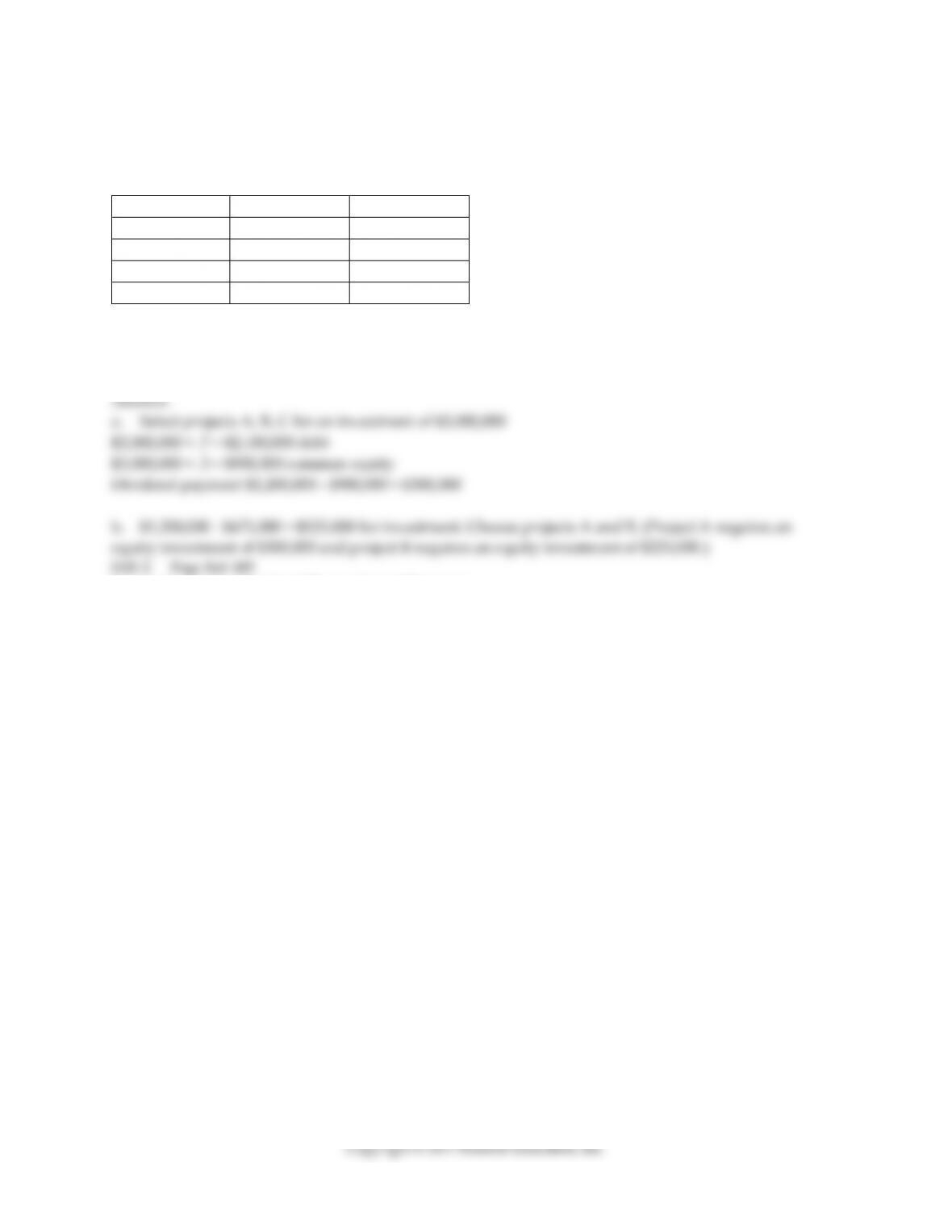
72) The Clydesdale Corporation has an optimal capital structure consisting of 70 percent debt and 30
percent equity. The marginal cost of capital is calculated to be 14.75 percent. Total earnings available to
common stockholders for the coming year total $1,200,000. Investment opportunities are:
Project
Investment
IRR (%)
A
$1,000,000
22
B
$750,000
18
C
$1,250,000
15
D
$500,000
14
a. According to the residual dividend theory, what should the firm’s total dividend payment be?
b. If the firm paid a total dividend of $675,000, and restricted equity financing to internally generated
funds, which projects should be selected? Assume the marginal cost of capital is constant.
Keywords: Residual Dividend Theory, Internal Financing
Learning Obj.: L.O. 13.2
AACSB: Analytical Thinking
20
73) Coppell Timber Company had total earnings last year of $5,000,000, but expects total earnings to drop
to $4,750,000 this year because of a slump in the housing industry. There are currently 1,000,000 shares of
common stock outstanding. The company has $4,000,000 worth of investments to undertake this year.
The company finances 40 percent of its investments with debt and 60 percent with equity capital. The
company paid $3.00 per share in dividends last year.
a. If the company follows a pure residual dividend policy, how large a dividend will each shareholder
receive this year?
b. If the company maintains a constant dividend payout ratio each year, how large a dividend will each
shareholder receive this year?
c. If the company follows a constant dollar dividend policy, how large a dividend will each shareholder
receive this year?
Keywords: Residual Dividend Policy, Constant Dividend Payout Ratio, Constant Dollar Dividend Policy
Learning Obj.: L.O. 13.2
AACSB: Analytical Thinking
74) Bass Frozen Foods, Inc. has found three acceptable investment opportunities. The three projects
require a total of $5 million in financing. It is the company‘s policy to finance its investments by using
40% debt and 60% common equity. The firm has generated $3.8 million dollars from its operations that
could be used to finance the common equity portion of its investments.
a. What portion of the new investments will be financed by common equity and what portion by debt?
b. According to the residual dividend theory, how much would be paid out in dividends?
Keywords: Capital Structure, Residual Dividend Theory
Learning Obj.: L.O. 13.2
AACSB: Analytical Thinking