1
Foundations of Finance, 9e (Keown/Martin/Petty)
Chapter 12 Determining the Financing Mix
Learning Objective 12.1
1) Business risk refers to the relative dispersion of a firm‘s earnings before interest and taxes.
Keywords: Business Risk
Learning Obj.: L.O. 12.1
AACSB: Reflective Thinking
2) Private equity funds tend to focus their investments in situations where promised returns are very high
and the need for funds is brief.
Keywords: Private Equity Funds
Learning Obj.: L.O. 12.1
AACSB: Reflective Thinking
3) The three major components responsible for variation in a company‘s income stream are business risk,
operating risk, and financial risk.
Keywords: Business Risk, Operating Risk, Financial Risk
Learning Obj.: L.O. 12.1
AACSB: Reflective Thinking
4) Sales of consumer durable goods, such as appliances, are more sensitive to swings in the business
cycle, and therefore companies in these industries face a higher level of operating risk.
Keywords: Business Risk, Operating Risk, Business Cycle
Learning Obj.: L.O. 12.1
AACSB: Reflective Thinking
5) Variation in a company‘s income stream results from its choice of business line, its choice of an
operating cost structure, and its choice of a capital structure.
Keywords: Business Risk
Learning Obj.: L.O. 12.1
AACSB: Reflective Thinking
6) Business risk refers to the relative dispersion (variability) of a company‘s net income.
Keywords: Business Risk
Learning Obj.: L.O. 12.1
AACSB: Reflective Thinking
2
7) Corporations utilize external financing either because they do not have sufficient earnings to reinvest
or they want to rebalance their capital structures.
Keywords: Capital Structure, Internal Financing, External Financing
Learning Obj.: L.O. 12.1
AACSB: Reflective Thinking
8) Companies that sell basic necessities face the highest levels of business risk because consumers will
price shop aggressively for items they purchase on a regular basis.
Keywords: Business Risk
Learning Obj.: L.O. 12.1
AACSB: Reflective Thinking
9) The four basic determinants of business risk include all of the following EXCEPT
A) the stability of the domestic economy.
B) the level of fixed cost used in the company‘s production process.
C) sensitivity to the business cycle.
D) competitive pressures in the firm’s industry.
Keywords: Business Risk
Learning Obj.: L.O. 12.1
AACSB: Reflective Thinking
10) A high degree of variability in a firm’s earnings before interest and taxes refers to
A) business risk.
B) financial risk.
C) financial leverage.
D) operating leverage.
Keywords: Business Risk
Learning Obj.: L.O. 12.1
AACSB: Reflective Thinking
11) Business risk refers to
A) the risk associated with financing a firm with debt.
B) the variability of a firm’s expected earnings before interest and taxes.
C) the uncertainty associated with a firm’s CAPM.
D) the variability of a firm’s stock price.
Keywords: Business Risk
Learning Obj.: L.O. 12.1
AACSB: Reflective Thinking
3
12) What are the three determinants of the volatility of a firm’s earnings?
Keywords: Business Risk, Operating Risk, Financial Risk
Learning Obj.: L.O. 12.1
AACSB: Reflective Thinking
13) Describe the sources of business risk.
Keywords: Business Risk
Learning Obj.: L.O. 12.1
AACSB: Reflective Thinking
Learning Objective 12.2
1) A key tool for evaluating business risk is break-even analysis.
Keywords: Business Risk, Operating Risk, Break-Even Analysis
Learning Obj.: L.O. 12.2
AACSB: Reflective Thinking
4
2) The break-even quantity of output is that quantity of output, in units, that results in an EBIT equal to
zero.
Keywords: Break-even Quantity, EBIT
Learning Obj.: L.O. 12.2
AACSB: Reflective Thinking
3) Break-even analysis is a short-term concept because, in the long run, all costs are variable.
Keywords: Break-even Analysis
Learning Obj.: L.O. 12.2
AACSB: Reflective Thinking
4) As production levels increase, fixed costs stay the same in total, but decrease on a per unit basis.
Keywords: Fixed Costs Per Unit
Learning Obj.: L.O. 12.2
AACSB: Analytical Thinking
5) Break-even analysis ignores fixed costs because fixed costs do not change.
Keywords: Break-even Analysis, Fixed Costs
Learning Obj.: L.O. 12.2
AACSB: Reflective Thinking
6) Fixed costs are called indirect costs while variable costs are called direct costs.
Keywords: Fixed Costs, Variable Costs, Direct Costs, Indirect Costs
Learning Obj.: L.O. 12.2
AACSB: Reflective Thinking
7) As the volume of production increases the variable cost–per unit of the product decreases.
Keywords: Variable Cost Per Unit
Learning Obj.: L.O. 12.2
AACSB: Analytical Thinking
8) A decrease in the level of production results in decreased fixed cost per unit.
Keywords: Fixed Costs Per Unit
Learning Obj.: L.O. 12.2
AACSB: Analytical Thinking
5
9) If sales double, the break-even model assumes that total variable costs will double.
Keywords: Break-even, Variable Costs
Learning Obj.: L.O. 12.2
AACSB: Analytical Thinking
10) The break-even model assumes that selling price per unit and variable cost per unit of output are
constant over the relevant range of output.
Keywords: Break-even Model, Selling Price Per Unit, Variable Cost Per Unit
Learning Obj.: L.O. 12.2
AACSB: Reflective Thinking
11) If fixed costs are $150,000, price per unit is $10, and variable cost per unit is $4, the break-even point is
15,000 units.
Keywords: Break-even Point
Learning Obj.: L.O. 12.2
AACSB: Analytical Thinking
12) Fixed costs per unit vary inversely with production output.
Keywords: Fixed Costs Per Unit
Learning Obj.: L.O. 12.2
AACSB: Reflective Thinking
13) Over the relevant range of output, fixed costs remain unchanged.
Keywords: Fixed Costs, Relevant Range
Learning Obj.: L.O. 12.2
AACSB: Reflective Thinking
14) Jones Blanket Company sells blankets for $25 each. The variable cost of each blanket is $10. If fixed
cost is $4,500,000, then the break-even point is 300,000 units.
Keywords: Break-even Point
Learning Obj.: L.O. 12.2
AACSB: Analytical Thinking
15) Depreciation is considered a fixed cost.
Keywords: Depreciation, Fixed Cost
Learning Obj.: L.O. 12.2
AACSB: Reflective Thinking
6
16) Fixed operating costs include charges incurred from the firm’s use of debt financing.
Keywords: Fixed Operating Costs, Debt Financing
Learning Obj.: L.O. 12.2
AACSB: Reflective Thinking
17) In break-even analysis, semivariable costs are segregated into their fixed and variable components
over the relevant range of output.
Keywords: Semivariable Costs, Break–Even Analysis
Learning Obj.: L.O. 12.2
AACSB: Reflective Thinking
18) Break-even analysis assumes that a multiproduct firm maintains a constant production and sales mix.
Keywords: Break-even Analysis, Multiproduct Firm
Learning Obj.: L.O. 12.2
AACSB: Reflective Thinking
19) Kohler Manufacturing typically achieves one of three production levels in any given year: 8 million
pounds of steel, 10 million pounds of steel, or 16 million pounds of steel. In tracking some of its costs,
Kohler’s controller discovered one cost that was $10 per pound at a production level of 8 million pounds,
$8 per pound at a production level of 10 million pounds, and $5 per pound at a production level of 16
million pounds. This is an example of a
A) variable cost.
B) fixed cost.
C) semivariable cost.
D) semifixed cost.
Keywords: Fixed Costs Per Unit
Learning Obj.: L.O. 12.2
AACSB: Reflective Thinking
7
20) Kohler Manufacturing typically achieves one of three production levels in any given year: 8 million
pounds of steel, 10 million pounds of steel, or 16 million pounds of steel. In tracking some of its costs,
Kohler’s controller discovered one cost that was $10 per pound no matter what the production level for
the year. This is an example of a
A) variable cost.
B) fixed cost.
C) semivariable cost.
D) semifixed cost.
Keywords: Variable Cost, Variable Cost per Unit
Learning Obj.: L.O. 12.2
AACSB: Reflective Thinking
21) The break-even model enables the manager of the firm to
A) calculate the minimum price of common stock for certain situations.
B) set appropriate equilibrium thresholds.
C) determine the quantity of output that must be sold to cover all operating costs.
D) determine the optimal amount of debt financing to use.
Keywords: Break-even Model
Learning Obj.: L.O. 12.2
AACSB: Reflective Thinking
22) As production levels increase,
A) variable costs per unit decrease.
B) fixed costs per unit increase.
C) fixed costs per unit stay the same and variable costs per unit increase.
D) fixed costs per unit decrease and variable costs per unit stay the same.
Keywords: Fixed Costs, Variable Costs
Learning Obj.: L.O. 12.2
AACSB: Analytical Thinking
23) The break-even point is equal to
A) fixed costs divided by (sales price per unit – variable cost per unit).
B) fixed costs divided by unit variable costs.
C) fixed costs divided by selling price per unit.
D) (sales price per unit – variable cost per unit) times the fixed costs.
Keywords: Break-even Point, Fixed Costs, Variable Costs
Learning Obj.: L.O. 12.2
AACSB: Analytical Thinking
8
24) HomeCraft makes wooden play sets. The company pays annual rent of $400,000 per year and pays
administrative salaries totaling $150,000 per year. Each play set requires $400 of wood, ten hours of labor
at $70 per hour, and variable overhead costs of $100. Fixed advertising expenses equal $100,000 per year.
Each play set sells for $3,200. What is HomeCraft‘s break-even output level?
A) 340 play sets
B) 325 play sets
C) 297 play sets
D) 258 play sets
Keywords: Break-even Output, Variable Costs, Fixed Costs
Learning Obj.: L.O. 12.2
AACSB: Analytical Thinking
25) QuadCity Manufacturing, Inc. reported the following items: Sales = $6,000,000; Variable Costs of
Production = $1,500,000; Variable Selling and Administrative Expenses = $550,000; Fixed Costs =
$1,350,000; EBIT = $2,600,000; and the Marginal Tax Rate = 35%. QuadCity’s break-even point in sales
dollars is
A) $2,050,633.
B) $2,197,500.
C) $2,438,750.
D) $2,785,000.
Keywords: Break-even Point, Fixed Costs, Variable Costs
Learning Obj.: L.O. 12.2
AACSB: Analytical Thinking
26) Variable costs include all of the following EXCEPT
A) property taxes.
B) direct labor.
C) sales commissions.
D) annual rent.
Keywords: Variable Cost
Learning Obj.: L.O. 12.2
AACSB: Reflective Thinking
27) Which of the following is a fixed cost?
A) insurance
B) direct material
C) direct labor
D) freight costs on products
Keywords: Fixed Costs
Learning Obj.: L.O. 12.2
AACSB: Reflective Thinking
9
28) A plant may remain operating when sales are depressed
A) if the selling price per unit exceeds the variable cost per unit.
B) to help the local economy.
C) in an effort to cover at least some of the variable cost.
D) unless variable costs are zero when production is zero.
Keywords: Break-even Analysis
Learning Obj.: L.O. 12.2
AACSB: Analytical Thinking
29) Potential applications of the break-even model include
A) replacement for time-adjusted capital budgeting techniques.
B) pricing policy.
C) optimizing the cash-marketable securities position of a firm.
D) all of the above.
Keywords: Break-even Model, Pricing Policy
Learning Obj.: L.O. 12.2
AACSB: Reflective Thinking
30) Break-even analysis is used to study the effect on EBIT of changes in all of the following EXCEPT
A) corporate taxes.
B) prices.
C) cost structure.
D) volume.
Keywords: Break-even Analysis
Learning Obj.: L.O. 12.2
AACSB: Reflective Thinking
10
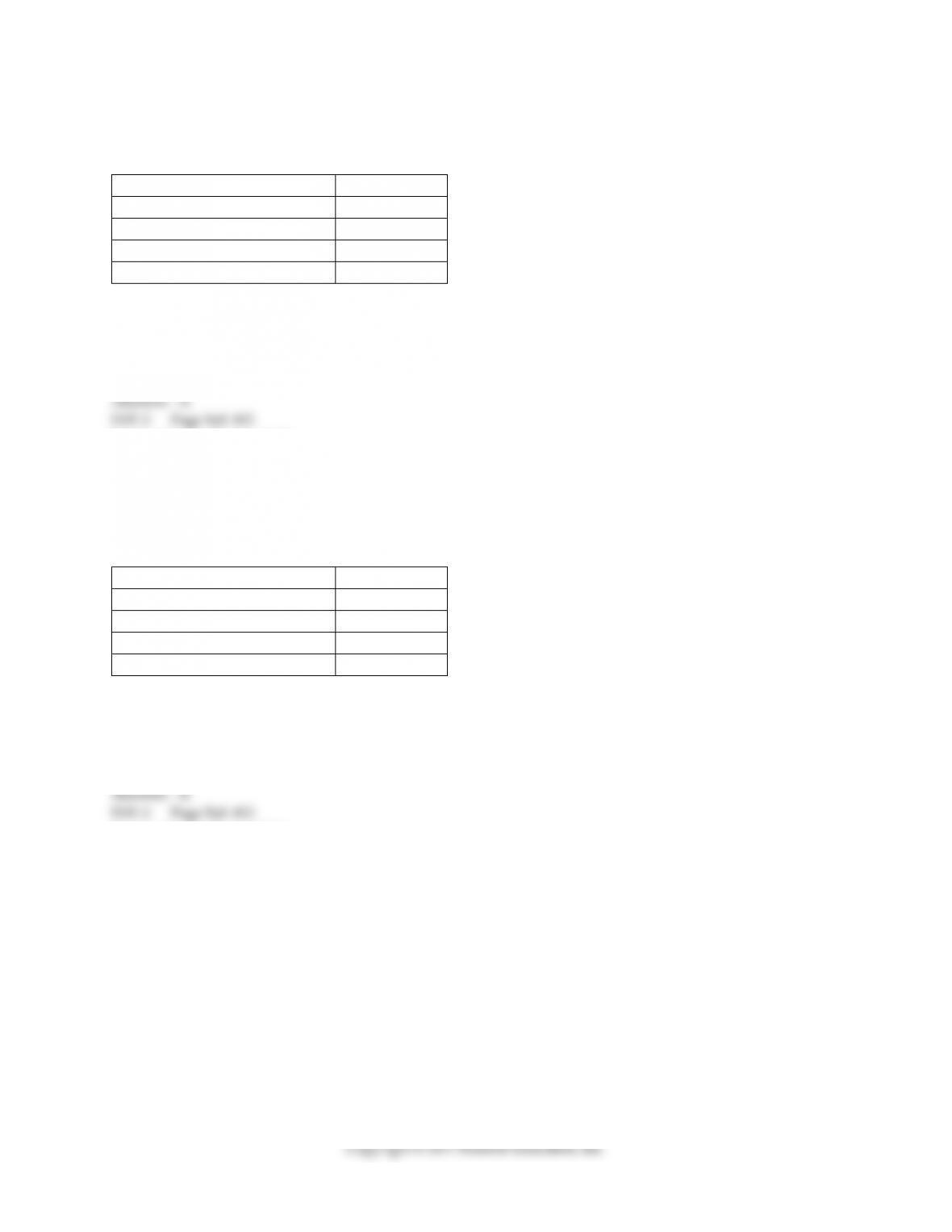
31) Based on the data contained in Table A, what is the break-even point in units produced and sold?
TABLE A
Average selling price per unit
$18.00
Variable cost per unit
$13.00
Units sold
400,000
Fixed costs
$650,000
Interest expense
$50,000
A) 130,000
B) 140,000
C) 150,000
D) 180,000
Keywords: Break-even Units
Learning Obj.: L.O. 12.2
AACSB: Analytical Thinking
32) Based on the data contained in Table A, what is the break-even point in sales dollars?
TABLE A
Average selling price per unit
$18.00
Variable cost per unit
$13.00
Units sold
400,000
Fixed costs
$650,000
Interest expense
$50,000
A) $2,340,000
B) $1,850,000
C) $1,775,500
D) $700,000
Keywords: Break-even Sales
Learning Obj.: L.O. 12.2
AACSB: Analytical Thinking