31
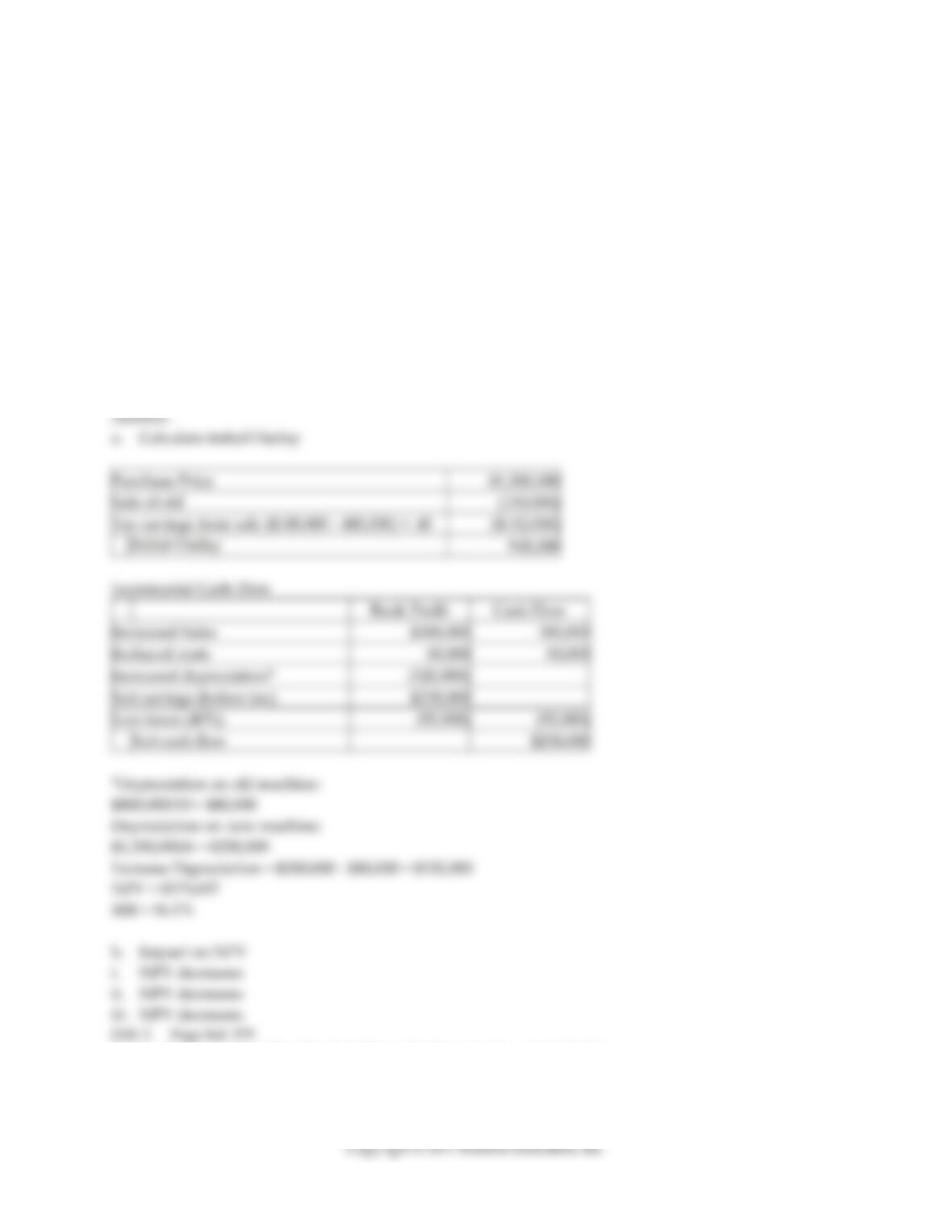
73) Premium Pie Company needs to purchase a new baking oven to replace an older oven that requires
too much energy to run. The industrial size oven will cost $1,200,000. The oven will be depreciated on a
straight-line basis over its six-year useful life. The old oven cost the company $800,000 just four years ago.
The old oven is being depreciated on a straight-line basis over its expected ten-year useful life. (That is,
the old oven is expected to last six more years if it is not replaced now.) Due to changes in fuel costs, the
old oven may only be sold today for $100,000. The new oven will allow the company to expand,
increasing sales by $300,000 per year. Expenses will also decrease by $50,000 per year due to the more
energy efficient design of the new oven. Premium Pie Company is in the 40% marginal tax bracket and
has a required rate of return of 10%.
a. Calculate the net present value and internal rate of return of replacing the existing machine
b. Explain the impact on NPV of the following:
i. Required rate of return increases
ii. Operating costs of new machine are increased
iii. Existing machine sold for less
Keywords: Incremental After-Tax Cash Flows, Net Present Value, Initial Outlay
Learning Obj.: L.O. 11.2
AACSB: Analytical Thinking
32
74) Agri-Industries purchased some agricultural land at the edge of a large metropolitan area for $250,000
five years ago. In order to have the land classified as agricultural for property tax purposes, the company
has been leasing the property to neighboring farmers. The before-tax return from leasing the property is
$12,000 per year. This company‘s corporate tax rate is 35 percent. If the company sells the land for
$400,000 today, what is the internal rate of return on this investment?
Keywords: Incremental After-Tax Cash Flows, Initial Outlay, Internal Rate of Return
Learning Obj.: L.O. 11.2
AACSB: Analytical Thinking
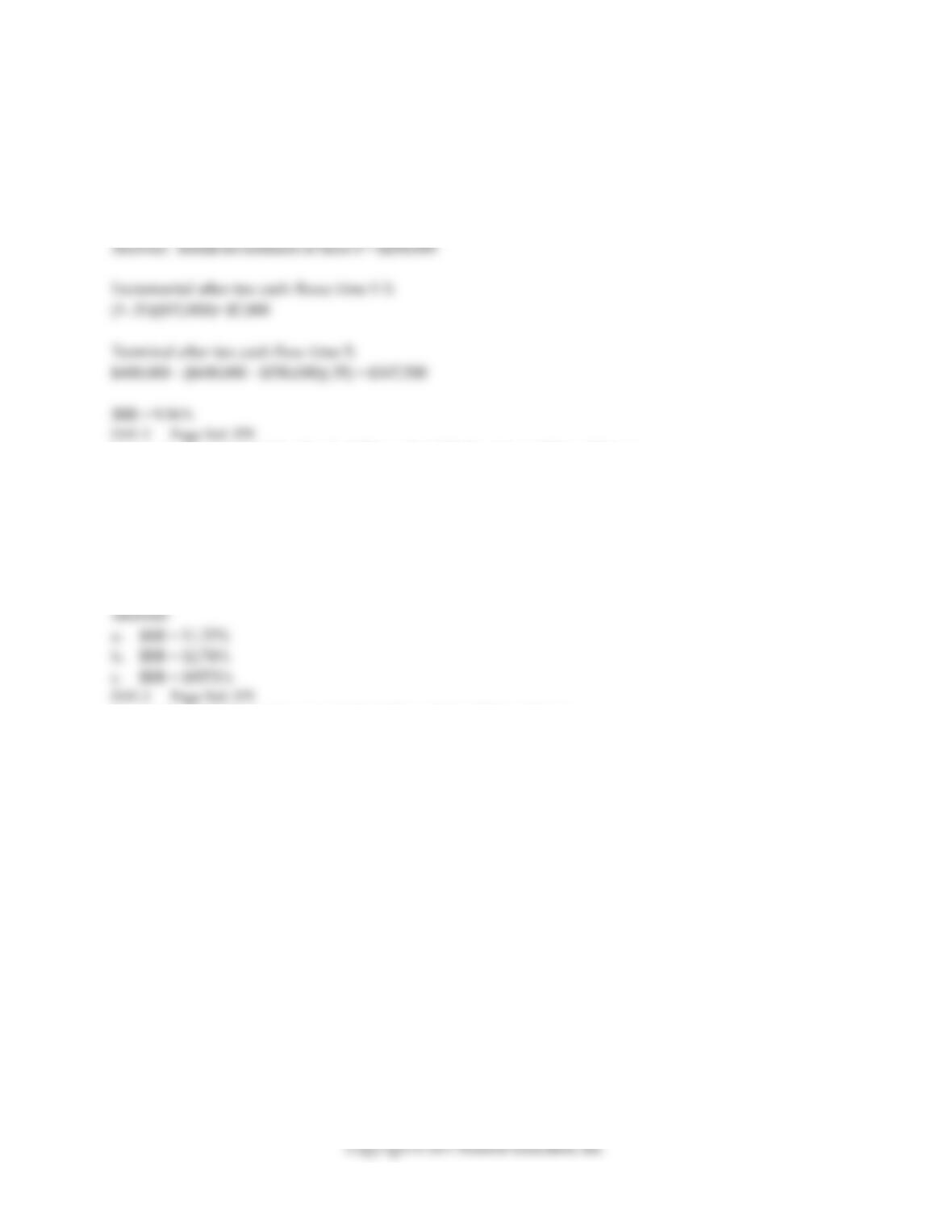
75) Calculate the internal rate of return on the following projects:
a. Initial outlay of $60,500 with an after-tax cash flow of $11,897 per year for eight years.
b. Initial outlay of $647,000 with an after-tax cash flow of $118,000 per year for ten years.
c. Initial outlay of $25,400 with an after-tax cash flow $11,788 per year for three years.
Keywords: Initial Outlay, Incremental Cash Flows, Internal Rate of Return
Learning Obj.: L.O. 11.2
AACSB: Analytical Thinking

33
76) Kelly Corporation is considering an investment proposal that requires an initial investment of
$150,000 in equipment. Fully depreciated existing equipment may be disposed of for $40,000 pre-tax. The
proposed project will have a five-year life, and is expected to produce additional revenue of $65,000 per
year. Expenses other than depreciation will be $15,000 per year. The new equipment will be depreciated
to zero over the five-year useful life, but it is expected to actually be sold for $20,000. Kelly has a 35% tax
rate.
a. What is the net initial outlay for the proposed project?
b. What is the operating cash flow for years 1–4?
c. What is the total cash flow at the end of year five (operating cash flow for year 5 plus terminal cash
flow)?
Keywords: Initial Outlay, Incremental Operating Cash Flows, Terminal Cash Flow
Learning Obj.: L.O. 11.2
AACSB: Analytical Thinking
77) Dave Company, Inc. is considering purchasing a new grinding machine with a useful life of five
years. The initial outlay for the machine is $165,000. The expected cash inflows are as follows:
Year
After-tax Expected Cash Flow
1
15,000
2
35,000
3
70,000
4
90,000
5
70,000
Given that the firm has a 10% required rate of return, what is the NPV?
Keywords: Net Present Value, Initial Outlay, Incremental After-tax Cash Flows
Learning Obj.: L.O. 11.2
AACSB: Analytical Thinking
34
78) P.D. Corporation is considering the purchase of a high-speed lathe that has an invoice price of
$250,000. The cost to ship the lathe to P.D.‘s factory is $10,000, and the existing facilities will require
modifications that are expected to cost $20,000. The machine will be depreciated on a straight-line basis
over its useful life of 10 years, assuming no salvage value. P.D. Corporation is planning on paying for the
lathe using a line of credit at the bank that has an interest rate of 6 percent per year. The lathe is expected
to increase production and sales. Sales are expected to increase by $100,000 per year. Inventory and
accounts receivable balances are expected to increase by $10,000 and $20,000 respectively. Expenses to
operate the lathe are $25,000 per year. P.D.’s marginal tax rate is 40%.
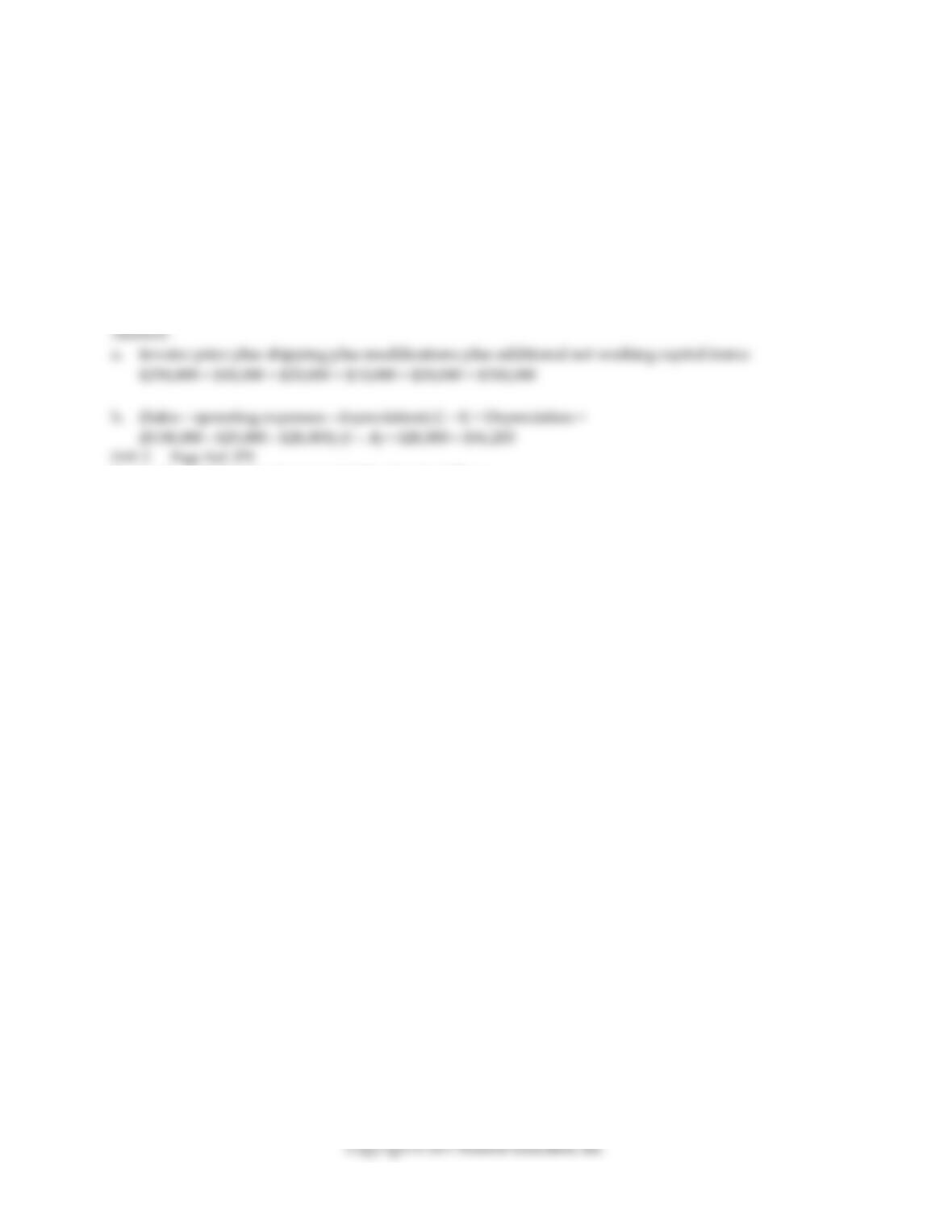
a. Calculate the initial outlay required to fund this project.
b. Calculate the incremental after-tax cash flow in year one of the project.
Keywords: Initial Outlay, Incremental After-Tax Cash Flows
Learning Obj.: L.O. 11.2
AACSB: Analytical Thinking
35
79) LEE Corporation intends to purchase equipment for $1,500,000. The equipment has a 5-year useful life
and will be depreciated on a straight-line basis. Addition of the equipment requires additional working
capital of $20,000. The $20,000 is expected to be recaptured at the end of the project. LEE’s marginal tax
rate is 40%. Use of the equipment is expected to change the company‘s reported EBIT by $600,000 in year
one, $700,000 in year two, $550,000 in year three, $200,000 in year four, and $100,000 in year five. Due to
changing market conditions, the equipment did have a salvage value of $100,000 at the end of year five.
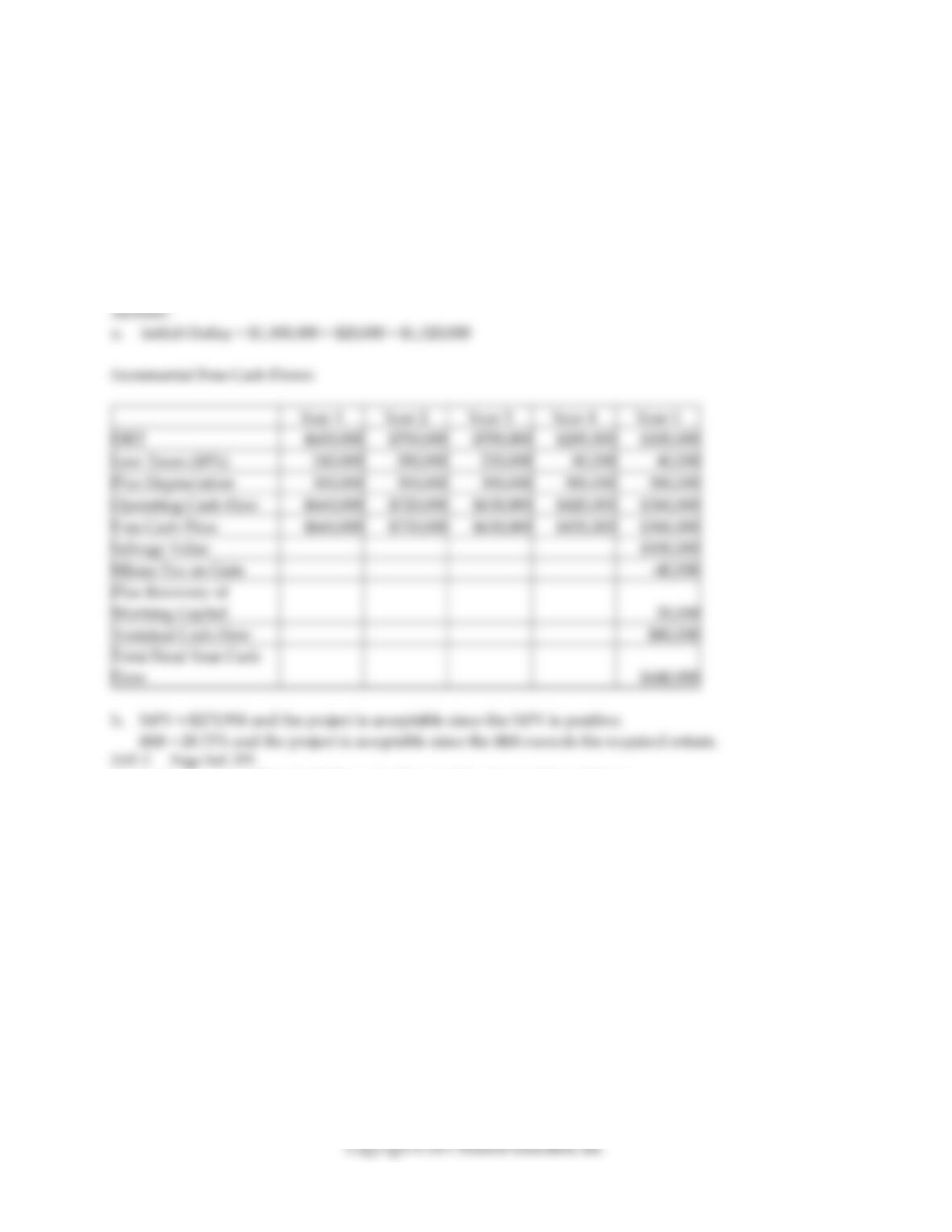
a. Calculate the initial outlay and the incremental free cash flows over the life of the project.
b. If the risk-adjusted discount rate for this project is 20%, calculate the project‘s net present value and
internal rate of return and comment on the acceptability of the project.
Keywords: Incremental Free Cash Flows, Net Present Value, Internal Rate of Return
Learning Obj.: L.O. 11.2
AACSB: Analytical Thinking
36
80) J.B. Corporation is considering the purchase of equipment that has an invoice price of $450,000. The
equipment was recommended by a consulting firm that did an analysis for J.B. Corporation. J.B. paid the
consulting firm $12,000 for its report. The cost of shipping and installation is $50,000. The equipment will
be depreciated on a straight-line basis over its useful life of 10 years, assuming no salvage value. The
equipment will replace existing assets that have a current book value of $100,000 and which could be sold
for $150,000. Additional net working capital of $15,000 will be required to maintain the equipment and to
support higher sales. J.B.’s marginal tax rate is 40%. Calculate the initial outlay required to fund this
project.
Keywords: Initial Outlay, Tax Effect of Sale of Old Assets, Additional Net Working Capital, Sunk Costs
Learning Obj.: L.O. 11.2
AACSB: Analytical Thinking
81) In general, a project’s cash flows will fall into one of three categories. What are these categories?
Keywords: Free Cash Flow, Initial Outlay, Differential Cash Flows, Terminal Cash Flow
Learning Obj.: L.O. 11.2
AACSB: Reflective Thinking
37
Copyright © 2017 Pearson Education, Inc.
Learning Objective 11.3
1) Three of the most common options that can add value to a capital budgeting project are the option to
delay the project, the option to expand the project, and the option to abandon the project.
Keywords: Options in Capital Budgeting
Learning Obj.: L.O. 11.3
AACSB: Reflective Thinking
2) A major corporation is considering a capital budgeting project that involves the development of a new
technology. The controller estimates the net present value to be negative, yet argues that the company
should invest in the project. Which of the following statements is MOST correct?
A) The controller should be fired for making such a poor decision.
B) The controller may be considering the option to expand or modify the project in the future.
C) The profitability index may be greater than one, giving an accept decision.
D) Capital rationing may exist for the current year.
Keywords: Capital Budgeting Options
Learning Obj.: L.O. 11.3
AACSB: Reflective Thinking
3) Give an example of an option to delay a project. Why might this be of value?
Keywords: Options in Capital Budgeting
Learning Obj.: L.O. 11.3
AACSB: Reflective Thinking
38
4) Give an example of an option to expand a project. Why might this be of value?
Keywords: Options in Capital Budgeting
Learning Obj.: L.O. 11.3
AACSB: Reflective Thinking
5) Give an example of an option to abandon a project. Why might this be of value?
Keywords: Options in Capital Budgeting
Learning Obj.: L.O. 11.3
AACSB: Reflective Thinking
Learning Objective 11.4
1) A small, family-owned corporation would be more likely to use the contribution–to-firm risk criteria
rather than the systematic risk to evaluate capital budgeting projects.
Keywords: Contribution-To-Firm Risk, Systematic Risk
Learning Obj.: L.O. 11.4
AACSB: Reflective Thinking
2) Since stockholders are able to reduce their exposure to risk by efficiently diversifying their holdings of
securities, there is no reason for individual firms to seek diversification of their holdings of assets.
Keywords: Diversification, CAPM
Learning Obj.: L.O. 11.4
AACSB: Reflective Thinking

39
3) According to the CAPM, systematic risk is the only relevant risk for capital budgeting purposes.
Keywords: CAPM, Systematic Risk
Learning Obj.: L.O. 11.4
AACSB: Reflective Thinking
4) A project’s contribution–to-firm risk does allow for diversification within the firm.
Keywords: Contribution-To-Firm Risk, Diversification
Learning Obj.: L.O. 11.4
AACSB: Reflective Thinking
5) A project’s standing alone risk allows for diversification within a sole firm.
Keywords: Standing Alone Risk, Diversification
Learning Obj.: L.O. 11.4
AACSB: Reflective Thinking
6) The most relevant measure of risk for capital budgeting is project standing alone risk.
Keywords: Project Standing Alone Risk
Learning Obj.: L.O. 11.4
AACSB: Reflective Thinking
7) A project’s contribution to firm risk is relevant for undiversified investors or when bankruptcy costs
exist.
Keywords: Project’s Contribution to Firm Risk
Learning Obj.: L.O. 11.4
AACSB: Reflective Thinking
8) The use of risk-adjusted discount rates is based on the concept that investors require a higher rate of
return for more risky projects.
Keywords: Risk-Adjusted Discount Rate, Risk-Return Trade-off
Learning Obj.: L.O. 11.4
AACSB: Reflective Thinking
9) The risk-adjusted discount rate method implicitly assumes that distant cash flows have the same risk
as near cash flows.
Keywords: Risk-Adjusted Discount Rate
Learning Obj.: L.O. 11.4
AACSB: Reflective Thinking