Chapter 5
Multiple Choice
1. Which of the following is not a “principle of behavior” as described in the textbook?
a. All behavior is learned
b. All behavior serves a purpose
c. All behavior is automatic
d. All behavior is contextual
2. Which concept is referred to as “a particular teaching strategy that…uses the three-term
contingency”?
a. Incidental teaching
b. Milieu teaching
c. Discrete trial training
d. Errorless teaching
3. A discriminative stimulus, or SD, is also known as what?
a. Antecedent
b. Behavior
c. Consequence
d. Teaching
4. Having the student sit up straight, hands in lap, and looking toward the teacher are all examples
of which important concept?
a. Discrete trial teaching
b. Shaping
c. Instructional control
d. Errorless teaching
5. What is “additional help that is provided to a student to make sure each learning attempt is
successful”?
a. Instructional cue
b. Prompt
c. Discrete trial teaching
d. Chaining
6. Providing a system of most-to-least prompts is also known as what?
a. Errorless learning
b. Error correction
c. Incidental teaching
d. Instructional control
7. Once a skill has been mastered, a teacher may use which system of prompts, only as needed?
a. Most-to-least
b. Least-to-most
c. Errorless learning
d. Graduated guidance
8. Making “two or more items available to the student and asking the student to respond to one of
them” is an example of which concept?
a. Shaping
b. Chaining
c. Incidental teaching
d. Discrimination training
9. Which concept is referred to as the process of reinforcing successive approximations of the
desired behavior?
a. Shaping
b. Chaining
c. Incidental teaching
d. Discrimination training
10. Which instructional strategy is used to teach a series of behaviors in a complex, multi-step skill?
a. Shaping
b. Chaining
c. Incidental teaching
d. Discrimination training
11. The behavioral approach to language, as developed by Skinner, is known as what?
a. Incidental teaching
b. Milieu teaching
c. Verbal Behavior
d. Receptive language
12. A request is known as which Verbal Behavior?
a. Mand
b. Tact
c. Intraverbal
d. Echoic
13. A label is known as which Verbal Behavior?
a. Mand
b. Tact
c. Intraverbal
d. Echoic
14. Answering questions is an example of which Verbal Behavior?
a. Mand
b. Tact
c. Intraverbal
d. Echoic
Short answer
1. List the 3 principles of behavior as described in the textbook.
2. What is the three-term contingency?
3. List 3 things to keep in mind during discrete trial training.
4. List the hierarchy of prompts from most to least dependence.
5. What are the steps of the error correction procedure?
6. List the 3 skills needed for modeling to be an effective instructional strategy for students.
Essay
1. Describe the rationale (including research) for the use of applied behavior analysis with students
with ASD.
2. List and describe each of the 3 principles of behavior as discussed in the textbook.
3. Compare and contrast discrete trial training versus incidental or milieu teaching. Describe how
one might combine the two approaches.
4. List and describe the four main types of Verbal behavior.
Explain how one might go about determining the weekly intensity of ABA for a student with ASD
(reference the literature).
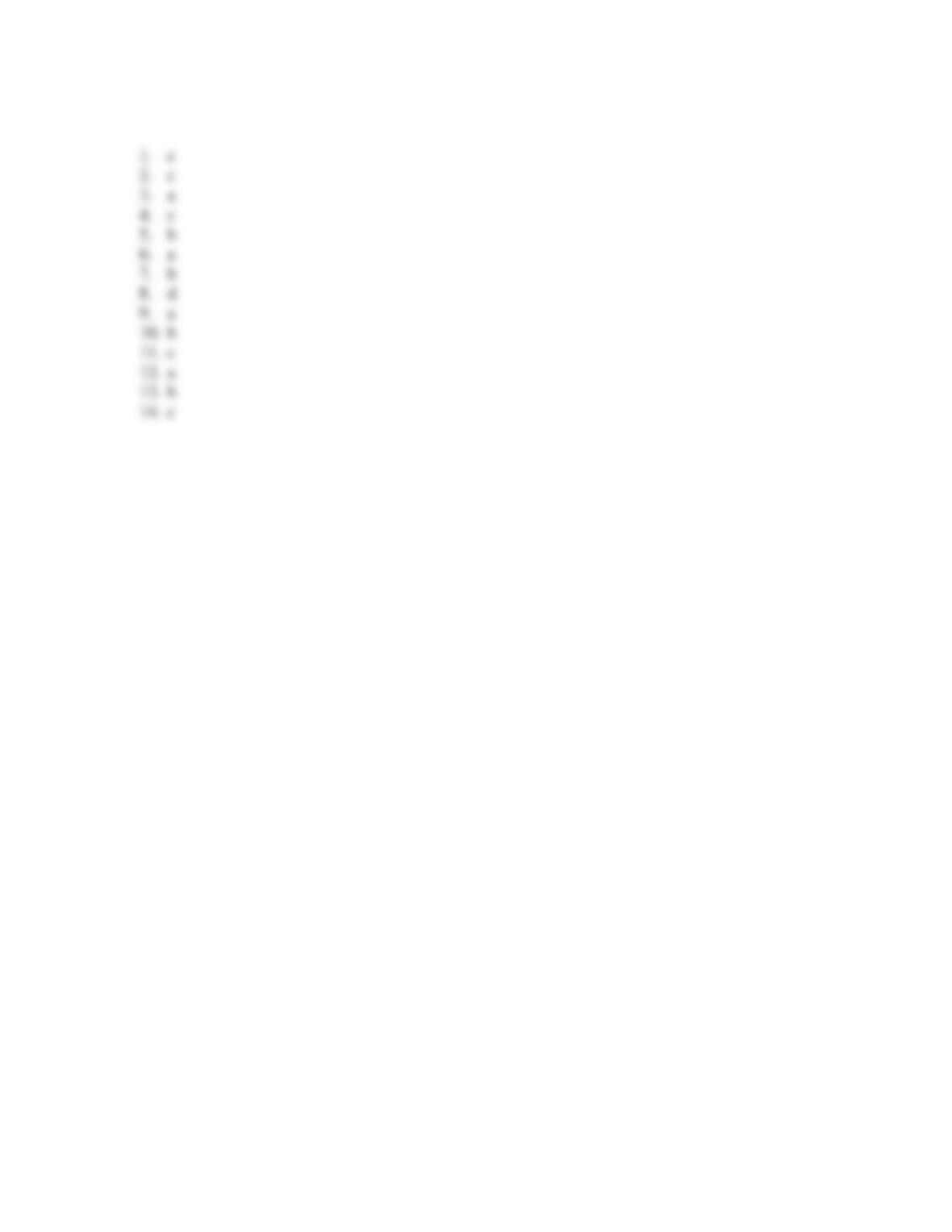
Answer Key