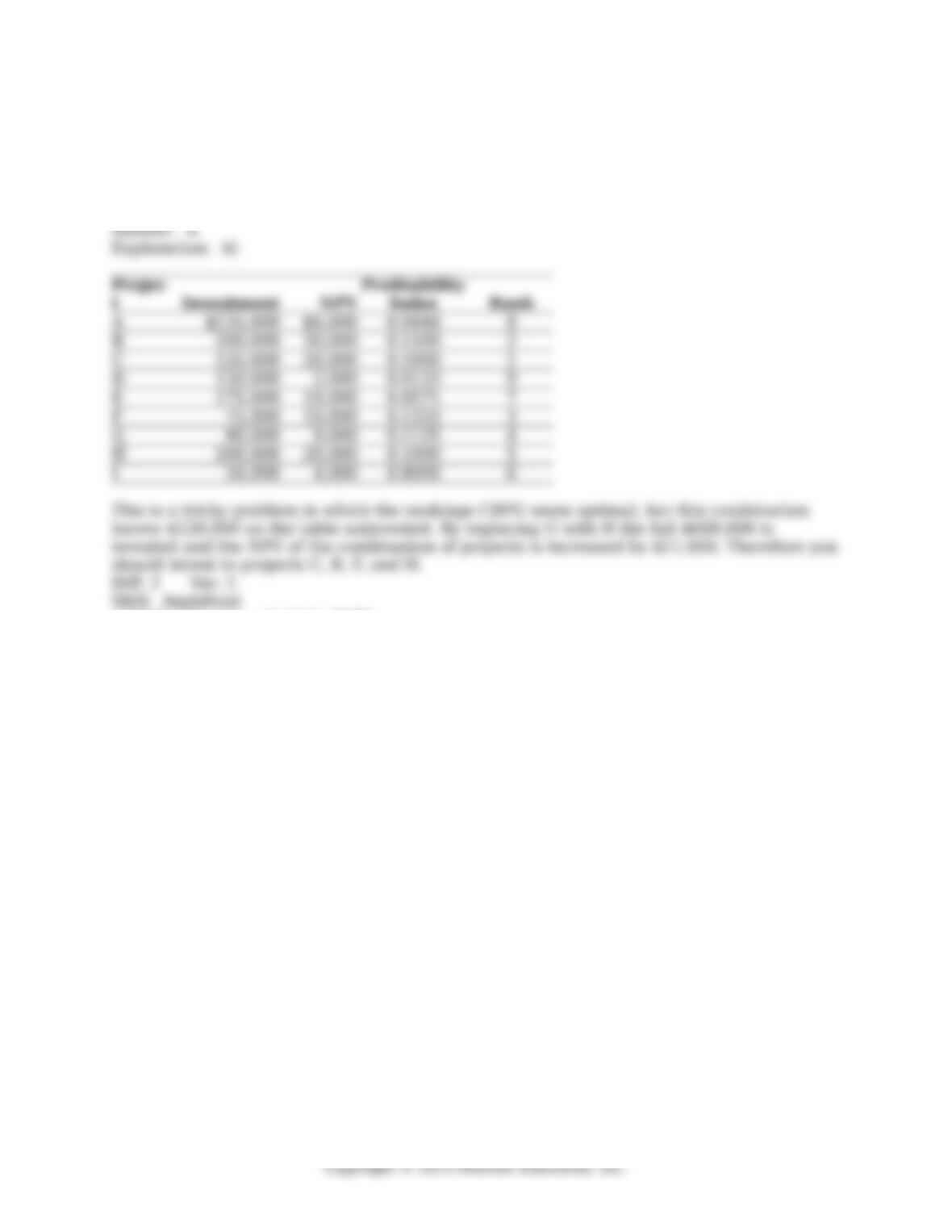
19) Assuming that your capital is constrained, so that you only have $600,000 available to
invest in projects, which project should you invest in and in what order?
A) CBFH
B) CBGF
C) BCFG
D) CBFG
AACSB Objective: Analytic Skills
Author: JN
Question Status: Revised
51
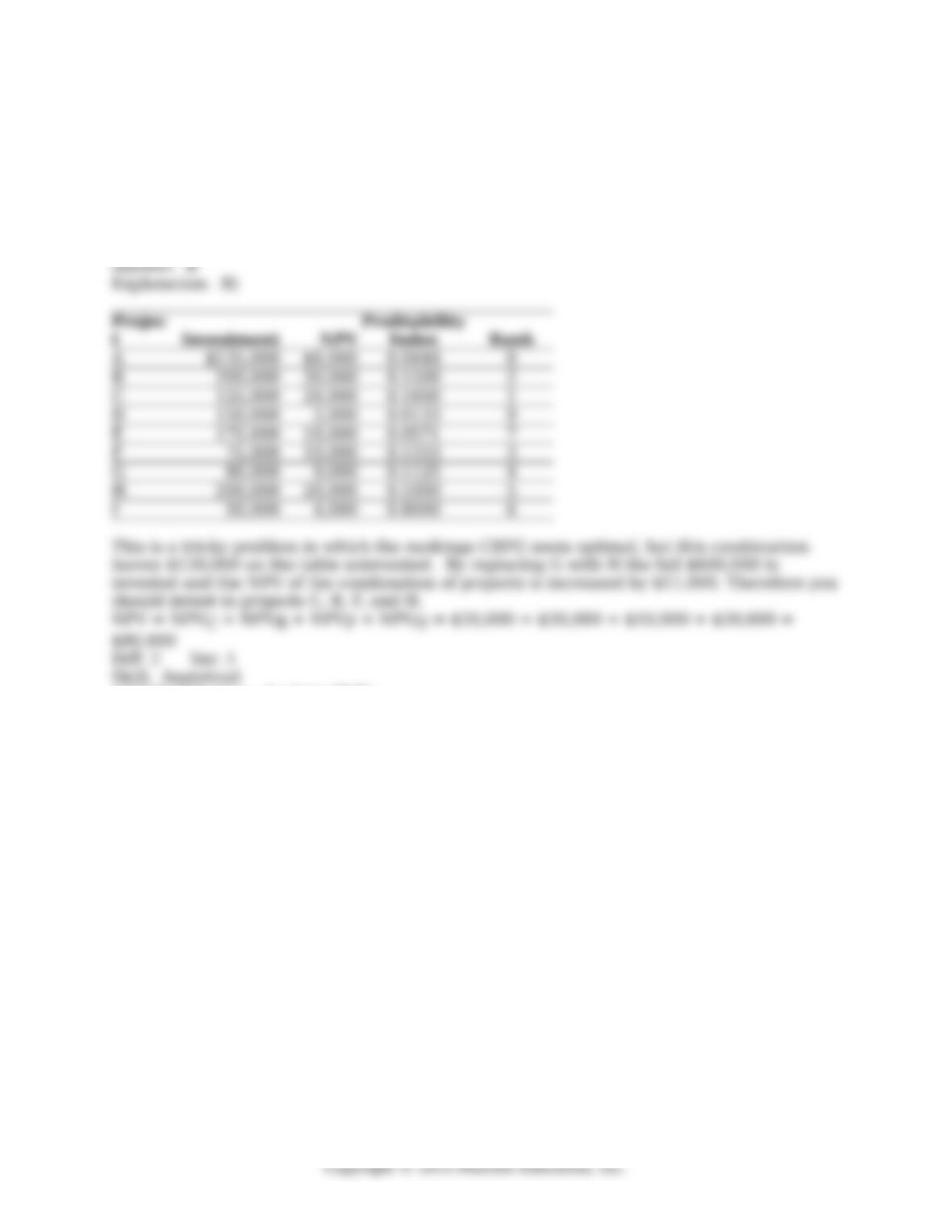
20) Assume that your capital is constrained, so that you only have $600,000 available to
invest in projects. If you invest in the optimal combination of projects given your capital
constraint, then the total net present value (NPV) for all the projects you invest in will be
closest to ________.
A) $65,000
B) $80,000
C) $69,000
D) $111,000
AACSB Objective: Analytic Skills
Author: JN
Question Status: Revised
52
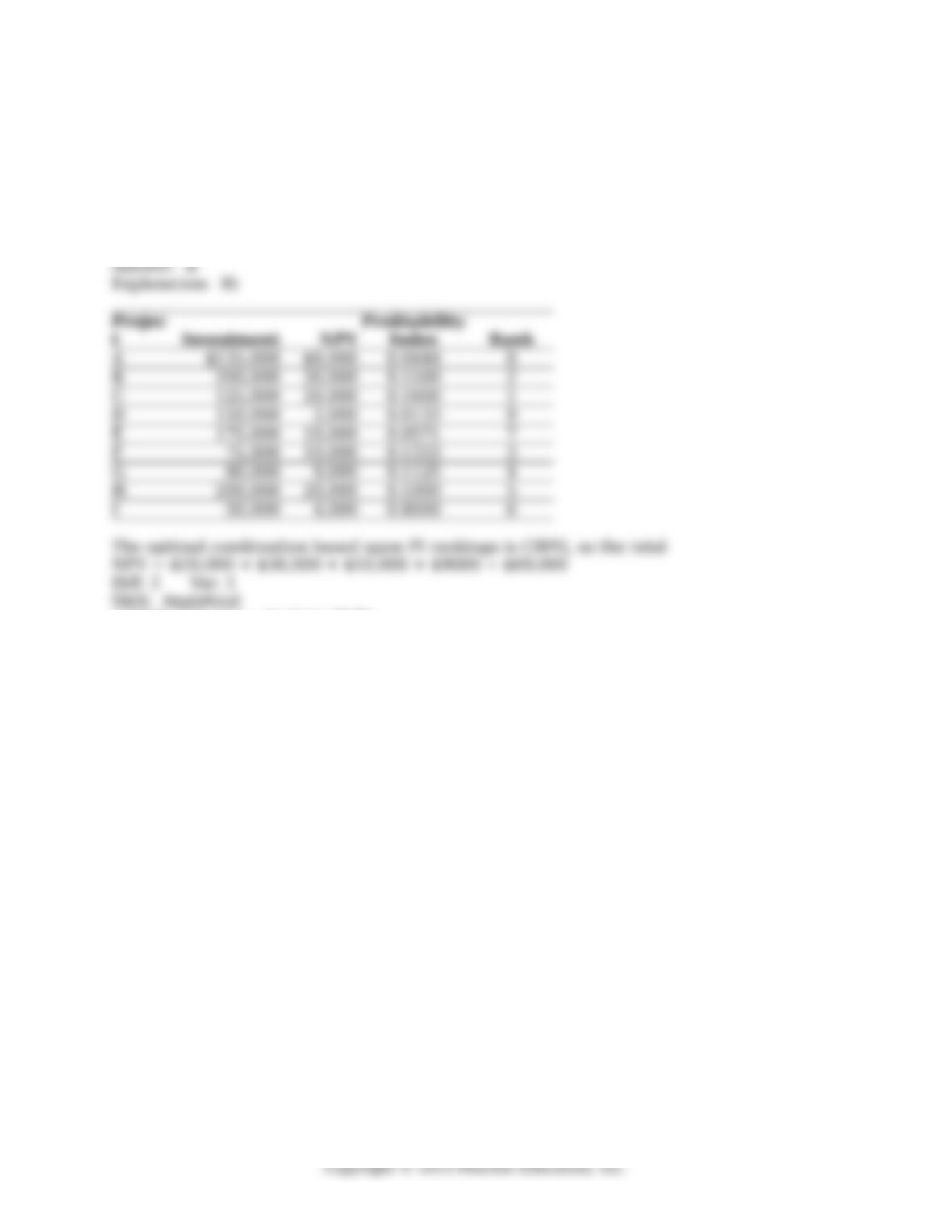
21) Assume that your capital is constrained, so that you only have $500,000 available to
invest in projects. If you invest in the optimal combination of projects given your capital
constraint, then the total net present value (NPV) for all the projects you invest in will be
closest to ________.
A) $111,000
B) $69,000
C) $80,000
D) $58,000
AACSB Objective: Analytic Skills
Author: JN
Question Status: Revised
53

Use the information for the question(s) below.
Your irm is preparing to open a new retail strip mall and you have multiple businesses that
would like lease space in it. Each business will pay a ixed amount of rent each month plus
a percentage of the gross sales generated each month. The cash lows from each of the
businesses has approximately the same amount of risk. The business names, square footage
requirements, and monthly expected cash lows for each of the businesses that would like
to lease space in your strip mall are provided below:
Business Name
Square
Feet
Required
Expected
Monthly Cash
Flow
Videos Now 4,000 $70,000
Gords Gym 3,500 52,500
Pizza Warehouse 2,500 52,500
Super Clips 1,500 25,500
30 1/2 Flavors 1,500 28,500
S-Mart 12,000 180,000
WalVerde Drugs 6,000 147,000
Multigular
Wireless 1,000 22,250
22) If your new strip mall will have 15,000 square feet of retail space available to be leased,
to which businesses should you lease and why?
AACSB Objective: Analytic Skills
Author: JN
Question Status: Revised
23) If your new strip mall will have 16,000 square feet of retail space available to be leased,
54
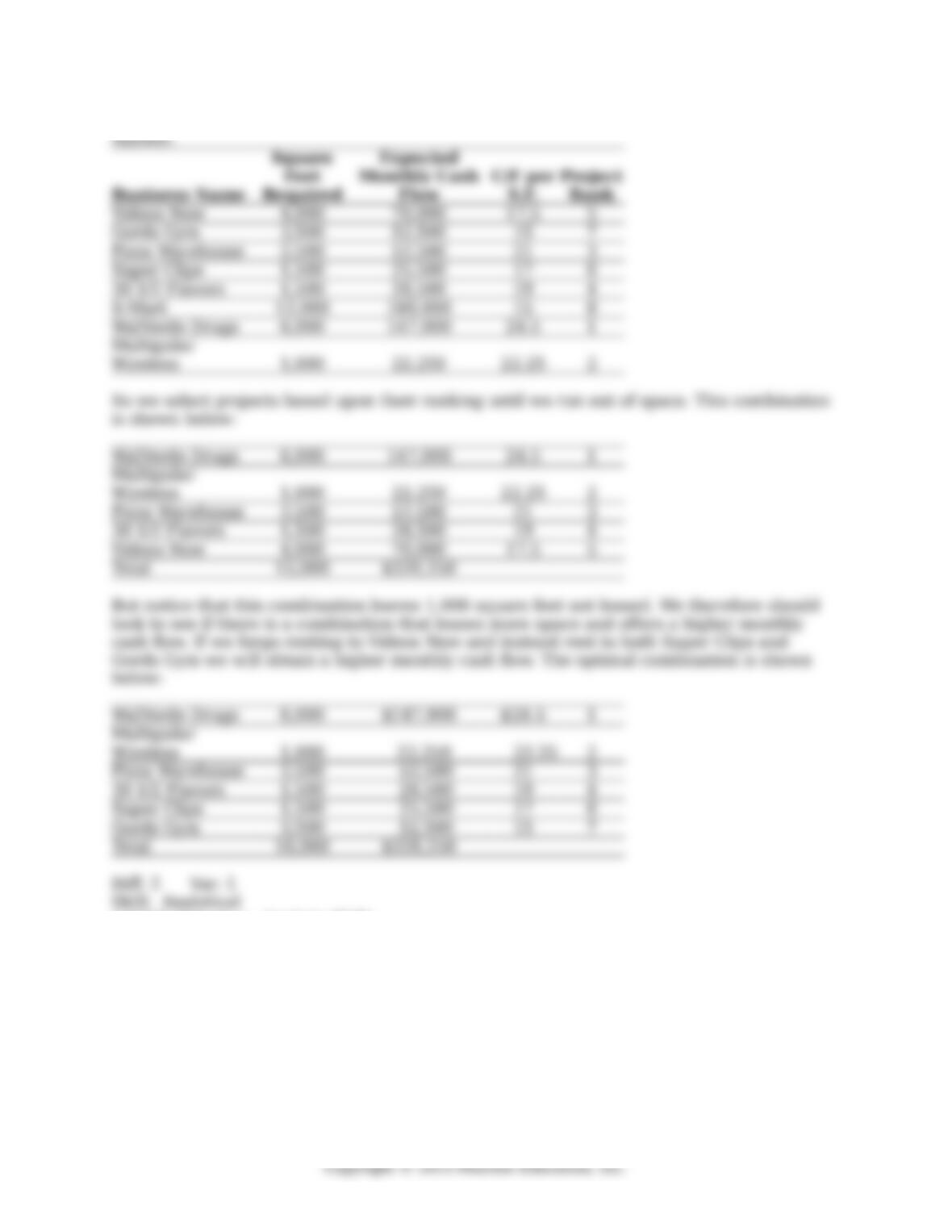
to which businesses should you lease and why?
AACSB Objective: Analytic Skills
Author: JN
Question Status: Revised
55

24) Consider the following list of projects:
Project Investment NPV
A $405,000 $18,000
B 600,000 90,000
C 375,000 60,000
D 450,000 6,000
E 525,000 30,000
F 225,000 30,000
G 240,000 27,000
H 600,000 60,000
I 150,000 12,000
J 270,000 30,000
You are given a budget of only $1,800,000 to invest in projects. Which projects will you
select, in what order will you select them, and why?
AACSB Objective: Analytic Skills
Author: JN
Question Status: Revised
56

8.7 Putting It All Together
1) Net present value (NPV) is usefully supplemented by internal rate of return (IRR), since
IRR gives a good indication of the sensitivity of any decision made to changes in the
discount rate.
AACSB Objective: Analytic Skills
Author: DS
Question Status: Revised
2) When an alternative decision rule disagrees with the net present value (NPV), the NPV
should be followed.
AACSB Objective: Relective Thinking Skills
Author: DS
Question Status: Revised
3) Which of the following best describes the Net Present Value rule?
A) Take any investment opportunity where the net present value (NPV) is not negative; turn
down any opportunity when it is negative.
B) Take any investment opportunity where the net present value (NPV) exceeds the
opportunity cost of capital; turn down any opportunity where the cost of capital exceeds
the net present value (NPV)
C) When choosing among any list of investment opportunities where resources are limited,
always choose those projects with the highest net present value (NPV).
D) If the diference between the present cost of an investment and the present value (PV) of
its beneits after a ixed number of years is positive the investment should be taken,
otherwise it should be rejected.
AACSB Objective: Relective Thinking Skills
Author: DS
Question Status: Revised
4) Which of the following is a disadvantage of the Net Present Value rule?
A) can be misleading if inlows come before outlows
B) not necessarily consistent with maximizing shareholder wealth
C) ignores cash lows after the cutof point
D) relies on accurate estimate of the discount rate
AACSB Objective: Analytic Skills
Author: JP
Question Status: Revised
5) Which of the following decision rules is best deined as the amount of time it takes to pay
back the initial investment?
A) internal rate of return (IRR)
B) proitability index
C) net present value (NPV)
57

D) payback period
AACSB Objective: Analytic Skills
Author: DS
Question Status: Revised
6) Which of the following decision rules might best be used as a supplement to net present
value (NPV) by a irm that favors liquidity?
A) proitability index
B) MIRR
C) equivalent annual annuity
D) payback period
AACSB Objective: Analytic Skills
Author: DS
Question Status: Previous Edition
7) Which of the following is NOT a limitation of the payback period rule?
A) It does not account for the time value of money.
B) It is diicult to calculate.
C) It ignores cash lows after payback.
D) It does not account for changes in the discount rate.
AACSB Objective: Analytic Skills
Author: DS
Question Status: Revised
58

8) Which of the following is true regarding the proitability index?
A) It does not use the net present value (NPV) to assess beneits.
B) It is very simple to compute.
C) Attention must be taken when using it to make sure that all of the constrained resource
is utilized.
D) It is unreliable when used for choosing between diferent projects.
AACSB Objective: Analytic Skills
Author: DS
Question Status: Revised
9) A irm is considering several mutually exclusive investment opportunities. The best way
to choose between them is which of the following?
A) proitability index
B) payback period
C) net present value (NPV)
D) internal rate of return (IRR)
AACSB Objective: Analytic Skills
Author: DS
Question Status: Revised
59