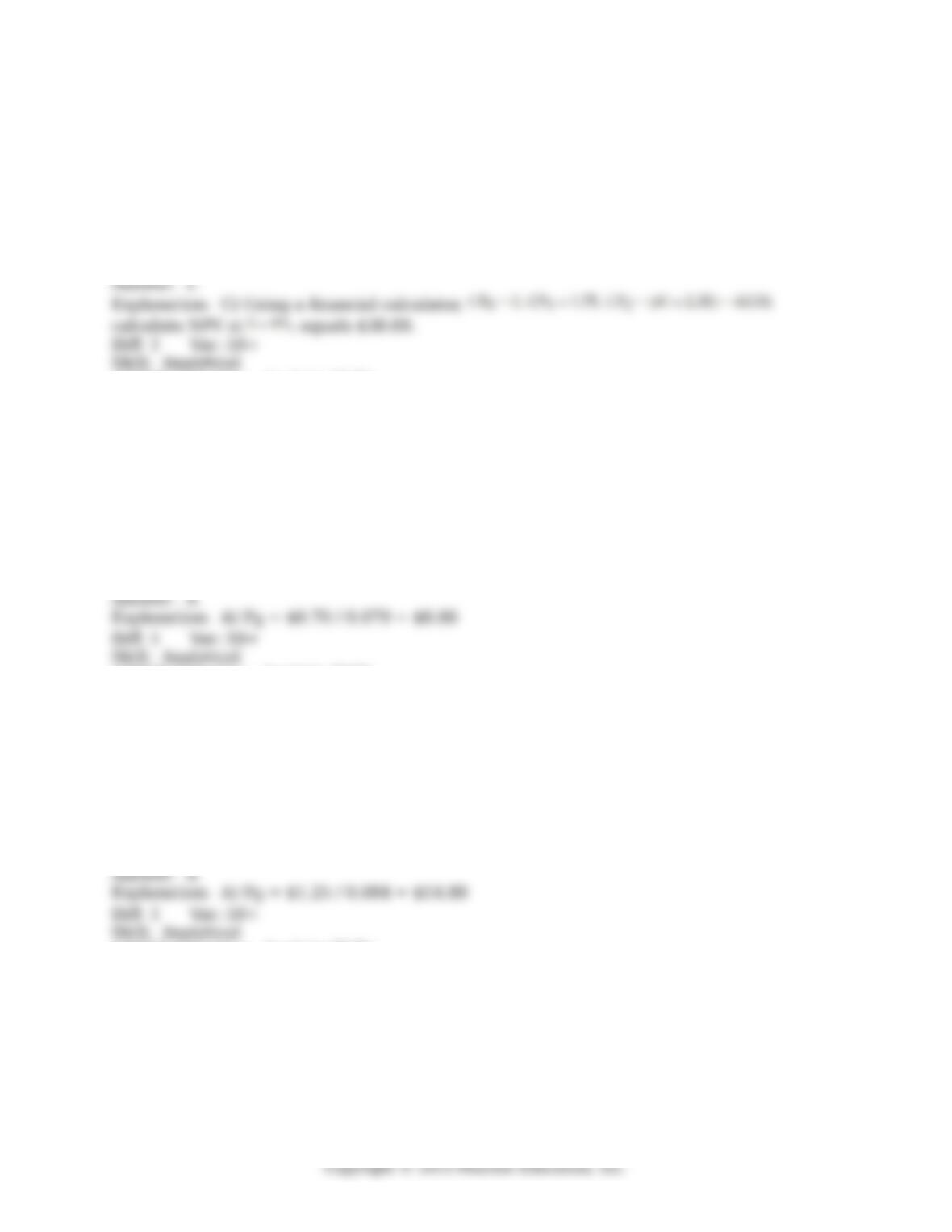
10) Valorous Corporation will pay a dividend of $1.75 per share at this year’s end and a
dividend of $2.35 per share at the end of next year. It is expected that the price of Valorous’
stock will be $41 per share after two years. If Valorous has an equity cost of capital of 9%,
what is the maximum price that a prudent investor would be willing to pay for a share of
Valorous stock today?
A) $32.38
B) $36.19
C) $38.09
D) $39.99
AACSB Objective: Analytic Skills
Author: DS
Question Status: Previous Edition
11) A stock is expected to pay $0.70 per share every year indeinitely. If the current price of
the stock is $18.90, and the equity cost of capital for the company that released the shares
is 7.9%, what price would an investor be expected to pay per share ive years into the
future?
A) $8.86
B) $14.18
C) $14.62
D) $15.06
AACSB Objective: Analytic Skills
Author: DS
Question Status: Previous Edition
12) A stock is expected to pay $1.25 per share every year indeinitely and the equity cost of
capital for the company is 8.4%. What price would an investor be expected to pay per share
ten years in the future?
A) $14.88
B) $22.32
C) $29.76
D) $37.20
AACSB Objective: Analytic Skills
Author: WC
Question Status: Previous Edition
11
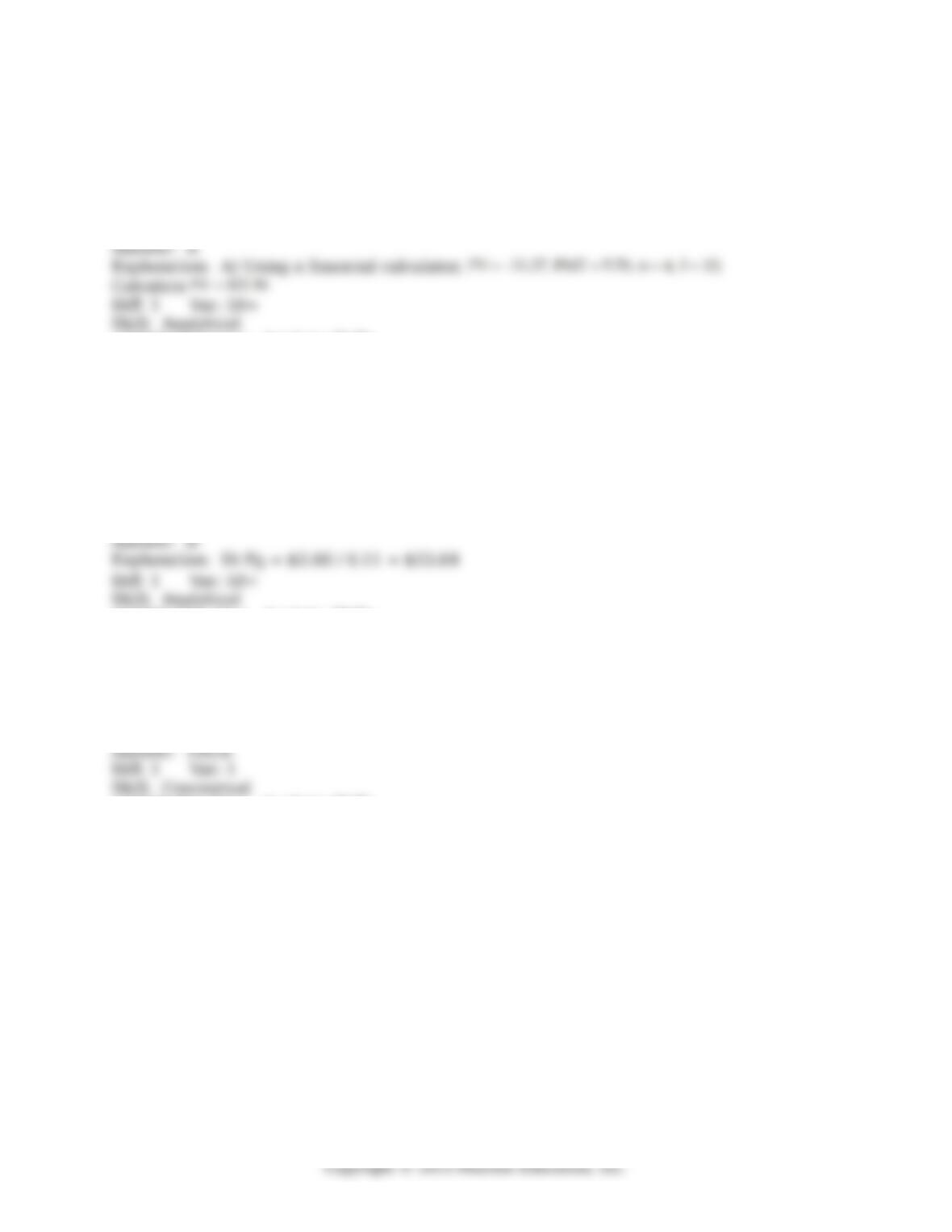
13) Rylan Industries is expected to pay a dividend of $5.70 year for the next four years. If
the current price of Rylan stock is $31.27, and Rylan’s equity cost of capital is 12%, what
price would you expect Rylan’s stock to sell for at the end of the four years?
A) $21.96
B) $39.53
C) $17.57
D) $61.49
AACSB Objective: Analytic Skills
Author: WC
Question Status: Previous Edition
14) A stock is expected to pay $2.60 per share every year indeinitely and the equity cost of
capital for the company is 11%. What price would an investor be expected to pay per share
next year?
A) $5.91
B) $11.82
C) $17.73
D) $23.64
AACSB Objective: Analytic Skills
Author: WC
Question Status: New
7.4 Estimating Dividends in the Dividend-Discount Model
1) A irm can either pay its earnings to its investors, or it can keep them and reinvest them.
AACSB Objective: Analytic Skills
Author: DS
Question Status: Previous Edition
12
2) Which of the following is NOT a way that a irm can increase its dividend?
A) by increasing its retention rate
B) by decreasing its shares outstanding
C) by increasing its earnings (net income)
D) by increasing its dividend payout rate
AACSB Objective: Analytic Skills
Author: JN
Question Status: Previous Edition
3) Which of the following statements is FALSE regarding proitable and unproitable
growth?
A) If a irm wants to increase its share price, it must diversify.
B) If a irm retains more earnings, it will pay out less of those earnings, reducing its
dividends.
C) A irm can increase its growth rate by retaining more of its earnings.
D) Cutting a irm’s dividend to increase investment will raise the stock price if the new
investment has a positive net present value (NPV).
AACSB Objective: Analytic Skills
Author: JN
Question Status: Revised
4) Which of the following statements is FALSE?
A) Estimating dividends, especially for the distant future, is diicult.
B) A irm can only pay out its earnings to investors or reinvest their earnings.
C) Successful young irms often have high initial earnings growth rates.
D) According to the constant dividend growth model, the value of the irm depends on the
current dividend level, divided by the equity cost of capital plus the grow rate.
AACSB Objective: Analytic Skills
Author: JN
Question Status: Previous Edition
13
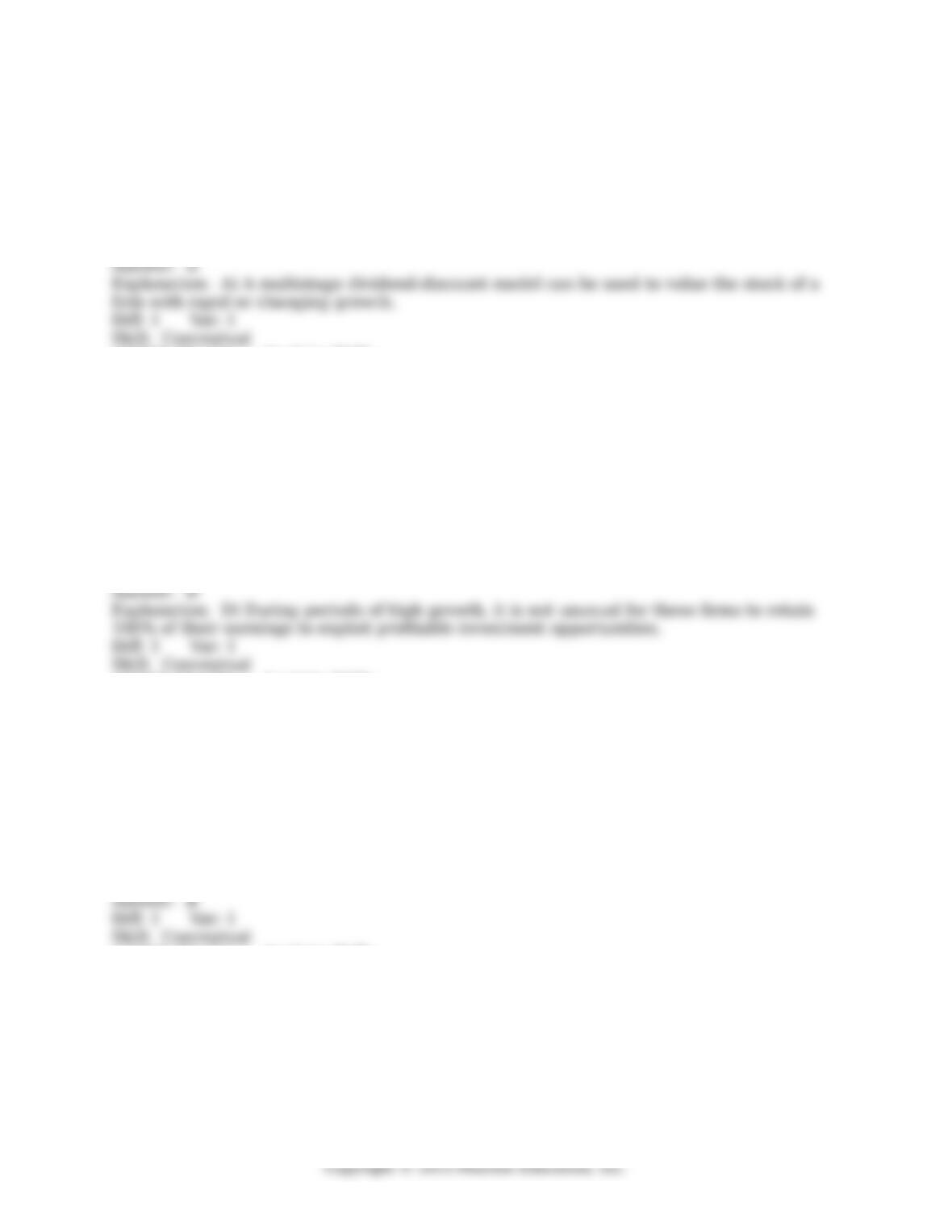
5) Which of the following statements is FALSE of the dividend-discount model?
A) We cannot use the dividend-discount model to value the stock of a irm with rapid or
changing growth.
B) As irms mature, their growth slows to rates more typical of established companies.
C) The dividend-discount model values the stock based on a forecast of the future dividends
paid to shareholders.
D) The simplest forecast for the irm’s future dividends states that they will grow at a
constant rate, i.e., forever.
AACSB Objective: Analytic Skills
Author: JN
Question Status: Previous Edition
6) Which of the following statements is FALSE about dividend payout and growth?
A) A common approximation is to assume that in the long run, dividends will grow at a
constant rate.
B) The dividend each year is the irm’s earnings per share (EPS) multiplied by its dividend
payout rate.
C) There is a tremendous amount of uncertainty associated with any forecast of a irm’s
future dividends.
D) During periods of high growth, it is not unusual for irms to pay out 100% of their
earnings to shareholders in the form of dividends.
AACSB Objective: Analytic Skills
Author: JN
Question Status: Revised
7) Which of the following statements is FALSE?
A) As irms mature, their earnings exceed their investment needs and they begin to pay
dividends.
B) Total return equals earnings multiplied by the dividend payout rate.
C) Cutting the irm’s dividend to increase investment will raise the stock price if, and only
if, the new investments have a positive net present value (NPV).
D) We cannot use the constant dividend growth model to value the stock of a irm with
rapid or changing growth.
AACSB Objective: Analytic Skills
Author: JN
Question Status: Revised
14
8) Which of the following formulas is INCORRECT?
A) g = Retention Rate × Return on New Investment
B) Divt = EPSt × Dividend Payout Rate
C) P0 = Div1 / (rE – g)
D) rE = (Div1 / P0) – g
AACSB Objective: Analytic Skills
Author: JN
Question Status: New
9) Which of the following formulas is INCORRECT?
A) Divt = EPSt × Dividend Payout Rate
B) PN = (rE – g) × DivN+1
C) earnings growth rate = retention rate × return on new investment
D) rE = (Divt / P0) + g
AACSB Objective: Analytic Skills
Author: JN
Question Status: Revised
10) NoGrowth Industries presently pays an annual dividend of $1.20 per share and it is
expected that these dividend payments will continue indeinitely. If NoGrowth’s equity cost
of capital is 10%, then the value of a share of NoGrowth’s stock is closest to ________.
A) $9.60
B) $14.40
C) $13.20
D) $12.00
AACSB Objective: Analytic Skills
Author: JN
Question Status: Previous Edition
15
11) Von Bora Corporation (VBC) is expected to pay a $3.00 dividend at the end of this year.
If you expect VBC’s dividend to grow by 6% per year forever and VBC’s equity cost of
capital to be 13%, then the value of a share of VBS stock is closest to ________.
A) $42.86
B) $15.79
C) $25.72
D) $17.14
AACSB Objective: Analytic Skills
Author: JN
Question Status: Previous Edition
12) Luther Industries has a dividend yield of 4.5% and a cost of equity capital of 10%.
Luther Industries’ dividends are expected to grow at a constant rate indeinitely. The
growth rate of Luther’s dividends is closest to ________.
A) 5.5%
B) 14.5%
C) 11.0%
D) 5.0%
AACSB Objective: Analytic Skills
Author: JN
Question Status: Previous Edition
13) The Sisyphean Company’s common stock is currently trading for $25.50 per share. The
stock is expected to pay a $2.80 dividend at the end of the year and the Sisyphean
Company’s equity cost of capital is 10%. If the dividend payout rate is expected to remain
constant, then the expected growth rate in the Sisyphean Company’s earnings is closest to
________.
A) -1.96%
B) -1.47%
C) -0.98%
D) -0.49%
AACSB Objective: Analytic Skills
Author: JN
Question Status: Revised
16
14) You expect KT industries (KTI) will have earnings per share of $5 this year and expect
that they will pay out $1.25 of these earnings to shareholders in the form of a dividend.
KTI’s return on new investments is 13% and their equity cost of capital is 15%. The
expected growth rate for KTI’s dividends is closest to ________.
A) 11.3%
B) 9.8%
C) 5.9%
D) 3.9%
AACSB Objective: Analytic Skills
Author: JN
Question Status: Previous Edition
15) You expect KT industries (KTI) will have earnings per share of $5 this year and expect
that they will pay out $2.50 of these earnings to shareholders in the form of a dividend.
KTI’s return on new investments is 14% and their equity cost of capital is 11%. The value of
a share of KTI’s stock today is closest to ________.
A) $75.00
B) $37.50
C) $62.50
D) $25.00
AACSB Objective: Analytic Skills
Author: JN
Question Status: Previous Edition
17
16) JRN Enterprises just announced that it plans to cut its dividend from $3.00 to $1.50 per
share and use the extra funds to expand its operations. Prior to this announcement, JRN’s
dividends were expected to grow indeinitely at 4% per year and JRN’s stock was trading at
$25.50 per share. With the new expansion, JRN’s dividends are expected to grow at 8% per
year indeinitely. Assuming that JRN’s risk is unchanged by the expansion, the value of a
share of JRN after the announcement is closest to ________.
A) $19.32
B) $12.75
C) $38.63
D) $25.50
AACSB Objective: Analytic Skills
Author: JN
Question Status: Revised
17) You expect that Bean Enterprises will have earnings per share of $2 for the coming
year. Bean plans to retain all of its earnings for the next three years. For the subsequent
two years, the irm plans on retaining 50% of its earnings. It will then retain only 25% of its
earnings from that point forward. Retained earnings will be invested in projects with an
expected return of 20% per year. If Bean’s equity cost of capital is 10%, then the price of a
share of Bean’s stock is closest to ________.
A) $24.82
B) $16.54
C) $41.36
D) $66.18
AACSB Objective: Analytic Skills
Author: JN
Question Status: Previous Edition
18) Avril Synchronistics will pay a dividend of $1.20 per share this year. It is expected that
this dividend will grow by 3% each year in the future. What will be the current value of a
single share of Avril’s stock if the irm’s equity cost of capital is 16%?