Fundamentals of Corporate Finance, 3e (Berk/DeMarzo/Harford)
Chapter 10 Stock Valuation: A Second Look
10.1 The Discounted Free Cash Flow Model
1) The discounted free cash low model ignores interest income and expense but adjusts for
cash and debt directly, if free cash low is calculated based on EBIT.
AACSB Objective: Analytic Skills
Author: DS
Question Status: Revised
2) Year 1 2 3 4
Free Cash Flow$12 million $18 million $22 million $26 million
Conundrum Mining is expected to generate the above free cash lows over the next four
years, after which they are expected to grow at a rate of 6% per year. If the weighted
average cost of capital is 12% and Conundrum has cash of $80 million, debt of $60 million,
and 30 million shares outstanding, what is Conundrum’s expected terminal enterprise
value?
A) $413.4 million
B) $459.3 million
C) $505.3 million
D) $528.2 million
AACSB Objective: Analytic Skills
Author: JP
Question Status: Revised
1
3) Year 1 2 3 4
Free Cash Flow $12 million $18 million $22 million $26 million
Conundrum Mining is expected to generate the above free cash lows over the next four
years, after which they are expected to grow at a rate of 5% per year. If the weighted
average cost of capital is 11% and Conundrum has cash of $85 million, debt of $65 million,
and 30 million shares outstanding, what is Conundrum’s expected current share price?
A) $12.61
B) $16.40
C) $20.18
D) $20.81
AACSB Objective: Analytic Skills
Author: DS
Question Status: Revised
4) Year 1 2 3 4 5
Free Cash Flow$22 million $26 million $29 million $30 million
$32 million
General Industries is expected to generate the above free cash lows over the next ive
years, after which free cash lows are expected to grow at a rate of 5% per year. If the
weighted average cost of capital is 9% and General Industries has cash of $15 million, debt
of $45 million, and 80 million shares outstanding, what is General Industries’ expected
current share price?
A) $7.78
B) $8.17
C) $9.34
D) $11.67
AACSB Objective: Analytic Skills
Author: DS
Question Status: Revised
2
5) Gonzales Corporation generated free cash low of $88 million this year. For the next two
years, the company’s free cash low is expected to grow at a rate of 10%. After that time,
the company’s free cash low is expected to level of to the industry long-term growth rate
of 4% per year. If the weighted average cost of capital is 12% and Gonzales Corporation
has cash of $100 million, debt of $300 million, and 100 million shares outstanding, what is
Gonzales Corporation’s expected terminal enterprise value in year 2?
A) $1384.24
B) $1245.82
C) $1107.39
D) $968.97
AACSB Objective: Analytic Skills
Author: JP
Question Status: Revised
6) Gonzales Corporation generated free cash low of $81 million this year. For the next two
years, the company’s free cash low is expected to grow at a rate of 9%. After that time, the
company’s free cash low is expected to level of to the industry long-term growth rate of
4% per year. If the weighted average cost of capital is 11% and Gonzales Corporation has
cash of $100 million, debt of $300 million, and 100 million shares outstanding, what is
Gonzales Corporation’s expected free cash low in year 2?
A) $1429.79 million
B) $86.61 million
C) $1572.77 million
D) $96.24 million
AACSB Objective: Analytic Skills
Author: JP
Question Status: Revised
3
7) Gonzales Corporation generated free cash low of $86 million this year. For the next two
years, the company’s free cash low is expected to grow at a rate of 10%. After that time,
the company’s free cash low is expected to level of to the industry long-term growth rate
of 4% per year. If the weighted average cost of capital is 11% and Gonzales Corporation
has cash of $100 million, debt of $275 million, and 100 million shares outstanding, what is
Gonzales Corporation’s expected current share price?
A) $14.37
B) $11.87
C) $12.49
D) $16.24
AACSB Objective: Analytic Skills
Author: JP
Question Status: Revised
4
8) Use the table for the question(s) below.
FCF Forecast ($ million)
Year 0 1 2 3 4
Sales 240 270 290 310 325.5
Growth versus Prior Year 12.5% 7.4% 6.9% 5.0%
EBIT (10% of Sales) 27.00 29.00 31.00 32.55
Less: Income Tax (37%) (9.99) 10.73 11.47 12.44
Less Increase in NWC (12% of Change in Sales 3.6 2.4 2.4 1.86
Free Cash Flow 13.41 15.87 17.13 18.65
Banco Industries expect sales to grow at a rapid rate over the next three years, but settle
to an industry growth rate of 5% in year 4. The spreadsheet above shows a simpliied pro
forma for Banco Industries. If Banco industries has a weighted average cost of capital of
11%, $50 million in cash, $80 million in debt, and 18 million shares outstanding, which of
the following is the best estimate of Banco‘s stock price at the start of year 1?
A) $6.52
B) $11.74
C) $13.04
D) $23.48
AACSB Objective: Analytic Skills
Author: DS
Question Status: Revised
5
9) Use the table for the question(s) below.
FCF Forecast ($ million)
Year 0 1 2 3 4
Sales 240 270 290 310 325.5
Growth versus Prior Year 12.5% 7.4% 6.9% 5.0%
EBIT (10% of Sales) 27.00 29.00 31.00 32.55
Less: Income Tax (37%) (9.99) (10.73) (11.47) (12.44)
Less Increase in NWC (12% of Change in Sales 3.6 2.4 2.4 1.86
Free Cash Flow 13.41 15.87 17.13 18.65
Banco Industries expect sales to grow at a rapid rate over the next 3 years, but settle to an
industry growth rate of 5% in year 4. The spreadsheet above shows a simpliied pro forma
for Banco Industries. Banco industries has a weighted average cost of capital of 11%, $40
million in cash, $70 million in debt, and 18 million shares outstanding. If Banco Industries
can reduce its operating expenses so that EBIT becomes 12% of sales, by how much will its
stock price increase?
A) $3.27
B) $3.92
C) $5.72
D) $9.80
AACSB Objective: Analytic Skills
Author: DS
Question Status: Revised
10) Which of the following is the appropriate way to calculate the price of a share of a
given company using the free cash low valuation model?
A) P0 = Div1/(rE – g)
B) P0 = PV(Future Free Cash Flow of Firm) / (Shares Outstanding0)
C) P0 = [Div1 / (rE – g)] / (Shares Outstanding0)
D) P0 = (V0 + Cash0 – Debt0) / (Shares Outstanding0)
AACSB Objective: Analytic Skills
Author: DS
Question Status: Revised
6
11) If you want to value a irm that consistently pays out its earnings as dividends, the
simplest model for you to use is the ________.
A) enterprise value model
B) method of comparables
C) dividend-discount model
D) discounted free cash low model
AACSB Objective: Analytic Skills
Author: JN
Question Status: Revised
12) If you want to value a irm but do not want to explicitly forecast its dividends, the
simplest model for you to use is ________.
A) the discounted free cash low model
B) the dividend-discount model
C) the enterprise value model
D) None of the above models can be used if you do not want to forecast dividends or use of
debt.
AACSB Objective: Analytic Skills
Author: JN
Question Status: Revised
13) Which of the following statements is FALSE?
A) The more cash a irm uses to repurchase shares, the less it has available to pay
dividends.
B) Free cash low measures the cash generated by a irm after payments to debt or equity
holders are considered.
C) We estimate a irm’s current enterprise value by computing the present value (PV) of the
irm’s free cash low.
D) We can interpret the enterprise value of a irm as the net cost of acquiring the irm’s
equity, taking its cash, and paying of all debts.
AACSB Objective: Analytic Skills
Author: JN
Question Status: Revised
7
14) Which of the following statements is FALSE?
A) A irm’s weighted average cost of capital, denoted rwacc, is the cost of capital that
relects the risk of the overall business, which is the combined risk of the irm’s equity and
debt.
B) Intuitively, the diference between the discounted free cash low model and the dividend-
discount model is that in the divided-discount model, a irm’s cash and debt are included
indirectly through the efect of interest income and expenses on earnings in the dividend-
discount model.
C) We interpret rwacc as the expected return a irm must pay to investors to compensate
them for the risk of holding the irm’s debt and equity together.
D) When using the discounted free cash low model, we should use a irm’s equity cost of
capital.
AACSB Objective: Analytic Skills
Author: JN
Question Status: Revised
15) Which of the following statements is FALSE?
A) The long-run growth rate gFCF is typically based on the expected long-run growth rate
of a irm’s revenues.
B) Since a irm’s free cash low is equal to the sum of the free cash lows from the irm’s
current and future investments, we can interpret the irm’s enterprise value as the total net
present value (NPV) that the irm will earn from continuing its existing projects and
initiating new ones.
C) If a irm has no debt, then rwacc equals the risk-free rate of return.
D) When using the discounted free cash low model, we forecast a irm’s free cash low up
to some horizon, together with some terminal (continuation) value of the enterprise.
AACSB Objective: Analytic Skills
Author: JN
Question Status: Revised
16) What additional adjustments are required to ind the share price, in case we are using
the discounted cash low model?
AACSB Objective: Analytic Skills
Author: SS
Question Status: Revised
8
10.2 Valuation Based on Comparable Firms
1) In the method of comparables, the known values of a irm’s cash lows are used to
estimate the unknown cash lows of a similar irm.
AACSB Objective: Analytic Skills
Author: DS
Question Status: Revised
2) Several methods should be used to provide an estimate of a stock’s value since no single
method provides a deinitive value.
AACSB Objective: Analytic Skills
Author: DS
Question Status: Revised
3) On a particular date, FedEx has a stock price of $89.27 and an EPS of $7.11. Its
competitor, UPS, had an EPS of $0.38. What would be the expected price of UPS stock on
this date, if estimated using the method of comparables?
A) $4.77
B) $7.16
C) $9.54
D) $10.50
AACSB Objective: Analytic Skills
Author: DS
Question Status: Revised
9
4) Which of the following statements concerning the valuation of irms using the method of
comparables is FALSE?
A) If two diferent irms generate identical cash lows, the Law of One Price will imply that
both irms have the same value.
B) Comparables adjust for scale diferences when valuing similar irms.
C) Valuation multiples take into account diferences in the risk and future growth between
the irms being compared.
D) Two irms that sell very similar products or ofer very similar services will have diferent
values if they are of diferent sizes.
AACSB Objective: Analytic Skills
Author: DS
Question Status: Previous Edition
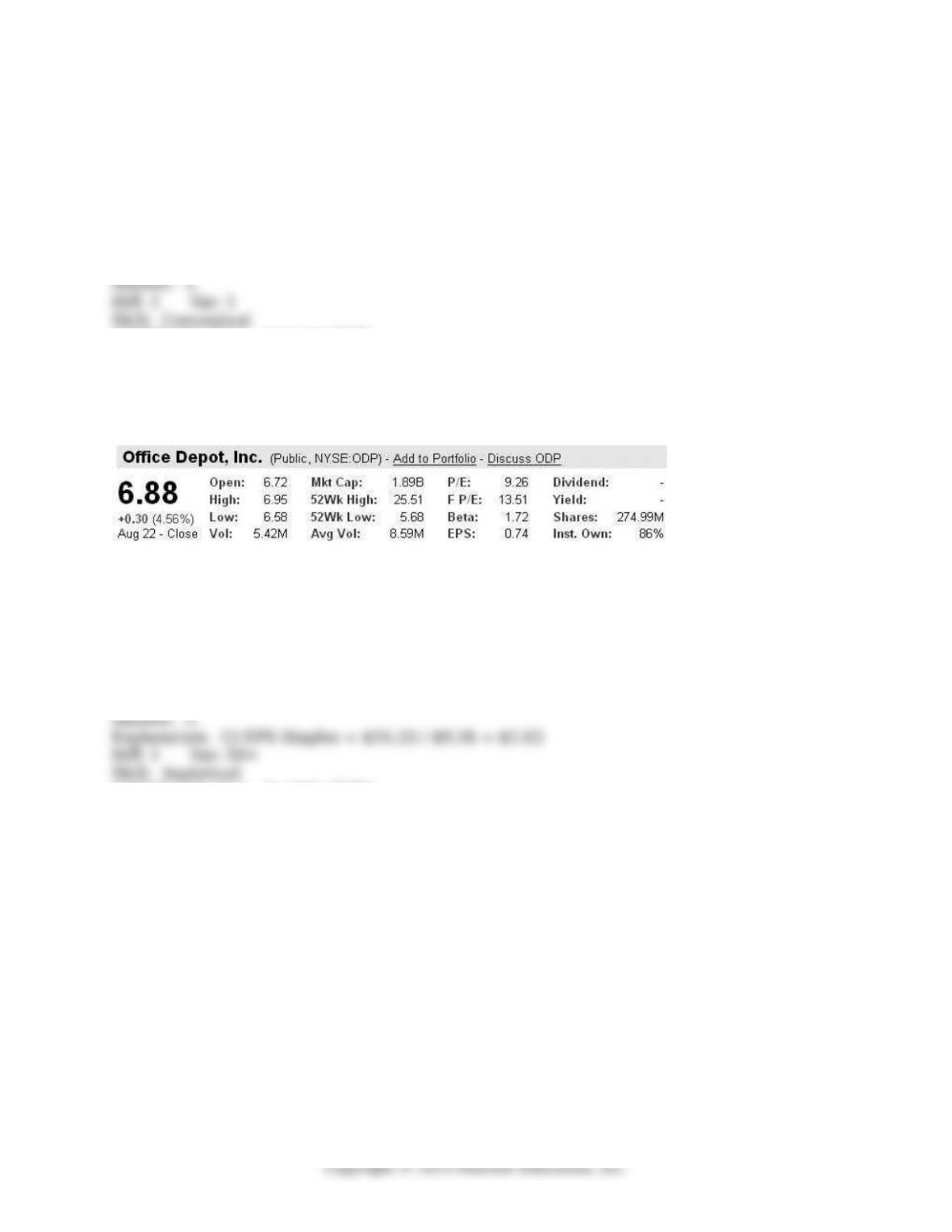
Use the igure for the question(s) below:
5) On a particular date, the above information concerning Oice Depot, Incorporated, was
given on Google Finance. Its competitor, Staples Incorporated, had a stock price of $24.33.
Which of the following is closest to the EPS of Staples Incorporated if it is estimated using
valuation multiples based on price-earnings ratios?
A) $1.58
B) $1.84
C) $2.63
D) $14.15
AACSB Objective: Analytic Skills
Author: DS
Question Status: Revised
10