Exam
Name___________________________________
SHORT ANSWER. Write the word or phrase that best completes each statement or answers the question.
Answer the question.
1)
A manufacturing company wants to acquire a new closed circuit TV (CCTV) system. The
new CCTV system can be purchased or it can be leased from the building in which the
company has recently moved. If purchased, the system will cost $87,500 and will have a
useful life of 5 years with no market value at that time. The annual operating cost is
expected to be $52,000 per year. To lease the system, the company must pay a
nonrefundable deposit of $21,500, an end–of–year leasing fee of $20,000, and an additional
annual inspection and maintenance cost of $1000. Additionally, the operating costs
incurred by the company will be reduced to $3400 per year. The company’s after tax
MARR is 10% per year and the effective income tax rate is 36% per year. Determine
whether the company should purchase or lease the CCTV system. Assume straight–line
depreciation with zero salvage value and a study period of 5 years.
1)
Answer:
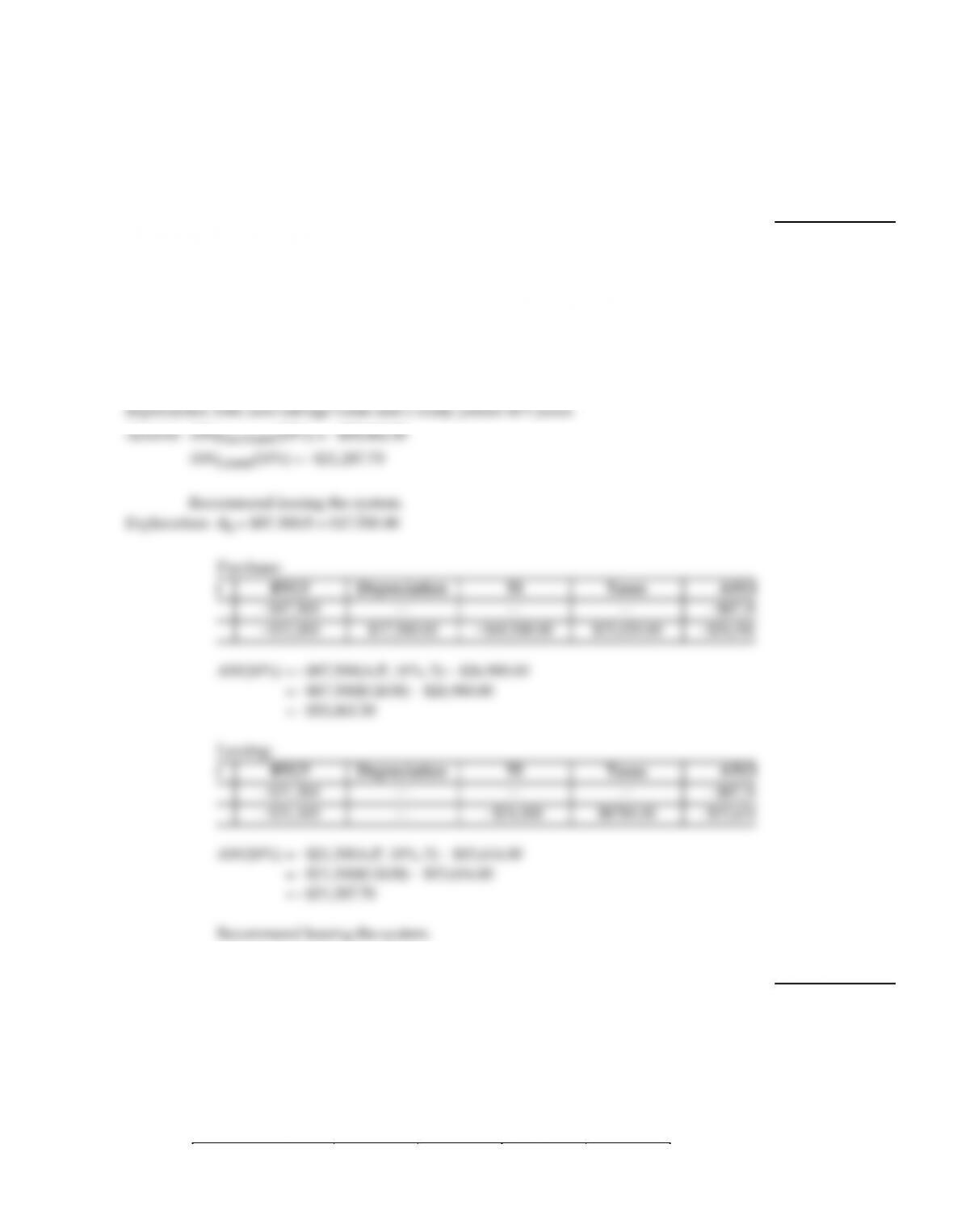
AWPurchase(10%) = –$50,062.50
AWLease(10%) = –$21,287.70
Recommend leasing the system.
Explanation:
dk=$87,500/5 =$17,500.00
Purchase:
Year BTCF Depreciation TI Taxes ATCF
0–$87,500 — — — –$87,500
1–5–$52,000 $17,500.00 –$69,500.00 $25,020.00 –$26,980.00
AW(10%) = –$87,500(A/P, 10%, 5) –$26,980.00
= –$87,500(0.2638) –$26,980.00
= –$50,062.50
Leasing:
Year BTCF Depreciation TI Taxes ATCF
0–$21,500 — — — –$87,500
1–5–$24,400 — –$24,400 $8784.00 –$15,616.00
AW(10%) = –$21,500A/P, 10%, 5) –$15,616.00
= –$21,500(0.2638) –$15,616.00
= –$21,287.70
Recommend leasing the system.
2)
GGV Corp. is considering the expansion of its networking and communication equipment
production. Four projects are being considered. Projects A and B are mutually exclusive,
and Projects C and D are mutually exclusive. Project C cannot be selected unless Project A
or B has been selected. Project D is an optional add–on of Project A. The company’s board
of directors has approved $2 million for this expansion. In addition, because of limited
personnel, only 27,000 labor hours can be committed to the expansion. Formulate the
resource allocation problem as a linear programming model. Use a MARR of 7.2% per
year.
Project A Project B Project C Project D
2)
1
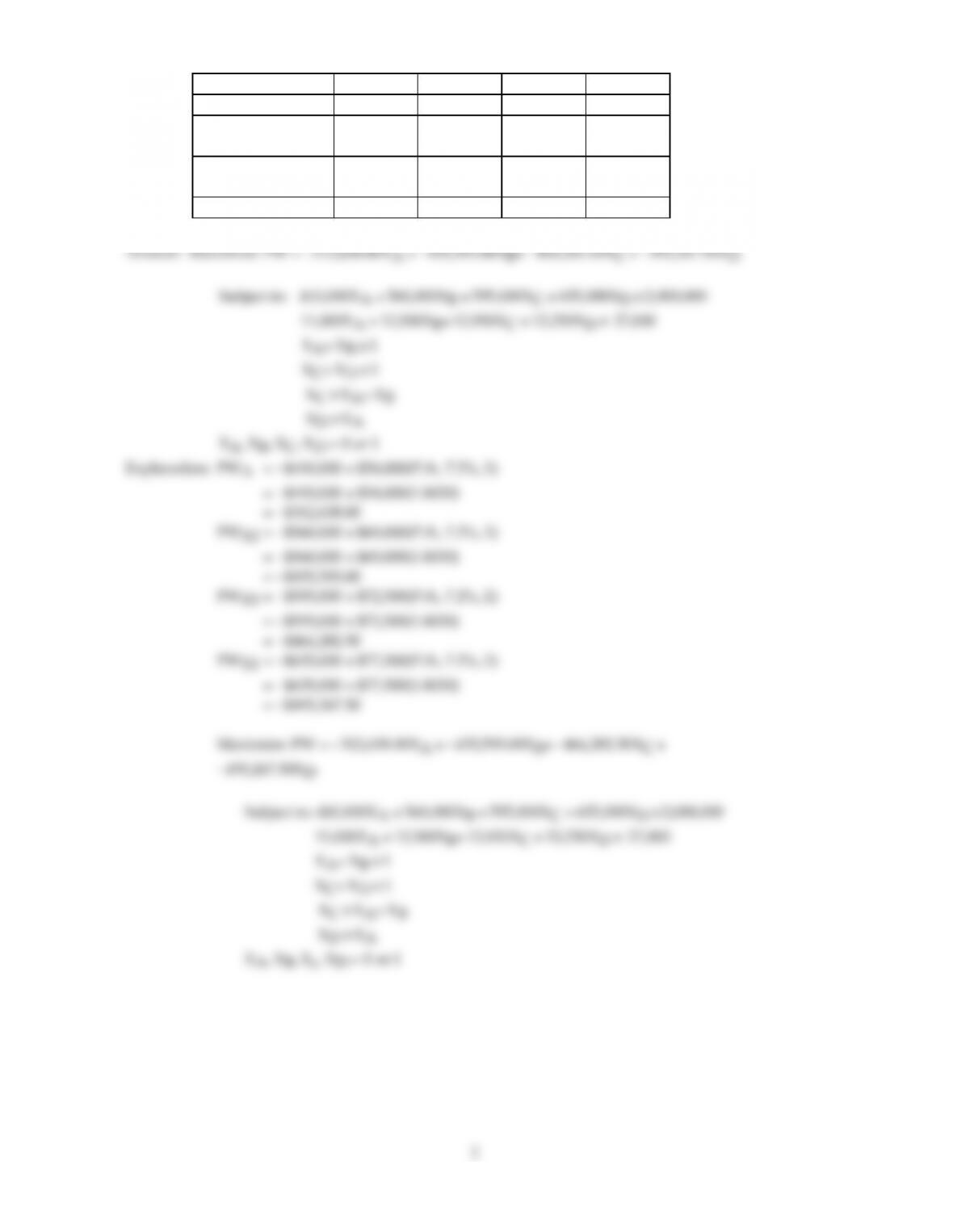
Project A Project B Project C Project D
Initial costs, $ 410,000 560,000 595,000 635,000
Net annual
revenue, $ 54,000 69,000 72,500 77,500
Man–hours
requirement, hours 11,000 12,500 12,950 13,250
Life, years 2 2 2 2
Answer:
Maximize: PW = –312,638.00XA+ –435,593.00XB+ –464,282.50XC+ –495,267.50XD
Subject to: 410,000XA+560,000XB+595,000XC+635,000XD2,000,000
11,000XA+12,500XB+12,950XC+13,250XD27,000
XA+XB 1
XC+XD
1
XCXA+XB
XDXA
XA, XB, XC, XD= 0 or 1
Explanation:
PWA= –$410,000 +$54,000(P/A, 7.2%, 2)
= –$410,000 +$54,000(1.8030)
= –$312,638.00
PWX2 = –$560,000 +$69,000(P/A, 7.2%, 2)
= –$560,000 +$69,000(1.8030)
= –$435,593.00
PWX3 = –$595,000 +$72,500(P/A, 7.2%, 2)
= –$595,000 +$72,500(1.8030)
= –$464,282.50
PWY1 = –$635,000 +$77,500(P/A, 7.2%, 2)
= –$635,000 +$77,500(1.8030)
= –$495,267.50
Maximize: PW = –312,638.00XA+ –435,593.00XB+ –464,282.50XC+
–495,267.50XD
Subject to: 410,000XA+560,000XB+595,000XC+635,000XD2,000,000
11,000XA+12,500XB+12,950XC+13,250XD27,000
XA+XB
1
XC+XD
1
XCXA+XB
XDXA
XA, XB, Xc, XD= 0 or 1
2

3)
TDJ Corp. needs $6.4 million in capital for its new state–of–the–art manufacturing facility.
The current financing plan is 45% equity capital and 55% debt financing. Compute the
WACC based on the following scenario if the company’s effective income tax rate is 37.5%.
Debt Financing: 47% of the amount will be obtained through a bank loan at 10.6% per year
and the remaining amount will be obtained through an issue of corporate bonds at a bond
rate of 11.7% per year.
Equity Financing: 25% of the amount will be obtained through the issue of common stock
that pays a dividend of 4.8% per year and 36% of the amount will be obtained through the
issue of preferred stock that pays a dividend of 11.2% per year. The remaining amount
will be taken from retained earnings that earn a rate of 7.5% per year.
3)
Answer:
7.51%
Explanation:
WACC =(1 –t)ib+(1 –)ea
= (0.55)(1 –0.375)[(0.47)(0.106) + (1 –0.47)(0.117)] + (0.45)[(0.25)(0.048) +
(0.36)(0.112) + (1 –0.61)(0.075)]
=0.0751
Or =7.51%
4)
George wants to evaluate the following investment options. He has collected the
information below from the latest performance report for the VGT mutual fund. Use
CAPM to approximate the expected return in each of the mutual fund categories. Assume
that the risk–free investment is based on a 60–day U.S. Treasury Bill with a return of 3.85%
per year.
Fund Name Beta Total Return, % per year
A0.96 15.5
B1.09 16.14
C1.06 22.5
4)
Answer:
Fund A: RS=15.03%
Fund B: RS=17.25%
Fund C: RS=23.62%
Explanation:
From RS=RF+S(RM–RF),
Fund A: RS=0.0385 +0.96(0.155–0.0385)
=0.1503 or 15.03%
Fund B: RS=0.0385 +1.09(0.1614 –0.0385)
=0.1725 or 17.25%
Fund C: RS=0.0385 +1.06(0.225–0.0385)
=0.2362 or 23.62%
5)
DD&T, Inc. is considering the development of three new environmentally friendly
products. One product will be selected from each of the high–end products and the
commercial products lines. The company will set aside $2.5 million for this development.
If the company’s MARR is 8% per year, and all products have the same useful life of 7
years with zero salvage value, formulate the capital allocation problem as a linear
programming model.
Product Line Product Development Cost, $ Estimated Net
5)
3
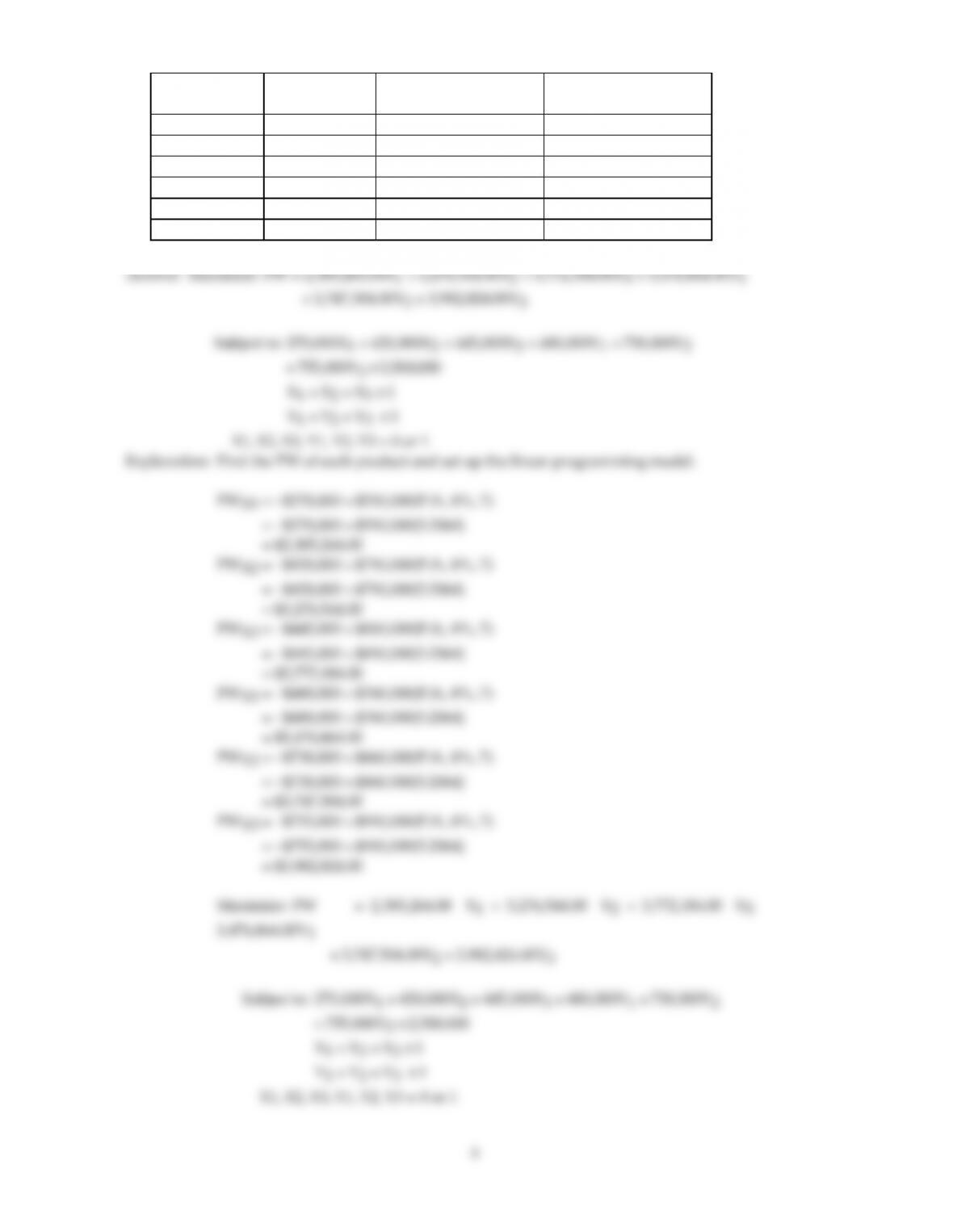
Product Line Product Development Cost, $ Estimated Net
Annual Revenue, $
Commercial X1 270,000 510,000
X2 420,000 710,000
X3 445,000 810,000
High–End Y1 480,000 760,000
Y2 730,000 860,000
Y3 755,000 910,000
Answer:
Maximize: PW =2,385,264.00X1+3,276,544.00X2+3,772,184.00X3+3,476,864.00Y1
+3,747,504.00Y2+3,982,824.00Y3
Subject to: 270,000X1+420,000X2+445,000X3+480,000Y1+730,000Y2
+755,000Y32,500,000
X1+X2+X3
1
Y1+Y2+Y3
1
X1, X2, X3, Y1, Y2, Y3 = 0 or 1
Explanation:
Find the PW of each product and set up the linear programming model.
PWX1 = –$270,000 +$510,000(P/A, 8%, 7)
= –$270,000 +$510,000(5.2064)
=$2,385,264.00
PWX2 = –$420,000 +$710,000(P/A, 8%, 7)
= –$420,000 +$710,000(5.2064)
=$3,276,544.00
PWX3 = –$445,000 +$810,000(P/A, 8%, 7)
= –$445,000 +$810,000(5.2064)
=$3,772,184.00
PWY1 = –$480,000 +$760,000(P/A, 8%, 7)
= –$480,000 +$760,000(5.2064)
=$3,476,864.00
PWY2 = –$730,000 +$860,000(P/A, 8%, 7)
= –$730,000 +$860,000(5.2064)
=$3,747,504.00
PWY3 = –$755,000 +$910,000(P/A, 8%, 7)
= –$755,000 +$910,000(5.2064)
=$3,982,824.00
Maximize: PW =2,385,264.00 X1+3,276,544.00 X2+3,772,184.00 X3+
3,476,864.00Y1+3,747,504.00Y2+3,982,824.00Y3
Subject to: 270,000X1+420,000X2+445,000X3+480,000Y1+730,000Y2
+755,000Y32,500,000
X1+X2+X3
1
Y1+Y2+Y3
1
X1, X2, X3, Y1, Y2, Y3 = 0 or 1
4
Answer Key
Testname: C13
1)
AWPurchase(10%) = –$50,062.50
AWLease(10%) = –$21,287.70
Recommend leasing the system.
2)
Maximize: PW = –312,638.00XA+ –435,593.00XB+ –464,282.50XC+ –495,267.50XD
Subject to: 410,000XA+560,000XB+595,000XC+635,000XD2,000,000
11,000XA+12,500XB+12,950XC+13,250XD27,000
XA+XB 1
XC+XD 1
XCXA+XB
XDXA
XA, XB, XC, XD= 0 or 1
3)
7.51%
4)
Fund A: RS=15.03%
Fund B: RS=17.25%
Fund C: RS=23.62%
5)
Maximize: PW =2,385,264.00X1+3,276,544.00X2+3,772,184.00X3+3,476,864.00Y1
+3,747,504.00Y2+3,982,824.00Y3
Subject to: 270,000X1+420,000X2+445,000X3+480,000Y1+730,000Y2
+755,000Y32,500,000
X1+X2+X3
1
Y1+Y2+Y3
1
X1, X2, X3, Y1, Y2, Y3 = 0 or 1