Exam
Name___________________________________
SHORT ANSWER. Write the word or phrase that best completes each statement or answers the question.
Answer the question.
1)
Buffalo Manufacturing is considering purchasing new equipment with an initial cost of
$65,000 and zero market value at any time of its useful life. The company expects this new
equipment to generate additional net revenue of $6700 per year. Due to the harsh
environment in which the equipment will be operated, the useful life of the equipment is
uncertain. The estimated probabilities of different useful lives are shown below. Calculate
the expected present worth and variance of present worth associated with the purchase of
the equipment. Assume the company’s MARR is 11% per year.
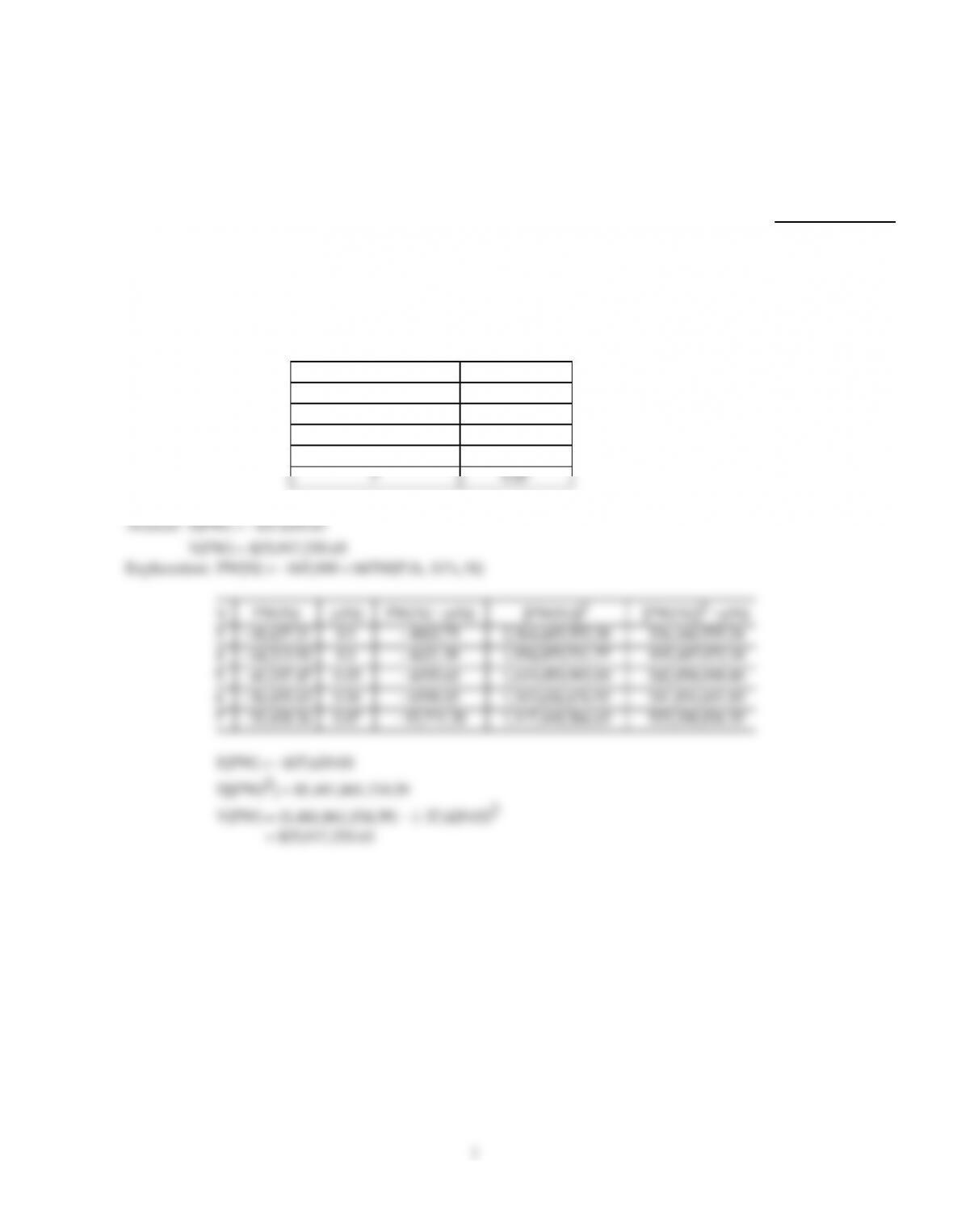
Useful life, Years (N) P(N)
30.1
40.1
50.15
60.18
70.47
1)
Answer:
E(PW) = –$37,629.03
V(PW) =$25,917,255.65
Explanation:
PW(N) = –$65,000 +$6700(P/A, 11%, N)
NPW(N) p(N) PW(N) · p(N) [PW(N)]2[PW(N)]2· p(N)
3–48,627.21 0.1 –4862.72 2,364,605,552.38 236,460,555.24
4–44,213.92 0.1 –4421.39 1,954,870,721.77 195,487,072.18
5–40,237.47 0.15 –6035.62 1,619,053,992.00 242,858,098.80
6–36,655.65 0.18 –6598.02 1,343,636,676.92 241,854,601.85
7–33,428.26 0.47 –15,711.28 1,117,448,566.63 525,200,826.32
E(PW) = –$37,629.03
E[(PW)2] =$1,441,861,154.39
V(PW) = (1,441,861,154.39) –(–37,629.03)2
=$25,917,255.65
1
2)
Amy wants to estimate the average number of items per purchase at the express lane of a
local grocery store. She has estimated the following probabilities based on a sample size of
50 customers. Determine the expected value, variance, and standard deviation of items per
purchase.
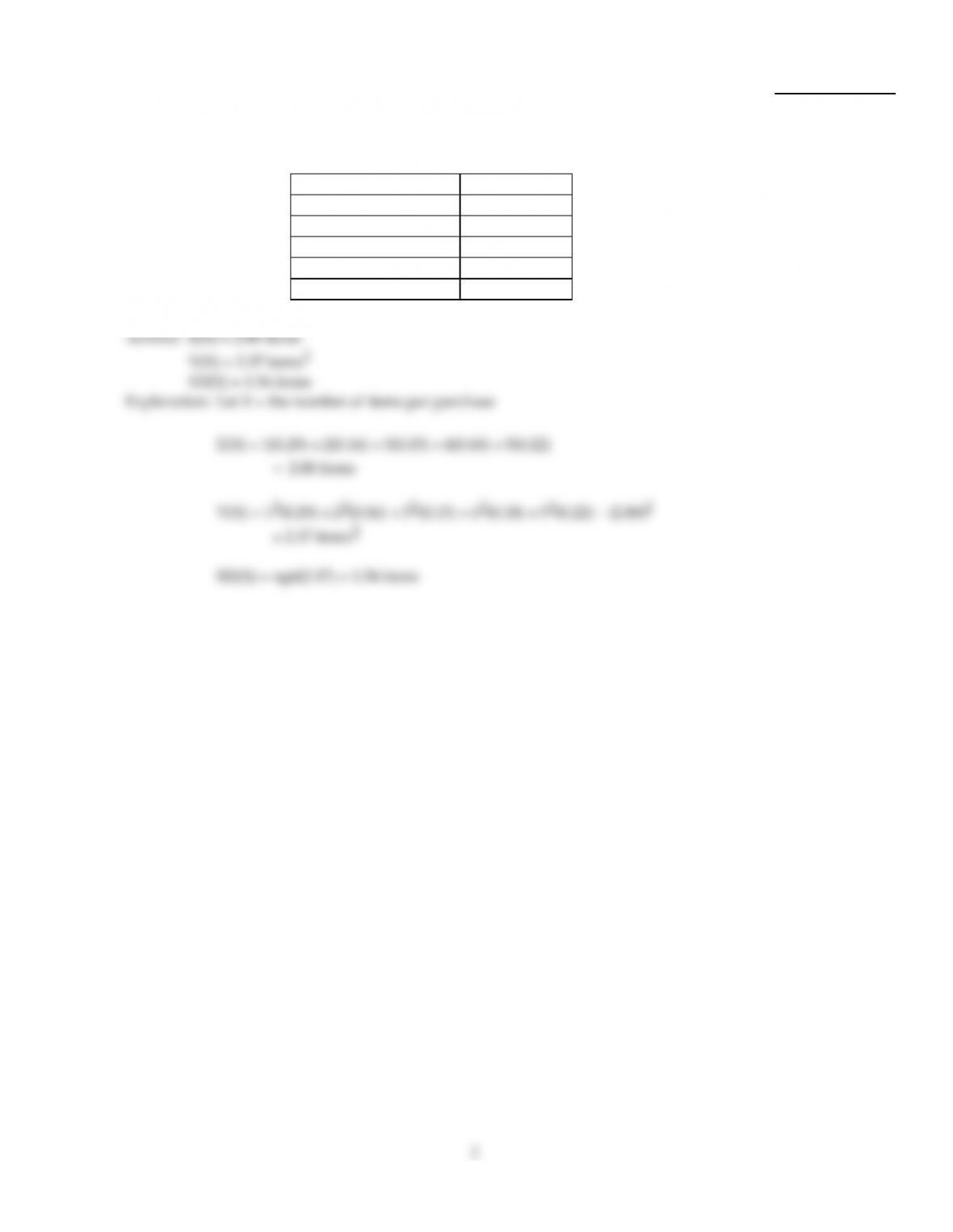
Items per Purchase Probability
10.29
20.16
30.15
40.18
50.22
2)
Answer:
E(X) =2.88 items
V(X) =2.37 items2
SD(X) =1.54 items
Explanation:
Let X = the number of items per purchase
E(X) = 1(0.29) + 2(0.16) + 3(0.15) + 4(0.18) + 5(0.22)
=2.88 items
V(X) =12(0.29) +22(0.16) +32(0.15) +42(0.18) +52(0.22) –(2.88)2
=2.37 items2
SD(X) = sqrt(2.37) =1.54 items
2
3)
The probability distribution of a certain overhead cost is f(x) =2(1–x)2, where x is
production hours per day. Determine the expected value and variance for this distribution
if the number of production hours per day ranges from 4 to 11 hours.
3)
Answer:
E(X) =5608.17
V(X) = –31,401,100.27
Explanation:
Let X = the number of production hours per day
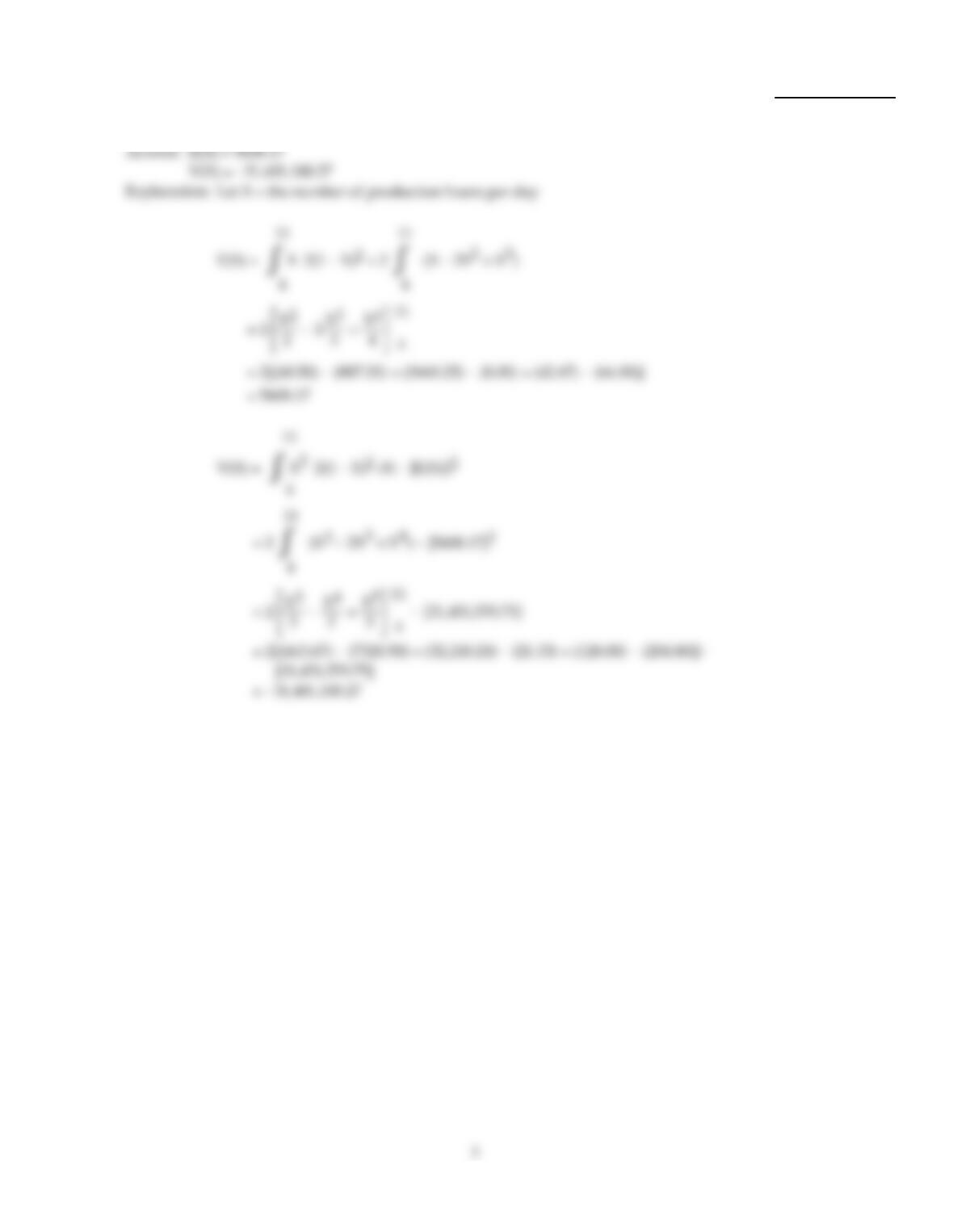
E(X) =
11
X
42(1 –X)2=2
11
4(X –2X2+ X3)
=2X2
2– 2X3
3+X4
4
11
4
=2[(60.50) – (887.33) + (3660.25) – (8.00) + (42.67) – (64.00)]
=5608.17
V(X) =
11
X2
42(1 –X)2X–[E(X)]2
=2
11
4(X2–2X3+X4) –[5608.17]2
=2X3
3–X4
2+X5
5
11
4– [31,451,570.75]
=2[(443.67) – (7320.50) + (32,210.20) – (21.33) + (128.00) – (204.80)] –
[31,451,570.75]
= –31,401,100.27
3
4)
Kewpie, Inc. is considering purchasing a new set of packaging and labeling equipment. A
comparison of estimated cash flows is shown below.
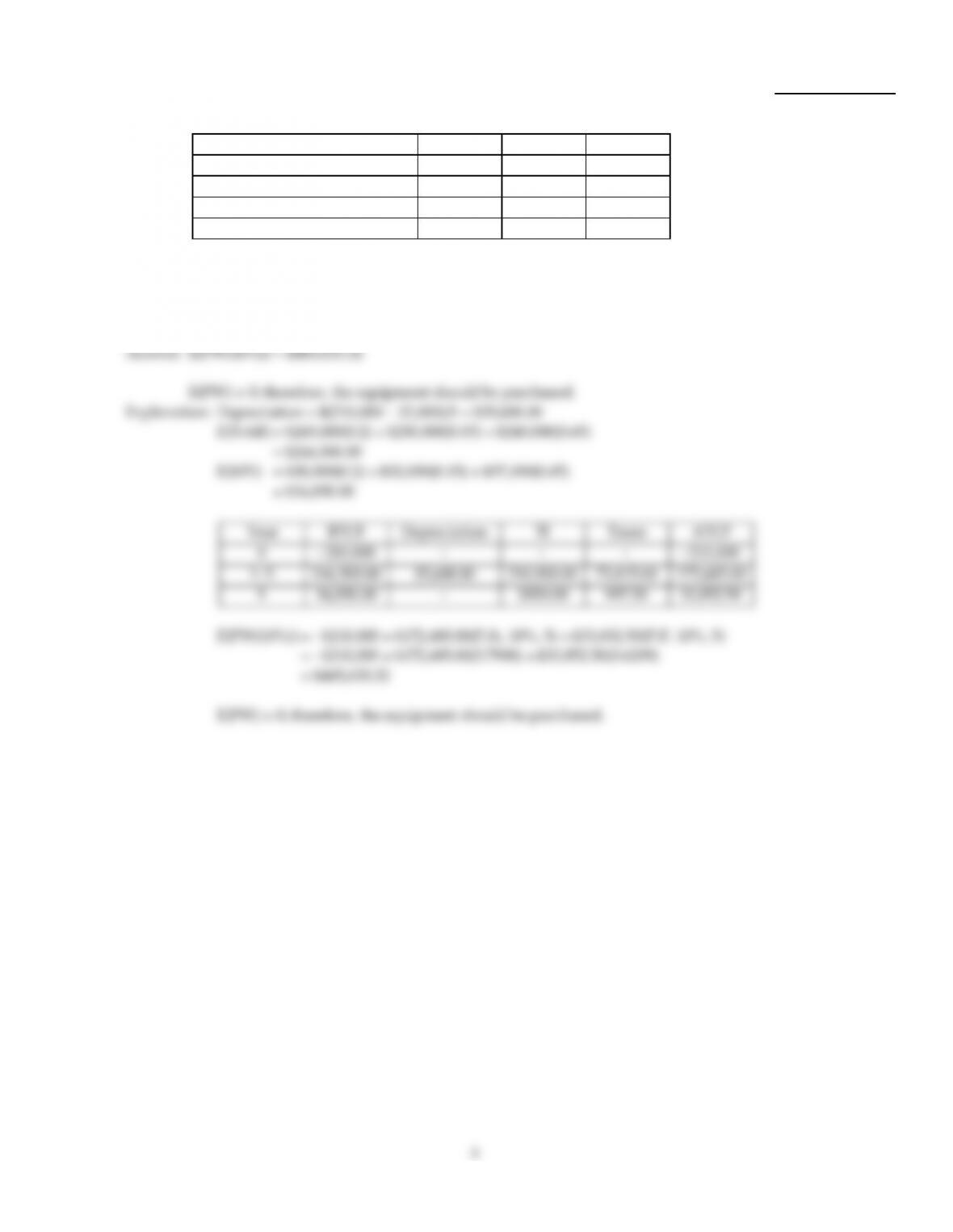
Item P =0.2 P =0.15 P =0.65
Initial investment, $ 210,000 210,000 210,000
Net annual revenue, $/year 265,000 250,000 240,000
Market value, $ 30,000 32,000 37,000
Project life, years 5 5 5
If straight–line depreciation with a salvage value of $32,000 and a useful life of 5 years is
used, determine whether Kewpie should invest in the equipment on the basis of the
expected value of after–tax PW. Assume an effective tax rate of 35% and a MARR of 10%
per year.
4)
Answer:
E(PW(10%)) =$465,633.32
E(PW) > 0; therefore, the equipment should be purchased.
Explanation:
Depreciation = $(210,000 –32,000)/5=$35,600.00
E(NAR)=$265,000(0.2) +$250,000(0.15) +$240,000(0.65)
=$246,500.00
E(MV) =$30,000(0.2) +$32,000(0.15) +$37,000(0.65)
=$34,850.00
Year BTCF Depreciation TI Taxes ATCF
0–210,000 – – – –210,000
1–5246,500.00 35,600.00 210,900.00 73,815.00 172,685.00
534,850.00 –2850.00 997.50 33,852.50
E(PW(10%))= –$210,000 +$172,685.00(P/A, 10%, 5) +$33,852.50(P/F, 10%, 5)
= –$210,000 +$172,685.00(3.7908) +$33,852.50(0.6209)
=$465,633.32
E(PW) > 0; therefore, the equipment should be purchased.
4
5)
Gopher Manufacturing is considering purchasing new calibration equipment to improve
the quality of its processes. The equipment has an initial cost of $66,000 and a market
value of $52,000 at the end of its useful life of 10 years. Net annual revenue is estimated
based on the production and market conditions and is shown below. If the optimistic and
pessimistic values each have an estimated 11% chance of occurring, determine whether the
equipment should be purchased on the basis of the expected value of AW. Use a MARR of
8% per year.
Optimistic Most likely Pessimistic
Net annual revenue, $/year 93,500 90,000 88,500
5)
Answer:
E(AW) =$83,974.00
The equipment should be purchased.
Explanation:
E(NAR) =$93,500(0.11) +$90,000(0.78) +$88,500(0.11)
=$90,220.00
E(AW) = –$66,000(A/P, 8%, 10) +$90,220.00 +$52,000 (A/F, 8%, 10)
= –$66,000(0.1490) +$90,220.00 +$52,000 (0.0690)
=$83,974.00
E(AW) > 0; therefore, the equipment should be purchased.
6)
An engineer is considering the size of a reservoir for flood control in the northern part of
Germany. The size of the reservoir is closely related to the annual rainfall. In addition,
there will be reparation costs from damages when the amount of rainfall exceeds the
design capacity. If such damage occurs, it is estimated that the annual reparation cost will
be 2.3% of the capital investment. The probabilities of specific amounts of rainfall per year
and the estimated investment costs of the reservoir are given below. Using an interest rate
of 8% per year and a study period of 11 years, determine the appropriate investment on the
basis of AW.
Annual
Rainfall, M3 Probability
of
Greater Rainfall
Estimated
Capital
Investment, $
110 0.6 2,500,000
120 0.2 2,550,000
130 0.1 2,600,000
140 0.055 2,650,000
150 0.045 2,700,000
6)
Answer:
AW110 (8%) = –$384,750.00
AW120 (8%) = –$368,985.00
AW130 (8%) = –$370,240.00
AW140 (8%) = –$374,617.25
AW150 (8%) = –$381,064.50
Select the annual rainfall that yields the least AW.
5
Explanation:
AW110(8%) = –$2,500,000(A/P, 8%, 11) – $(0.6)(0.0230)(2,500,000)
= –$2,500,000(0.1401) – $(34,500.00)
= –$384,750.00
AW120(8%) = –$2,550,000(A/P, 8%, 11) – $(0.2)(0.0230)(2,550,000)
= –$2,550,000(0.1401) – $(11,730.00)
= $–$368,985.00
AW130(8%) = –$2,600,000(A/P, 8%, 11) – $(0.1)(0.0230)(2,600,000)
= –$2,600,000(0.1401) – $(5980.00)
= –$370,240.00
AW140(8%) = –$2,650,000(A/P, 8%, 11) – $(0.055)(0.0230)(2,650,000)
= –$2,650,000(0.1401) – $(3352.25)
= –$374,617.25
AW150(8%) = –$2,700,000(A/P, 8%, 11) – $(0.045)(0.0230)(2,700,000)
= –$2,700,000(0.1401) – $(2794.50)
= –$381,064.50
Select the annual rainfall that yields the least AW.
7)
The estimated annual cash flow of an investment project along with associated
probabilities are given below. Determine the expected present worth of this annual cash
flow series at an interest rate of 11% per year.
Year P =0.5 P =0.4 P =0.1
0–$57,000 –$59,000 –$57,500
1$3100 $3000 $3100
2–6$3250 $3000 $3100
7$3400 $6000 $3100
7)
Answer:
E(PW) = –$42,530.59
Explanation:
PW0.5 = –$57,000 +$3100(P/F, 11%, 1) +$3250(P/A,11%, 5)(P/F, 11%, 1) +
$3400(P/F, 11%, 7)
= –$57,000 +$3100(0.9009) +$3250(3.6959)(0.9009) +$3400(0.4817)
= –$41,748.11
PW0.4 = –$59,000 +$3000(P/A, 11%, 6) +$6000(P/F, 11%, 7)
= –$59,000 +$3000(4.2305) +$6000(0.4817)
= –$43,418.30
PW0.1 = –$57,500 +$3100(P/A,11%, 7)
= –$57,500 +$3100(4.7122)
= –$42,892.18
E(PW) = (0.5)PW0.5 + (0.4)PW0.4 + (0.1)PW0.1
= (0.5)(–41,748.11) + (0.4)(–43,418.30) + (0.1)(–42,892.18)
= –$42,530.59
6
Answer Key
Testname: C12
1)
E(PW) = –$37,629.03
V(PW) =$25,917,255.65
2)
E(X) =2.88 items
V(X) =2.37 items2
SD(X) =1.54 items
3)
E(X) =5608.17
V(X) = –31,401,100.27
4)
E(PW(10%)) =$465,633.32
E(PW) > 0; therefore, the equipment should be purchased.
5)
E(AW) =$83,974.00
The equipment should be purchased.
6)
AW110 (8%) = –$384,750.00
AW120 (8%) = –$368,985.00
AW130 (8%) = –$370,240.00
AW140 (8%) = –$374,617.25
AW150 (8%) = –$381,064.50
Select the annual rainfall that yields the least AW.
7)
E(PW) = –$42,530.59