24)
A piece of liquid handling equipment that costs $10,000 has a $3000 salvage value. Using
MACRS depreciation with a 3–year recovery period, calculate the accumulated annual
depreciation at the end of year 3.
24)
Answer:
Accumulated depreciation =$9259.00
Explanation:
From Table 7.3 and dk=rkB
d1= 0.3333(10,000) =3333.00
d2= 0.4445(10,000) =4445.00
d3= 0.1481(10,000) =1481.00
Accumulated depreciation =d1+d2+d3
=9259.00
Or accumulated depreciation = 1–d4= (1– 0.0741)(10,000) =9259.00
25)
A $22,000 flow measurement instrument was installed and depreciated for 9 years and was
sold for $4500. If the double declining balance method of depreciation is used, determine
the difference between the book value and the market value at the end of year 9.
25)
Answer:
BV9=$2351.12
MV9–BV9=$2148.88
Explanation:
From R=2
N, dk=B(1 –R)k–1(R) and BVk=B(1 –R)k
R = 2/9=0.22
BV9=22,000(1 –0.22)9=2351.12
MV9–BV9=4500 –2351.12
=2148.88
26)
A petroleum refining and recovery service company, Cowboy Enterprises, purchased
$13,000 worth of equipment for reconditioning fuels in its storage tanks. The equipment
has a functional life of 14 years and a salvage value of 5% of the purchased price. Use
MACRS depreciation with a 10–year recovery period to determine the book value after 4
years.
26)
Answer:
BV4=$5990.40
Explanation:
From Table 7.3 , dk=rkB and BVk= B –k
i=1
di
BV4=13,000 – (0.1 + 0.18 + 0.144 + 0.1152)(13,000)
=5990.40
27)
A construction company has an effective income tax rate of 38%. The company must
purchase one of the following two models of tower cranes for its new project. The
after–tax MARR is 12% per year. Select a crane on the basis of present worth of the EVA
estimates using MACRS with a 5–year recovery period.
Machine Model Q Model R
First costs $21,000 $22,000
Net Annual Revenue $15,500 $15,800
Market Value at the end of useful life $1100 $2100
Life, years 6 6
27)
19

Answer:
PWQ (12%) =$24,745.86
PWR (12%) =$25,938.43
Model R should be selected.
20
Explanation:
MACRS: from Table 7.3 and dk=rkB
BTCF = – Capital Investment + GI – Expense
TI = GI – Expense – Depreciation
Taxes = TI (t)
ATCF = BTCF – Taxes
NOPATk= TI –Taxes
EVAk=NOPATk–i BVk–1
Model Q:
Year BTCF rkDepreciation TI Taxes ATCF
0–21,000 – – – – – 21,000
115,500 0.2 4200.00 11,300.00 4294.00 11,206.00
… … … … … … ...
515,500 0.1152 2149.20 13,080.80 4970.70 10,529.30
616,600 0.0576 1209.60 15,390.40 5848.35 10,751.65
Year NOPAT BV EVA
17006.00 16,800.00 4486.00
25443.60 10,080.00 3427.60
… … … …
69542.05 09396.90
PWQ (12%) =4486.00 (P/F, 12%, 1) +3427.60 (P/F, 12%, 2) +…+9396.90 (P/F,
12%, 6)
=4486.00 (0.8929) +3427.60 (0.7972) +…+9396.90 (0.5066)
=24,745.86
Model R:
Year BTCF rkDepreciation TI Taxes ATCF
0–22,000 – – – – – 22,000
115,800 0.2 4400.00 11,400.00 4332.00 11,468.00
… … … … … … …
515,800 0.1152 2534.40 13,265.60 5040.93 10,759.07
617,900 0.0576 1267.20 16,632.80 6320.46 11,579.54
Year NOPAT BV EVA
17068.00 17,600.00 4428.00
25629.60 10,560.00 3517.60
… … … …
610,312.34 010,160.28
PWR (12%) =4428.00 (P/F, 12%, 1) +3517.60 (P/F, 12%, 2) +…+10,160.28 (P/F,
12%, 6)
=4428.00 (0.8929) +3517.60 (0.7972) +…+10,160.28 (0.5066)
=25,938.43
PWR (12%) >PWQ (12%) > 0; therefore, model R should be selected.
21
28)
A low–cost airline operating in South Africa is considering adding either Boeing 737–400
or Boeing 737–800 to its fleet. The following information is prepared for the economic
evaluation. Either aircraft is to be used for 5 years and sold for the estimated salvage
value. Assume the double declining balance is used for tax purposes in this country and
the airline’s before–tax MARR is 6.00% per year and the effective tax rate is 35%. Select a
machine on the basis of after–tax present worth analysis.
Alternative 737–400 737–800
First costs $390,000 $475,000
Annual benefits $330,000 $405,000
Salvage value $234,000 $234,000
Life, years 810
28)
Answer:
PW400(4% =$805,391.27
PW800(4%) =$967,949.71
Select Boeing 737–800.
22
Explanation:
BTCF = – Capital Investment + GI – Expense
DDB: R=2
N, dk=B(1 –R)k–1 (R) and BVk=B(1 –R)k
After–tax MARR = Before–tax MARR (1 – Effective income tax rate)
=0.06 (1 – 0.35) =0.04 or 4%
Boeing 737–400:
R = 2/8 = 0.25
BV5=390,000 (1 – 0.25)5=$92,548.83 <$234,000; therefore, depreciation
recapture =234,000 –92,548.83 =$141,451.17
Year BTCF Depreciation TI Taxes ATCF
0–390,000 – – – – 390,000
1330,000 97,500.00 232,500.00 81,375.00 248,625.00
2330,000 73,125.00 256,875.00 89,906.25 240,093.75
… … … … … …
5a 330,000 30,849.61 299,150.39 104,702.64 225,297.36
5b 234,000 –141,451.17 49,507.91 184,492.09
PW400(4%) = – 390,000 +248,625.00 (P/F, 4%, 1) + … + (225,297.36 +184,492.09)
(P/F, 4%, 5)
= – 390,000 +248,625.00 (0.9615) + … + (225,297.36 +184,492.09) (
0.8219)
=805,391.27
Boeing 737–800:
R = 2/10 = 0.2
BV5=475,000 (1–0.2)5=$155,648.00 <$234,000; therefore, depreciation
recapture =234,000 –155,648.00 =$78,352.00
Year BTCF Depreciation TI Taxes ATCF
0–475,000 – – – – 475,000
1405,000 95,000.00 310,000.00 108,500.00 296,500.00
2405,000 76,000.00 329,000.00 115,150.00 289,850.00
… … … … … …
5a 405,000 38,912.00 366,088.00 128,130.80 276,869.20
5b 234,000 –78,352.00 27,423.20 206,576.80
PW800(4%) = – 475,000 +296,500.00 (P/F, 4%, 1) +289,850.00 (P/F, 4%, 2) + …
+ (276,869.20 +206,576.80) (P/F, 4%, 5)
= – 475,000 +296,500.00 (0.9615) +289,850.00 (0.9246) + …
+ (276,869.20 +206,576.80) (0.8219)
=967,949.71
PW800(4%) >PW400(4%) > 0; therefore, select Boeing 737–800.
23
29)
For depreciation purposes, a 150% declining balance depreciation is used for a material
handling lift truck with a cost basis of $23,000 and a salvage value of $6250 at the end of its
useful life of 5 years. If the MACRS depreciation method with a 3–year recovery period is
used for tax purposes, determine the difference between the annual depreciation after 2
years calculated from both depreciation methods.
29)
Answer:
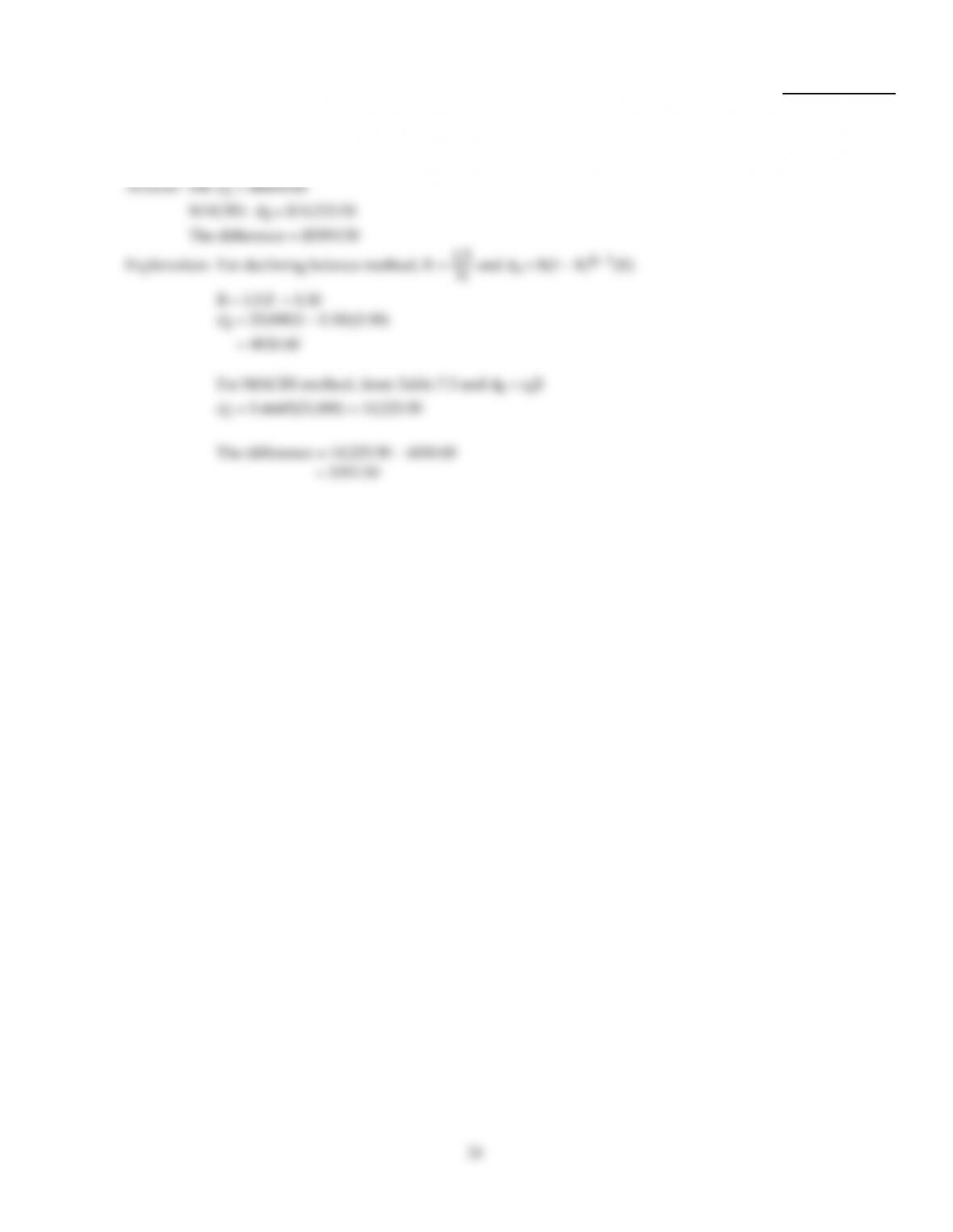
DB: d2=$4830.00
MACRS: d2=$10,223.50
The difference =$5393.50
Explanation:
For declining balance method, R=1.5
N and dk=B(1 –R)k–1(R)
R =1.5/5 =0.30
d2=23,000(1 –0.30)(0.30)
=4830.00
For MACRS method, from Table 7.3 and dk=rkB
d2= 0.4445(23,000) =10,223.50
The difference =10,223.50 –4830.00
=5393.50
24
Answer Key
Testname: C7
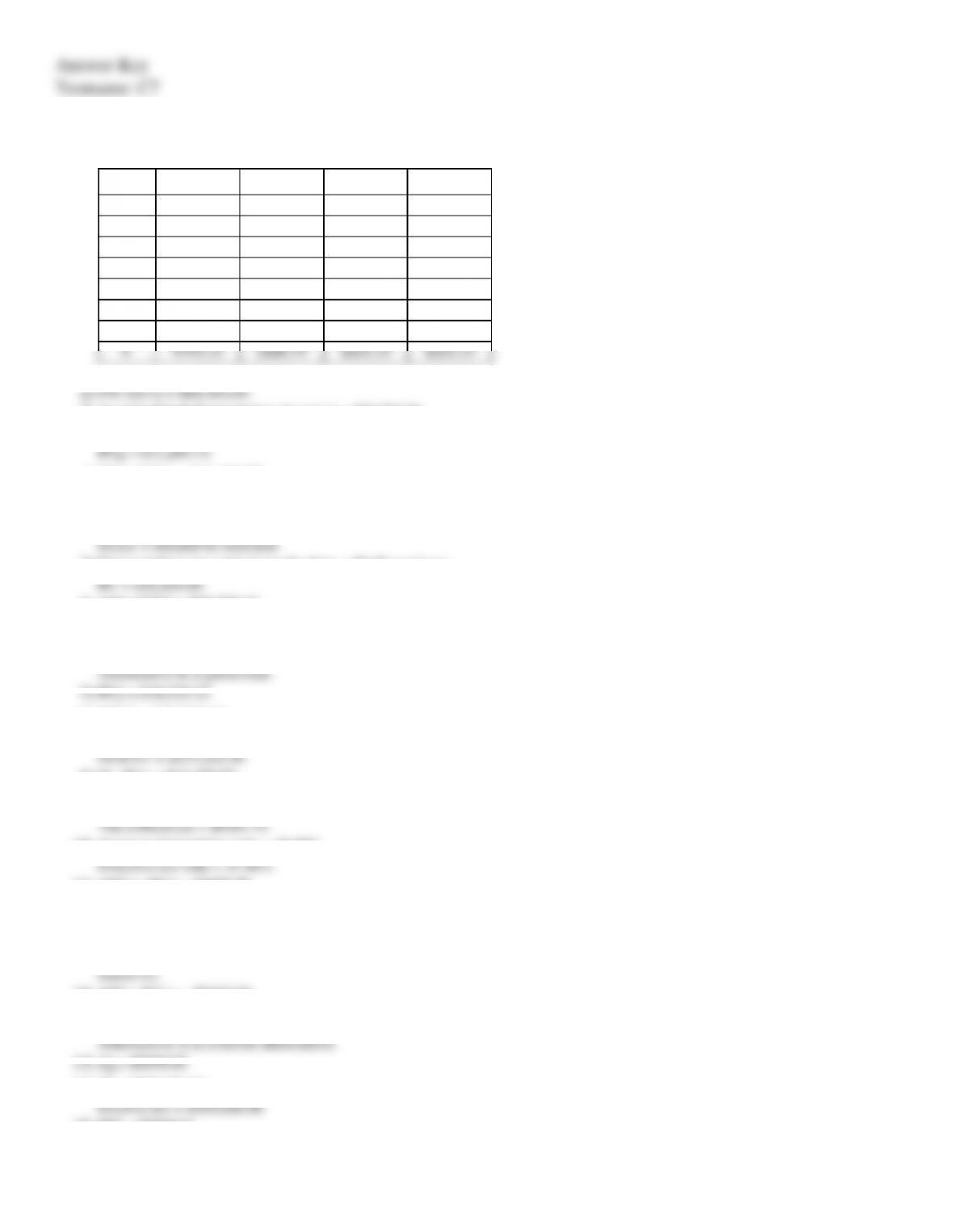
1)
Year BVk–1DDB SL dk
179,000.00 19,750.00 9183.75 19,750.00
259,250.00 14,812.50 7674.29 14,812.50
344,437.50 11,109.38 6484.58 11,109.38
433,328.12 8332.03 5559.62 8332.03
524,996.09 6249.02 4866.52 6249.02
618,747.07 4686.77 4405.69 4686.77
714,060.30 3515.08 4265.15 4265.15
89795.15 2448.79 4265.15 4265.15
2)
FW (12%) =$68,304.00
3)
Accumulated depreciation at year 6=$34,714.26
BV6=$11,285.74
4)
PW1 (10%) =$46,426.57
PW2 (10%) =$42,867.19
Mixer 1 should be selected.
5)
Depreciation per unit of production =$0.40 per hour
BV =$25,200.00
6)
AWQ(12%) =$40,392.67
AWR(12%) =$45,882.31
Alternative R is preferred.
7)
BV7=$10,222.23
8)
BTCF =$420,000.00
ATCF =$288,211.50
NOPAT =$177,211.50
9)
SL: BV5=$15,499.99
MACRS: BV5=$6158.25
The difference =$9341.74
10)
Average federal tax rate =34.00%
Effective tax rate =37.96%
11)
AWT1 (8%) =$8658.58
AWT2 (8%) =$289.75
Select T1.
12)
AWA (8%) = – $5032.99
AWB (8%) = – $12,569.59
Alternative A is a better alternative.
13)
d2=$8190.00
14)
TI =$599,000.00
Income tax =$203,660.00
15)
PW =$5008.01
Answer Key
Testname: C7
16)
d5=$4375.00
17)
PW =$17,956.05
18)
PW(2)% =355,303.51
The investment in the equipment is justifiable.
19)
X =$2545.38
20)
d7=$2000.00
BV7=$11,000.00
21)
PW =$63,264.58
22)
PW =$432,628.96
PW (10%) > 0; therefore, the equipment should be purchased.
23)
AWP1 (10%) =$62,261.12
AWP2 (10%) =$54,813.17
P1 should be selected.
24)
Accumulated depreciation =$9259.00
25)
BV9=$2351.12
MV9–BV9=$2148.88
26)
BV4=$5990.40
27)
PWQ (12%) =$24,745.86
PWR (12%) =$25,938.43
Model R should be selected.
28)
PW400(4% =$805,391.27
PW800(4%) =$967,949.71
Select Boeing 737–800.
29)
DB: d2=$4830.00
MACRS: d2=$10,223.50
The difference =$5393.50