13)
A slip sheet manufacturer is considering two machines. An engineer is asked to perform
analyses to select the best machine. She prepares the following information for the
evaluation. All machines have a useful life of 5 years. If the company’s MARR is 4% per
year, which machine should be selected.
Machine X Y
First costs $52,000 $37,000
Annual expenses $5750 $8050
Annual revenue $15,250 $15,750
Salvage value $23,400 $5550
IRR (%) 9.10 5.62
13)
Answer:
Incremental IRR (X–Y) =14.83% >4%; discard machine Y
Machine X should be selected.
Explanation:
Rank Y and X.
PW(X–Y) = 0 = – 52,000 +37,000 + (–5750 +8050 +15,250 –15,750)(P/A, i%, 5)
+ (23,400 –5550)(P/F, i%, 5)
= – 15,000 + 1,800 (P/A, i%, 5) + (17,850) (P/F, i%, 5)
Solve for i by interpolation and incremental IRR =14.83% >4%; therefore,
discard machine Y.
Or, PW(X–Y, 4%) = – 15,000 + 1,800 (P/A, 4%, 5) + (17,850)(P/F, 4%, 5)
= – 15,000 + 1,800 (4.4518) + (17,850)(0.8219)
=7684.16 > 0
Select machine X.
11
14)
The Pentagon is deciding between two models of light–duty support vehicles proposed by
two high–technology defense contractors. The costs associated with each model are shown
below. Which model should be selected if the MARR is 16% per year based on the future
worth method?
Alternative A B
Initial R&D costs $481,000 $496,000
Non–recurring
investment costs
(Years 1, 3, and 5)
$47,000 $72,000
Recurring costs $15,000 in year 4,
increasing by $500
until year 10
$16,500 in year 4,
increasing by $400
until year 10
Annual maintenance
costs
$3000 $5000
Disposal costs $3000 $3500
Life, years 14 14
14)
Answer:
FW(A) = – $5,053,855.29
FW(B) = – $5,682,668.31
The alternative with the least negative future worth should be selected.
Explanation:
FW(A) = – 481,000(F/P, 16%, 14) –47,000(F/P, 16%, 13) –47,000(F/P, 16%, 11)
–47,000(F/P, 16%, 9) –15,000(F/A, 16%, 7)(F/P, 16%, 4)
–500(P/G, 16%, 7)(F/P, 16%, 11) –3000(F/A, 16%, 14) –3000
= – 481,000(7.9875) –47,000(6.8858) –47,000(5.1173) –47,000(3.803)
–15,000(11.4139)1.8106 –500(9.761)(5.1173) –3000(43.672) –3000
= – 5,053,855.29
FW(B) = – 496,000 (F/P, 16%, 14) –72,000(F/P, 16%, 13) –72,000(F/P, 16%, 11)
–72,000(F/P, 16%, 9) –16,500(F/A, 16%, 7)(F/P, 16%, 4)
–400(P/G, 16%, 7)(F/P, 16%, 11) –5000(F/A, 16%, 14) –3500
= (–496,000 * 7.9875) –72,000(6.8858) –72,000(5.1173) –72,000(3.803)
–16,500(11.4139)1.8106 –400(9.761)(5.1173) –5000(43.672) –3500
= – 5,682,668.31
Select the alternative with the least negative future worth.
12
15)
A textile company is considering opening a production and shipping facility in Dallas to
keep up with demand for its pillows. The 105,000–square–foot facility, if purchased, will
require an initial investment of $255,000 and an annual operating cost of $68,500. It will
have a $80,000 salvage value after 8 years. Alternatively, the facility can be leased with
annual rent of $51,000 in year 1 and increasing by $1000 per year. If the company’s
minimum attractive rate of return is 6% per year, compounded quarterly, should the
facility be purchased or leased?
15)
Answer:
AW (Purchase) = – $101,744.50
AW (Lease) = – $54,188.40
Select the alternative with the least negative annual worth.
Explanation:
Effective interest rate =(1 +r/M)M– 1 =(1+0.06/4)4–1
=0.0614 or 6.14% per year
AW (Purchase) = – 255,000(A/P, 6.14%, 8) –68,500 +80,000(A/F, 6.14%, 8)
= – 255,000(0.1619) –68,500 +80,000(0.1005)
= – 101,744.50
AW (Lease) = – 51,000 –1000(A/G, 6.14%, 8)
= – 51,000 –1000(3.1884)
= – 54,188.40
Select the alternative with the least negative annual worth.
16)
Consider the three mutually exclusive alternatives below. Determine which alternative is
preferable at an interest rate of 9% per year.
Alternative M N P
Capital investment $400,000 $4000 $150,000
Annual expense $189,000 $94,500 $134,000
Annual revenue $309,000 $194,500 $234,000
Salvage value $65,000 –$130,000
Life, years 24 12
16)
Answer:
AW(M) =$79,645.00
AW(N) =$99,640.00
AW(P) =$85,506.00
The alternative with the largest positive annual worth should be selected.
Explanation:
AW(M) = – 400,000(A/P, 9%, 24) –189,000 +309,000 +65,000(A/F, 9%, 24)
= – 400,000(0.103) + 120,000 +65,000(0.013)
=79,645.00
AW(N) = – 4000 x 0.09 –94,500 +194,500
=99,640.00
AW(P) = – 150,000(A/P, 9%, 12) –134,000 +234,000 +130,000(A/F, 9%, 12)
= – 150,000(0.1397) + 100,000 +130,000(0.0497)
=85,506.00
Select the alternative with the largest positive annual worth.
13
17)
A leading cancer research institution received a gift for cancer research. The institution is
deciding whether to use the gift to create an endowment fund or to build a new research
facility. If the gift is used to establish an endowment fund, the fund would award research
funding and scholarships totaling $9.75 million per year with the first awards to be granted
at the end of next year and continue each year perpetually. Alternatively, if the gift is used
to building an integrative cancer research facility, the construction of the facility will cost
$16.5 million and the building is expected to be renovated every 10 years at a cost of $3.3
million. The annual maintenance costs are expected to be $1 million. If the facility is
expected to last forever, which alternative should be selected at an interest rate of 2% per
year?
17)
Answer:
CW (Fund) = – $487,500,000.00
CW (Building) = – $81,564,500.00
Select the alternative with the least negative capitalized worth.
Explanation:
CW (Fund) =–9.750000000 × 10⁶/0.02 = – 487,500,000.00
CW (Building) = – 16,500,000 –1,000,000/0.02 – [3,300,000(A/F, 2%, 10]/0.02
= – 16,500,000 –50,000,000 –3,300,000(0.0913)/0.02
= – 81,564,500.00
Select the alternative with the least negative capitalized worth.
18)
A manufacturing firm is considering two models of lathes. Model A will have an initial
cost of $29,000, an operating cost of $2750, and a salvage value of $6500 after 6 years.
Model B will have an initial cost of $36,500, an operating cost of $2200, and a $7750 resale
value after 12 years. At an interest rate of 10% per year, which model should the
consulting firm buy?
18)
Answer:
AW(A) = – $8566.00
AW(B) = – $7195.50
The alternative with the least negative annual worth should be selected.
Explanation:
Use the annual worth method.
AW(A) = – 29,000(A/P, 10%, 6) –2750 +6500(A/F, 10%, 6)
= – 29,000(0.2296) –2750 +6500(0.1296)
= – 8566.00
AW(B) = – 36,500(A/P, 10%, 12) –2200 +7750(A/F, 10%, 12)
= – 36,500(0.1468)–2200 +7750(0.0468)
= – 7195.50
Select the alternative with the least negative annual worth.
14
19)
Two delivery methods have been proposed for a standard delivery method for new bridge
constructions in Oregon to overcome traditional design–bid–build models that do not
adequately account for site conditions and constructability, and often lead to additional
expenses. One alternative must be selected to represent the delivery method specified in
the RFP. Based on data from recent bridge construction projects of comparable size, we
can estimate the savings from reduced redesign costs, risk management costs, and
overhead costs during the life of the construction contract over the traditional delivery
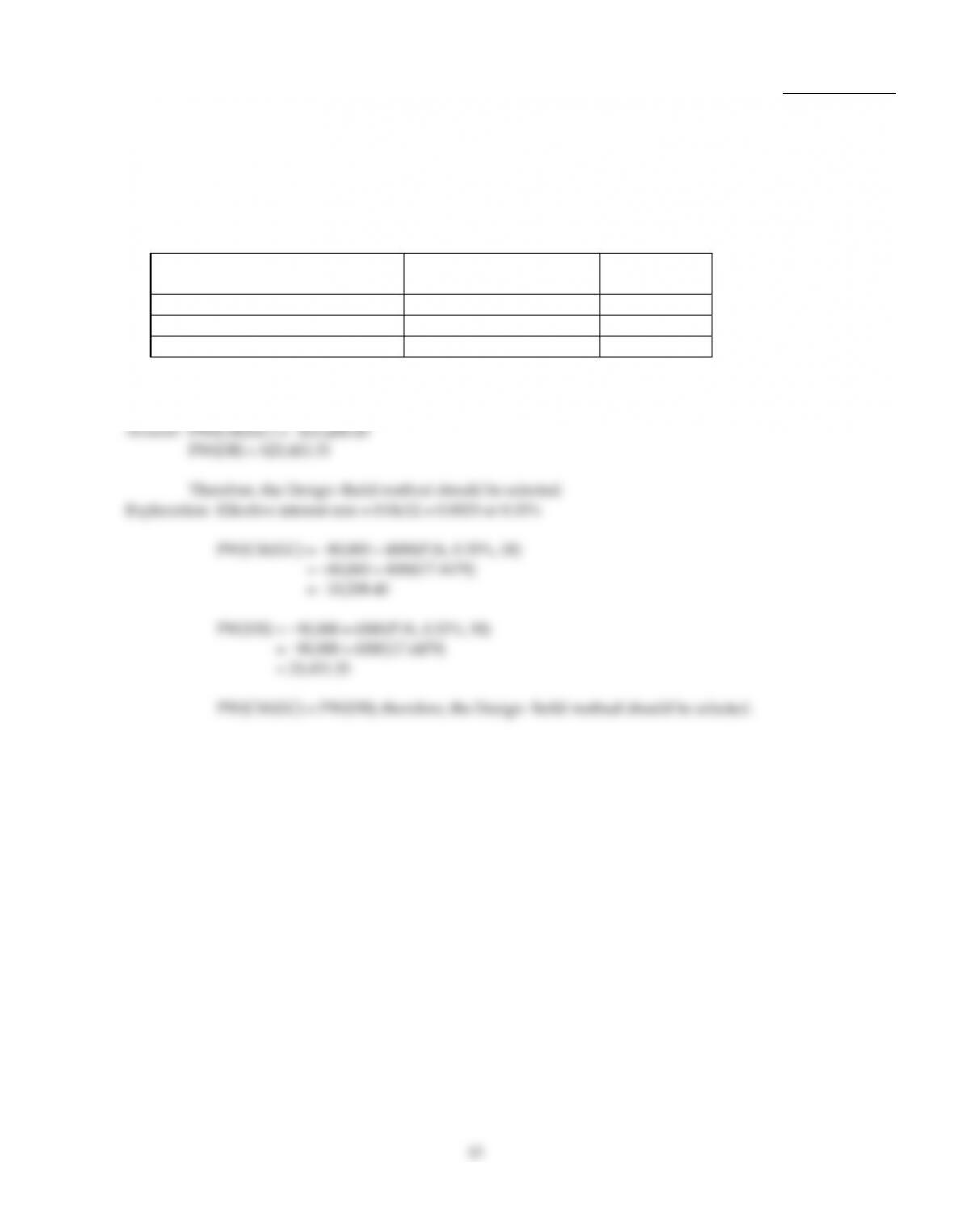
model. The estimated costs of a 18–month contract are the following:
Alternative Construction manager
/General contractor
Design–Build
Preconstruction and design costs $80,000 $90,000
Monthly savings $4000 $6500
Project life, months 18 18
Which alternative should be selected based on the present worth method? Use a MARR of
4%, compounded monthly. Assume other benefits and costs are negligible.
19)
Answer:
PW(CM/GC) = – $10,208.40
PW(DB) =$23,411.35
Therefore, the Design–Build method should be selected.
Explanation:
Effective interest rate =0.04/12 =0.0033 or 0.33%
PW(CM/GC) = – 80,000 +4000(P/A, 0.33%, 18)
= – 80,000 +4000(17.4479)
= – 10,208.40
PW(DB) = – 90,000 +6500(P/A, 0.33%, 18)
= – 90,000 +6500(17.4479)
=23,411.35
PW(CM/GC) < PW(DB); therefore, the Design–Build method should be selected.
15
20)
Compare the alternatives shown below on the basis of their future worth, using an interest
rate of 14% per year, compounded quarterly. Which alternative should be selected?
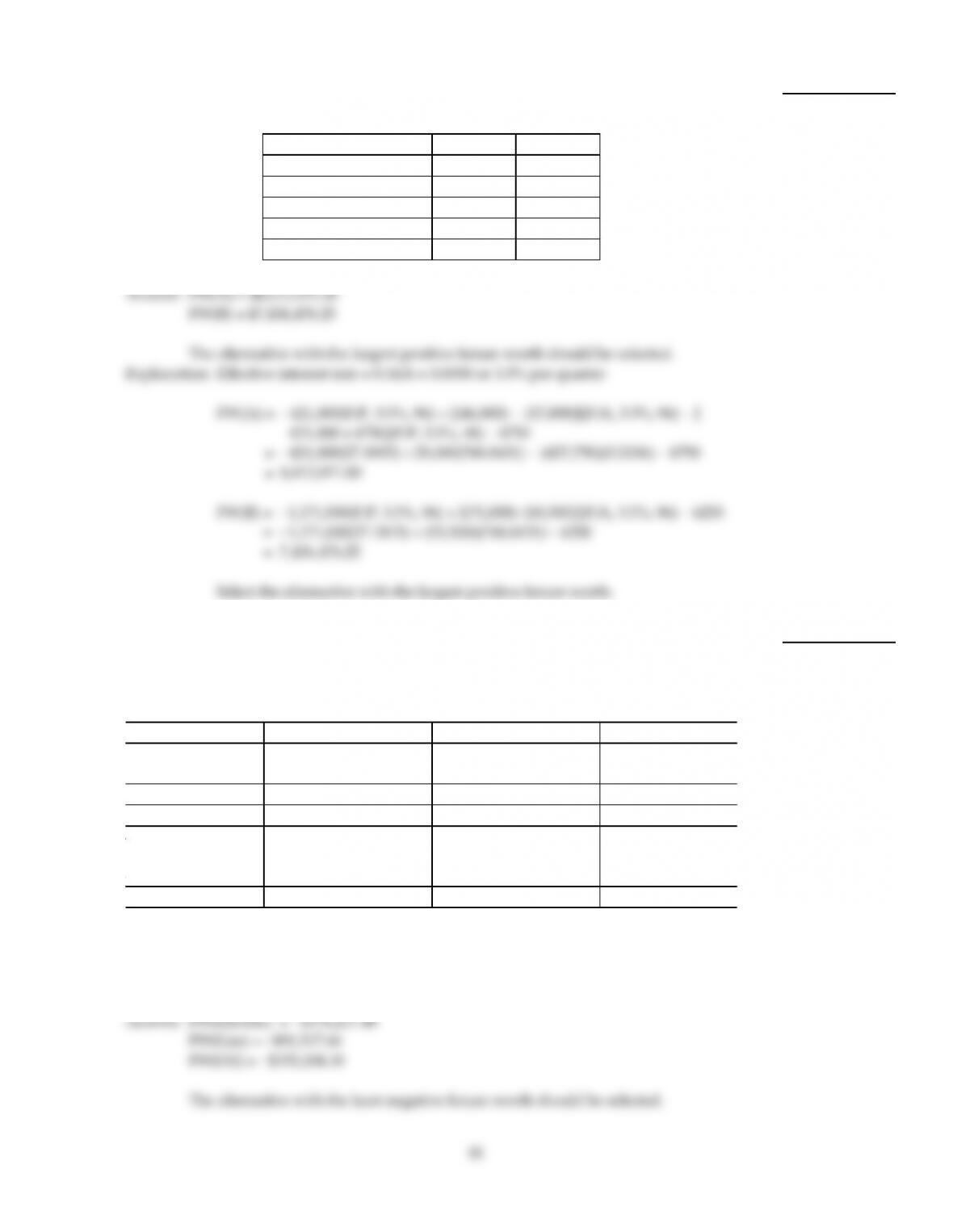
Alternative A B
Initial costs $421,000 $1,171,000
Quarterly revenues $46,000 $71,000
Quarterly expenses $17,000 $18,500
Disposal costs $6750 $6250
Life, years 12 24
20)
Answer:
FW(A) =$8,012,971.00
FW(B) =$7,436,476.25
The alternative with the largest positive future worth should be selected.
Explanation:
Effective interest rate =0.14/4 =0.0350 or 3.5% per quarter
FW(A) = – 421,000(F/P, 3.5%, 96) + [(46,000) – (17,000)](F/A, 3.5%, 96) – [
421,000 +6750](F/P, 3.5%, 48) –6750
= – 421,000(27.1815) +29,000(748.0431) – (427,750)(5.2136) –6750
=8,012,971.00
FW(B) = – 1,171,000(F/P, 3.5%, 96) + [(71,000)–(18,500)](F/A, 3.5%, 96) –6250
= – 1,171,000(27.1815) + (52,500)(748.0431) –6250
=7,436,476.25
Select the alternative with the largest positive future worth.
21)
You are deciding between three types of water heaters. The associated costs are shown
below. At the end of year 5, the electricity and oil water heaters need to be replaced with
the same model at the purchased prices. Which alternative should be selected on the basis
of their future worth at an interest rate of 12% per year?
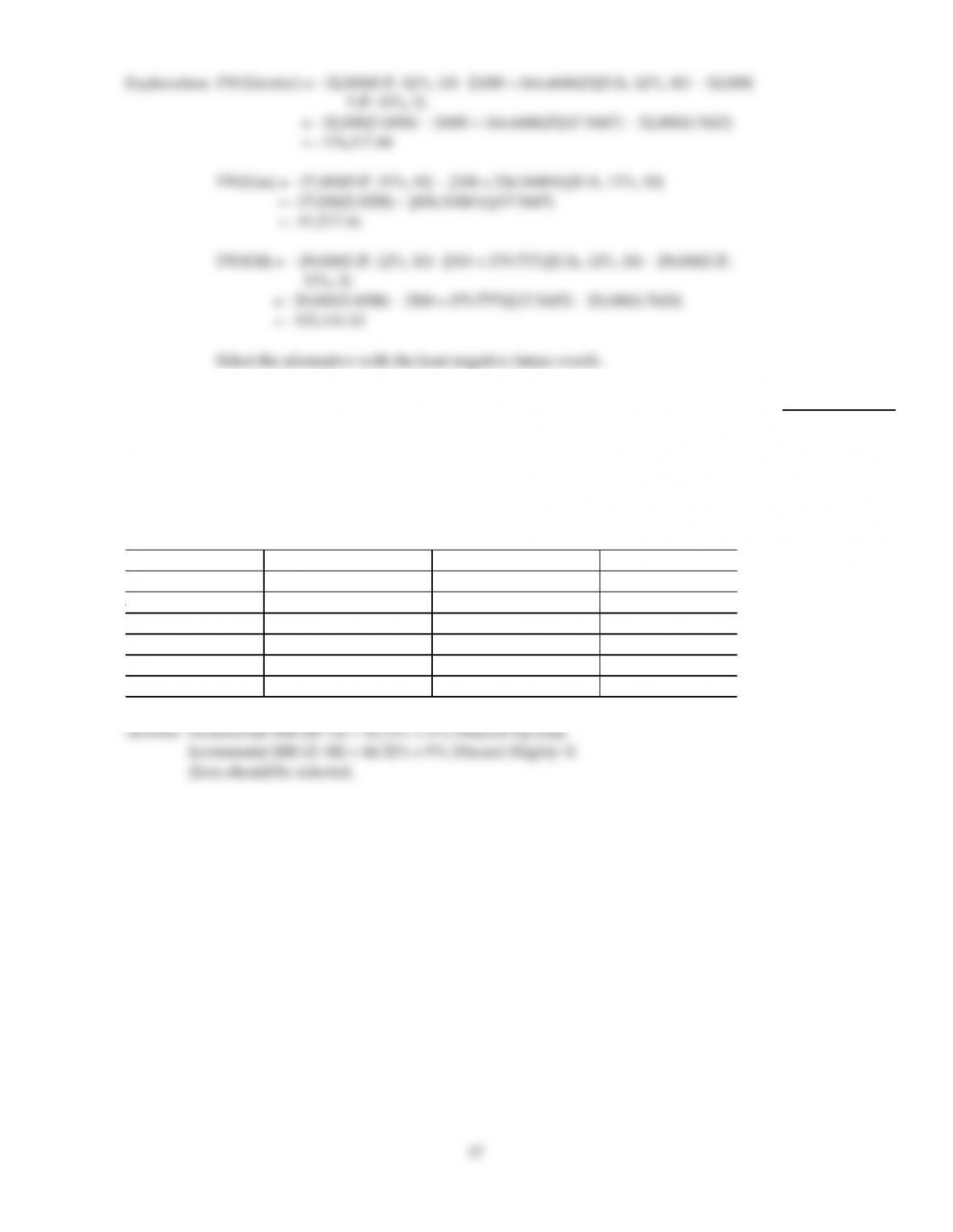
Alternative Electricity Gas Oil
Price of water
heater
$32,000 $27,000 $29,000
EF 2.0 0.57 0.75
Fuel cost $0.075 /kWh $0.000009/Btu $0.000009/Btu
Annual
aintenance
costs
$1000 $200 $500
Life, years 510 5
Hint: The estimated annual cost of operation for gas and oil heaters equals
365 x 41045/EF x Fuel Cost per Btu and the estimated annual cost of operation for electric
water heaters equals 365 x 12.03/EF x Electricity Cost per kWh.
21)
Answer:
FW(Electric) = – $176,217.48
FW(Gas) = – $91,517.46
FW(Oil) = – $153,104.10
The alternative with the least negative future worth should be selected.
16
Explanation:
FW(Electric) = – 32,000(F/P, 12%, 10)– [1000 +164.660625](F/A, 12%, 10) –32,000(
F/P, 12%, 5)
= – 32,000(3.1058) – [1000 +164.660625](17.5487) –32,000(1.7623)
= – 176,217.48
FW(Gas) = – 27,000(F/P, 12%, 10) – [200 +236.548816](F/A, 12%, 10)
= – 27,000(3.1058) – [436.548816](17.5487)
= – 91,517.46
FW(Oil) = – 29,000(F/P, 12%, 10)– [500 +179.7771](F/A, 12%, 10) –29,000(F/P,
12%, 5)
= – 29,000(3.1058) – [500 +179.7771](17.5487) –29,000(1.7623)
= – 153,104.10
Select the alternative with the least negative future worth.
22)
Nadia recently moved to Celebration, Florida, an unincorporated master–planned
community in Osceola County that connects directly to the Walt Disney World parks. To
support the planned community’s environmentally friendly transit system and to save on
transportation costs, she wants to buy a new Neighborhood Electric Vehicle. She is looking
into three models of the NEVs and has been provided with the following information.
Compare the alternatives shown below on the basis of rate of return and determine which
model should be purchased if her personal MARR is 9% per year.
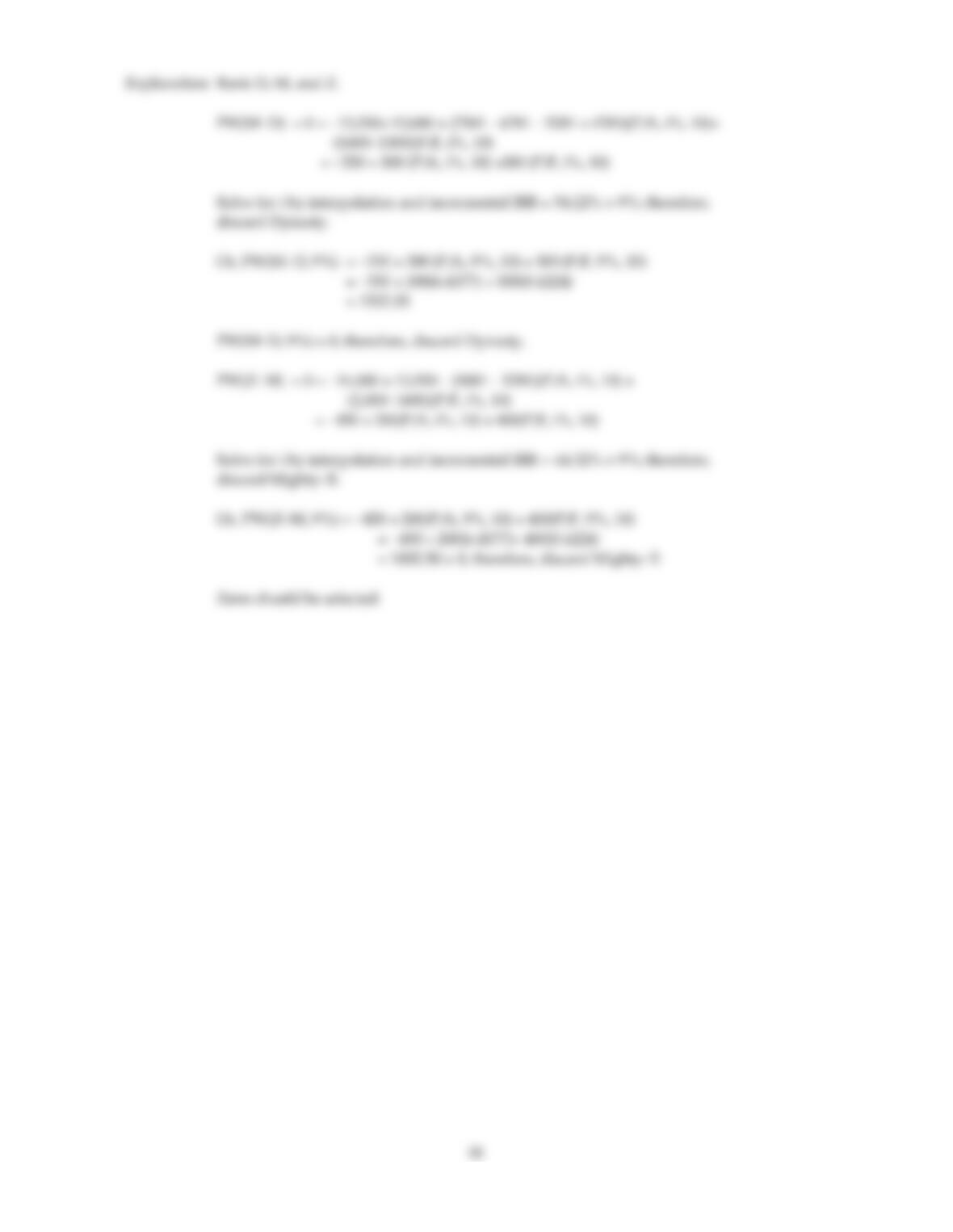
Alternative Dynasty Might–EZenn
Initial costs $13,000 $13,550 $14,000
Annual expenses $4781 $5281 $5081
Annual Saving $6781 $7581 $7581
Salvage value $1300 $1600 $2000
Life, years 10 10 10
IRR (%) 9.64 11.93 13.26
22)
Answer:
Incremental IRR (M–D) = 54.22% >9%; Discard Dynasty
Incremental IRR (Z–M) = 44.32% >9%; Discard Mighty–E
Zenn should be selected.
17
Explanation:
Rank D, M, and Z.
PW(M–D) = 0 = – 13,550+13,000 + (7581 –6781 –5281 +4781)(P/A, i%, 10)+
(1600–1300)(P/F, i%, 10)
= – 550 + 300 (P/A, i%, 10) +300 (P/F, i%, 10)
Solve for i by interpolation and incremental IRR = 54.22% >9%; therefore,
discard Dynasty.
Or, PW(M–D, 9%) = – 550 + 300 (P/A, 9%, 10) + 300 (P/F, 9%, 10)
= – 550 + 300(6.4177) + 300(0.4224)
=1502.03
PW(M–D, 9%) > 0; therefore, discard Dynasty.
PW(Z–M) = 0 = – 14,000 +13,550 – (5081 –5281)(P/A, i%, 10) +
(2,000–1600)(P/F, i%, 10)
= – 450 + 200(P/A, i%, 10) + 400(P/F, i%, 10)
Solve for i by interpolation and incremental IRR = 44.32% >9%; therefore,
discard Mighty–E.
Or, PW(Z–M, 9%) = – 450 + 200(P/A, 9%, 10) + 400(P/F, 9%, 10)
= – 450 + 200(6.4177)+ 400(0.4224)
=1002.50 > 0; therefore, discard Mighty–E
Zenn should be selected.
18
23)
A manufacturer of Neighborhood Electric Vehicles (NEVs) plans to upgrade its parts
inventory tracking system. Two alternatives are under consideration. The estimated costs
of each alternative are provided below. At the end of 9 years, alternative E will need to be
upgraded with additional costs of $19,300 over the initial cost of the system. The upgrade
will reduce the annual maintenance costs by $2000 over the next 9 years. Which
alternative should be selected on the basis of their future worth at an interest rate of 17%
per year and a study period of 18 years? Assume negligible salvage value.
Alternative E F
First costs $386,000 $401,000
Annual maintenance
costs $60,000 $58,500
Life, years 918
23)
Answer:
FW(E) = – $13,748,192.81
FW(F) = – $12,232,706.60
The alternative with the least negative future worth should be selected.
Explanation:
FW(E) = – 386,000(F/P, 17%, 18) –60,000(F/A, 17%, 9)(F/P, 17%, 9) –405,300(F/P,
17%, 9) –58,000(F/A, 17%, 9)
= – 386,000(16.879) –60,000(18.2847)(4.1084) –405,300(4.1084) –58,000(
18.2847)
= – 13,748,192.81
FW(F) = – 401,000(F/P, 17%, 18) –58,500(F/A, 17%, 18)
= – 401,000(16.879) –58,500(93.4056)
= – 12,232,706.60
Select the alternative with the least negative future worth.
19
24)
A manufacturer of automated optical inspection (AOI) devices is deciding on a project to
increase the productivity of the manufacturing processes. The estimated costs for the two
feasible alternatives being compared are shown below. Use the ERR method to determine
which alternative should be selected if the analysis period is 8 years and the reinvestment
rate equals the company’s MARR of 4% per year.
Alternative M N
Initial costs $30,000 $45,000
Net annual cash flow $4,500 $7,000
Life, years 8 8
24)
Answer:
ERR (M) =4.11% > 4%
ERR (N–M) =5.55% > 4%
Select project N.
Explanation:
Rank M and N.
Find the ERR of project M.
N
k=0
Ek(P/F, %, k)(F/P,i%, N) =N
k=0
Rk(F/P, %, N–k)
30,000(F/P, i%, 8) = 4,500(F/A, 4%, 8)
(1+i)8= 4,500(9.2142)/30,000
(1+i) =(1.38)1/8
i=0.0411
Using a MARR of 4%, project M is justified.
Next, find the incremental ERR of N–M.
15000(F/P, i%, 8) = 2,500(F/A, 4%, 8)
(1+i)8= 2,500(9.2142)/ 15,000
(1+i) =(1.54)1/8
i=0.0555
i> 4%; therefore, project N is justified.
Select Project N.
20