Exam
Name___________________________________
SHORT ANSWER. Write the word or phrase that best completes each statement or answers the question.
Answer the question.
1)
A $38,000 coil winding and unwinding machine is estimated to provide additional value to
production by $15 per unit. When the machine is operated at 58 units per hour, it needs to
be cooled down after 4 hours of operation and receive minor maintenance for 15 minutes.
When the machine is operated at 118 units per hour, it needs to be cooled down after 5
hours of operation and receive minor maintenance for 30 minutes. The production line
runs 8 hours per day. If each maintenance check costs $625 and the machine has a useful
life of 80,000 hours of operations, at what speed should the machine should be operated?
1)
Answer:
At 58 units per hour, net increase in value per day =$5363.83
At 118 units per hour, net increase in value per day =$11,922.81
Select the machine speed that provides the higher net increase in value per day
machine speed B.
Explanation:
At 58 units per hour:
Cycle time =4 hours + 0.25 hour =4.25 hours
Cycles per day =8/4.25 =1.88 cycles
Value added per day =1.88 x 4 x 58 x $15=$6542.40
Cost of maintenance per day =1.88 x $625 =$1175.00
Cost of operating the machine per day =$38,000/80,000 x 4 x 1.88
=$3.57
Net increase in value per day =$6542.40 –$1175.00 –$3.57
=$5363.83
At 118 units per hour:
Cycle time =5 hours + 0.5 hour =5.50 hours
Cycles per day =8/5.50 =1.45 cycles
Value added per day =1.45 x 5 x 118 x $15=$12,832.50
Cost of maintenance per day =1.45 x $625 =$906.25
Cost of operating the machine per day =$38,000/80,000 x 5 x 1.45
=$3.44
Net increase in value per day =$12,832.50 –$906.25 –$3.44
=$11,922.81
Select the machine speed that provides the higher net increase in value per day
machine speed B.
2)
A local cable company has a fixed cost of $7400 per month and variable costs of $50 per
month per subscriber. If the company charges on average $110 per month to its customers,
find the breakeven point in terms of subscribers per month for the company.
2)
Answer:
123.33 subscribers per month
Explanation:
Let y = number of subscribers
Total revenue = Total cost (breakeven point)
Total revenue = y x $110 per month
Total cost =$7400 + ($50 x y) per month
y =7400/(110–50) =123.33 subscribers per month
1
3)
A manufacturing company leases a machine for $31,000 per year. Each unit produced
costs $36 in labor and $65 in materials. To break even, 21,000 units must be sold. What is
the price of the product?
3)
Answer:
$102.48
Explanation:
CF=$31,000 per yr; cV=$36+$65 per unit
Total revenue = Total cost (breakeven point)
pD =CF+cvD
p(21,000) =31,000 + (101)(21,000)
p =1.48 + (101) =$102.48
4)
The annual fixed cost for a light fixture manufacturing company are $38,000, and the
variable costs are $40 per unit. If the selling price per unit is p =485–1.395X, what is the
optimum demand for a light fixture?
4)
Answer:
159.50 units per year
Explanation:
p =485–1.395D; CF=$38,000 per year; CV=$40 per unit
D*=a –CV
2b =485–40
2(1.395)=159.50 units per year
5)
A manufacturing plant is planning to replace outdated equipment with more
energy–efficient and environmental–friendly equipment. Two models are under
consideration. Model A is sold for $159,000 and can produce at an optimum speed of 78
unit/hour. Model B is sold for the same price, but can produce at an optimum speed of 76
unit/hour. Model A requires 6 hours of maintenance for every 4300 units produced, while
Model B requires 5 hours of maintenance for every 3300 units. The maintenance cost for
both models is $100 per hour. The variable operating cost is $340 per hour for Model A
and $290 per hour for Model B. Due to obsolete parts, there is a sunk cost of $2700 for
model A and $1900 for Model B . If the price of the product is $150 per unit and the
company expects to sell 145,000 units each year, which model should be selected?
5)
Answer:
Model A: $652,284 per 145,000 units
Model B: $575,259 per 145,000 units
Select the design that minimizes the total cost for 145,000 units/yearModel B.
Explanation:
The sunk costs can be ignored because they do not affect the analysis of future
costs.
Model A: Total cost for 145,000 units = [(6 hours/4300 units)($100/hr) + (1 hour/
78 units)
($340/hr)](145,000)
=$652,284
Model B: Total cost for 145,000 units = [(5 hrs/3300 units)($100/hr) + (1 hour/76
units) ($290/hr)](145,000)
=$575,259
Select the design that minimizes the total cost for 145,000 units/yearModel B.
2
6)
An accounting and management consulting firm charge–out rate is $112 per hour. The
maximum output is 214,000 hours per year. The fixed cost is $610,000 per year and the
variable cost is $62 per standard service hour. What is the breakeven point in percentage
of total capacity?
6)
Answer:
5.70% of capacity
Explanation:
CF=$610,000/yr; CV=$62/hr
Total revenue = Total cost (breakeven point)
pD =CF+CVD
D=CF
p –CV=$610,000
($112 –$62)=12,200
D (% of capacity) =$12,200
214,000 =0.057 or 5.70% of capacity
7)
The cost for operating a commercial truck is knv1/2, where k is a constant of
proportionally, v is velocity in miles per hours, and n is the trip length in miles. It is
estimated that at 85 mph, the average cost of operation is $52 per mile. The truck owner
wants to minimize the cost of operation, which needs to balance against the cost of delays
and unscheduled maintenance, which is assumed to be $10 per hour. What is the optimum
velocity needed to minimize the total costs?
7)
Answer:
The truck should be operated at an average velocity of 2.33 mph to minimize the
total cost of operation and delays.
Explanation:
CT=Co+Cc=knv1/2 +$10n
v
dCT
dv= 0 =0.5knv–0.5–10n
v2=0.5kv3/2 –10
v =(10/0.5k)2/3
To find k, we know that Co
n=$52/mile at v =85 mph
Co
n=kv0.5=k(85)0.5 =52
and k =52/9.22 =5.64
so v =[10/(0.5 * 5.64)]2/3 =2.33 miles/hr
The truck should be operated at an average velocity of 2.33 mph to minimize the
total cost of operation and delays.
3
8)
A company estimates its annual expenses, Y, in dollars from Y =0.235X2+7X +4 and
annual revenue in dollars from 0.215X2+ 15X, where X is annual units sold. Find the value
of X that gives maximum profit.
8)
Answer:
200 units
Explanation:
Profit = Total revenue – Total cost
= (0.215X2– 1X) – (0.235X2+7X +4)
= –0.02X2+ 8X –4
dProfit
dX= 0 = –0.04X + 8
X = 8/0.04 = 200 units
Note: d2Profit
dX2= –0.04 Thus, X = 200 units maximizes profit.
9)
A manufacturer of hard board and fiber cement sidings and panels purchased new
equipment for its new product line. Three alternatives are under consideration. The costs
associated with each alternative are given below. Which alternative is most economical to
minimize total life cycle costs, if the life of the equipment is estimated to be 7 years and the
company operates on average 3800 hours per year? Assume negligible salvage value.
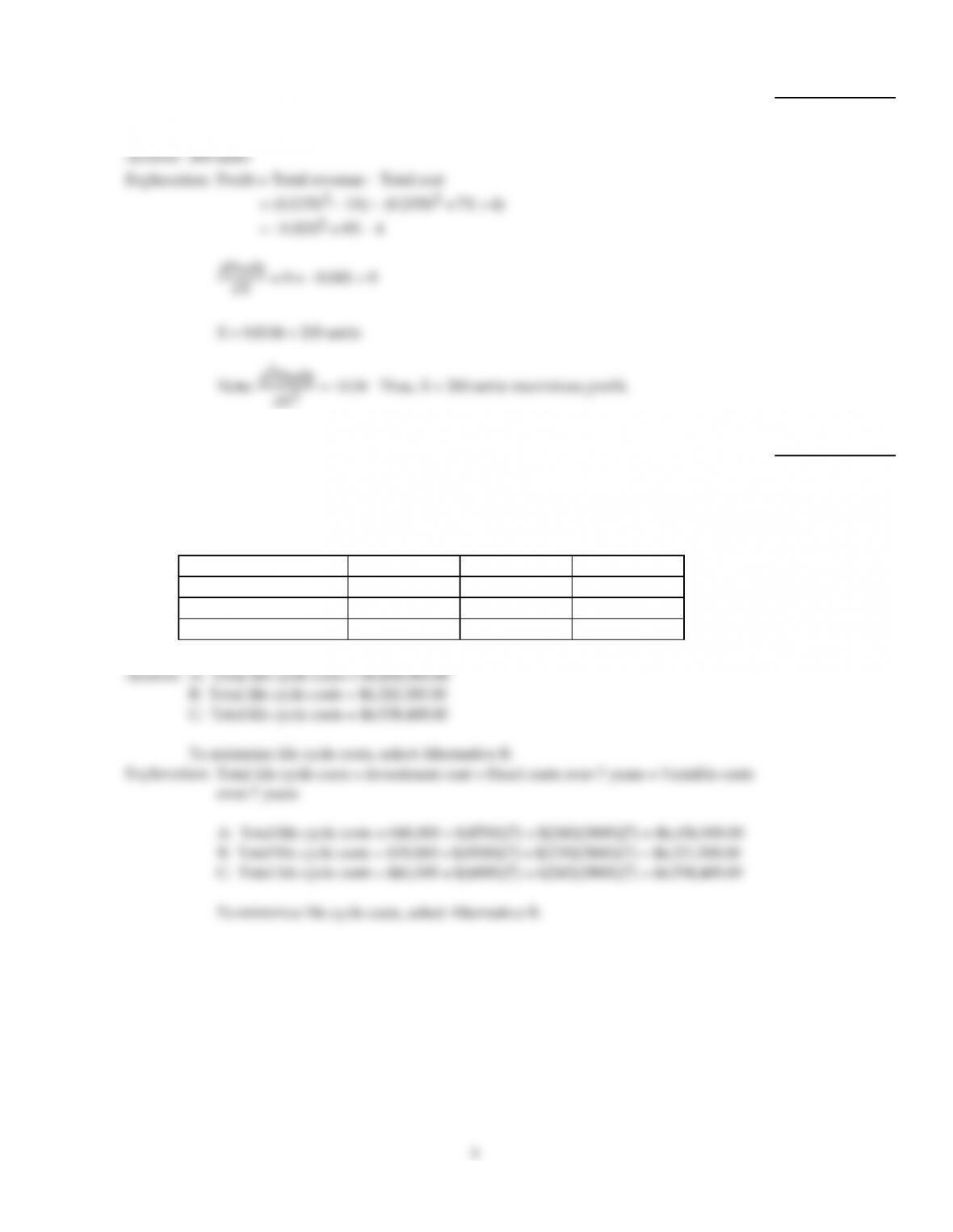
Alternative A B C
Investment cost, $ 40,000 39,000 41,000
Fixed cost, $/year 4700 4500 4800
Variable cost, $/hour 240 235 243
9)
Answer:
A: Total life cycle costs =$6,456,900.00
B: Total life cycle costs =$6,321,500.00
C: Total life cycle costs =$6,538,400.00
To minimize life cycle costs, select Alternative B.
Explanation:
Total life cycle costs = Investment cost + Fixed costs over 7 years + Variable costs
over 7 years
A: Total life cycle costs =$40,000 + $(4700)(7) + $(240)(3800)(7) =$6,456,900.00
B: Total life cycle costs =$39,000 + $(4500)(7) + $(235)(3800)(7) =$6,321,500.00
C: Total life cycle costs =$41,000 + $(4800)(7) + $(243)(3800)(7) =$6,538,400.00
To minimize life cycle costs, select Alternative B.
4
10)
A night vision goggle manufacturer is evaluating a make–versus–purchase situation for a
component used in its low–priced products. The component can be purchased at a
variable wholesale price of P = 1200 + 50X, where X is the number of items. Alternatively,
the component can be produced with a direct material cost of $17 per item and direct labor
cost of $38 per item. The manufacturing overhead is allocated at 150% of direct labor cost
per item. If the company requires, on average, 575 items each year, should the item be
purchased or manufactured?
10)
Answer:
Purchase: $29,950.00
Manufacture: $64,400.00
Select the option that has the least total costpurchasing the item.
Explanation:
Purchase: CT= 1200 + 50(575) =$29,950.00
Manufacture: CT= $(17 +38 +57)(575) =$64,400.00
Select option that has the least total costpurchasing the item.
11)
The annual fixed cost for an inspecting and profiling web controller manufacturing
company are $44,000, and the variable costs are $38 per unit. If the selling price per unit is
p =495–0.57X, what is the company’s range of profitable demand?
11)
Answer:
The range of profitable demand is 112 to 689 units per year.
Explanation:
p =495–0.57D; CF=$44,000 per year; CV=$38 per unit
D*=a –CV
2b =495–38
2(0.57)=401 units per year
Profit (loss) = Total Revenue – Total Cost
=495D –0.57D2– (44,000 +38D)
=495(401) –0.57(401)2–44,000 –38(401)
=$47,600.43 per year
Breakeven occurs when profit = 0.
Profit = 0 = –0.57D2+457D –44,000 =D2–801.75D +77,192.98
D=801.75 ± (801.75)2– 4(77,192.98)
2
D1=112 units per year
D2=689 units per year
The range of profitable demand is 112 to 689 units per year.
5
12)
A headhunter company has fixed costs of $57,000 per month and variable costs of $1000
per customer account. The company currently charges $1150 per month for each account
and has 38,000 accounts. It wants to raise the monthly fee to $1160.55 to cover enhanced
features such as a new web interface and a newly acquired database, which increases the
variable cost by 9 percent. What is the new breakeven point in number of accounts?
12)
Answer:
807.94 accounts
Explanation:
CF=$57,000/yr; CV= $(1+0.09)1000 =$1090.00/yr ; p =1160.55
Total revenue = Total cost (breakeven point)
pD =CF+CVD
D=CF
p –CV=$57,000
($1160.55 –$1090.00)=807.94 accounts
13)
An uninterruptible power system manufacturer is currently deciding between two
processes for its new automated assembly system. All defect–free units can be sold at $210
each, and all rejected units can be sold at $11 for scrap. Other related information for each
model is given below.
Process A B
Output rate, units/hour 250 230
Daily available
production time, hours 14 16
Material cost, $/unit 25 25
Variable operating cost,
$/hour 45 49
Variable overhead cost,
$/hour 40 39
Percent reject 40 38
Which process should be adopted to maximize profit per day?
13)
Answer:
Process A : Profit per day =$367,710.00
Process B : Profit per day =$401,110.40
Select the process that maximizes profit per dayProcess B.
Explanation:
Profit per day = Revenue per day – Cost per day
Process A: Profit per day = (250 unit/hr)(14 hr/day)($210/unit)(1–0.4) + (250
unit/hr)(14
hr/day)($11/unit)(0.4) – (250 unit/hr)(14 hr/day) (
$25/unit) – (14
hr/day) ($45/unit +$40/unit)
=367,710.00
Process B: Profit per day = (230 unit/hr)(16 hr/day)($210/unit)(1–0.38) + (230
unit/hr)(16
hr/day)($11/unit)(0.38) – (230 unit/hr)(16 hr/day) (
$25/unit) – (16
hr/day) ($49/unit +$39/unit)
=401,110.40
Select the process that maximizes profit per dayProcess B.
6
14)
A garment manufacturing company makes 380,000 articles per year. Each article takes 95
minutes of direct labor at the rate of $9.00 per hour. The overhead costs are $7.50 per direct
labor hour. The average price of the finished product is $80 per article. A new machine
will reduce the direct labor hour by 15 minutes per article. What is the maximum amount
the company should pay for the new machine if it wants to break even by the end of the
first year?
14)
Answer:
$1,567,500.00
Explanation:
Let X = breakeven cost of the new machine
Total cost (with old machine) = X + Total cost (with new machine)
Total cost (with old machine) = [(95/60) x ($9.00+$7.50)](380,000) =
$9,927,500.00
Total cost (with new machine) = [(95 – 15)/60 x ($9.00 +$7.50)](380,000) =
$8,360,000.00
X =$9,927,500.00 –$8,360,000.00 =$1,567,500.00
15)
You are deciding between three types of water heaters. The associated costs are shown
below. The annual cost of operation for gas and oil heaters is estimated by 365 x 41045/EF
x Fuel Cost per Btu, and the annual cost of operation for electric water heaters is estimated
by 365 x 12.03/EF x Electricity Cost per kWh. The selected heater will be used for only one
year and then sold at the market value. Which alternative should be selected?
Alternative Electric Gas Oil
Price of water heater $28,000 $23,000 $25,000
EF 2.0 0.57 0.75
Fuel cost $0.1/kWh $0.00001/Btu $0.00001/Btu
Annual maintenance costs $3000 $2200 $2500
Market value $25,200 $20,700 $22,500
15)
Answer:
Total cost of electric heater =$6019.55
Total cost of gas heater =$4762.83
Total cost of oil heater =$5199.75
Select the heater that provides the least annual coststhe gas heater.
7

Explanation:
Electric heater:
The purchase price =$28,000
The annual cost = 365 x 12.03/EF x Electricity Cost per kWh +3000
= 365 x 12.03/2 x 0.1 +3000
=$3219.55
Salvage value =$25,200
Total cost =28,000 +3219.55 +25,200
=$6019.55
Gas heater:
The purchase price =$23,000
The annual cost = 365 x 41,045/EF x Fuel Cost per Btu +2200
= 365 x 41,045/0.57 x 0.00001 +2200
=$2462.83
Salvage value =$20,700
Total cost =23,000 +2462.83 +20,700
=$4762.83
Oil heater:
The purchase price =$25,000
The annual cost = 365 x 41,045/EF x Fuel Cost per Btu +2500
= 365 x 41,045/0.75 x 0.00001 +2500
=$2699.75
Salvage value =$22,500
Total cost =25,000 +2699.75 +22,500
=$5199.75
Select the heater that provides the least total coststhe gas heater.
8
Answer Key
Testname: C2
1)
At 58 units per hour, net increase in value per day =$5363.83
At 118 units per hour, net increase in value per day =$11,922.81
Select the machine speed that provides the higher net increase in value per daymachine speed B.
2)
123.33 subscribers per month
3)
$102.48
4)
159.50 units per year
5)
Model A: $652,284 per 145,000 units
Model B: $575,259 per 145,000 units
Select the design that minimizes the total cost for 145,000 units/yearModel B.
6)
5.70% of capacity
7)
The truck should be operated at an average velocity of 2.33 mph to minimize the total cost of operation and delays.
8)
200 units
9)
A: Total life cycle costs =$6,456,900.00
B: Total life cycle costs =$6,321,500.00
C: Total life cycle costs =$6,538,400.00
To minimize life cycle costs, select Alternative B.
10)
Purchase: $29,950.00
Manufacture: $64,400.00
Select the option that has the least total costpurchasing the item.
11)
The range of profitable demand is 112 to 689 units per year.
12)
807.94 accounts
13)
Process A : Profit per day =$367,710.00
Process B : Profit per day =$401,110.40
Select the process that maximizes profit per dayProcess B.
14)
$1,567,500.00
15)
Total cost of electric heater =$6019.55
Total cost of gas heater =$4762.83
Total cost of oil heater =$5199.75
Select the heater that provides the least annual coststhe gas heater.