43) When the inflation rate is expected to increase, the real cost of borrowing declines at any
given interest rate; as a result, the ________ bonds increases and the ________ curve shifts to
the right.
A) demand for; demand
B) demand for; supply
C) supply of; demand
D) supply of; supply
44) In Figure 4.4, the most likely cause of the increase in the equilibrium interest rate from i1 to
i2 is
A) an increase in the price of bonds.
B) a business cycle boom.
C) an increase in the expected inflation rate.
D) a decrease in the expected inflation rate.
45) In Figure 4.4, the most likely cause of the increase in the equilibrium interest rate from i1 to
i2 is a(n) ________ in the ________.
A) increase; expected inflation rate
B) decrease; expected inflation rate
C) increase; government budget deficit
D) decrease; government budget deficit
46) In Figure 4.4, the most likely cause of a decrease in the equilibrium interest rate from i2 to i1
is
A) an increase in the expected inflation rate.
B) a decrease in the expected inflation rate.
C) a business cycle expansion.
D) a combination of both A and C of the above.
47) Factors that can cause the supply curve for bonds to shift to the right include
A) an expansion in overall economic activity.
B) a decrease in expected inflation.
C) a decrease in government deficits.
D) all of the above.
E) only A and B of the above.
48) Factors that can cause the supply curve for bonds to shift to the left include
A) an expansion in overall economic activity.
B) a decrease in expected inflation.
C) an increase in government deficits.
D) only A and C of the above.
49) The economist Irving Fisher, after whom the Fisher effect is named, explained why interest
rates ________ as the expected rate of inflation ________.
A) rise; increases
B) rise; stabilizes
C) rise; decreases
D) fall; increases
E) fall; stabilizes
50) An increase in the expected rate of inflation causes the demand for bonds to ________ and
the supply for bonds to ________.
A) fall; fall
B) fall; rise
C) rise; fall
D) rise; rise
51) A decrease in the expected rate of inflation causes the demand for bonds to ________ and
the supply of bonds to ________.
A) fall; fall
B) fall; rise
C) rise; fall
D) rise; rise
52) When the economy slips into a recession, normally the demand for bonds ________, the
supply of bonds ________, and the interest rate ________.
A) increases; increases; rises
B) decreases; decreases; falls
C) increases; decreases; falls
D) decreases; increases; rises
53) When the economy enters into a boom, normally the demand for bonds ________,
the supply of bonds ________, and the interest rate ________.
A) increases; increases; rises
B) decreases; decreases; falls
C) increases; decreases; rises
D) decreases; increases; rises
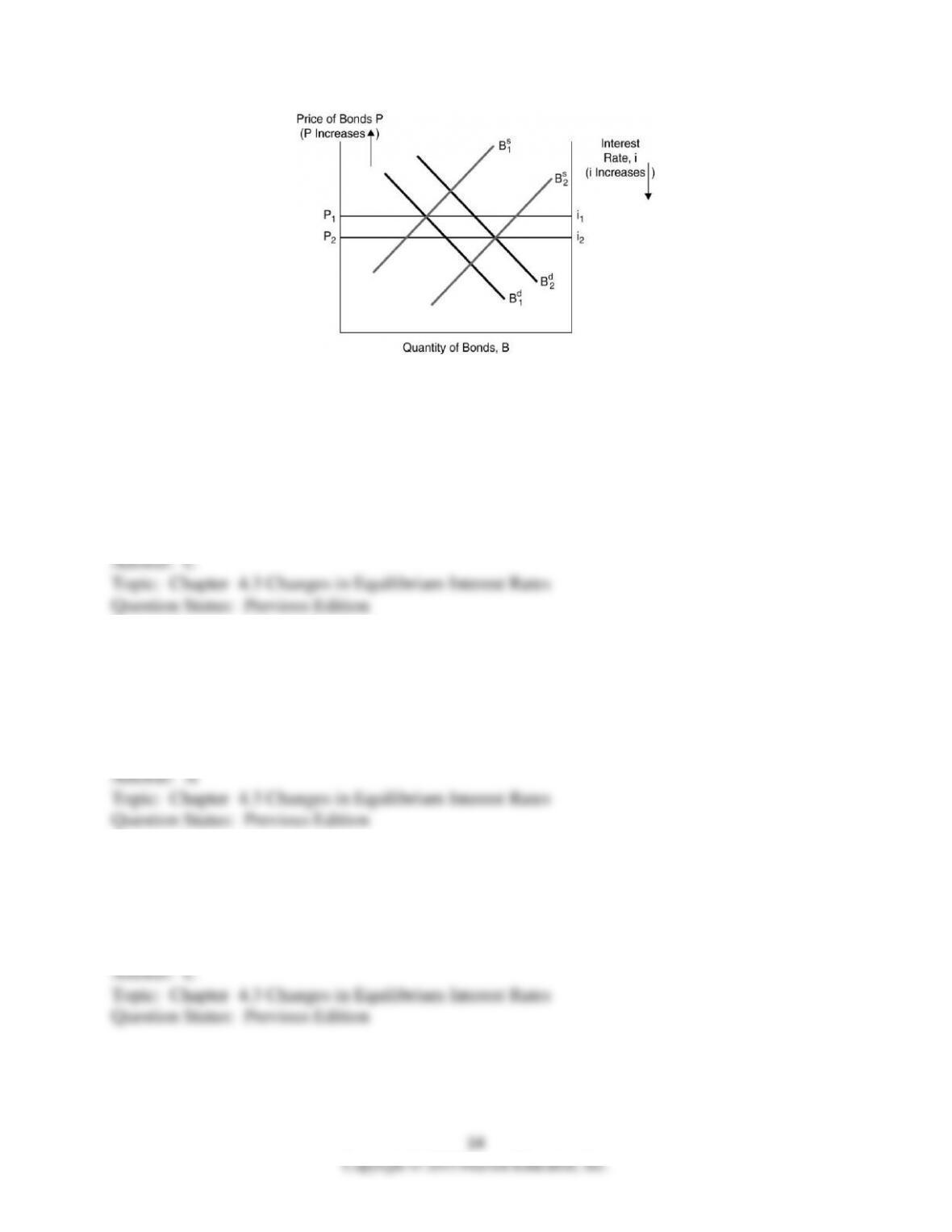
Figure 4.2
54) In Figure 4.2, one possible explanation for the increase in the interest rate from i1 to i2 is
a(n) ________ in ________.
A) increase; the expected inflation rate
B) decrease; the expected inflation rate
C) increase; economic growth
D) decrease; economic growth
55) In Figure 4.2, one possible explanation for the increase in the interest rate from i1 to i2 is
A) an increase in economic growth.
B) an increase in government budget deficits.
C) a decrease in government budget deficits.
D) a decrease in economic growth.
E) a decrease in the riskiness of bonds relative to other investments.
56) In Figure 4.2, one possible explanation for a decrease in the interest rate from i2 to i1 is
A) an increase in government budget deficits.
B) an increase in expected inflation.
C) a decrease in economic growth.
D) a decrease in the riskiness of bonds relative to other investments.
57) In Keynes’s liquidity preference framework, individuals are assumed to hold their wealth in
two forms:
A) real assets and financial assets.
B) stocks and bonds.
C) money and bonds.
D) money and gold.
58) In his liquidity preference framework, Keynes assumed that money has a zero rate of return;
thus, when interest rates ________ the expected return on money falls relative to the expected
return on bonds, causing the demand for money to ________.
A) rise; fall
B) rise; rise
C) fall; fall
D) fall; rise
59) The loanable funds framework is easier to use when analyzing the effects of changes in
________, while the liquidity preference framework provides a simpler analysis of the effects
from changes in income, the price level, and the supply of ________.
A) expected inflation; bonds
B) expected inflation; money
C) government budget deficits; bonds
D) the supply of money; bonds
60) When comparing the loanable funds and liquidity preference frameworks of interest rate
determination, which of the following is true?
A) The liquidity preference framework is easier to use when analyzing the effects of changes in
expected inflation.
B) The loanable funds framework provides a simpler analysis of the effects of changes in
income, the price level, and the supply of money.
C) In most instances, the two approaches to interest rate determination yield the same
predictions.
D) All of the above are true.
E) Only A and B of the above are true.
61) A higher level of income causes the demand for money to ________ and the interest rate to
________.
A) decrease; decrease
B) decrease; increase
C) increase; decrease
D) increase; increase
62) A lower level of income causes the demand for money to ________ and the interest rate to
________.
A) decrease; decrease
B) decrease; increase
C) increase; decrease
D) increase; increase
63) A rise in the price level causes the demand for money to ________ and the demand curve to
shift to the ________.
A) decrease; right
B) decrease; left
C) increase; right
D) increase; left
64) A decline in the price level causes the demand for money to ________ and the demand curve
to shift to the ________.
A) decrease; right
B) decrease; left
C) increase; right
D) increase; left
65) A decline in the expected inflation rate causes the demand for money to ________ and the
demand curve to shift to the ________.
A) decrease; right
B) decrease; left
C) increase; right
D) increase; left
66) Holding everything else constant, an increase in the money supply causes
A) interest rates to decline initially.
B) interest rates to increase initially.
C) bond prices to decline initially.
D) both A and C of the above.
E) both B and C of the above.
67) Holding everything else constant, a decrease in the money supply causes
A) interest rates to decline initially.
B) interest rates to increase initially.
C) bond prices to increase initially.
D) both A and C of the above.
E) both B and C of the above.
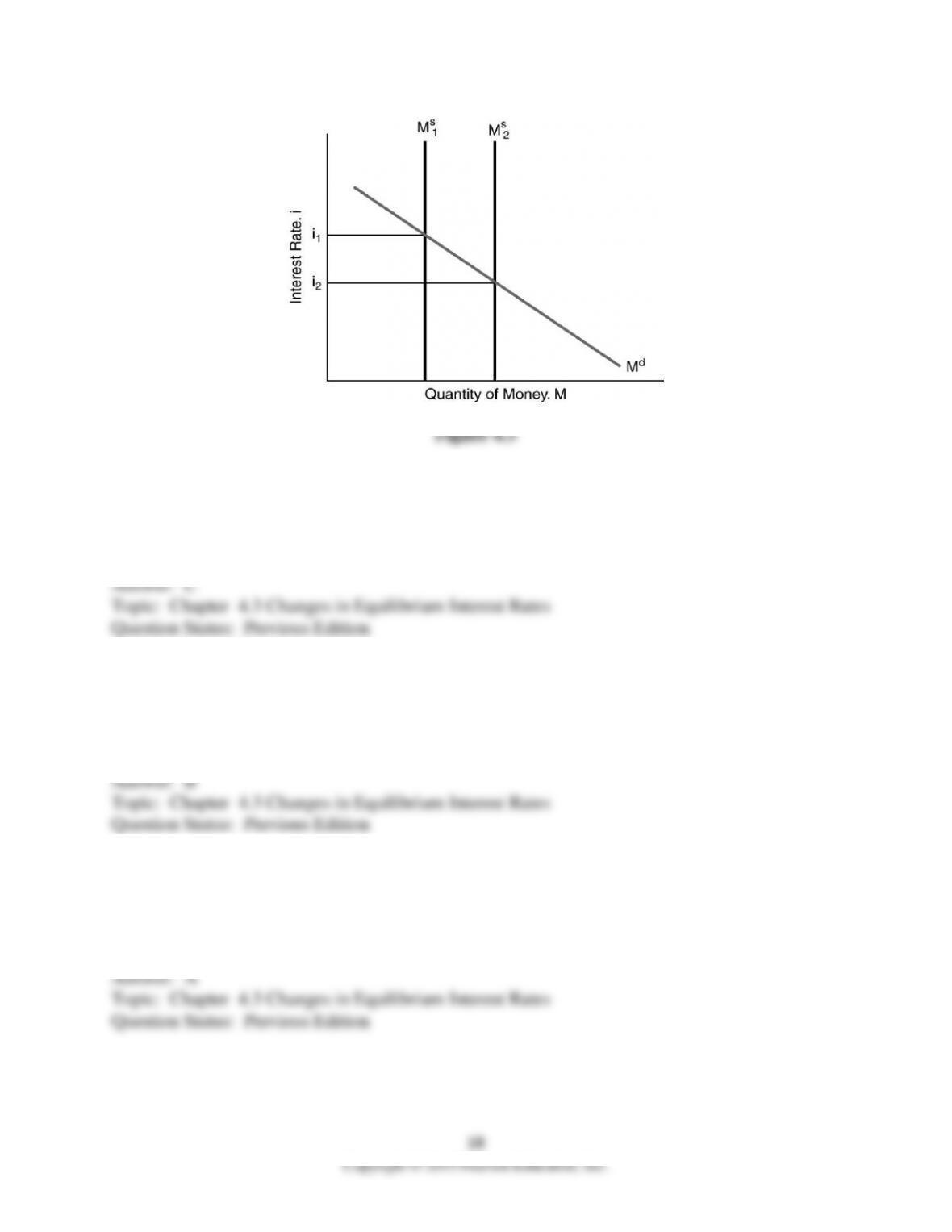
68) In Figure 4.3, the factor responsible for the decline in the interest rate is
A) a decline in the price level.
B) a decline in income.
C) an increase in the money supply.
D) a decline in the expected inflation rate.
69) In Figure 4.3, the decrease in the interest rate from i1 to i2 can be explained by
A) a decrease in money growth.
B) an increase in money growth.
C) a decline in the expected price level.
D) only A and B of the above.
70) In Figure 4.3, an increase in the interest rate from i2 to i1 can be explained by
A) a decrease in money growth.
B) an increase in money growth.
C) a decline in the price level.
D) an increase in the expected price level.